
- About Us

- Our Services
- Your Industry
- Resources
- News & Blog
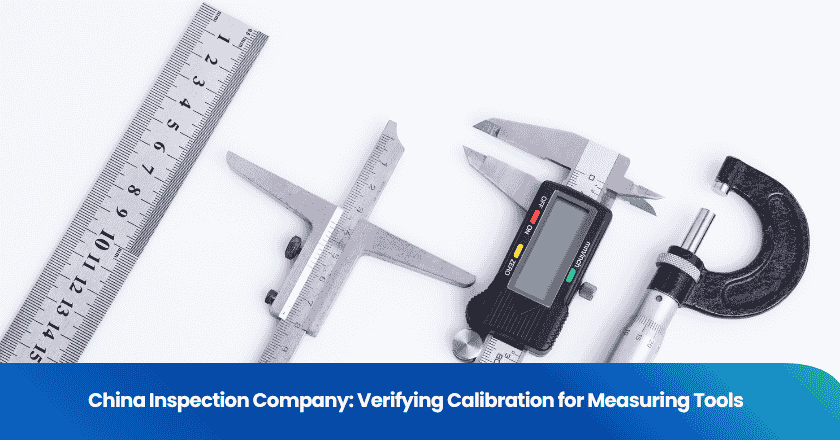
A tape measure that reads 5% short. A spirit level that's 2 degrees off true. A torque wrench that undertorques by 15%. For professional tradespeople and serious DIYers, inaccurate measuring tools don't just cause frustration—they cause failed projects, damaged materials, and in the case of torque wrenches, genuine safety hazards.
Yet calibration accuracy is one of the most overlooked quality checks in measuring tool production. Factories producing tape measures, levels, calipers, and torque wrenches in China operate on thin margins, and the difference between a properly calibrated tool and one that's slightly off-spec is often just a fraction of a millimeter—invisible to the naked eye, but consequential in use.
This article explains how a professional China inspection company verifies calibration accuracy on measuring tools during pre-shipment inspection—and why these checks are essential for any importer selling precision measurement products.
Key Takeaways
- Measuring tools have specific accuracy standards—EC accuracy classes for tape measures, ISO 6789 for torque wrenches, and recognized tolerances for spirit levels and calipers
- Calibration verification is a specialized inspection skill that goes beyond standard visual checks—inspectors use reference standards and measurement equipment to validate accuracy
- Tape measure accuracy is defined by EC accuracy classes: Class I (highest precision), Class II, and Class III, each with specific tolerance formulas
- Torque wrenches certified under ISO 6789 must maintain accuracy within approximately 2-4% of the set torque value
- Real-time inspection reporting allows you to verify calibration test results and make shipment decisions before goods leave the factory
Why Calibration Verification Matters for Measuring Tools
The Precision Expectation Gap
Consumers who buy measuring tools—whether professionals or serious DIYers—expect precision. A tape measure that doesn't measure accurately breaks the fundamental promise of the product. According to NIST (National Institute of Standards and Technology), a standard 1.82-meter (6-foot) tape measure should be accurate to within 0.79 millimeters (1/32 inch). That's the tolerance window—and it's surprisingly narrow.
When measuring tools ship with calibration errors, the consequences cascade through the customer's work: cuts that don't fit, joints that don't align, fasteners that are under- or over-tightened. For a brand selling measuring tools, calibration accuracy isn't a nice-to-have quality attribute—it's the core product promise.
Where Calibration Goes Wrong in Production
Calibration errors in measuring tools typically originate from:
- Inconsistent printing or marking—tape measure graduation marks printed with slight dimensional shifts
- Material shrinkage or stretching—tape blade material that contracts or elongates after the graduation marks are applied
- Assembly tolerance stack-up—spirit level vials mounted at slight angles due to loose assembly fixtures
- Insufficient factory calibration equipment—torque wrench testing machines that are themselves out of calibration
- Cost-cutting on reference standards—factories not maintaining calibrated reference gauges for production-line checks
These issues are systematic, not random. When one unit in a batch has a calibration error, the entire production run is likely affected because the same equipment and processes produced all units.
How Inspectors Verify Tape Measure Calibration
EC Accuracy Classes and Tolerance Verification
Tape measures sold in European and many international markets are classified under EC accuracy classes, which define maximum permissible errors at standard conditions (20 degrees Celsius, specified tension):
| EC Accuracy Class | Tolerance Formula | Typical Application |
|---|---|---|
| Class I (Highest) | Tightest tolerance; formula-based per length | Professional surveying, precision trade work |
| Class II | Moderate tolerance; suitable for most trade use | General construction, professional trades |
| Class III | Widest tolerance; adequate for rough measurement | Consumer/DIY use, non-critical measurement |
What Inspectors Actually Do
During a pre-shipment inspection, inspectors verify tape measure calibration by:
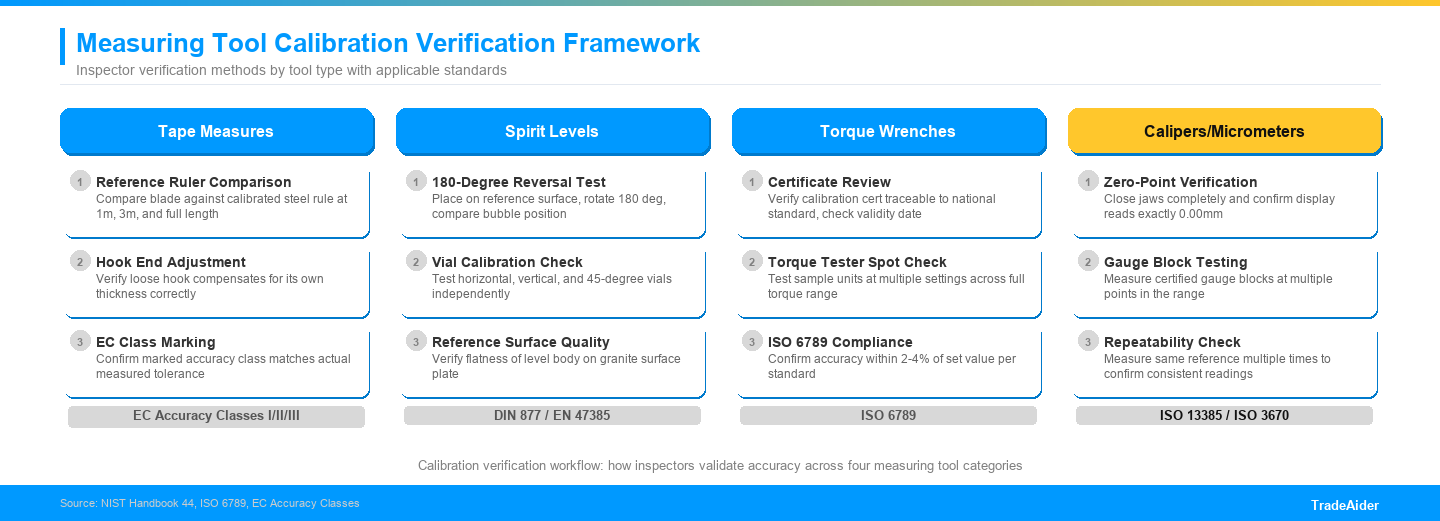
- Comparing against a calibrated reference steel rule—laying the tape blade alongside a certified reference ruler at multiple points along its length
- Checking graduation mark alignment at 1-meter, 3-meter, and full-length intervals
- Verifying the hook end adjustment—the loose hook at the end of a tape measure is designed to compensate for its own thickness; inspectors check that it moves correctly for both inside and outside measurements
- Testing blade retraction—a tape that doesn't retract smoothly has a spring tension issue that affects both usability and long-term accuracy
Inspectors also verify that the tape housing and blade markings clearly display the correct EC accuracy class designation. A tape marked as Class II that actually meets only Class III tolerance is a misrepresentation that can cause regulatory issues in certain markets.
Verifying Spirit Level Calibration
Spirit levels are deceptively simple tools with surprisingly precise calibration requirements. A spirit level that's off by even 1 millimeter per meter can cause cumulative errors across a construction project.
Inspectors verify spirit level accuracy using a calibrated reference surface (typically a granite surface plate). The check is straightforward but precise:
- Place the level on the reference surface and note the bubble position
- Rotate the level 180 degrees on the same surface and check the bubble again
- If the bubble reads differently in the two positions, the vial is out of calibration
This 180-degree reversal test is the industry-standard method for verifying level accuracy. Inspectors perform it on every vial (horizontal, vertical, and 45-degree if applicable) on each level in the AQL sample.
Torque Wrench Calibration Verification
Torque wrenches are the most safety-critical measuring tools in most tool kits. An undertorqued bolt can vibrate loose; an overtorqued bolt can shear. According to ISO 6789, torque tools must maintain accuracy within approximately 2-4% of the set torque value.
During a pre-shipment inspection, inspectors verify torque wrench calibration by:
- Reviewing factory calibration certificates—each torque wrench should have a calibration certificate traceable to a national standard, issued by an accredited laboratory
- Checking calibration date validity—ISO 6789 recommends calibration every 5,000 cycles or six months, whichever comes first
- Testing sample units against a calibrated torque tester—if the factory has a calibrated torque testing machine, inspectors may witness or conduct spot tests at multiple torque settings across the wrench's range
- Verifying the serial number and calibration label match between the tool and its certificate
The NIST calibration process for measuring tools involves controlled-environment testing with reference standards traceable to national measurement institutes. While pre-shipment inspectors don't replicate the full NIST laboratory process, they apply the same principles: comparison against known references, documentation of results, and traceability of calibration certificates.
Digital Caliper and Micrometer Checks
Digital calipers and micrometers represent the precision tier of measuring tools. These instruments typically offer resolution to 0.01mm (calipers) or 0.001mm (micrometers). For these tools, calibration verification focuses on:
- Zero-point accuracy—closing the jaws completely and verifying the display reads exactly 0.00
- Gauge block testing—measuring certified gauge blocks at multiple points in the tool's range to verify accuracy
- Repeatability testing—measuring the same gauge block multiple times to confirm consistent readings
- Battery and display function—for digital models, verifying display clarity, button operation, and battery life
A Practical Scenario: Catching Systematic Tape Measure Errors
An Amazon FBA seller ordered 20,000 tape measures from a factory in Zhejiang. The product specification required EC Class II accuracy. The factory had produced a prior batch without issues, so the buyer scheduled a standard pre-shipment inspection.
During the inspection, the checker compared sample tapes against a calibrated reference steel rule and discovered a systematic error: all sampled tapes were reading approximately 1.5mm short at the 5-meter mark. The investigation revealed that the factory had changed tape blade suppliers between production runs, and the new blade material had a different thermal expansion coefficient than the original specification.
Because the error was caught during inspection, the buyer was able to:
- Reject the batch and require the factory to source the original specification blade material
- Request factory calibration test records for future production runs
- Include calibration verification as a mandatory checkpoint in all future inspection protocols for this product
The inspection cost was $199 for one man-day. The potential cost of selling 20,000 inaccurate tape measures—including returns, negative reviews, and potential marketplace listing suspension—would have been significantly higher.
Why Real-Time Calibration Reporting Matters
Calibration errors are systematic. When one unit fails, the entire batch is suspect. This makes fast, informed decision-making critical.
TradeAider's real-time inspection platform means you see calibration test results as the inspector performs them on the factory floor. When a tape measure fails the reference ruler test, you see the photograph and measurement data immediately—not 48 hours later when the container may already be sealed.
This real-time visibility gives you the power to:
- Identify systematic calibration errors across the entire production run while the goods are still accessible
- Communicate specific, data-backed findings to your factory for corrective action
- Make a documented go/no-go decision before shipment
At $199/man-day with transparent, all-inclusive pricing, TradeAider makes professional calibration verification accessible for measuring tool importers of every size.
Common Questions
Do inspectors bring their own calibrated reference equipment?
Professional inspection companies equip their inspectors with calibrated reference tools—steel rules, gauge blocks, granite surface plates—for calibration verification. Inspectors should be able to provide calibration certificates for their own reference equipment upon request. Always confirm this capability when booking your inspection.
How accurate does a tape measure need to be for consumer sale?
For consumer and general trade use, EC Class II accuracy is the most common specification. This means the tape must meet defined tolerance requirements at standard temperature and tension. For professional surveying applications, Class I is required. The key is that the product's actual accuracy matches its marked classification.
Should I schedule a during-production inspection for measuring tools?
Yes, for large orders or when working with a new factory. A during-production inspection can catch calibration issues while the production line is still running, allowing mid-production correction rather than post-production rejection. This is especially valuable for tape measures where graduation printing errors affect the entire run.
Conclusion
Calibration accuracy is the defining quality attribute of any measuring tool. A tape measure that doesn't measure, a level that isn't level, or a torque wrench that doesn't torque accurately is fundamentally defective—regardless of how good it looks cosmetically.
A professional China inspection company that verifies calibration against recognized standards—EC accuracy classes, ISO 6789, NIST guidelines—protects your customers and your brand reputation before the goods ship. With real-time reporting and transparent pricing, TradeAider makes this specialized verification accessible to every measuring tool importer.
Schedule your measuring tool inspection with TradeAider and ensure your products deliver the precision your customers expect.
Related Articles


Grow your business with TradeAider Service
Click the button below to directly enter the TradeAider Service System. The simple steps from booking and payment to receiving reports are easy to operate.

