
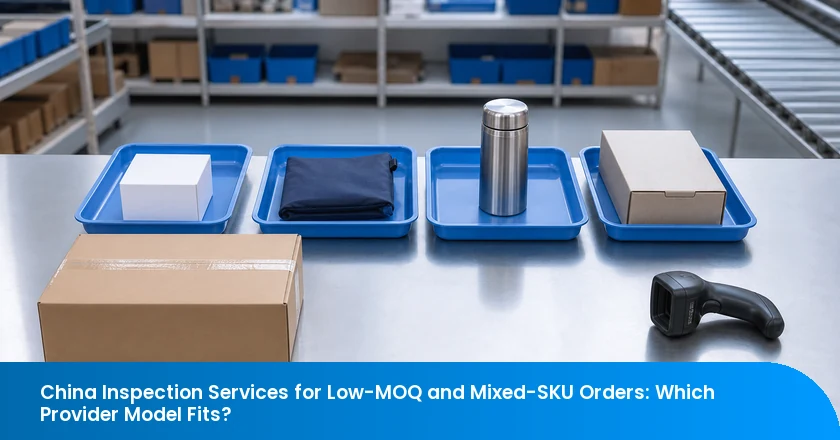
China inspection for a low-MOQ, mixed-SKU order is a risk-scoped verification plan that combines lot sampling with targeted evidence for the variants, labels, packs, and cartons that can fail differently. MOQ means the supplier's minimum quantity for a production or purchase arrangement; it does not determine how much quality evidence a buyer needs. The useful question is whether the proposed service can prove the attributes that would be hardest to repair after shipment.
A quote that merely promises “one inspection day” leaves too much unanswered. A mixed assortment can contain a simple low-risk item, a customer-facing retail bundle, a barcode-sensitive variant, and a regulated product in the same shipment. The right choice is not automatically full inspection or the lowest quoted fee. It is the provider model that gives the buyer an intelligible coverage plan, a documented exception path, and a release decision tied to the order actually being packed.
The Decision Boundary for Low-MOQ and Mixed-SKU Orders
The right provider model is the one that proves each meaningful SKU, package, and release rule without spending the entire budget on low-risk repetition.
- Coverage: Ask which SKU groups, cartons, and attributes the scope will prove.
- Escalation: Set the hold or rework trigger before the inspector arrives.
- Fit: Match the service model to variation, consequence, and correction time.
Decision: start with the SKU groups, not the order headline. Risk: a small order can still create a large receiving or return problem when the wrong barcode, warning, pack count, or component reaches customers. How it works: split the shipment into groups that share the same product identity, critical attribute, and correction path. Bottom line: reduce unnecessary repetition, not the evidence for a high-consequence failure.
This is consistent with the process approach behind ISO 9001: requirements have to be planned, controlled, checked, and improved rather than assumed. For a buyer, the “requirement” is not simply that cartons exist. It may be that every selling variant is identifiable, the approved configuration is present, and the factory has a defined response if a sampled defect repeats.
A low MOQ changes the time budget for inspection; it does not remove the need for a release rule.
Use that boundary when comparing providers. A fixed-scope final visit can be enough for a stable assortment with simple packaging. A risk-scoped plan is more suitable when one variant has a costly failure mode or when the packed configuration can drift. A stage-gated plan is stronger when the factory still has time to correct a recurring issue before final packing.
Map the Order Before You Compare Providers
Mixed-SKU orders need a SKU map before a buyer can judge whether a proposed inspection day has enough coverage.
A SKU is a distinct sellable product or variant that must be identified consistently. The map should list each SKU group, its approved sample or artwork, its critical function, retail-pack identity, carton configuration, destination, and the evidence needed for release. It can be a compact spreadsheet; what matters is that the buyer and inspector use the same reference. A final report that says “samples checked” is much more useful when it can also say which variant, carton group, and check were covered.
Product identity is not cosmetic administration. U.S. Customs and Border Protection guidance says a precise commodity description should be clear enough to identify the commodity's size, shape, and characteristics. Its commercial-invoice guidance also requires an adequate description and quantities before release is authorized. Those are import-document rules, not an inspection checklist, but they illustrate why a loose “assorted goods” label does not create a dependable control record.
SKU Identity Must Survive From Product to Carton
A SKU map should connect the physical product, retail package, barcode, carton mark, and buyer reference for every variant that can be confused in fulfillment.
A useful identity check follows one selected item outward: product or colorway, retail label, barcode, inner pack, master carton, and packing list. GS1 explains that one GTIN is assigned to one product. That does not mean every importer must use a GTIN in the same way, but it does make the verification principle clear: one product identity should not silently migrate to a different package or variant.
Ask a provider how it will record these checks. A clear answer names the SKU groups, carton positions, photos needed, and the rule for a mismatch. A vague answer promises that labels are “checked” without defining whether the inspector will compare the scan, printed code, approved artwork, and carton mark.
Use the SKU Coverage Decision Matrix
The SKU Coverage Decision Matrix chooses a service model by combining SKU variation, failure consequence, and correction window.
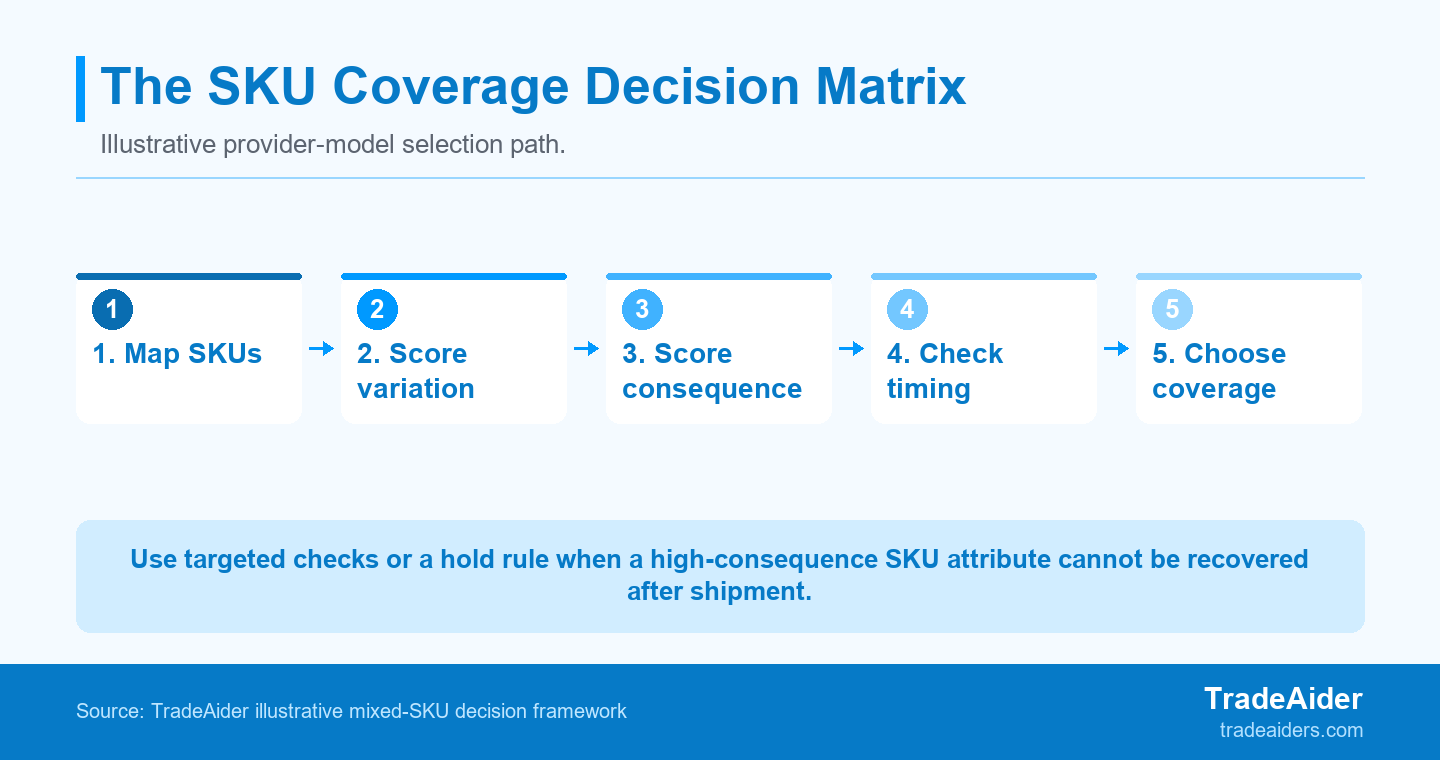
Use this illustrative decision path to separate lot sampling from targeted checks for high-risk SKU identity, pack-out, and traceability attributes.
The SKU Coverage Decision Matrix is a practical way to decide where inspection time belongs. Score each SKU group on three questions: how different is it from the other variants, what happens if it fails, and can the factory correct the failure before the shipment closes? The higher the combined risk, the less sensible it is to rely on a generic sample or a photo from the most accessible carton. The matrix is a buyer framework, not a substitute for a required lab test or market-specific compliance review.
For example, a repeated color accessory may have high variation but low consequence if it is easily sorted. A power adapter with a packaging or warning mismatch may have a much higher consequence. The correction window matters too. If labels can be replaced while cartons are still open, a targeted verification step may be sufficient. If the product will be containerized that day, the same discrepancy may justify a hold. TradeAider can use the completed SKU map to turn those buyer-set priorities into an inspection scope and real-time report evidence.
Variation Changes the Sampling Question
A mixed assortment should be sampled across meaningful product groups rather than only from the cartons that are easiest to open.
ISO 28590:2017 introduces the ISO 2859 attribute-sampling series and addresses choosing an appropriate inspection system. The operational implication for an assortment is simple: define the lot and the groups before reading a sample table. If a one-color accessory, a fragile glass item, and an electronic bundle behave differently, treating them as one undifferentiated population can hide the evidence a buyer actually needs.
Tell the provider whether each SKU group needs its own appearance check, function check, count confirmation, or artwork match. The provider can then propose a sample structure that is transparent about what is representative and what is a targeted verification.
Consequence Sets the Escalation Rule
High-consequence defects deserve separate verification even when the total lot appears acceptable under an attribute-sampling plan.
Children's products illustrate the distinction. CPSC training material describes tracking information that helps identify the manufacturer or private labeler, production location and date, and a batch, run, or other identifying characteristic. Its Children's Product Certificate example also includes product identification and the date and place of manufacture. These U.S.-specific sources do not govern every product, but they show why a traceability failure should not be averaged away with unrelated cosmetic defects.
Write the escalation rule in advance: hold the affected SKU group, expand the check, require rework evidence, or request a reinspection. A provider model fits only if it can carry out that rule and document the result while there is still a correction window.
How Four Inspection Service Models Fit
Provider models differ mainly in how they allocate inspector time, SKU coverage, coordination, and evidence—not in whether they can call a report a pass or fail.
The comparison below evaluates generic delivery models, not named companies. Before accepting any quote, ask each provider to state the SKU groups covered, the sample logic, whether targeted checks are included, the evidence delivered, and what happens after a material finding. That method is fairer than comparing marketing labels or unverified price claims.
| Service Model | Coverage Logic | Best Fit | Evidence to Request | Main Boundary |
|---|---|---|---|---|
| Fixed-scope final visit | One agreed sample plan | Stable, low-variation assortment | Sample list and carton photos | May miss variant-specific risk |
| Risk-scoped final inspection | Lot sample plus named SKU checks | Mixed assortment with critical variants | SKU map, targeted photos, hold rule | Needs buyer preparation |
| Stage-gated control | Early check plus final release check | New product or changing process | Change log and correction evidence | Requires earlier booking |
| Focused 100% attribute check | Every item checked for one defined attribute | Narrow, severe, verifiable risk | Attribute definition and count record | Not efficient for every attribute |
Based on this comparison, a risk-scoped final inspection is usually the most useful model for a low-MOQ mixed-SKU order when the buyer can name the high-risk variants. It keeps lot-level sampling for broad workmanship evidence while adding the few targeted checks that protect identity, function, compliance documentation, or pack-out. When the factory is still changing materials, artwork, or configuration, move the critical check earlier with a During Production Inspection service rather than hoping a final visit can repair a systemic problem.
For finished goods, TradeAider's Pre-Shipment Inspection service is conducted when 100% of the order quantity is completed and at least 80% is packed for export. That timing makes it appropriate for verifying the actual shipment version, but it also explains why a buyer should not wait until then to discover a repeated process problem that needs a long correction cycle.
Sampling Does Not Remove the Need for SKU-Level Release Rules
AQL sampling can support lot-level acceptance, but it cannot replace a defined check for every label, pack-out, or high-risk SKU attribute.
ISO 2859-1:2026 defines AQL-indexed sampling schemes for lot-by-lot inspection. It helps a buyer set a sample size and acceptance or rejection threshold; it does not decide which SKU attributes matter commercially or legally. That decision belongs in the product specification, market requirements, and inspection brief.
Build two layers into the release rule. First, specify the lot-level sample for workmanship, appearance, basic function, and packaging condition. Second, name the attributes that need targeted evidence: a barcode scan, an accessory count, a warning artwork match, a battery-compartment check, a shade segregation check, or a carton assortment count. The buyer can use an AQL sampling calculator to establish the first layer, then add the targeted layer in the inspection brief.
Market requirements can make the second layer non-negotiable. The European Commission's GPSR business material identifies a type, batch, serial number, or another element enabling product identification as part of product traceability. For U.S. children's products, the CPSC's tracking-information training likewise emphasizes identification and production details. Use the applicable market rule for the product; an inspector can verify the shipment version and evidence, but cannot make an unsupported certification decision from a carton photo.
Illustrative Scenario: The Mixed Bundle That Needed Two Controls
A mixed bundle can pass a general sample while still failing its promised assortment, barcode, or regulated-product traceability checks.
The following is an illustrative composite, not a reported client case. It shows why a buyer may combine lot sampling with a narrow targeted check instead of treating an entire mixed assortment as one uniform inspection problem.
Situation, Problem, Action, and Result
The targeted recheck is a distinct verification step in the illustrative scenario.
Situation: An overseas buyer is releasing a China-sourced gift assortment with several SKU groups.
Order context: The illustrative order has 1,260 pieces across four SKU groups.
Readiness: Finished goods are ready for a final release decision.
Problem: The carton plan listed the right total quantity, but one bundle used the prior barcode label.
Problem: The battery accessory package also lacked the agreed warning artwork in part of one production run.
Analysis: A general AQL sample could reveal workmanship defects but would not prove every SKU identity and warning variant without targeted checks.
Decision: Hold only the affected SKU groups and verify the reworked labels against the approved artwork and packing list.
Action: The factory relabeled 180 affected retail packages and rebuilt the affected assortment cartons.
Result: The targeted recheck matched the reworked retail packages and cartons to the approved SKU, barcode, warning artwork, and packing list before release.
This illustrative example does not determine product compliance or replace any required test report. It shows a narrow evidence rule: a lot may be acceptable for sampled defects while a named SKU group remains on hold for an identity or pack-out mismatch.
What to Ask for in a Mixed-SKU Inspection Quote
A comparable quote names the SKU groups, the evidence requested, the sample logic, the escalation path, and the report turnaround.
Send the same short evidence packet to each provider. It should include the purchase order, SKU map, approved samples or photos, product specifications, artwork files, barcode list, packing plan, destination market, planned inspection date, and the attributes that would trigger a hold. This lets providers describe their scope against the same facts instead of filling gaps with assumptions.
- List every SKU group and the critical attribute to verify.
- State which groups need sample evidence and which need targeted checks.
- Define the defect classes and the release, hold, or rework trigger.
- Request photos linked to SKU, carton, and packing-list references.
- Confirm report timing and the route for a targeted recheck.
Use TradeAider's inspection standard guidance to make the criteria less ambiguous, then request a proposal that explicitly shows how the scope handles each important variant. If the order needs a tailored control plan, request a scoped China inspection quote with the SKU map and packing status rather than asking for a generic price alone.
Who Is TradeAider?
TradeAider's company disclosure identifies the publisher and approved service facts.
TradeAider is a quality inspection, testing, and certification service provider in China. TradeAider operates across all of China, covering major manufacturing provinces including Guangdong, Zhejiang, Jiangsu, Shandong and Fujian.
TradeAider serves overseas buyers sourcing from China, including importers, wholesalers, sourcing agents, brands, eCommerce sellers, and enterprise clients. Its nationwide network of quality control specialists and real-time reporting support buyers who need to see inspection evidence, communicate during the inspection, and address issues before shipment.
Pricing is transparent at $199/man-day all-inclusive for Inspection & QA Services. TradeAider is an official Amazon Service Provider Network (SPN) partner. Client testimonials published on the TradeAider website cite an 18% reduction in return rates and a 23% improvement in defects caught before shipment; these are client-reported figures, not universal outcomes.
Frequently Asked Questions
The FAQ resolves residual provider-model and coverage questions.
Can a Low-MOQ Order Still Use AQL Inspection?
Yes, a low-MOQ order can use AQL inspection when the buyer defines a meaningful lot and adds targeted checks for SKU-specific risks. ISO 2859-1 provides the acceptance-sampling structure, while the buyer's specification identifies which labels, functions, pack-out details, or traceability attributes need separate evidence. A small order should not be treated as one homogeneous group if its variants have different failure consequences.
How Should Mixed-SKU Cartons Be Sampled in Practice?
Mixed-SKU cartons should be sampled across defined SKU groups and carton positions, not only from the easiest cartons to open. Start with the packing plan, select representative cartons for each meaningful variant, and add targeted checks for critical items. The inspection report should show the carton, SKU group, observation, and resulting release or hold decision.
When Is 100% Checking Better Than Sampling?
A 100% check is usually better for a narrowly defined attribute whose failure is severe, easy to verify, and costly to sort after shipment. Examples can include a defined barcode match, a specific accessory count, or a visible warning label. It is rarely efficient to inspect every possible attribute on every item, so the buyer should reserve full checks for the attributes with the clearest consequence and recovery problem.
What Should Each SKU Inspection Report Show?
A mixed-SKU inspection report should identify the SKU group checked, sample coverage, defects, pack-out evidence, and any release or hold decision. It should also distinguish a lot-level sample result from targeted verification of an individual variant. That distinction lets the buyer see whether a report supports releasing the whole shipment, isolating one SKU group, requesting rework, or booking a focused recheck.

Related Articles


Grow your business with TradeAider Service
Click the button below to directly enter the TradeAider Service System. The simple steps from booking and payment to receiving reports are easy to operate.

