
- About Us

- Our Services
- Your Industry
- Resources
- News & Blog
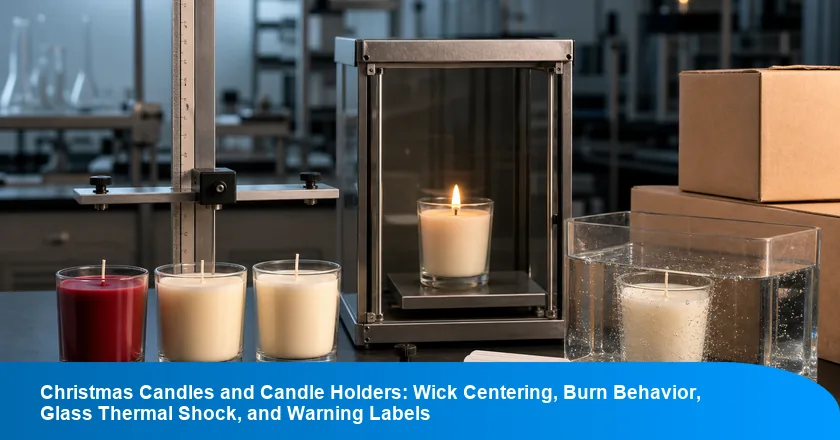
A Christmas candle can look ready for a gift box while its release evidence still belongs to a different build. A wick may be centered in one vessel but not another. A burn record may describe one wax-and-fragrance combination while a later fill level, lid, or warning panel changed. The costly failure is not simply a defect; it is using a result beyond the product and carton range it can actually support.
For an import team, the practical chain is product identity, recorded observations, supporting evidence, and packed-carton traceability. Product-specific testing, conformity work, and legal assessment remain separate destination-market responsibilities.
Start With the Sellable Candle Build, Not a Generic Sample
A Christmas candle release should start with a defined sellable build, because a burn observation or visual check cannot safely be generalized across changed wick, wax, fragrance, vessel, lid, or warning-artwork combinations.
- Name the build first. The release unit is the exact wick, wax, fragrance, fill, vessel, lid, artwork, and destination route - not "the candle"?in general.
- Keep evidence types separate. A burn log, a visual glass check, and product-specific glass evidence each answer a different question.
- Release packed populations. A passed result matters only when the retail pack and master-carton range can be connected to that same approved build.
That distinction makes recurring defects cheaper to close. Instead of adding broad inspection steps after a failure, the buyer can identify the changed build, locate the affected packed range, and ask for only the evidence or correction that decision requires.
Build a Candle Control Card Before Sampling
A Candle Build Control Card keeps the approved wick, wax, fragrance, fill, vessel, lid, artwork, and destination route in one record before inspection begins. It is a buyer-owned record, not a factory marketing sheet, and it makes the release unit visible before anyone draws a sample.
Think of the card as a buyer-owned record rather than a factory marketing sheet. It should identify the SKU and revision, approved sample or photo reference, wick code and position reference, wax and fragrance specification, vessel and holder version, nominal fill, lid and retail-pack components, artwork version, destination route, and the carton identifiers expected at release. Add an owner for each acceptance decision. If a field is unknown, mark it as an open evidence gap instead of silently borrowing data from a nearby variant.
| Record area | What identifies it | Release question |
|---|---|---|
| Physical build | Wick, wax, fragrance, fill, vessel, holder, lid | Is this the product that was observed or supported by evidence? |
| Consumer-facing build | Warning artwork, insert, gift box, barcode, destination | Will the shopper receive the approved information with the correct product? |
| Shipment identity | Retail-pack code, master-carton mark, packing date and range | Which cartons does the result actually cover? |
Define the Approved Build Before a Burn Sample Is Lit
An approved build record makes a burn observation traceable only when it identifies the product parts and the approved reference used for comparison. Put the identified sample beside the current card so the observer can confirm the build without relying on memory.
Place the sample beside its build card before the burn sequence starts. The observer should be able to show which vessel, wick, fragrance, fill, lid, and label version is in front of them without relying on memory. Photograph the product identifier and the relevant configuration markers, then record any deviation in plain language. A sample with an uncertain build is not a failed candle; it is an unqualified sample that should not be used to release a broader population.
Control the Burn-Test Loop, Not a One-Time Demonstration
The National Candle Association identifies separate ASTM standards for cautionary labeling, heat strength of glass candle containers, and fire safety for candles. The cited ASTM list identifies F2058-07(2021), F2179-20, and F2417-24. National Candle Association overview and the ASTM F15.45 standards list provide that context.
For an importer, the practical implication is simple: do not ask an inspector to turn one burn demonstration into a blanket declaration. Define the approved protocol and decision owner, then keep the observed behavior separate from the release conclusion. TradeAider can turn those buyer-defined records into a fieldwork scope when a recurring wick, fill, or vessel issue must be contained. Where the issue appears during production, a during-production inspection can verify whether the factory has applied the agreed build correction before final gift packing makes the affected population harder to separate.
Record Burn Behavior as Observations, Not as an Unscoped Pass
Flame behavior, melt pool, soot observation, vessel condition, and extinguishing behavior should be recorded against the agreed protocol rather than compressed into a generic pass label. Name what was seen, when it was seen, and which build it belonged to before asking for a release decision.
The record should state what was seen, when it was seen, and what build it relates to. A useful log names the agreed cycle, the starting condition, the observation point, the photo reference, any deviation, and the next owner decision. It does not need to manufacture universal limits for flame height, surface temperature, soot, or burn duration. Those are product- and protocol-specific questions. What matters here is that the buyer can compare an observation with the approved reference and see whether it belongs to the release candidate.
Consumer candle-safety guidance reinforces the value of clear observations and label control. It does not turn a field check into an unqualified product-safety claim, so keep the burn record tied to the buyer's approved build and decision route.
Treat Wick Centering as a Build Feature
Wick centering should be checked against the vessel and fill configuration it will serve, because an apparently centered wick in one build does not prove the same placement in another variant. Pair the position image with the SKU and vessel code so a repeat finding can be contained by build.
Use the buyer-approved reference to define the visual centerline and the allowable production condition. Check placement before the product enters a box, and again when the build has changed in a way that affects the physical configuration. If the wick or fill condition repeatedly drifts, group the defect pattern by build card, then decide whether a contained correction, a production recheck, or a broader hold is warranted.
Separate Glass Thermal-Shock Evidence From Visual Glass Checks
Visual inspection can reveal present defects, while thermal-shock evidence addresses a different product-evidence question and must be linked to the exact candle-container variant. Keep each result inside the container and build scope that its supporting material actually names.
At inspection, record visible issues that affect the released product: cracks, chips, sharp or damaged rims, trapped debris, inconsistent vessel appearance, unstable holder contact, or a lid that does not match the approved retail pack. Keep those observations honest. A clean-looking vessel does not independently establish the container's behavior under the applicable thermal conditions. The buyer should request the relevant product-specific evidence for the exact container configuration, retain its scope, and escalate discrepancies rather than calling the visual check conclusive.
That is also where a product testing service becomes a natural bridge: fieldwork can verify the observed product and paperwork match the approved scope, while any technical test program remains selected and interpreted for the actual product, route, and applicable requirements.
Keep Holder Stability, Lids, and Fragrance Attached to the Same Variant
A change in fragrance, wax, fill, lid, holder, or vessel can create a new release-relevant variant unless the buyer's approved documentation says otherwise. Seasonal ranges often share a glass shape while changing the attributes that determine whether an earlier observation still applies.
This is especially important in seasonal ranges that share one glass shape but use several scents, colors, fills, or gift-box formats. The inspection record should not assume that the vessel alone defines equivalence. Record the fragrance and wax specification version, fill, lid fit, holder stability observation, and packaging configuration together. If the buyer has a documented justification for grouping variants, attach it to the card. If not, preserve the changed build as its own decision path.
Use a Five-Gate Candle Release Path
A five-gate release path moves a candle from build identity through burn evidence, glass evidence, artwork, and packed-carton verification before shipment approval. Each gate either adds a usable link to the same build or exposes a gap that narrows the population eligible for release.
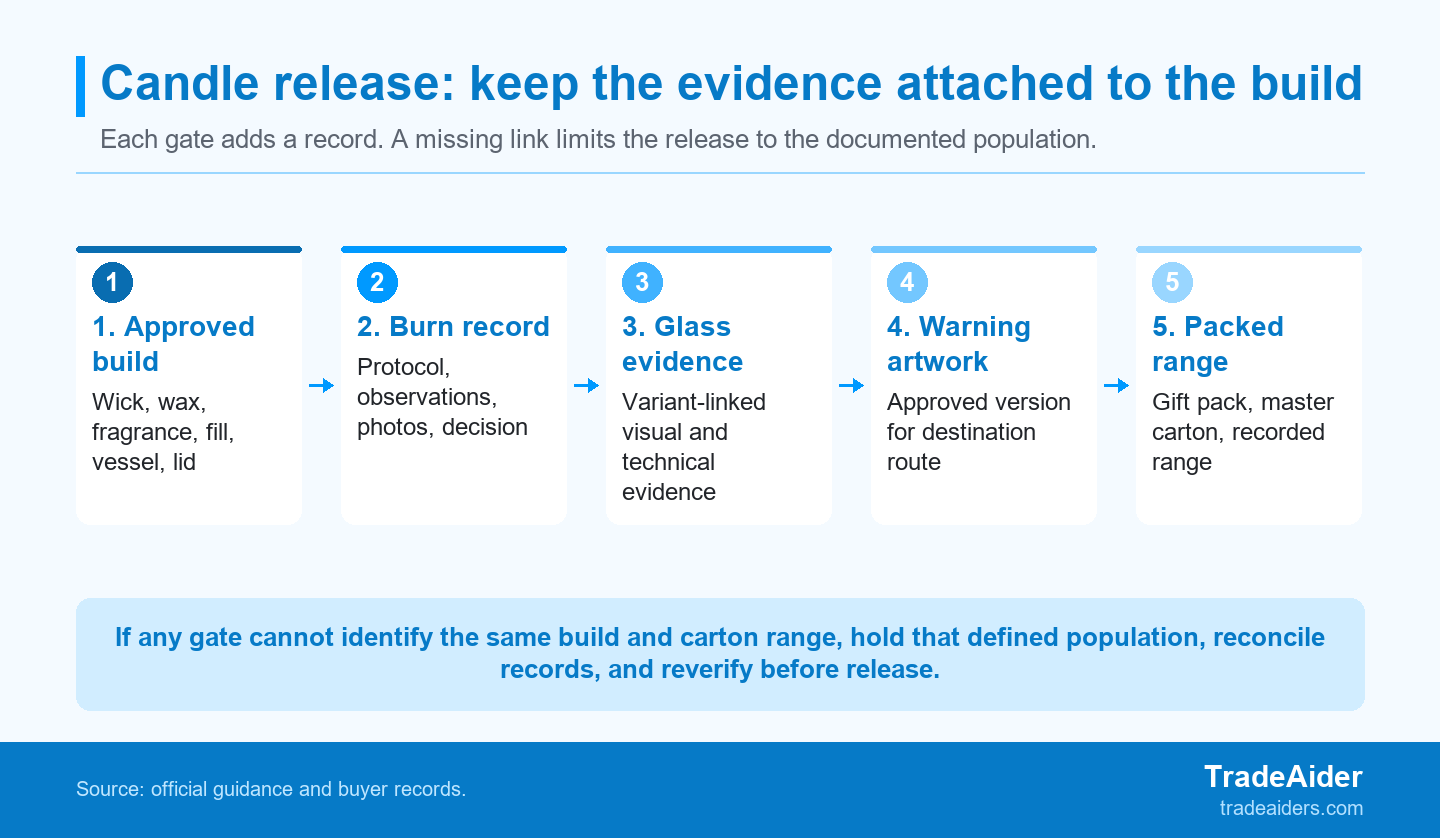
Treat a missing evidence link as a contained release question: reconcile the affected build and carton range before shipment approval.
The sequence is deliberately narrow: each gate either adds a record that still names the same build or exposes a gap that limits the release population. It avoids the false choice between releasing an entire order on a generic sample and stopping every carton for an isolated, traceable record mismatch.
Inspect Gift Packaging and Warning Artwork as Product Evidence
A packed candle is release-ready only when the retail pack, lid, warning artwork version, destination route, and master-carton identifier agree with the approved build. This keeps the decision focused on the shopper-facing unit and the documented shipment population behind it.
Inspect the shopper-facing pack as a system: vessel condition, lid, warning and instruction placement, barcode, insert, gift-box closure, protective materials, and master-carton identification. "Retail pack"?here means the consumer-facing unit package, not a loose candle pulled from a packing line. Once the carton record is added, the buyer can identify the release population - the group of packed products and cartons that one inspection decision can actually support.
ISTA Procedure 2A covers individual packaged-products at or below 150 lb (68 kg) when prepared for shipment, so its use should be matched to the actual package scope. ISTA 2A overview
That scope reminder matters when a gift box looks sound in a pre-shipment check but the buyer also needs a transport-packaging method. Confirm the applicable package and program rather than treating retail-pack appearance as a transport-test result. For the physical release itself, a pre-shipment inspection service can check the current packed population, and container loading supervision can help preserve master-carton identity as it moves into dispatch.
Assign Each Warning Version to Its Market Before Final Pack-Out
Do not approve a label merely because the design file looks familiar. Maintain an artwork register that states the product build, destination route, version code, approver, proof date, and carton range. The register should also distinguish a warning, an instruction, a product claim, and a certification reference. A release team can then find a late change before the range becomes untraceable.
UK guidance tells manufacturers and importers to demonstrate relevant compliance and safety before market placement, provide adequate consumer information, and support traceability. UK product-safety guidance
The EU General Product Safety Regulation overview includes a responsible economic operator and essential product safety and traceability information in its product-safety framework. EU Regulation (EU) 2023/988 overview
Canada's Consumer Product Safety Act prohibits packaging or labelling that creates a misleading safety impression or makes misleading safety-certification claims. Canada Consumer Product Safety Act, section 9
Australian product-safety guidance says suppliers are legally responsible for product safety and should check compliance when sourcing and testing where relevant. Australian product-safety sourcing guidance
These sources set market context; they do not create one universal candle-warning template. Confirm the requirements that apply to the product and destination before release, and keep the approved proof with the pack and carton range it supports.
Illustrative Scenario: a Late Warning Revision Splits the Release
When a label revision reaches one candle variant late, a conditional release can protect the traceable cartons while records are reconciled for the unlinked range. The decision follows the records that identify the build and carton range, not a guess about the full order.
The following is an illustrative operational scenario, not a client case. It shows how a product and paperwork mismatch can be contained without claiming that a label review decides every destination-market requirement.
Why the Hold Stops at the Unlinked Carton Range
The illustrative hold applies to cartons without a documented artwork-to-build link, not to every candle in the order.
A mid-market importer is preparing a Christmas home-fragrance launch across two destination routes. An illustrative order contains 2,400 glass candles in two fragrance variants, packed in 12-piece gift-pack master cartons. Burn observations and vessel records are available, but a late warning-panel revision is not linked to every carton range.
The winter-spice variant was packed with the revised warning panel after the change was approved. The pine variant has a defined carton range whose packing records do not state which warning-panel version entered the gift pack. The records support a distinction between cartons whose build-and-artwork link is documented and cartons whose warning version cannot be proven.
Use a conditional release: release documented cartons and hold only the 480 unlinked pine-variant candles in the defined carton range. Reconcile packing records, identify the affected cartons, correct or relabel the verified range, and resample the finished packs.
Confirm product build, warning version, retail pack, carton label, and carton range in the corrected inspection record. The example does not say whether the revised artwork meets every market requirement; that determination needs route-specific verification.
Conditional release means a release decision limited to cartons whose product and records are already traceable, while a defined remainder stays on hold. In this example, the documented winter-spice range can move only if all other buyer conditions are met. The pine range needs reconciliation because its records do not support a confident connection between build, artwork, and packed cartons. The correction is then focused: identify the cartons, correct or relabel the verified population, and recheck the finished pack before release.
Send a Release Packet Before Peak Dispatch
A usable candle inspection request identifies the approved build, burn record, glass evidence, warning proof, gift-pack specification, carton range, and decision owner. It gives the inspection team a way to report a real decision boundary rather than return a generic defect list.
A release packet is the evidence bundle that ties a product build and its records to a specific shipment decision. Send the approved build card, current burn-observation record, product-specific glass evidence where needed, artwork register and final proof, gift-pack specification, carton-marking file, expected carton range, and the person authorized to decide a correction or hold. This gives the inspection team a way to report a real decision boundary instead of returning a generic defect list.
If the order is approaching dispatch, request a candle inspection scope with those records attached. The goal is a defined check of the current product and pack-out - not a promise that more inspection alone will solve an unapproved build or missing market evidence.
Who Is TradeAider?
TradeAider provides inspection, testing, and certification service context in China and publishes approved client-reported outcomes with qualification. Buyers sourcing in Guangdong, Zhejiang, Jiangsu, Shandong, Fujian and other regions can review the TradeAider background when they need a defined inspection scope for Christmas candles and holders.
For Inspection & QA Services, TradeAider states a $199/man-day all-inclusive rate. Client-reported outcomes include an 18% reduction in returns and 23% of defects caught before shipment; these are client-reported figures, not universal results. TradeAider also provides testing services across hardline, softline, electrical and electronic, and industrial products, enabling buyers to manage quality control and testing needs within one service framework.
Provider support can structure fieldwork and reporting, but it does not replace product-specific conformity or legal assessment. The buyer should retain ownership of the approved build, applicable evidence route, destination-market review, and shipment-release decision.
Frequently Asked Questions
What Should a Candle Burn-Test Record Show?
A usable record identifies the build, protocol, observations, photos, deviations, and next decision.
Keep the sample identity visible in the log, including the wick, wax, fragrance, fill, vessel, and relevant retail version. The record should make clear what was observed under the agreed procedure and who decides the next step. It should not use a short "pass"?line to hide a changed build, an unresolved deviation, or an undefined acceptance rule.
Is Visual Glass Inspection Enough for a Candle Holder?
No; visual findings and thermal-shock evidence answer different questions about the candle container.
Visual checks remain useful for the actual goods: chips, cracks, sharp edges, contamination, lid fit, and holder stability can all affect the packed product. But they do not replace the applicable product-specific evidence route for a container's heat behavior. Keep both records connected to the exact vessel and build before using either one in release decisions.
Can One Warning Artwork File Serve Every Market?
Not by assumption; each destination route needs its own confirmed information and approved version link.
Use an artwork register to show the destination, product build, version, approver, proof, and carton range. If a product, market, claim, or warning changes, treat the earlier approval as a record to review - not an automatic approval for the new route. The resulting release packet should show exactly which packed range received the confirmed artwork.
What Should Gift-Pack Inspection Record for Candles?
Record the product build, vessel, lid, artwork, retail pack, carton label, and carton range together.
Add the gift-box closure, inserts, protective materials, barcode, and visible condition where they are part of the approved pack. Those fields let the buyer identify both the shopper-facing candle and the shipment population behind the decision. If a record cannot identify the packed range, use a defined hold and reconciliation step rather than treating a loose sample as proof for every carton.
Related Articles

Grow your business with TradeAider Service
Click the button below to directly enter the TradeAider Service System. The simple steps from booking and payment to receiving reports are easy to operate.

