
- About Us

- Our Services
- Your Industry
- Resources
- News & Blog
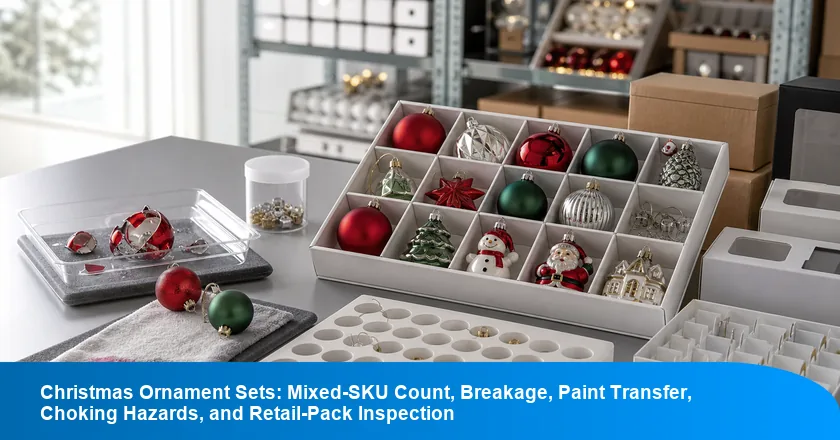
Christmas ornament set inspection fails when a loose ornament is treated as proof of the sellable set. A correct-looking bauble can still sit beside the wrong finish, hanger, insert, barcode, or carton label. Start with the packed sets and cartons that can be identified as one shipment group, then keep every count, condition, and market-scope observation attached to that group.
The Release Unit Is the Ornament Set, Not a Loose Ornament
An ornament-set release decision is reliable only when each finding is tied to the configuration and packed population that will ship. Here, a release population is an identified group of packed sets and cartons whose shipment approval is supported by one inspection result. That changes the inspection question from “Did this sphere look acceptable?” to “Which exact shopper-facing set and carton range can this result clear?” A single sample can be physically sound while the consumer pack around it is short, mixed, or untraceable.
- Group before sampling: separate shape, color, finish, hanger, retail-pack version, and master-carton range before units are pooled.
- Read breakage as a pattern: retain the fragile shape, hardware, pack handling, and observed damage together.
- Classify before making safety claims: intended use, labeling, marketing, and destination market determine whether a toy route is relevant.
- Release the pack, not the photo: verify count, insert, barcode, and carton identity against the approved configuration.
Build an Ornament Set Integrity Matrix Before Sampling
A configuration matrix makes count, finish, hardware, pack, and carton evidence comparable instead of pooled. For this purpose, an Ornament Set Integrity Matrix is a buyer-made record connecting one ornament configuration to its approved sample, pack details, and carton range. It is not a conformity score or a substitute for a contracted sampling plan. It simply stops evidence for a red gloss ball with a gold cap from being borrowed to clear a matte silver star in a different pack.
Give every matrix row a configuration code that appears on the sample label, pack-out sheet, inspection form, and carton record. The buyer can set acceptance limits separately, using the product specification and an inspection standards reference as a baseline for describing defects and sampling. The key is consistency: the row that is inspected must be the row that can later be released, reworked, or held.
Start With the Configuration That a Shopper Actually Receives
The SKU record needs shape, color, finish, hanger, component count, retail-pack version, barcode, and carton range. A retail pack is the consumer-facing package that holds the ornament set a shopper receives, so its identity belongs in the same row as the ornaments themselves. Add the approved photo or physical sample reference, any required insert language, and the master-carton mark that connects the pack to dispatch.
Use one row for each combination that could change a buyer decision. A six-piece red-and-gold ball set and a six-piece red-and-gold star set may share a family name, but they should not share a release result if their component count, hanging hardware, finish, insert, or barcode differs. This is where the Ornament Set Integrity Matrix earns its value: it makes a mixed-SKU order inspectable without pretending every variation is identical.
Check Breakage and Hanging Hardware by Configuration, Not by Average
Breakage and hanger defects need an observed pattern tied to the fragile shape, finish, hardware, and pack handling conditions. A chipped glitter star beside a detached cap is different from a single scuff on a protected plastic sphere. Record the defect location, finish, hanger type, cushioning, and the pack position in which it appeared; those fields make it possible to distinguish handling damage from a repeated assembly or coating problem.
Ask for the buyer-approved method before fieldwork begins. It may require a visual workmanship review, a defined handling or drop observation, a pull check for a hanging component, or a factory-record review. Do not convert a one-off observation into a universal durability promise. If a repeatable defect appears while production is still open, during-production inspection can focus on the traceable output window before all retail packs are closed and mixed into export cartons. TradeAider can carry the same configuration fields into the field report, so a factory correction can be matched to a specific output group rather than a broad product-family label.
For each failed unit, photograph the full pack first, then the affected ornament and hardware. The wider image preserves the configuration and count context; the close image preserves the condition. That pairing helps the buyer decide whether the remedy is a local replacement, a pack recount, a packaging correction, or a wider hold for the configuration group.
Treat Child-Hazard Checks as a Market-Scope Decision
The European Commission states that the Toy Safety Directive lays down safety criteria that toys must meet before they can be marketed in the EU. That is a route for toys, not an automatic label for every seasonal decoration. Before assigning a safety conclusion, confirm what the set is designed, labeled, and marketed to be, then match that answer to the destination-market file.
Classify Intended Use Before Calling a Set Child-Safe
A decorative set is not automatically a toy, and a toy safety claim cannot be inferred from a loose small-part check alone. In the United States, the federal toy-safety standard and the small-parts regulation each have an applicable scope. Put intended age, product claim, packaging language, sales images, and destination market in the release file before deciding which evidence route is relevant.
For products within the applicable young-child scope, a small-part assessment must consider the relevant product condition and regulatory test context. The U.S. regulation is useful here because it frames the scope and method together. A visual look at an unattached cap may flag a concern, but it does not by itself establish the status of the finished set for a particular market.
Keep Every Paint Observation Attached to the Exact Finish
A wipe observation or transfer finding is useful only when linked to the approved finish sample, material evidence, and configuration being released. Record whether color moves onto an adjacent ornament, the insert, the clear window, or the shopper-facing surface. Then compare the observation with the approved finish and the product evidence for that specific configuration instead of treating every red, gold, or glitter coating as interchangeable.
U.S. federal regulation addresses lead-containing paint and consumer products bearing lead-containing paint. This does not make a surface wipe a universal laboratory test or a market-wide legal conclusion. It is a reason to preserve coating evidence and verify the relevant destination-market requirement whenever paint observations, product claims, or requested documents point beyond appearance approval.
Retail-Pack Inspection Must Prove the Shopper’s Set and the Shipped Carton
A retail pack passes only when count, ornament condition, insert, barcode, and carton identity match the approved configuration. The pack is the place where separate components become a shopper promise. A correct count in an open tray cannot clear a sealed box if the insert belongs to another variant, the barcode resolves to another listing, or the master-carton mark cannot connect it to the inspected population.
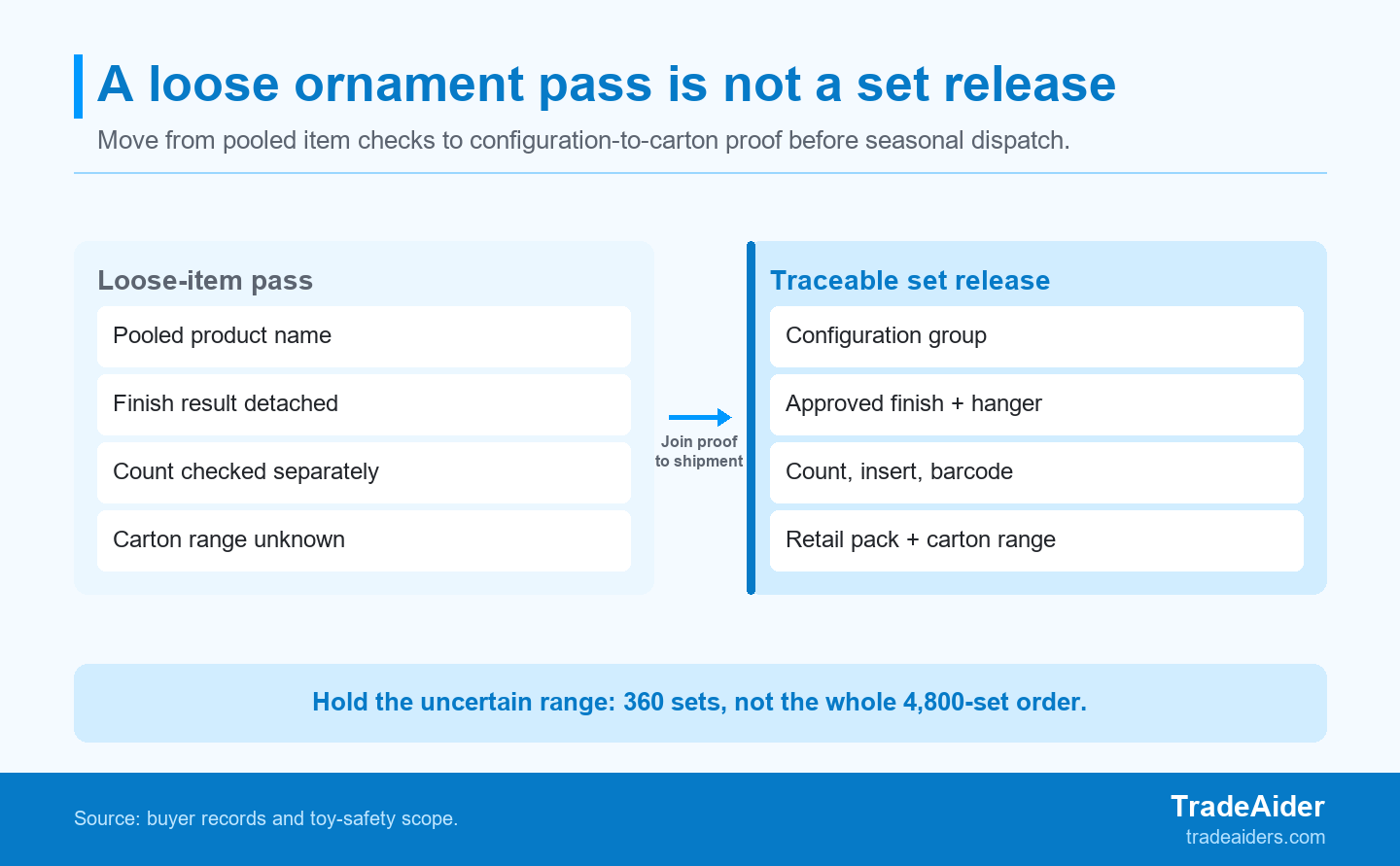
A passing loose ornament is not a release result until its configuration, retail pack, and master-carton range point to the same shipment population; in the illustrative scenario, only the uncertain 360-set range is held.
Check the set in the order a shopper experiences it: outer retail pack, visible condition, count, insert, barcode, and closure; then move outward to the master carton and pallet mark. A pre-shipment inspection service can review the finished population against those fields before release. The following record structure makes a pack finding usable at shipment release. It does not set universal acceptance limits; those remain the buyer’s approved criteria.
| Release field | What to compare | Evidence kept | Decision if mismatched |
|---|---|---|---|
| Configuration | Shape, color, finish, hanger, and component list | Approved sample and configuration code | Isolate that variant until identity is restored |
| Ornament condition | Breakage, sharp edges, paint transfer, and cap attachment | Full-pack and close-condition photos | Assess the observed pattern and its traceable group |
| Retail-pack completeness | Count, insert, barcode, and closure | Pack photos and scan or artwork record | Recount or correct the affected pack population |
| Carton identity | Master-carton label, quantity, variant, and range | Carton photos and packing record | Hold only cartons that cannot be joined to a set row |
Based on this comparison, an open-carton check is complete only when the retail configuration and the dispatch record resolve to the same set row. If the cartons remain identified through dispatch, container loading supervision can preserve the link between the inspected range and the cartons actually loaded.
Illustrative Scenario: a Shared Carton Label Widens Only the Necessary Hold
When master-carton identity is uncertain, the buyer can contain only the affected carton range, reconcile records, and resample separated variants. The practical trade-off is a focused delay for the cartons with an evidence gap, rather than an order-wide rejection that treats all finished sets as equally uncertain.
Why the 360-Set Carton Range Is Held, Not the Entire Order
The illustrative 360-set hold is driven by shared carton labels and incomplete variant records, not by an assumption that every set is defective. The point is to make the hold follow the evidence boundary: a missing star or mismatched insert triggers a check of the cartons that could carry the same uncontrolled variant, not a guess about the rest of the order.
In this illustrative scenario, a marketplace quality manager is preparing a seasonal ornament assortment for marketplace fulfillment. The manager needs a shipment decision that gives each retail variant its own count, barcode, insert, and carton evidence before the booking window closes. The 4,800-set order contains three variants under one family name. Each has a different shopper-facing barcode and insert version, yet 12 master cartons are marked only “silver-and-red,” creating a 360-set range whose variant identity cannot be read from the carton label. All retail packs are finished and placed in master cartons, but final dispatch remains open. The approved photo set distinguishes the variants, and the packing list can identify the 12 shared-label cartons, so the uncertain range is still physically separable from the other cartons.
Two cartons in that range contain retail packs with different insert versions. One sampled pack is also missing a star ornament, even though its outer label matches the family name used across all three variants. The approved artwork shows separate barcode files for the variants. Because the shared carton label does not show which barcode and insert version it contains, a correct-looking outer carton cannot prove the identity of every enclosed shopper set. The missing ornament is a pack-completeness finding, while the shared label is a traceability finding. Together they prevent the buyer from knowing whether the observed pack is isolated or repeated across the 12 cartons. The rest of the order does not share that uncertainty because its cartons retain a variant-specific mark.
Hold the 12 identified cartons, reconcile carton-to-variant records, recount their retail packs, and resample the rebuilt groups. Keep the remaining 4,440 sets outside that hold unless another record links them to the same mixed-carton condition. The immediate cost is a targeted dispatch delay, balanced against avoiding a blind release of packs with unresolved count or identity. Relabel the master cartons, separate variants, correct incomplete packs, and photograph the revised carton range. Update the Ornament Set Integrity Matrix so each repaired pack group carries the matching insert, barcode, count result, and carton mark.
Reinspection checks the count, visible condition, insert, barcode, and carton range for every separated variant group. Release can resume only when the records and physical packs point to the same configuration; a new mixed label would reopen the affected range. This is an illustrative scenario, not a universal sampling plan or defect-rate estimate. Actual containment depends on the buyer’s traceability records, pack-out design, contract terms, accepted criteria, and destination-market requirements.
Hand Off a Release Packet Before Peak Dispatch
A testable ornament-set inspection request names the configuration matrix, approved sample, pack-out specification, carton range, and decision owner. That packet gives the inspector a defined job and gives the buyer a defined result: which configurations were checked, which cartons they represent, and who can approve a recheck, correction, or hold.
- List every shopper-facing configuration with its approved sample, count, finish, hanger, retail-pack version, barcode, and carton range.
- State the planned condition checks, buyer acceptance criteria, and the evidence needed if a finish, hardware, small-part, or pack issue appears.
- Provide pack-out and carton-label records, then name the decision owner and the rule for widening a hold.
Send the packet before final cartons are sealed or mixed for dispatch. When the finished set needs an evidence-led review, assemble the approved samples and pack-out records first, then book an ornament-set inspection.
Who Is TradeAider?
TradeAider provides inspection, testing, and certification services in China with real-time reporting and transparent Inspection & QA Services pricing. Buyers sourcing in Guangdong, Zhejiang, Jiangsu, Shandong, and Fujian can review its provider context when they need a defined inspection scope for finished seasonal goods through its Amazon Service Provider Network (SPN) partner.
For Inspection & QA Services, TradeAider states a $199/man-day all-inclusive rate. Client-reported outcomes include an 18% reduction in returns and 23% of defects caught before shipment; these are client-reported figures, not universal results for every ornament program, supplier, or destination market.
TradeAider also provides testing services, covering Hardline Products, Softline Products, Electrical & Electronic Products, and Industrial Products, enabling buyers to manage quality control and testing needs within a single service framework.
Provider support can structure fieldwork and reporting, but it does not replace the product-specific conformity or legal assessment required for the destination market.
Frequently Asked Questions
Do Christmas Ornament Sets Need Toy Safety Testing?
Christmas ornament sets need a toy-safety review only when their design, labeling, or marketing places them within the applicable toy or children’s-product scope for the destination market. Great Britain’s toys guidance describes essential safety requirements for toys supplied in or into Great Britain. Confirm the marketed use before selecting tests.
Australian product safety guidance links its young-child small-parts standard to toys manufactured, designed, labeled, or marketed as playthings. Preserve intended age, sales copy, packaging, and destination-market information with the inspection request, then choose the relevant technical route rather than making a blanket safety statement from appearance alone.
How Should Mixed Ornament SKUs Be Sampled?
Mixed ornament SKUs should be sampled by configuration groups so their shape, finish, hanger, count, retail-pack version, and carton range remain traceable. Sampling should preserve configuration groups rather than pooling all ornament variants. Use the agreed quantities, but clarify a group that is too small or too mixed to identify instead of hiding it inside a family-level average.
Is Paint Transfer a Cosmetic Defect or a Release Issue?
Paint transfer should block or qualify release whenever it changes the approved appearance, contaminates the retail pack, or conflicts with required product evidence. Paint transfer becomes a release issue when it breaks approved appearance, contaminates the pack, or conflicts with required evidence. Record the exact finish and affected surface, then compare them with the approved sample and product file.
What Should the Retail-Pack Inspection Record Show?
A retail-pack inspection record should show enough evidence to connect the shopper set to its physically identified carton range. The record should join configuration, count, condition, insert, barcode, pack photos, and carton range. Include the approved sample or artwork reference, inspection date, sampled-pack identity, and decision taken for any mismatch.

Related Articles



Grow your business with TradeAider Service
Click the button below to directly enter the TradeAider Service System. The simple steps from booking and payment to receiving reports are easy to operate.

