
- About Us

- Our Services
- Your Industry
- Resources
- News & Blog
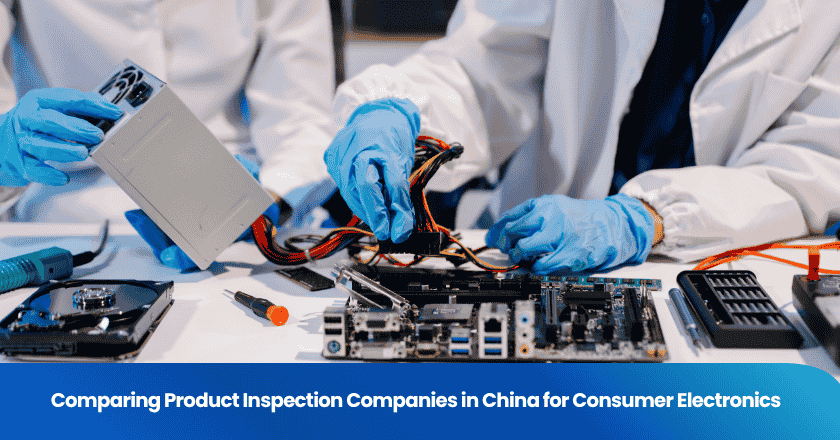
If you source consumer electronics from China, choosing the right inspection partner isn't a nice-to-have — it's the difference between products that fly off shelves and products that get recalled. Consumer electronics carry unique risks: regulatory non-compliance, functional failures, and safety hazards that can destroy a brand overnight. This guide walks you through a structured framework for comparing product inspection companies in China, with specific attention to what electronics importers need.
Key Takeaways
- Electronics inspection is fundamentally different from general product checks — you need partners with FCC, CE, RoHS, and CCC testing expertise
- Real-time visibility separates modern inspection companies from those still delivering static PDF reports days later
- Pricing transparency is a critical differentiator — watch for hidden fees around weekends, holidays, and travel surcharges
- Industry-specific experience in consumer electronics matters more than general inspection volume
- A structured evaluation framework helps you compare companies on objective criteria rather than marketing claims
What Makes Consumer Electronics Inspection Different
Consumer electronics occupy a unique position in the quality control landscape. Unlike textiles or furniture, electronics products face strict regulatory requirements in every major market, carry genuine safety risks, and demand functional testing that goes far beyond visual inspection. A quality inspection company that excels at checking garments may be completely unqualified to evaluate a Bluetooth speaker or a USB-C charger.
Compliance Standards You Cannot Ignore
Every consumer electronics product destined for international markets must clear specific regulatory hurdles. In the United States, the FCC regulates radio frequency emissions — any device with Wi-Fi, Bluetooth, or cellular connectivity needs FCC certification or testing (per Fictiv's certification guide). The European Union requires CE marking under directives like the RED (Radio Equipment Directive) and the Low Voltage Directive. China mandates CCC certification for products sold domestically.
RoHS compliance restricts hazardous substances like lead, mercury, and cadmium in electronic components. An inspection company that doesn't understand these standards — or worse, doesn't know how to verify them on-site — cannot adequately protect your business (per Retekess's complete certification guide).
Common Defects in Consumer Electronics Manufacturing
Consumer electronics manufacturing in China presents specific defect patterns that experienced inspectors learn to spot. According to Tetra Inspection's electronics guide, the most common issues include:
| Defect Category | Examples | Risk Level |
|---|---|---|
| Functional Failures | Dead pixels, charging failures, button malfunctions | Critical |
| Safety Hazards | Exposed wiring, overheating batteries, loose connections | Critical |
| Cosmetic Defects | Scratches on screens, inconsistent finishes, misaligned panels | Major |
| Labeling Errors | Missing FCC/CE marks, incorrect voltage labels, wrong UPC codes | Major |
| Packaging Issues | Insufficient padding, crushed boxes, missing manuals | Minor |
How to Evaluate Inspection Companies for Electronics
The comparison framework below is built from real-world experience helping electronics importers select quality partners. It focuses on five evaluation pillars that directly impact your inspection outcomes.
Technical Capabilities and Testing Equipment
An inspection company's value for electronics begins with their technical toolkit. Can they perform hi-pot testing on-site? Do they carry multimeters, oscilloscopes, and thermal imaging cameras? Do their inspectors understand circuit board inspection well enough to spot cold solder joints or incorrect component placement?
Ask potential inspection companies specifically about their electronics testing protocols. A company that only offers visual inspection is not sufficient for consumer electronics — you need partners who can perform functional testing, electrical safety checks, and basic compliance verification during the inspection itself (per Wonderful PCB's certification requirements guide).
Real-Time Reporting and Transparency
This is where the biggest gap exists between inspection companies today. Traditional inspection companies deliver reports 2-5 business days after the inspection — by which point your goods may already be on a container ship. Modern inspection platforms like TradeAider's pre-shipment inspection service provide real-time online monitoring, where you can follow the inspection as it happens, see photos and videos immediately, and communicate with inspectors directly.
For electronics importers, this speed matters enormously. If a pre-shipment inspection reveals a 15% functional failure rate on your Bluetooth headphones, you need to know that today — not four days from now when the factory has already sealed the cartons and loaded the container.
Pricing Structure and Hidden Fees
Inspection pricing in China typically ranges from $200 to $350 per man-day, but the headline rate rarely tells the full story. When comparing inspection companies, dig into the fine print:
| Fee Category | What to Ask | Typical Range |
|---|---|---|
| Base Rate | What's the per man-day rate? | $199 – $350 |
| Weekend/Holiday Surcharge | Is there an extra charge for weekends or Chinese holidays? | 0% – 100% markup |
| Travel Expenses | Are travel costs included or billed separately? | $0 – $150 per trip |
| Report Fees | Is the official report included in the base rate? | Included – $50 extra |
| Rush Surcharges | What if you need next-day inspection? | 0% – 50% markup |
Transparent pricing is one of the strongest signals of a trustworthy inspection partner. TradeAider, for example, publishes a flat rate of $199 per man-day with no hidden surcharges — you can use the inspection cost calculator to estimate your total expenses before booking.
Key Comparison Factors: What Separates Good from Great
When you strip away the marketing materials, the differences between inspection companies come down to a handful of measurable factors. Here's what actually matters when your products are consumer electronics:
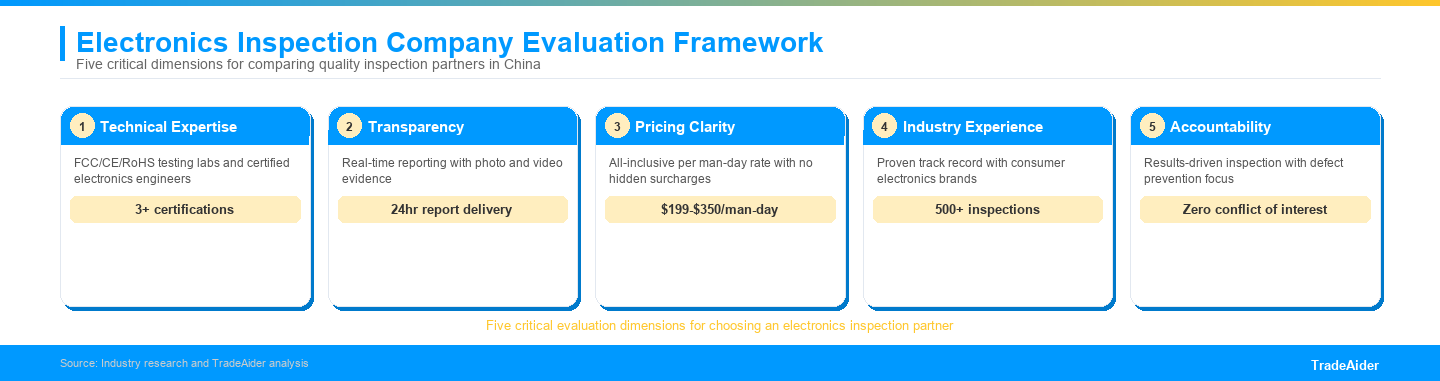
The Five Pillars Framework: Each pillar represents a critical evaluation dimension that determines whether an inspection company can effectively protect your electronics brand
Industry-Specific Experience in Electronics
General inspection experience doesn't translate to electronics expertise. A company that has inspected 10,000 toy shipments isn't automatically qualified to evaluate your smart home devices. Look for inspection companies that can demonstrate specific experience with your product category — ask for sample reports (with client names redacted), request details about their electronics-specific training programs, and verify that their inspectors hold relevant certifications.
According to Maple Sourcing's analysis of top inspection companies, the best firms maintain dedicated electronics teams rather than assigning generalist inspectors to specialized products.
AQL Standards and Sampling Rigor
Acceptable Quality Level (AQL) sampling is the backbone of statistical inspection — but not all companies apply it with the same rigor. For consumer electronics, you need an inspection partner that understands which AQL level to apply to which defect type. Critical defects (safety issues) should have zero tolerance. Major defects (functional failures) typically follow AQL 2.5. Minor defects (cosmetic issues) might use AQL 4.0.
If you're new to AQL, TradeAider's AQL calculator lets you input your lot size and inspection level to determine the correct sample size and acceptable defect count. A good inspection company should walk you through this process transparently rather than making these decisions for you behind closed doors (per Guangzhou Sourcing's AQL guide).
Red Flags When Choosing an Inspection Partner
Knowing what to avoid is just as important as knowing what to look for. These warning signs should make you think twice before committing to an inspection company for your electronics products.
Signs of Conflict of Interest
The most dangerous red flag is any financial relationship between your inspection company and your supplier. Some inspection firms — particularly those embedded in sourcing agencies — receive referral fees or commissions from factories. If your inspector is paid by the factory they're inspecting, you have a fundamental conflict of interest.
Independent, third-party inspection companies that work exclusively for buyers eliminate this risk. When evaluating companies, ask directly: "Do you have any financial relationship with the factories you inspect?" The answer should be an unequivocal no.
Lack of Transparent Communication
If an inspection company cannot clearly explain their testing methodology, their sampling approach, and their reporting timeline before you sign a contract, they won't suddenly become transparent after you do. Pay attention to how responsive and detailed they are during your initial inquiry — this is them at their best.
The Role of Real-Time Visibility in Modern Inspections
The inspection industry is undergoing a shift from delayed, static reporting to real-time, interactive monitoring. For electronics importers, this shift isn't just a convenience — it's a competitive advantage.
From PDF Reports to Live Monitoring
Traditional inspection companies follow this pattern: inspector visits factory, conducts inspection over 1-2 days, writes report, sends it to you 2-5 days later. If problems are found, you're already behind — your goods may have shipped, or your factory may have moved on to another order.
Real-time inspection platforms flip this model. You watch the inspection unfold through an online dashboard. You see photos as they're taken. You can direct inspectors to check specific concerns in real time. When the inspection identifies that 8% of your wireless chargers have overheating issues during the burn-in test, you can make a decision immediately — reject the batch, request rework, or adjust your tolerance — rather than discovering the problem a week later.
This is why companies that prioritize real-time visibility are increasingly preferred by electronics importers who can't afford the lag of traditional reporting.
Practical Checklist: Evaluating Your Next Inspection Company
Use this checklist when comparing inspection companies for your consumer electronics products:
| Evaluation Criteria | Questions to Ask | Must-Have |
|---|---|---|
| Electronics Expertise | Do you have dedicated electronics inspectors? What testing equipment do they carry? | Yes |
| Compliance Knowledge | Can you verify FCC/CE/RoHS compliance on-site? Do you understand CCC requirements? | Yes |
| Reporting Speed | How quickly do I receive the inspection report? Is real-time monitoring available? | Within 24 hours |
| Pricing Transparency | What's the all-inclusive rate? Are there any additional fees? | Published flat rate |
| Independence | Do you receive any compensation from the factories you inspect? | No financial ties |
| AQL Competence | Can you walk me through your AQL sampling approach for my product? | Clear methodology |
Walking through this checklist with 2-3 inspection companies will quickly reveal which ones are prepared for consumer electronics work and which are generalists hoping to learn on your dime. For electronics importers who want a partner that meets all six criteria, contact TradeAider's team to discuss your specific product requirements.
Frequently Asked Questions
How much does consumer electronics inspection cost in China?
Professional consumer electronics inspection in China typically costs between $199 and $350 per man-day. The exact price depends on the inspection company, the complexity of your product, and the location of the factory. Be sure to ask about additional fees for weekends, holidays, travel, and report generation — some companies charge significantly more than their advertised base rate. You can estimate your total cost using TradeAider's inspection calculator for a transparent, all-inclusive quote.
What certifications should an inspection company hold for electronics?
Look for inspection companies whose operations are ISO 17020 accredited (inspection body competence) and whose lab partners hold ISO 17025 accreditation for testing. For electronics specifically, the company should demonstrate working knowledge of FCC Part 15 (US), CE RED Directive (EU), and RoHS compliance verification. The inspectors themselves should have electronics-specific training — not just general quality control certification.
How long does a typical consumer electronics inspection take?
A standard pre-shipment inspection for consumer electronics typically takes 1 man-day per 500-2,000 units, depending on the product complexity and your AQL sampling requirements. Products requiring functional testing (power-on tests, connectivity checks, audio quality verification) take longer than those needing only visual and dimensional inspection. Your inspection company should provide a time estimate based on your specific product and lot size before the inspection begins.
Can inspection companies perform lab testing for FCC/CE compliance?
On-site inspectors can perform basic compliance checks — verifying labels, checking documentation, and running preliminary tests — but formal FCC and CE certification testing requires accredited laboratory facilities. Many inspection companies partner with certified labs for this purpose, offering a combined service where they handle both the on-site inspection and coordinate lab testing. This integrated approach saves time compared to hiring separate companies for inspection and testing (per Embien's global electronic certification guide).
Related Articles

Grow your business with TradeAider Service
Click the button below to directly enter the TradeAider Service System. The simple steps from booking and payment to receiving reports are easy to operate.

