
- About Us

- Our Services
- Your Industry
- Resources
- News & Blog

A factory audit finding is not a corrective action; it is evidence that a corrective action must be owned, dated, proven, and verified. Follow-up fails when buyers accept a factory promise as closure instead of asking what changed in the process, record, training, material control, or inspection gate.
The audit report tells the buyer what the factory looked like on audit day. Corrective action decides whether the next order will be safer. A finding such as missing incoming-material records, weak calibration control, subcontracting ambiguity, poor warehouse segregation, or no final QC log should not be closed because the factory says "we will improve." It closes only when the buyer can see what changed.
The most useful audit follow-up separates containment, root cause, corrective action, verification, and next-order release evidence. If 12 audit findings are closed with one general promise, the buyer has not reduced risk; the buyer has only renamed the risk.
- First move: Rank each finding by shipment consequence, not by how polite the factory response sounds.
- Owner rule: Every corrective action needs one factory owner, one buyer-side reviewer, one due date, and one proof type.
- Verification rule: Documents can verify process changes; DPI or PSI verifies whether the next order follows the change.
- Timing rule: Critical findings need containment within 48 hours and verified correction before the next related production step.
The Direct Answer
After a factory audit, follow up by turning each finding into a corrective action with severity, root cause, owner, due date, proof, and verification method.
TradeAider treats corrective action after an audit as a verification loop: the finding is only useful when documents, production behavior, and shipment-release evidence show that the factory changed the control point.
The buyer should not send a long audit report and wait for a general reply. The factory should respond finding by finding. Critical findings need immediate containment. Major findings need root-cause evidence and process correction. Minor findings need documentation or housekeeping improvement, but they still need closure proof. The follow-up should end with a decision: approved to proceed, approved with added inspection gates, paused until verification, or supplier exit.
According to ISO 19011 auditing guidance, management-system audits depend on evidence, findings, and conclusions. According to ISO 9001 quality management guidance, quality management relies on controlled processes and improvement. This is why a corrective action cannot be only a message. It has to change the process that created the finding.
Why Audit Follow-Up Fails
Audit follow-up fails when the buyer treats a supplier response as evidence before checking whether the process changed.
According to ASQ root cause analysis resources, root cause analysis looks for the underlying reason a problem occurred. A factory can correct a symptom and leave the root cause untouched. A missing calibration sticker can be replaced in 10 minutes; a weak calibration-control system may take training, record control, and periodic review. A blocked emergency exit can be cleared for a photo; poor facility discipline may reappear after the auditor leaves. The buyer's job is to separate appearance from control.
Containment stops the immediate shipment risk
Containment is the first response when an audit finding can affect an active order. If the audit shows mixed materials, uncontrolled labels, blocked inspection records, or unapproved subcontracting, the factory should isolate the risk before production continues. The buyer should ask what stock, line, product, supplier, or process is affected. For example, if carton labels for two SKUs are stored together, containment means segregating current labels, confirming quantity, and preventing the wrong labels from reaching packing. The action is temporary, but it protects the current shipment while root cause is investigated.
Root cause explains why the finding existed
Root cause is where many factory replies become too vague. "Worker mistake" is rarely enough. The buyer should ask why the worker could make the mistake, why the system did not catch it, and why management did not see it earlier. According to ASQ cost of quality resources, failure costs are different from prevention and appraisal costs. That distinction matters because a cheap corrective action can become expensive if it only moves the defect downstream. A missing incoming-material check should lead to an updated receiving process, not only a retrained worker.
Verification proves the correction before the next risk point
Verification is the step that turns a factory promise into buyer evidence. A photo may prove that a label area was cleaned, but it may not prove that workers will use the new label-control rule tomorrow. A revised procedure may prove management intent, but it does not prove line execution. The verification method should match the finding. Record-control issues may require document review. Process-control issues may require During Production Inspection. Finished-lot issues may require Pre-Shipment Inspection. A PSI is conducted when 100% of the order quantity is completed and at least 80% is packed for export, so it is useful for release evidence, not for early process correction.
Corrective Action Follow-Up Table
The best follow-up table does not list findings; it converts each finding into consequence, owner, proof, and verification.
| Finding Type | Immediate Question | Factory Proof | Buyer Verification |
|---|---|---|---|
| Critical process gap | Can the current order continue safely? | Containment record and affected-lot list | DPI before the next process gate |
| Material control weakness | Which batches or suppliers are affected? | Receiving record, segregation photo, supplier list | Document review plus incoming-material spot check |
| Label or carton control gap | Can the wrong SKU ship? | Label issue log and packing-line correction | Barcode scan and carton-mark check during PSI |
| Training failure | Did the worker receive usable instructions? | Training record and updated work instruction | Line observation during DPI |
| Final QC record gap | Can the factory prove release control? | Inspection checklist and signed QC record | Compare factory QC record with third-party inspection result |
The comparison reveals that the proof type must match the failure mechanism. A label-control finding is not closed by a general training record if the real risk is that two SKU labels can reach the packing table at the same time. A final-QC record gap is not closed by a photo of a finished product if the buyer needs evidence that the factory changed how release decisions are made.
A Practical Follow-Up Cadence
A corrective action plan should have three clocks: immediate containment, short-term root-cause proof, and next-order verification.
A useful cadence prevents the factory from treating all findings as equal. Critical findings need containment within 48 hours because they can affect current production. Major findings should have root-cause evidence within 7 days because they often require process, record, or training change. Minor findings can be closed during the next document review, but only if they do not affect shipment release. The cadence is not a punishment schedule. It is a way to prevent open risks from drifting into the next order.
Use documents when the issue is system control
Documents are useful when the finding concerns system discipline: supplier approval list, calibration log, receiving record, training file, QC checklist, nonconformity register, or corrective-action log. According to ASQ quality plan guidance, a quality plan links requirements, resources, specifications, and inspection programs. The buyer should therefore ask for documents that show the new control exists and is assigned. A revised document is not enough by itself, but it is the minimum evidence that the factory has changed the system rather than only staged a correction photo. The risk is highest when the new document has no owner, no revision date, and no example record from an actual order.
Use DPI when the issue can recur during production
DPI is useful when the audit finding may reappear while the order is still being made. If the audit found weak in-process inspection, missing material segregation, poor first-article approval, or unclear assembly instruction, waiting until the final packed lot may be too late. A TradeAider's During Production Inspection can check whether the corrective action is working while workers, materials, and line supervisors are still available. The decision point is practical: if the factory can still change the process before the batch is finished, verify earlier rather than waiting for the release gate.
Use PSI when the issue affects release evidence
PSI is useful when the buyer needs proof that the finished lot reflects the corrective action. If the audit finding involved final QC records, packing accuracy, barcode control, origin mark, accessory count, or carton condition, the buyer should verify the packed order before shipment. According to GS1 barcode standards, barcodes support supply-chain identification, so barcode correction needs scanning evidence rather than only artwork approval. According to CBP origin-marking guidance, origin marking can be a real import requirement, so carton and product marks should be part of the release check when relevant.
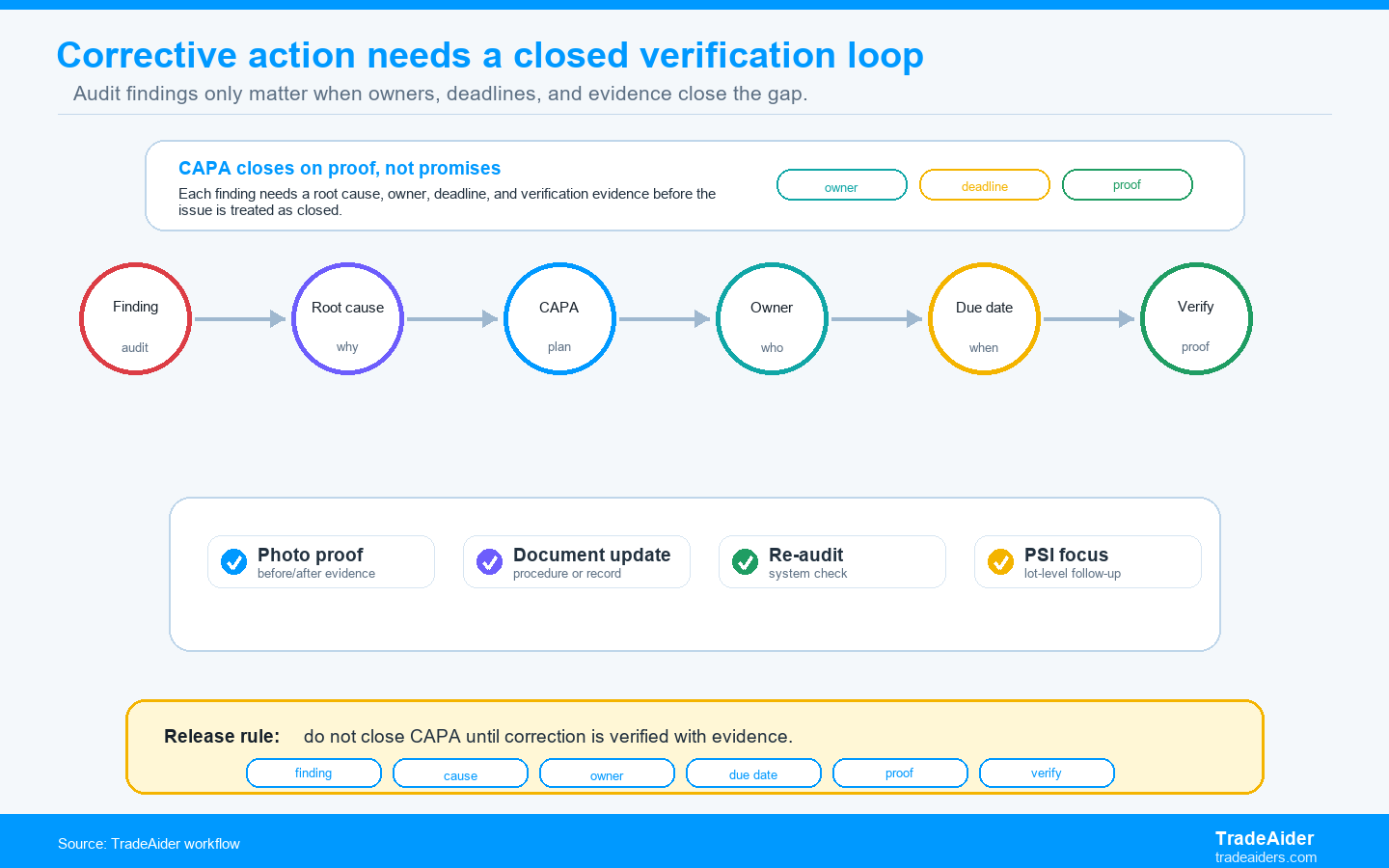
Corrective action only closes when the finding has an owner, evidence, and independent verification.
SPAR Scenario: The Audit Finding That Almost Became a Return Problem
The cost of follow-up is visible; the cost of accepting a weak factory promise usually appears later.
Situation: A Shopify brand audits a factory in Dongguan before a 4,000-unit bathroom accessory order. The audit report lists 12 findings: 3 critical, 5 major, and 4 minor. One critical finding is that incoming metal parts are stored without batch identification. One major finding is that final QC records do not show who approved release.
Problem: The factory replies that the issues are "already improved" and sends two photos. The photos show a cleaned shelf and a new form, but they do not show whether current material lots were separated or whether final QC staff actually use the new release form.
Action: The buyer asks for a corrective action table with owner, date, root cause, containment, and evidence. The buyer schedules a DPI after the first 30% of production and a PSI before shipment. The DPI checks batch segregation on the line; the PSI checks finished goods, cartons, labels, and QC record consistency.
Result: The order ships 4 days later than the original plan, and the buyer spends one extra inspection day. The trade-off is clear: the delay exposes a weak batch-control habit before 4,000 units are packed. The remaining limitation is that the buyer must keep the same follow-up discipline on the next repeat order, or the factory may slowly return to the old process.
Factory Audit Follow-Up Checklist
Close the corrective action only when the buyer can see the changed process, not just the factory's agreement.
- Separate findings into critical, major, and minor based on shipment consequence.
- Ask for one owner, one due date, one root cause, and one proof type for each finding.
- Require containment evidence before allowing current production to continue when the risk is active.
- Use document review, factory audit follow-up, DPI, or TradeAider's Pre-Shipment Inspection based on where the failure can reappear.
- Do not release the next order only because the factory has acknowledged the finding.
If an audit finding is already sitting in a corrective-action plan, send TradeAider the audit report, CAP, factory evidence photos, responsible person, due date, production status, and next shipment timing. The next step is to ask TradeAider to verify the corrective action through follow-up audit, DPI, or PSI before the same weakness reaches another shipment.
Frequently Asked Questions
What is corrective action after a factory audit?
Corrective action after a factory audit is the controlled follow-up that turns audit findings into process changes. It should define severity, root cause, owner, deadline, evidence, and verification method for each finding.
How soon should a Chinese factory respond to audit findings?
A factory should respond quickly enough to protect the next risk point. Critical findings may need containment within 48 hours, major findings often need root-cause proof within 7 days, and minor findings can usually close through document updates if they do not affect shipment release.
Should buyers use inspection after audit corrective action?
Yes, when the finding can affect actual production or shipment release. DPI is useful when the process can still be corrected during production, while PSI is useful when the buyer needs finished-order release evidence before shipment.
Related Articles


Grow your business with TradeAider Service
Click the button below to directly enter the TradeAider Service System. The simple steps from booking and payment to receiving reports are easy to operate.

