
- About Us

- Our Services
- Your Industry
- Resources
- News & Blog
Dynamic AQL is useful when it is decided before the inspection visit, written into the buyer’s control plan, and tied to evidence that can later return the plan to normal. It is not a tactic for lowering a number after a supplier has already presented a weak lot. The practical question is not simply “Which AQL should we use?” It is “What has changed in the release risk, what evidence is needed now, and what evidence will close that change?”
Dynamic AQL is a buyer-controlled sampling policy that adjusts inspection intensity or acceptance criteria when documented supplier history, order exposure, product consequence, or a current change alters release risk.
An acceptance quality limit (AQL) is the agreed limit used with a sampling table to make a decision about a defined lot. It is not a promised percentage of defects in every shipment. That distinction matters because a random sample can support a ship-or-hold decision while still leaving a buyer responsible for the attributes, records, and product risks that require separate evidence.
The Decision Rules Buyers Need Before Changing an AQL Plan
Dynamic AQL is a documented rule that changes sampling intensity or acceptance criteria when named evidence changes the buyer’s release risk.
- Definition: Keep the contract table and product specification visible; change only a pre-agreed control state.
- Supplier history: Use a trend of defect categories, corrective-action evidence, and a clear return-to-normal rule—not the memory of one good report.
- Order exposure: Let financial or channel exposure raise the proof required for release, not the assumed defect rate.
- Risk: Protect high-consequence attributes with an override that cannot be relaxed by a favorable general sample.
- Decision: Record the trigger, table entry, targeted check, evidence owner, and exit evidence in the booking brief.
The outcome should be explainable to the supplier and inspector in one page. If the reason for tightening cannot be stated in a sentence, or the return condition cannot be named, the plan is still a preference rather than a control.
The Evidence-Triggered Sampling Adjustment Framework
The Evidence-Triggered Sampling Adjustment Framework uses supplier history, order exposure, and product consequence to select a documented control state.
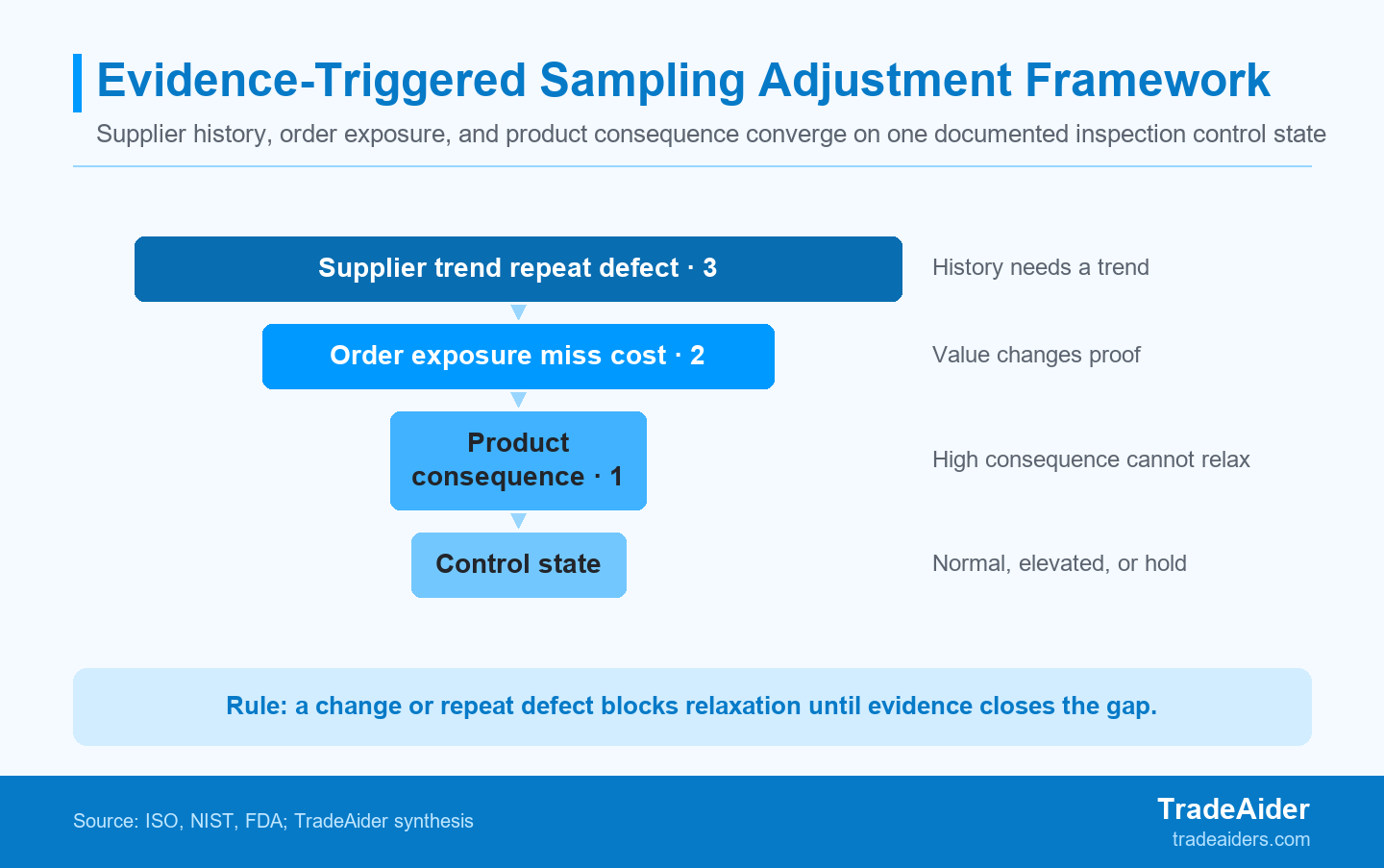
Use all three inputs to select a control state, then record the AQL table entry and the evidence needed to return to normal.
Acceptance sampling is a method of inspecting samples from a lot.
FDA training material makes that lot-sampling boundary explicit. NIST likewise describes acceptance sampling as a decision about whether a lot is likely acceptable, not an estimate of the exact quality of every unit. A buyer can therefore keep a valid general sampling decision while adding a second proof path for a repeat defect, a changed material, or an attribute with a much higher consequence if missed.
The Evidence-Triggered Sampling Adjustment Framework is deliberately simple. Supplier history answers whether the process has earned less or more trust. Order exposure answers how costly an unresolved miss would be. Product consequence answers whether some attributes need a ceiling on relaxation. Those are separate questions; combining them into one unsupported supplier score hides the action each signal should cause. TradeAider can use that distinction when a buyer asks for an inspection scope that reflects a specific release risk.
Use three control states. Normal applies the agreed table entry. Elevated keeps the agreed basis but increases evidence through a tighter approved setting, a larger or more representative sample, or a targeted check. Hold and verify prevents relaxation until a defined gap is closed. The framework does not prescribe one AQL value or one dollar threshold for every buyer.
AQL Is a Lot Decision, Not a Defect Allowance
An AQL sample supports a lot disposition; it does not prove the exact defect rate or that every unit is defect-free.
NIST explains the same limit in its acceptance-sampling handbook. That is why an AQL pass should never be translated into “the shipment has only this many defects” or “every carton is safe to release.” The sample is evidence for the defined lot and attributes. It cannot automatically prove that a changed component, a labeling requirement, or a particular recurring defect has been controlled.
Start every dynamic policy by stating what remains fixed: the controlling sampling standard or contract table, the lot definition, the defect classification, and the buyer’s final release authority. Then state what may change: inspection level, selected AQL for a named category where the contract allows it, sample allocation, targeted attribute checks, or a hold rule. This keeps a response to risk from becoming an untraceable rewrite of the acceptance standard.
Supplier History Is a Trend, Not a Last-Report Grade
A supplier-history relaxation rule needs a pre-specified accepted run and a return-to-normal condition after rejection.
NIST’s skip-lot sampling guidance starts with normal lot-by-lot inspection, requires a pre-specified run of accepted lots before reduced inspection, and returns to normal after rejection. The buyer does not need to adopt skip-lot sampling to learn from the logic: relaxation must have an entry condition, and it must also have an exit.
For a supplier history review, look beyond the overall pass or fail label. Track repeat defect category, defect location, production step, corrective action, evidence that the action was completed, and the number of later lots that show the issue stayed closed. A cosmetic scuff on one color is not the same history as repeated seam separation at the same construction point. The useful unit of history is a risk pattern, not a supplier reputation label.
A favorable record can support normal inspection only when the current production conditions are comparable. If the supplier changes tooling, material source, key process setting, or subcontracted operation, the historical signal may no longer apply to the changed population. That is where the hard override belongs.
Order Value Measures Exposure, Not Product Quality
Order value should change the amount of release evidence required, not be treated as evidence that the product is more defective.
Order value belongs in the policy as exposure. A $20,000 reorder and a $200,000 launch shipment can use the same supplier and product yet deserve different proof because replacement lead time, rework cost, retailer penalties, and lost selling time are different. None of those costs proves that the product has a higher defect probability. They only change the cost of accepting uncertainty.
A practical buyer rule is to name the commercial consequence first, then name the inspection action. For example: “If this lot misses the retail launch window, add targeted verification of the repeat-risk attribute and require traceable corrective-action evidence before release.” That is clearer than saying “orders above a certain value use a lower AQL.” The first rule names why the evidence changed and what the team will actually do.
Use a financial trigger cautiously. It should be internally approved, consistent with the purchase-order remedy, and paired with an action the inspector can observe. If the trigger only produces a vague instruction to “inspect more carefully,” it will not create reproducible evidence.
Product Risk Sets the Consequence Ceiling
Compliance history, hazard signals, and inherent product risk are distinct factors in a risk-based inspection approach.
The FDA lists those factors in its risk-based inspection approach. Its medical-product setting is not a consumer-goods rule, but the separation is instructive: a supplier’s record and the consequence of the product are not interchangeable. A good supplier history cannot lower the required evidence for an attribute whose failure would make the product unsafe, nonconforming, unusable, or commercially unrecoverable.
For a China-sourced consumer product, define risk in buyer terms: functional failure, mandatory label mismatch, material declaration conflict, retailer-specific requirement, or a defect that prevents intended use. Place such items in a “cannot relax” list. The result may be a targeted functional check, a document-to-product check, added testing evidence, or a hold. It is not automatically a claim that every product needs 100% inspection.
Translate the Inputs Into a Pre-Agreed Control State
A dynamic sampling policy should define the trigger, control state, evidence owner, and exit evidence before inspection begins.
The best policy states the action before cartons are selected. NIST defines a sampling plan as a detailed outline of what is measured, when, on what material, how, and by whom. That definition is a useful standard for a buyer’s own release brief: the rule must tell an inspector what to do, not merely warn them that the order feels risky.
In the normal state, record the agreed table and ordinary workmanship scope. In the elevated state, record the additional proof for the named risk: an approved tighter AQL setting, a larger approved sample, a separate sample allocation for the affected subgroup, or a targeted check. In hold and verify, record the missing evidence that prevents release and who can close it. Each state also needs an exit condition, such as two comparable lots without repeat findings or verified corrective-action evidence on the changed population.
Record the Table Entry Before Anyone Opens a Carton
AQL values become operational only when the controlling table, inspection level, sample size, and Ac/Re decision rule are recorded together.
NIST describes a lot acceptance plan as a sampling scheme plus decision rules. In a booking brief, write the controlling edition or contract table, lot size, general or special inspection level, resulting code letter, sample size, AQL value for each defect class, and Ac/Re pair. Ac/Re means the acceptance number and rejection number: the recorded counts that determine whether the sample is accepted or rejected.
Use an illustrative table-entry pattern rather than a remembered table. A buyer might write: “Lot: 4,800 benches; table: the edition named in the purchase order; inspection level: agreed general level; code letter: confirm from that table; sample size: confirm from that table; general workmanship: contracted AQL and Ac/Re; blue-fabric seam risk: elevated targeted evidence.” This makes the inspection plan complete without copying an obsolete or unlicensed table into the order file.
After the control state is agreed, buyers can use the TradeAider AQL calculator to document the table entry. The calculator is a documentation aid, not a substitute for confirming the controlling standard, customer requirement, and defect classification.
Use Change and Repeat-Defect Overrides
Known systematic problem areas can justify targeted testing in addition to objective random sampling.
FDA quality-control guidance says that a random sampling scheme should be objective and that systematic problem areas may warrant testing. Again, that document comes from a regulated context, but the operational lesson travels well: keep the lot sample random and direct a separate check to the known failure mode.
Set hard overrides for events that make historic performance less relevant: new material source, new tool or mold, changed production setting, a repeat defect not yet closed, an incomplete corrective action, or missing traceability for the affected subgroup. The override should say whether the response is an earlier process check, added test evidence, a targeted final check, or a hold. For a risk that cannot wait until finished goods, set an earlier during-production inspection checkpoint rather than hoping a final sample will reveal the problem in time.
Worked Example: Escalating One Attribute Without Rewriting the Whole Plan
The illustrative scenario uses both a contracted lot decision and targeted seam evidence before release.
This illustrative case is not a client result. It shows how a buyer can use the Evidence-Triggered Sampling Adjustment Framework without treating all products or all supplier history the same.
The Trigger: Repeat Seams and a Changed Upholstery Source
Repeat seam findings plus a changed upholstery source prevent relaxation in the illustrative scenario.
A global home-goods importer is reviewing 4,800 upholstered storage benches across 3 fabric colors, with an illustrative order value of $81,600. Finished goods are available with a color-level bill of materials, fabric-batch records, and an agreed general-workmanship sampling plan.
Two of the previous four lots had seam-separation findings at the same seam location. The blue color now uses a newly approved upholstery source, so there is no post-change evidence for that population. Supplier history therefore raises a repeat-risk signal, and the material change makes a favorable general record insufficient for blue units.
The buyer retains the contracted random lot decision for ordinary workmanship. For blue units, the plan requires targeted seam observation, fabric-batch traceability, and evidence of the supplier’s seam-setting adjustment. The order value explains why the buyer asks for that additional proof before release; it does not prove that blue units are defective.
The verification gate releases the 1 of 3 colors that uses the changed upholstery source only when the agreed lot decision, targeted seam observation, and fabric-batch traceability are complete. This is an illustrative operational example, not a universal sampling plan.
The Release Gate: Close the Targeted Risk and Preserve the Lot Decision
The illustrative release needs both the agreed lot decision and targeted seam evidence for the changed color.
The inspector records the table entry, random lot result, targeted seam observations, fabric-batch traceability, and unresolved findings. The buyer releases 1 of 3 colors, the blue population, only if the agreed lot result and the targeted evidence are both complete. If the seam evidence is missing or the affected batch cannot be identified, blue units remain on hold while other traceable populations follow the buyer’s documented release rule. This is an illustrative operational example, not a universal sampling plan.
The scenario shows why a dynamic policy should not rewrite every element of an inspection plan. It isolates the signal, names the affected population, and asks for enough evidence to close that particular gap. That makes corrective action and reinspection more focused than an all-purpose instruction to use a lower AQL.
Build a Sampling Policy the Supplier Can See
A sampling policy should identify what is measured, when, on which material, how, and by whom.
NIST uses those elements in its definition of a sampling plan. For a sourcing team, they become a short release brief that prevents the supplier, inspector, and buyer from working from three different assumptions.
- State the lot, controlling table, inspection level, sample size, AQL, and Ac/Re.
- Name the supplier-history trigger and the exact repeat defect it concerns.
- Separate order exposure from the product consequence and resulting inspection action.
- List any change override, targeted attribute, evidence owner, and hold condition.
- Write the exit evidence that permits a return to the normal state.
A pre-shipment scope is where the rule becomes execution. If the goods are ready for final inspection, turn the release brief into a pre-shipment inspection scope with the buyer’s approved criteria, affected population, and escalation route. For a second set of eyes on that brief, ask TradeAider to review your next inspection brief.
Who Is TradeAider?
TradeAider provides inspection, testing, and certification services for overseas buyers sourcing from China. Amazon Service Provider Network (SPN) partner
TradeAider is a quality inspection, testing, and certification service provider in China. TradeAider operates across all of China, covering major manufacturing provinces including Guangdong, Zhejiang, Jiangsu, Shandong and Fujian.
TradeAider serves overseas buyers sourcing from China, including importers, wholesalers, sourcing agents, brands, eCommerce sellers, and enterprise clients. Its approach combines a nationwide network of experienced quality control specialists with a digital platform featuring online real-time reporting. Buyers can monitor inspections, communicate directly with inspectors, and address issues during production rather than after shipment.
Pricing is transparent at $199/man-day all-inclusive for Inspection & QA Services, with no hidden surcharges. The company is an official Amazon Service Provider Network (SPN) partner. Client testimonials published on the TradeAider website cite an 18% reduction in return rates and a 23% improvement in defects caught before shipment; these are client-reported figures.
Frequently Asked Questions
Can supplier history justify reduced AQL inspection?
Supplier history can justify reduced inspection only when the buyer has documented entry conditions, a stable accepted run, and a return-to-normal rule after a failure. A string of generic pass results is not enough. Track comparable lots, repeat defect categories, corrective-action evidence, and any process changes. If the current lot uses a changed material, tool, or production setting, treat that as an override until the affected population has its own evidence.
Should a high-value order always use a lower AQL?
A high-value order should not automatically use a lower AQL, because order value changes the cost of a miss rather than proving that defects are more likely. Use the value and channel consequence to choose added proof, such as a targeted check, tighter approved acceptance setting, or clearer hold condition. The buyer should document the financial trigger and the inspection action together so the supplier understands what changes and why.
What must be written in an AQL sampling brief?
An AQL sampling brief must name the controlling table, inspection level, lot definition, sample size, AQL values, Ac/Re limits, target attributes, and the release escalation rule. It should also state the random-selection method, the product specification used for defect classification, and any added evidence for a repeat-risk or changed subgroup. This gives the inspector a usable plan and gives the buyer a traceable basis for the final ship-or-hold decision.
When should a buyer add targeted checks to AQL sampling?
A buyer should add targeted checks when a repeat defect, process change, or high-consequence attribute leaves a risk that a general random sample does not adequately address. The targeted check must name the attribute, covered population, pass condition, and evidence owner. It should supplement the general lot decision, not blur it. If the risk needs action before finished goods are ready, add an earlier production checkpoint instead of relying on a final inspection alone.
Can an inspection company choose the final AQL level?
An inspection company can apply the agreed sampling plan and report evidence, but the buyer or contract owner should approve the AQL rules and final release authority. The provider can help turn the buyer’s standard, product specification, and risk triggers into a clear inspection scope. That boundary keeps commercial acceptance decisions with the party that owns the product requirements, remedy terms, and customer commitments.

Related Articles



Grow your business with TradeAider Service
Click the button below to directly enter the TradeAider Service System. The simple steps from booking and payment to receiving reports are easy to operate.

