
- About Us

- Our Services
- Your Industry
- Resources
- News & Blog
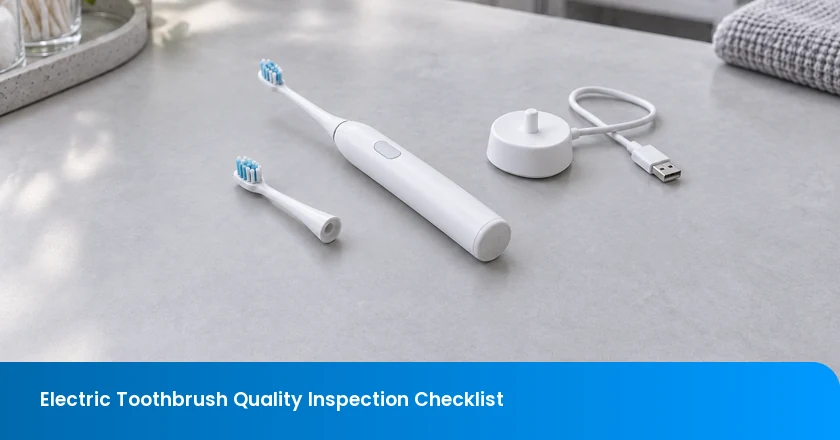
Electric toothbrush quality inspection should check the complete kit: charging, brush-head retention, water-resistance evidence and battery performance. Match each result to the supplied handle, head, charger and construction revision. A charging light cannot establish battery runtime, and a waterproof label cannot establish that a report covers the seals actually shipped. Agree the methods and acceptance criteria before the visit so incomplete evidence remains visible in the shipment decision.
Decisions to Set Before Sampling
- Define the complete handle, head and power-supply combination that each result must cover.
- Separate checks witnessed during the visit from claims requiring longer observation or laboratory evidence.
- Assign the technical owner who will resolve changed components, report mismatches and missing acceptance criteria.
Identify the Toothbrush, Charger and Applicable Requirements
IEC 60335-2-52:2021 addresses the safety of household and similar oral hygiene appliances, including toothbrushes. Its scope includes battery-operated appliances. The public summary identifies relevant product coverage; it does not provide all test methods or establish which national requirements apply to your destination.
As of September 15, 2026, the IEC oral-hygiene amendment preview is a pre-release Final Draft International Standard, not a final published amendment. Ask the responsible technical owner to confirm the applicable published edition and destination requirements before putting a standard number into the acceptance specification.
Start with the product being purchased. A rechargeable handle with a mains-powered base, a USB-powered charging stand and a replaceable-battery brush need different inspection arrangements. Identify whether the adapter is supplied or specified separately. Include every configuration claimed on the packaging rather than assuming that an electrically similar accessory is interchangeable. Safety documentation and routine factory checks then have a defined object to assess.
Prepare a Matched Sample and Document Set
Match the handle revision, brush head, charging equipment, battery and seal construction to controlled references. Supply an approved sample plus drawings or component identifiers that reveal changes the sample alone cannot show. A visually unchanged handle may contain a different cell, drive coupling or base seal.
The inspection brief should identify the purchase order, quantities by configuration, approved artwork and instructions, functional settings, test methods and acceptance limits. Include the report identifiers and tested specimen descriptions for checks supported by laboratory evidence. Assign someone to answer specification questions during the visit; an inspector should not have to invent a permissible fit tolerance when production differs from the reference.
When selecting an inspection provider, confirm the equipment and time available for the requested toothbrush checks. Identify laboratory work separately so the visit is booked with a feasible scope. For company background relevant to that selection, review TradeAider’s company background.
Electric Toothbrush Inspection Checklist: What to Record
Keep charging, brush-head retention, water-resistance evidence and battery observations as separate results. Record the inspected unit and configuration, the method used and the result against the agreed limit. This prevents an overall “works” comment from concealing an untested claim.
| Check | Record | Follow-up trigger |
|---|---|---|
| Charging | Handle, base, cable and power-source identifiers; initial charge state; indicator sequence; measured result under the approved method. | An unmatched accessory, intermittent connection or result outside the specified charging behavior needs investigation. |
| Brush-head retention | Head compatibility, seating, movement and attachment result; distinguish the replaceable-head connection from the head plate and bristle tufts. | Detachment, damage, abnormal movement or a result outside the agreed construction-specific limit requires a recorded disposition. |
| Water resistance | Claimed enclosure rating, report and specimen identity, current seal revision, test conditions and required post-test assessment. | Missing report coverage or a changed sealing interface needs technical assessment, even when the unit looks intact. |
| Battery | Chemistry and cell or pack identity; applicable safety evidence; charge preparation, operating mode and duration for performance checks. | A different battery, unexplained shutdown or insufficient runtime evidence needs separate follow-up from cosmetic findings. |
Record sample selection by configuration and carton location, including any replacement head assortment. This helps distinguish a recurring assembly issue from a mismatch confined to one accessory variant.
Add the unit’s external condition, labeling, accessories and packaging to the same inspection record. Check that the selected brushing modes, timer or pressure indication behave as specified, where fitted. Keep photographs connected to the relevant sample and finding, especially when a defect appears only while the brush is operating.
Agree how an observed defect differs from a check that could not be completed. An unavailable instrument or missing specification is a coverage gap, not a passing test. Define the reporting categories before sampling and use the product-specific limits alongside inspection-standard guidance.
Charging Checks: Test the Supplied Combination
Assess charging with the supplied compatible handle, base, cable and power source under the approved conditions. A factory demonstration using another stand may show that the handle can receive power, but it leaves the actual retail charging combination unverified.
First compare ratings, connectors and component identifiers with the specification. Where the adapter is excluded from the sale, use the documented compatible supply and confirm that the consumer instructions identify it accurately. Photograph the test combination. Substituting a convenient bench supply without recording it makes an apparently successful result difficult to interpret.
Follow the defined preparation for the battery’s starting charge state. Observe how the handle seats on the base, whether charging remains stable in its normal position and whether the indicator changes as specified. For contact-based systems, inspect accessible contact alignment and condition; for contactless systems, assess positioning and the defined charging response. Do not assume the same contact checks apply to both designs.
An illuminated symbol is only an indicator observation. If charging time, charging input or recovery from the specified low-charge state is an acceptance item, arrange the appropriate equipment, preparation and observation period. Record the method and actual result. If the visit cannot accommodate the complete charging interval, describe the portion observed and schedule the remaining verification rather than reporting a full charge test.
During operation after charging, check the selected modes, controls and shutdown behavior against the approved instructions. Unexpected heat, odor, deformation or unstable operation should trigger the agreed stop-and-escalate procedure. Repeatedly reconnecting an abnormal unit to obtain a successful indicator sequence does not resolve the underlying finding.
Brush-Head Retention: Check the Connection and the Head Itself
ISO 20127:2025 specifies physical-property requirements and tests for powered toothbrushes. Its public abstract makes brush head plate retention conditional on a construction whose head portion can detach from the brush shaft. That description should not be converted into a universal pull-force limit for the entire replacement head’s connection to the handle.
Identify the attachment you are checking: head to handle, head plate to shaft, or bristle tuft to head. These are distinct interfaces. Specify the relevant fixture, loading direction, conditioning and acceptance criterion for any measured retention test. Manual fitting can reveal obvious looseness or damage, but it does not produce a quantified retention result.
A visible gap is not automatically a defect. Philips’ Sonicare support guidance explains that a small head-to-handle gap is normal and needed for movement and vibration on the models covered by that page. This is model-specific guidance, not a gap dimension or an acceptance rule for every brand.
Compare seating and clearance with the approved construction. Run the fitted head under the specified conditions and record abnormal movement, rubbing, rattling or detachment. Check replacement heads from the supplied assortment, since a handle can fit its demonstration head yet mismatch another included head. If removal and refitting cycles are required, agree their number and method rather than choosing a convenient repetition count on site.
Pre-shipment inspection (PSI) requires the order quantity to be 100% complete and at least 80% packed for export. These are TradeAider’s readiness conditions; the packing threshold does not describe production completion. Confirm fixtures and time for the requested head checks when arranging the pre-shipment inspection service.
Water Resistance: Match the Report to the Actual Seals
IEC 60529 classifies the degrees of protection provided by electrical equipment enclosures. To assess a toothbrush’s claimed protection, obtain the report identifying the relevant assembly and test conditions. A general “waterproof” label does not show which construction was tested or whether the shipped seal matches it.
Map the reported specimen to the handle revision, sealing materials and relevant interfaces, including the drive-shaft exit, button area and base closure where applicable. The seal works as part of an assembled interface. A material substitution, changed geometry or different assembly process can therefore create a report-applicability question even if the outer housing and model name stay the same.
Ask the technical owner to resolve differences between the report and production drawings. The inspection can document visible construction and approved accessible checks; it should not infer unseen seal performance from an undamaged exterior. Destructive examination needs an agreed sample and disposition plan because opening a handle may invalidate subsequent water-resistance testing of that unit.
For any specified water-exposure test, arrange the complete approved method, equipment, specimen preparation and post-test assessment. A quick rinse is not a substitute for the required test. Treat the handle and charger as separate assemblies: evidence for a handle does not authorize immersion of its base or a live charger. Follow the applicable test procedure and electrical isolation controls.
Keep laboratory evidence and routine sampling results distinct in the report. A workmanship sample can show assembly defects in selected units; it cannot establish that a different sealing construction inherits the earlier report. Conversely, a report mismatch alone does not establish that water entered a product. The next action depends on whether the gap is missing applicability evidence or an observed failure.
For agreed workmanship sampling, define the acceptance quality limit (AQL) and inspection level. Those choices support sample selection and defect evaluation; they do not waive a required water-resistance assessment. Calculate the sampling plan with the AQL calculator.
Illustrative Example: A New Seal Behind an Old Model Number
Consider an illustrative importer order of 900 completed toothbrush handles, all packed in finished kits. The buyer needs the specified water-resistance evidence before acceptance. The model name is unchanged, but the production drawing identifies a revised base seal on every handle. The submitted report describes the previous sealing construction, and the document set contains no assessment covering the revision.
In this illustrative batch, all 900 handles share the changed seal. The matching model name does not establish that the earlier report covers their construction. Keep water-resistance acceptance pending for the revised batch while the responsible technical owner or laboratory assesses applicability. The evidence gap concerns the entire identified revision, so there is no documented basis here for releasing an unaffected subset.
The factory supplies the changed drawing, seal material and assembly controls. The responsible laboratory or technical owner determines whether documented applicability is sufficient or additional testing is required. Before the buyer resolves shipment disposition, obtain that assessment or the required results for the current construction, then verify that mass-produced units match the assessed revision. A photograph of the old model label would not close the construction question.
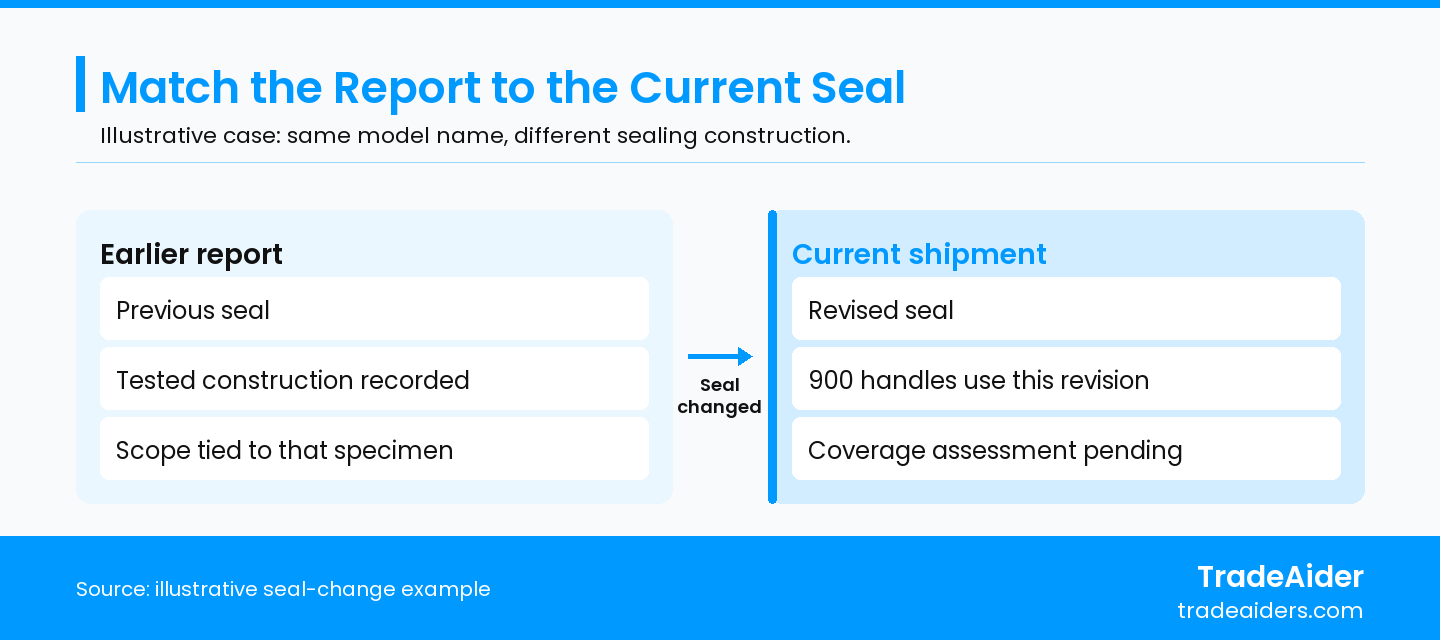
Illustrative construction change. A matching model name does not by itself establish that the earlier report covers the revised seal.
This example describes an evidence gap, not proof that the handles leak. It does not predict the laboratory’s conclusion or guarantee acceptance after testing. The buyer still needs the other agreed inspection results and release conditions satisfied; resolving report coverage addresses only the water-resistance question raised by this change.
Battery Checks: Separate Safety, Charge State and Runtime
IEC 62133-2:2017+AMD1:2021 addresses safety requirements and tests for portable sealed rechargeable lithium cells and batteries. Its scope concerns intended use and reasonably foreseeable misuse. It is not evidence that a toothbrush achieves its advertised runtime, and its lithium scope should not be applied automatically to a different battery chemistry.
Identify the installed cell or pack against the approved component record and supporting documentation. A nominal capacity printed on packaging is a claim to verify, not proof of the component inside. If identification requires opening a handle, agree the teardown sample separately from units reserved for intact-enclosure tests. Record substitutions for technical assessment rather than assuming equal printed ratings establish equivalence.
Define what the performance claim actually means. Runtime depends on the chosen mode, loading, starting charge, operating and rest intervals, and the endpoint used to stop measurement. A claim expressed as days of use also needs a stated use schedule. Without those conditions, two apparently conflicting results may describe different tests rather than different battery quality.
Prepare the selected units using the approved charging procedure, then record performance under the agreed cycle. Include abnormal early shutdown, low-battery indication and restart behavior where specified. A brief operation check establishes only the behavior observed during that interval. It cannot confirm a longer endurance claim, even if the motor sounds normal and the charge indicator remains on.
Keep an incomplete duration test visible. Decide before the visit whether it will be witnessed, continued through an agreed controlled arrangement or covered by suitable existing evidence. The inspection report should identify which evidence was reviewed and which performance was actually measured. If a unit shows leakage, swelling, deformation or other abnormal battery behavior, follow the agreed isolation and escalation procedure; do not continue charging it merely to complete a runtime entry.
Request an Inspection Built Around the Open Decisions
Provide the matched configuration, methods, acceptance criteria and unresolved reports so the provider can confirm feasible factory checks. Include the quantity and packing status, handle and head identifiers, charging equipment, battery details, seal revisions and the exact questions still preventing acceptance.
Ask which checks can be completed on site, which need fixtures or extended observation, and which require separate technical or laboratory work. Agree a report that connects selected samples to functional observations, measurements, construction findings and photographs, with uncompleted items identified. This gives the buyer specific findings to resolve rather than an unsupported assurance that the kit is compliant. Submit the specification and open evidence list for scope confirmation: Contact TradeAider to plan your electric toothbrush inspection.
Frequently Asked Questions
Should separately sold replacement heads be inspected?
Yes. Inspect them against their own specifications and the handles they claim to fit. Include assortment identity, fitting behavior, packaging and the relevant head-construction checks. Compatibility with one demonstration handle does not establish compatibility with every named model. Keep the claimed model list tied to the tested combinations.
Does a connected app need separate checks?
Yes, when connectivity or app features form part of the supplied specification. Define the supported phone environment, app and firmware versions, pairing process and functions to verify. Record those versions with the result. A successful pairing check does not by itself assess cybersecurity, privacy or the accuracy of health-related claims.
Can a used test brush head go back into a retail kit?
Only if the approved hygiene and disposition rules allow it. Establish handling and segregation before testing, especially for heads exposed to test media, contamination or destructive checks. Keep unsuitable heads out of saleable kits and document replacement accessories. Do not improvise a cleaning step and assume it restores retail suitability.
How do checks change for replaceable-battery toothbrushes?
Replace charging-base checks with the applicable battery-compartment, polarity, closure and power checks. Verify the specified battery type and supplied or excluded accessories. Evaluate compartment sealing where relevant to the claimed enclosure protection. Do not assume that a replaceable-battery model uses rechargeable lithium cells or needs the same supporting battery report.
Related Articles
Grow your business with TradeAider Service
Click the button below to directly enter the TradeAider Service System. The simple steps from booking and payment to receiving reports are easy to operate.

