

For EU-bound food-contact kitchenware, the most useful factory control is a document-to-lot handoff: it compares the selected material, intended use, controlled evidence, and shipment identifiers. It does not prove a migration result, validate a declaration, clear customs, or decide legal conformity. Its practical value is earlier: it makes a missing link visible before the buyer releases an export lot.
That distinction matters for reusable bowls, cups, utensils, storage products, and similar China-sourced goods. A document may be genuine yet belong to another material, colour, supplier run, or intended-use condition. A sound inspection brief therefore asks what can be observed at the factory, names the owner of the remaining technical decision, and gives the buyer a specific hold trigger.
Classify the Material and Intended Food Use Before You Request Documents
The European Commission states that all food-contact materials placed on the European market must comply with Regulation (EC) No 1935/2004, GMP, and applicable material-specific or national rules. A food contact material is a material or article intended to touch food during production, storage, preparation, or serving. The European Commission’s food-contact-materials overview is the starting point for that framework.
Begin with a controlled product identity, not a generic “food grade” statement. Record the base material, product code, colour or additive variant, supplier, and intended contact conditions. Is the item for cold storage, hot filling, microwave reheating, repeated use, acidic food, fatty food, or another specified condition? The answer determines which evidence may be relevant; it also prevents a plastic-document request from being applied automatically to every kitchenware product.
- Classify the actual material and article, including each materially different colour or component.
- State the intended food-contact conditions supplied by the responsible product owner.
- Keep the approved version and any supplier change record in the same index.
- Escalate material-scope or legal questions to the responsible technical or regulatory owner.
Build One Document Index for the Product Version and Intended Use
A controlled document index should link each kitchenware version to its intended use, relevant DoC, supporting migration evidence, supplier change record, and physical-lot reference without claiming that the index itself proves compliance. Good manufacturing practice rules require documented quality-assurance and quality-control systems, together with appropriate records. Commission Regulation (EC) No 2023/2006 provides that recordkeeping boundary.
Give each row a product code, revision date, material or resin reference where supplied, colour or masterbatch reference where relevant, intended-use statement, DoC reference, migration-report reference, supplier batch, and carton range. Add a named owner for the technical document, the supplier change record, and the buyer’s release decision. A row should be marked “open” when a reference is unavailable or its scope has not been confirmed; it should never be marked “pass” merely because a PDF was received.
Before production repeats an unresolved version change, a Pre-Production Inspection service can compare selected samples and supplied references early. It records the observable match or mismatch and leaves material scope, testing, and legal decisions with their accountable owners.
Read the Declaration of Compliance as a Supply-Chain Record
For plastic food-contact materials and articles at non-retail stages, a written declaration must be available and permit easy identification of the material or article; it must be renewed when substantial composition or production changes affect migration or when new scientific data becomes available. A Declaration of Compliance (DoC) is that written supply-chain record for applicable plastic food-contact materials and articles. Article 15 of Regulation (EU) No 10/2011 sets out that supply-chain requirement.
At the factory, do not ask an inspector to validate the declaration. Ask for its controlled reference, issuer, date, product-version link, and any stated conditions that the buyer’s technical owner needs to review. A DoC reference that cannot be tied to the selected product version is an evidence gap, not a substitute for a decision.
Match Migration Evidence to the Intended Contact Conditions
Migration evidence is meaningful only when the tested material, food simulant or food type, and time-temperature conditions are relevant to the worst foreseeable intended use of the kitchenware. Migration is the transfer of substances from a material or article into food or a test food simulant. Annex V of the current consolidated Regulation (EU) No 10/2011 describes testing under those use conditions.
Compare the report scope with the product version and intended-use statement; do not compare a numerical result with a carton label and call that verification. The report’s technical review belongs to the accountable laboratory or product-compliance owner. A factory visit can record whether the supplied report reference is the one listed for the selected product and lot.
When the decision needs a method and result rather than a physical comparison, use the appropriate product testing services. Keep the issued report reference in the index, but do not infer its result from a packing list or a visual check.
Use an On-Site Check to Link Documents to the Physical Lot
An on-site inspection can record selected material markings, product version, packaging, carton, and lot correspondence against a controlled document index, but it cannot reproduce a migration analysis or decide legal conformity. An EU food contact kitchenware inspection preserves a mismatch for the owner who can decide it.
Build the request as a comparison, not an assurance statement. Supply the inspector with the exact product codes, version references, expected markings, pack artwork, carton labels, supplier lot record, and photo points. If the shipment has multiple colours or factories, say whether each is a separate evidence line. TradeAider can scope those observable checks and report the selected findings; the buyer and designated technical owners retain their separate release and evidence decisions.
| Evidence lane | What an on-site check can record | What it cannot determine | Accountable owner |
|---|---|---|---|
| Material and intended use | Selected mark, product code, version cue, supplied use statement | Whether the classification is legally or technically sufficient | Product or regulatory owner |
| DoC | Listed reference, date, issuer, product-version link | Validity or completeness of the declaration | Responsible business operator |
| Migration evidence | Report reference matched to the index | Method suitability or migration conclusion | Laboratory or technical owner |
| Supplier lot and cartons | Lot sheet, carton range, packing, selected-unit photos | EU market-placement approval | Buyer release owner |
The practical conclusion is simple: record a missing or mismatched link as a hold for the named owner. Do not convert an observation into a laboratory, customs, or conformity result.
Apply the China/Hong Kong Import Rule Only When Its Scope Fits
Polyamide and melamine plastic kitchenware originating in or consigned from China or Hong Kong has a specific EU import process that requires a consignment declaration and accompanying laboratory report for the stated analyses. Regulation (EU) No 284/2011 defines those conditions.
Do not extend that rule to all kitchenware, all plastics, or every China shipment. First confirm material, article, origin or consignment facts, and the current import process with the competent authority or responsible import owner. An on-site check may record the relevant product, carton, and document references; it cannot decide customs treatment or whether the rule applies.
Make Supplier Batch, Product Version, and Export Carton Records Retrievable
A traceable release record lets the buyer retrieve a supplier batch, product version, and export-carton range from the same evidence chain. Article 17 of Regulation (EC) No 1935/2004 requires traceability at all stages to facilitate control, withdrawal, consumer information, and allocation of responsibility. The framework Regulation provides the legal traceability boundary.
For an inspection brief, choose retrieval points that exist in the factory record: supplier batch or production run, material or colour version, product code, packing date, carton range, and shipment reference. The same identifier does not need to appear everywhere, but the records must form a retrievable chain. When a colour masterbatch, resin grade, mould, label, or pack artwork changes, create a new change record and decide which lots it affects before final packing mixes the evidence.
Set a Hold Rule for the Pre-Shipment Inspection
A pre-shipment inspection can record selected finished-goods and packing evidence against the controlled kitchenware document index, while migration conclusions, legal assessment, and customs decisions remain outside the inspection result. A PSI is a finished-goods check before export. A PSI is conducted when 100% of the order quantity is completed and at least 80% is packed for export.
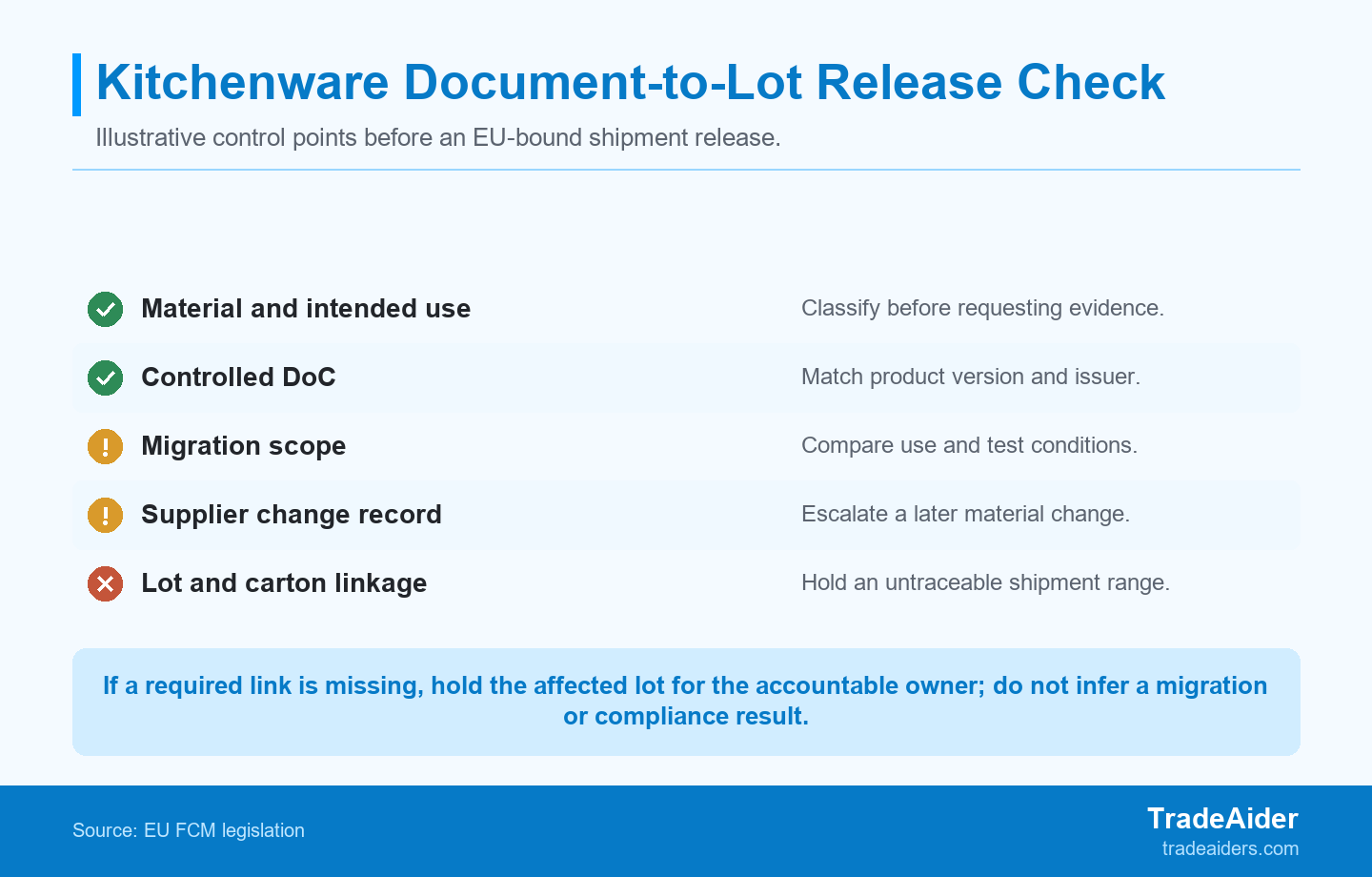
Use the scorecard to detect a missing document-to-lot link before shipment; it is not a laboratory or legal compliance result.
Send the buyer-controlled index before the visit, then define the sampling basis, selected product codes, expected markings, carton ranges, photo requirements, and escalation contact. A hold should be triggered when the product version cannot be tied to its document row, a material or colour change lacks a controlled reference, a report scope is unresolved, or the supplier cannot separate the affected cartons. TradeAider’s Pre-Shipment Inspection service can document those physical findings against the supplied scope.
Illustrative Scenario: A Color Change Without a Matching Evidence Record
A missing record after a material or color change should expand a hold to the untraceable lot rather than be closed with a visual similarity judgment. The following composite shows an evidence gap and a recheck path; it is not a client case or a migration outcome.
Situation, Problem, Action, and Result
The illustrative lot hold documents an evidence gap and recheck path without making a migration, compliance, or customs conclusion.
Situation. A private-label importer is preparing China-sourced reusable plastic bowls for EU distribution.
Order context. The order contains two bowl colours across 120 export cartons, with one controlled DoC and migration-report reference set.
Readiness state. Finished goods are complete and export-packed for the buyer’s shipment release decision.
Observation one. The factory lot sheet separates the blue and sand-colour production runs and identifies the carton ranges assigned to each.
Observation two. The sand-colour run uses a later colour-masterbatch record, but the supplied index has no matching revised DoC or migration-report reference.
Problem. The inspector can record the later physical version and the missing document link. The inspector cannot infer whether migration remains within limits or whether the product is legally compliant.
Action. The buyer holds the 48-carton sand-colour subset. If the supplier cannot distinguish that run from the remaining cartons, the hold expands to the full 120-carton lot.
The supplier provides controlled change records, while the responsible owner confirms which evidence references apply to the changed version before a targeted recheck.
Result. The recheck compares colour, material mark, product code, carton range, supplier lot record, and the approved document index. It produces a bounded physical evidence record only.
Illustrative only. This is not a client case, migration result, legal conclusion, customs clearance, or market-approval outcome.
Request a Food-Contact Kitchenware Inspection Scope
A comparable kitchenware inspection request identifies the material and intended use, controlled DoC and report references, lot plan, selected physical checks, and hold conditions before the visit. This allows the factory report to show what was compared, what was missing, and who needs to decide the next step.
Attach the product code and approved version; intended-use statement; document-index row; report and DoC references; supplier batch and carton plan; sampling instructions; required photos; and a clear hold-and-escalation contact. Use inspection standard guidance to define observable criteria. For a China-side document-to-lot check, request a kitchenware inspection quote.
Who Is TradeAider?
TradeAider is a quality inspection, testing, and certification service provider in China, with coverage across Guangdong, Zhejiang, Jiangsu, Shandong, and Fujian. Its nationwide network of quality control specialists provides real-time reporting for scoped quality-control work.
Inspection & QA Services are offered at an all-inclusive rate of $199/man-day. TradeAider is an Amazon Service Provider Network (SPN) partner.
Frequently Asked Questions
The FAQ keeps material classification, migration evidence, physical inspection, and import decisions in separate accountable lanes.
Does Every Kitchenware Product Need a Plastic DoC?
No, a plastic DoC is the specific supply-chain document for applicable plastic food-contact materials and articles, so material and intended use must be classified first. Other kitchenware materials may follow different Union or national requirements. Do not treat a broad “food grade” claim as a document decision. The responsible technical or regulatory owner should identify the applicable evidence for the actual material, product version, and intended contact conditions.
Can a Factory Inspection Validate a Migration Report?
No, a factory inspection can compare a report reference with the selected product and lot, but it cannot validate the laboratory method, test conditions, or migration conclusion. A useful brief asks the inspector to record the physical version, marking, pack, and lot evidence connected to the report reference. The laboratory and responsible technical owner retain the decision on whether the report applies to the intended use.
What Extra Records Apply to China or Hong Kong Melamine Kitchenware?
If the product falls within Regulation (EU) No 284/2011, each consignment needs the specified declaration and laboratory report for the relevant analysis. That rule is scope-specific: confirm the material, article, origin or consignment facts, and current entry process rather than applying it across all kitchenware. A factory record can preserve the selected carton and document references, but it cannot make a customs or import-admissibility decision.
What Should a Food-Contact Kitchenware PSI Compare?
A food-contact kitchenware PSI should compare selected product, mark, packing, carton, and supplier-lot evidence against the controlled document index supplied for the visit. It should also state the sample basis, photo requirements, product-version references, and hold triggers. The resulting report can show whether a physical lot is linked to the buyer’s records; it does not replace testing, certify a DoC, or approve EU market placement.
Related Articles

Grow your business with TradeAider Service
Click the button below to directly enter the TradeAider Service System. The simple steps from booking and payment to receiving reports are easy to operate.

