
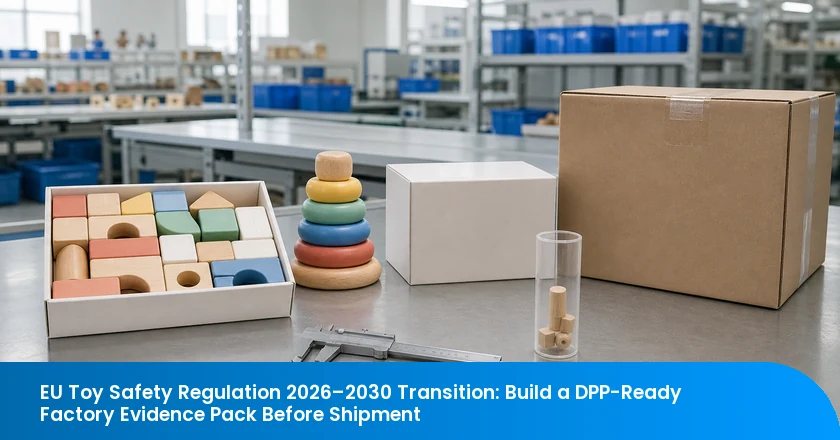
A DPP-ready factory evidence pack is a controlled set of product, packaging, scan-marker, and lot references that helps a buyer compare what ships from China with the approved toy version. It is not the passport itself, a conformity assessment, or a legal conclusion. Its job is narrower and valuable: make the physical record retrievable when the accountable manufacturer, importer, or seller needs it.
The EU Toy Safety Regulation transition creates time to establish that discipline before the general application date. The most durable preparation is not a late QR-code change. It is a repeatable handoff from an approved toy identity to the export lot, with named owners for everything a factory inspection cannot decide.
The 2026–2030 Transition: What Needs a Factory Evidence Plan
The Toy Safety Regulation entered into force on 1 January 2026 and will generally apply from 1 August 2030 after a four-and-a-half-year transition period. A Digital Product Passport is a digital record that the manufacturer creates for the toy before it is placed on the EU market. The European Commission's toy-safety overview sets out those dates and explains that the Regulation will replace the Toy Safety Directive.
- Name the manufacturer and buyer release owner for each controlled toy version.
- Connect approved artwork, warnings, scan-marker reference, and carton range before final packing.
- Use a physical check to document a match or mismatch, not to make a DPP or legal conclusion.
- Escalate testing, technical-file, and final online-offer decisions to their accountable owner.
For a China-sourced toy, the transition is an opportunity to decide which files are controlled, who may change them, and how an export lot is tied back to the approved version. That preparation supports an accountable DPP process later; it does not accelerate the legal application date for a particular product. Keep the date plan and the factory plan separate, then connect them through version control.
Build the Evidence Backbone Before the DPP Is Due
A DPP-ready factory evidence pack should connect approved toy identity, artwork, warnings, document references, data-carrier reference, and lot evidence without calling that pack a conformity conclusion. The passport and the factory record serve different jobs: the first is the manufacturer's market-placement record, while the second records a bounded physical observation.
Use one reference index for the model code, approved retail-pack artwork, warning panel, instruction revision, persistent unique product identifier, data-carrier artwork or payload reference, and carton or lot code. A data carrier is the machine-readable marker or link that connects the toy to its passport. The useful factory question is therefore: “Does this selected physical item match the controlled reference?” The residual question—whether that reference is sufficient for the DPP or EU requirements—belongs to its accountable owner.
Keep the Safety Assessment and Technical File With Their Accountable Owner
Before placing a toy on the market, manufacturers must carry out a safety assessment and prepare technical documentation demonstrating compliance with the regulation. EUR-Lex's official summary also describes the technical-documentation and passport duties. A factory can confirm that the inspected pack bears a specified reference, but it cannot decide whether a safety assessment is complete, whether test evidence is adequate, or whether the technical file supports the intended market placement. Put the document owner and escalation route in the evidence index, rather than asking an inspector to make that determination.
Treat the Data Carrier as a Traceability Handoff, Not a Label Fix
The DPP must be connected through a data carrier to a persistent unique product identifier. Regulation (EU) 2025/2509 makes the manufacturer responsible for creating the passport before placing the toy on the market. In an inspection brief, define what can be observed: placement, legibility, the approved carrier version, model identifier, and the carton range carrying it. Record the supplied payload or destination separately from the legal DPP record, and retain a dated photo of the selected marker where the brief requires it. Do not use a successful scan or a registration reference as proof that the DPP is complete or that the product conforms.
Who Owns the DPP, Product File, Online Offer, and Physical Lot?
A factory evidence check can supply bounded physical records, but DPP creation and the compliance responsibility that accompanies it remain with the manufacturer. The cleanest brief names both the evidence surface and its decision owner, so an observed mismatch produces a specific hold or escalation rather than an unsupported pass/fail statement.
When a China-side comparison is required, TradeAider can scope the observable product, pack, carrier, and carton checks against buyer-controlled references. The resulting report should preserve the observed facts and the hold trigger, while the manufacturer and other responsible owners retain their separate regulatory decisions.
| Evidence surface | Factory-side record | What it does not decide | Accountable owner |
|---|---|---|---|
| Toy identity and pack artwork | Model, warning, artwork, and photo comparison | Legal sufficiency of the content | Manufacturer / product owner |
| DPP and data carrier | Carrier version and identifier match | DPP creation, registration, or completeness | Manufacturer |
| Technical and test evidence | Reference number present in the supplied pack | Safety-assessment or laboratory conclusion | Qualified technical owner |
| Export lot | Carton range, lot code, selected-unit evidence | EU market-placement approval | Buyer release owner |
Keep the Online Offer Linked to the Approved Evidence
Where products are placed on the EU market through distance selling, online marketplaces need to make DPPs accessible, while required warnings must be visible in online offers. The Commission's economic-operators guidance explains the accessibility expectation for in-scope products in distance selling, and the official toy-regulation summary addresses warnings in online offers. A factory visit can compare approved listing inputs with a physical pack, but the seller or marketplace workflow must check the final online offer after publication. Keep screenshots, publication dates, and final listing responsibility in that workflow rather than in the factory report.
Freeze High-Risk Evidence Before Tooling and Artwork Spread
Version-controlled artwork and product-reference checks are most effective before a repeatable printed or moulded mismatch spreads across finished toy lots. Start with the product identity, age grading, warning and instruction revisions, packaging layout, and the data-carrier reference. Assign a change owner and forbid informal substitutions: a new QR artwork, a revised warning panel, or a new model code should generate a new controlled reference.
A Pre-Production Inspection service can focus on the physical sample, approved references, and early packaging or material cues before production expands the risk. The service record should state the observed evidence and any open point; it should not state that the toy is legally ready for the EU market.
Route Chemical and Test Questions to Qualified Evidence Owners
A physical inspection should not be represented as the laboratory, technical, or legal evidence needed for chemical and safety-assessment decisions. If a specification, material, or age-related risk requires a method and a result, send that question to the qualified technical owner and the relevant test process. TradeAider's product testing services can be considered where the decision needs testing rather than visual comparison. Preserve the test-report reference in the control index, but do not infer a result from its presence on a packing list. Where a new component or supplier is introduced, identify the affected toy version and route the technical review before the change spreads across the lot.
Use a PSI to Confirm the Shipped Lot Matches the Controlled Pack
A PSI can document selected physical matches to a controlled evidence pack, but it cannot certify that a DPP, technical file, or conformity decision satisfies EU law. A pre-shipment inspection (PSI) checks finished goods before export. A PSI is conducted when 100% of the order quantity is completed and at least 80% is packed for export.
For this use case, the brief should identify the order and carton range; the sample basis; the approved model, artwork, warning, carrier, and identifier references; the locations to observe; and the hold trigger. A lot linkage is the record connecting a shipment lot to those controlled product and packaging references. Record what was sampled, what matched, what did not, and which cartons are affected. When recurring production evidence needs intervention before final packing, a During Production Inspection service moves that check earlier. For the final lot, a Pre-Shipment Inspection service can provide the bounded physical record.
Illustrative Scenario: A Data Carrier Linked to an Older Toy Version
A data-carrier version mismatch can be isolated and rechecked without representing the recheck as a DPP registration or legal approval. The following composite illustrates a traceable subset, not a client outcome.
Situation, Problem, Action, and Result
The illustrative recheck documents a carrier-version correction without making a DPP or compliance conclusion.
Situation. A private-label importer is preparing a China-sourced educational toy for EU sale.
Order context. The order has three toy variants across 96 export cartons and one controlled product-information pack.
Readiness state. Finished goods are complete and export-packed for a release decision.
Observation one. The controlled pack identifies a current model code, warning panel, and data-carrier reference.
Observation two. A selected carton range carries a data carrier that points to an older toy-version reference.
The inspector can record the physical mismatch and carton range, but cannot determine whether the DPP has been created, registered, or legally complete.
Action. The buyer holds the 24 affected cartons, requests a controlled replacement, and retains the carton references for a targeted recheck. The unaffected, traceable carton range remains a separate release decision for the buyer.
The factory replaces the affected carrier labels and segregates the 24 cartons until the recheck is completed.
Result. The recheck compares the corrected carrier, model code, warning panel, retail pack, and carton references with the approved evidence pack. It creates a physical correction record only.
Illustrative only. This is not a client case, DPP registration, laboratory result, legal determination, or market-approval outcome.
A Practical 2026–2030 Toy Evidence Roadmap
The Commission announced a live DPP Registry and testing environment in July 2026, while product-specific toy obligations apply on their own legal transition timeline. The Commission's registry announcement says the registry supports product groups covered by separate legislation requiring DPP registration, including toys. Its toy-safety transition overview confirms the Regulation's general application from 1 August 2030.
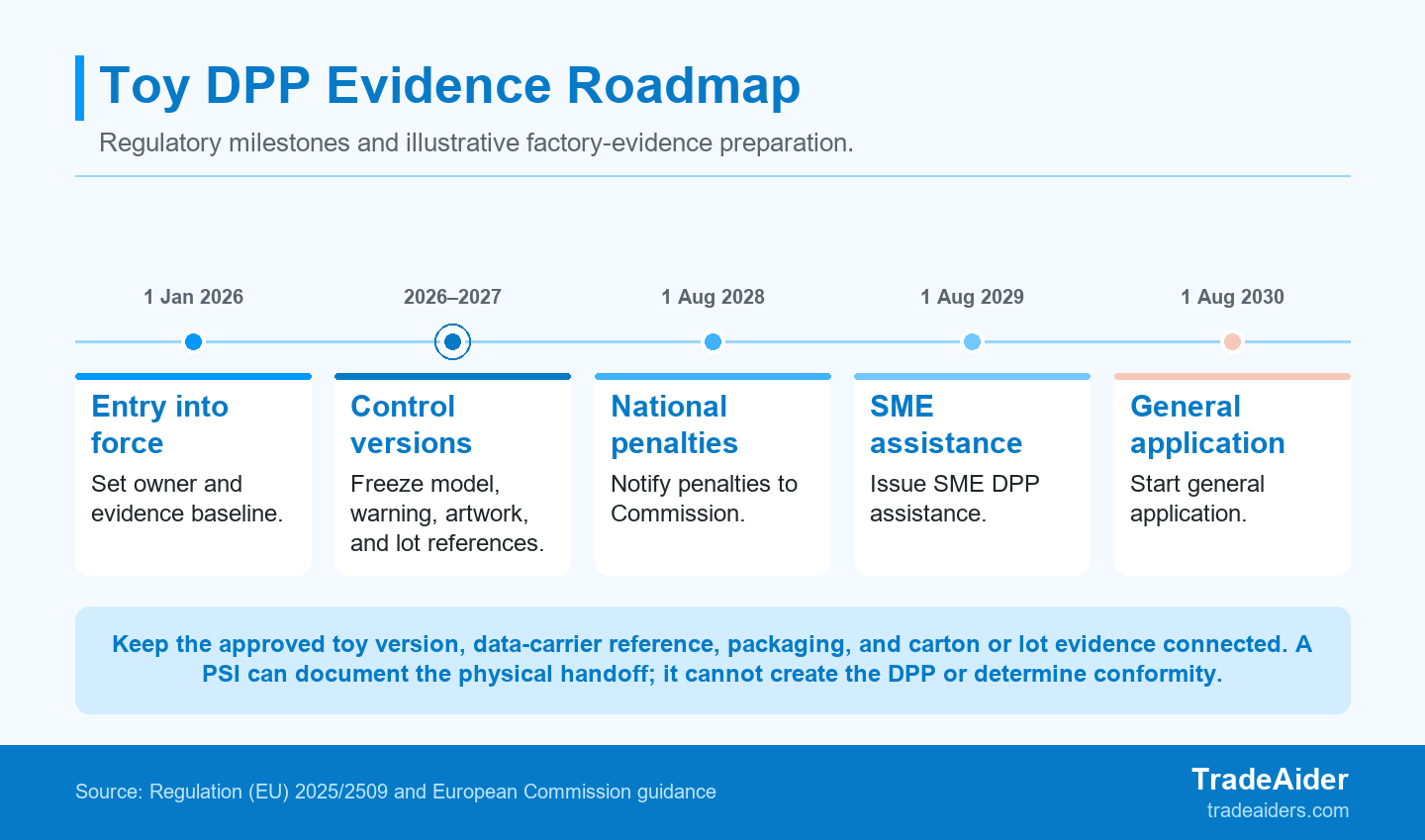
Use the timeline to establish controlled toy versions, evidence owners, and lot linkage during the transition period; it is not a product-specific compliance schedule.
The official dates below are regulatory milestones. The 2026–2027 control steps are an illustrative operational plan: establish a product-reference register, give each change an owner, retain approved carrier artwork, and make carton or lot linkage retrievable. Review the plan whenever a toy version, warning, supplier process, or product-information reference changes.
Request a DPP-Ready Toy Inspection Scope
A comparable DPP-ready inspection scope starts with the same controlled evidence pack and explicit physical hold triggers for every provider. Before requesting a quote, provide the order reference, factory location, selected sample basis, model and artwork revisions, warnings, data-carrier reference, identifier rule, carton or lot linkage, and the exact mismatch that should trigger a hold.
Use inspection standard guidance to make observable acceptance criteria explicit. If you need a China-side physical comparison and report, you can request a DPP-ready toy inspection quote with the controlled evidence pack attached. The scope should document what can be checked at the factory and clearly retain all DPP, technical, testing, and legal decisions with their accountable owner.
Who Is TradeAider?
TradeAider is a quality inspection, testing, and certification service provider in China, with coverage across Guangdong, Zhejiang, Jiangsu, Shandong, and Fujian. Its nationwide network of quality control specialists provides real-time reporting for scoped quality-control work.
Inspection & QA Services are offered at an all-inclusive rate of $199/man-day. TradeAider is an Amazon Service Provider Network (SPN) partner.
Frequently Asked Questions
The FAQ resolves the remaining DPP-transition scope questions without changing the article's boundary.
When Does the EU Toy Safety Regulation Apply?
The Regulation entered into force on 1 January 2026 and its general application begins on 1 August 2030, subject to its transitional provisions. Use the transition period to control product and packaging versions, but do not treat an internal factory roadmap as a product-specific legal deadline. The Commission's toy-safety materials are the starting point for the official timeline; category-specific questions should be reviewed by the responsible regulatory owner.
Does a Factory Inspection Create the Toy DPP?
No, a factory inspection can document selected physical evidence but cannot create the passport or assume the manufacturer's compliance responsibility. It can compare the supplied carrier reference, identifier, packaging, warnings, and lot evidence with selected finished goods. The manufacturer remains responsible for creating the DPP before placing the toy on the market, while the inspection report records only what was physically observed and compared.
What Can a China PSI Check for a DPP-Ready Toy Shipment?
A China PSI can check selected finished goods, packaging, data-carrier, identifier, and lot-linkage evidence against controlled references supplied for the inspection. The brief can also define sampling, photo requirements, carton references, and hold triggers. It cannot decide DPP completeness, validate the technical file, produce a laboratory conclusion, or approve a toy for EU market placement. Those boundaries should appear in the report and the buyer's release decision.
Do Online Toy Offers Need to Show DPP Information?
Online offers for products within DPP scope must make the passport accessible to customers through the applicable data carrier or other required means. Required warnings also need appropriate online visibility under the toy-safety framework. A factory comparison can confirm whether a supplied pack matches an approved reference; it cannot confirm what a shopper sees after an offer is published. Assign final online-offer verification to the seller or the marketplace process.

Related Articles
Grow your business with TradeAider Service
Click the button below to directly enter the TradeAider Service System. The simple steps from booking and payment to receiving reports are easy to operate.

