
- About Us

- Our Services
- Your Industry
- Resources
- News & Blog
A factory audit is a structured, independent evaluation of a manufacturer's legal status, quality management systems, production capability, equipment and test instruments, raw material handling, workforce practices, and social compliance — conducted on-site by a qualified third-party auditor against agreed standards such as ISO 9001, with findings documented in a scored report and corrective action plan.
Many importers assume a factory audit is essentially a general factory tour — a visual walkthrough that confirms the facility exists and looks operational. In practice, a professional factory audit is far more systematic. According to World Bank manufacturing data, China leads global manufacturing output by a wide margin, and the depth of that supply ecosystem means a structured audit is the only reliable way to distinguish genuinely capable suppliers from the many factories that present professional fronts without the operational substance to back them up. This article covers exactly what a complete factory audit checklist includes in 2026 — and what it deliberately does not, so buyers understand where audit scope ends and where other quality control tools begin.
Key Takeaways
- Definition: A factory audit evaluates the supplier as an organization — its systems, capability, and compliance — not the finished products. Product quality verification is the role of pre-shipment inspections.
- Framework: The 7-Pillar Factory Audit Framework covers legal legitimacy, quality management systems, production capacity, test equipment, raw material handling, workforce practices, and social compliance.
- Critical distinction: A factory audit does not inspect finished goods, does not certify product compliance with CE or FCC standards, and does not substitute for laboratory testing — each serves a different purpose in a complete QC program.
- Common gaps: Many buyers receive "audit reports" that only cover 2–3 of the 7 pillars. A credible audit must address all 7 to provide meaningful supplier qualification data.
- Pricing: TradeAider offers on-site factory audits at $199/man-day all-inclusive for Inspection & QA Services. A standard manufacturing capability audit typically requires one to two man-days.
Introducing the 7-Pillar Factory Audit Framework
The 7-Pillar Factory Audit Framework organizes the core components of a complete China factory audit into seven structured areas, each addressing a distinct category of supplier risk. The framework aligns with ISO 19011:2018 auditing management systems guidelines and ISO 9001:2015 quality management requirements. A professional third-party audit should cover all 7 pillars; reports that omit one or more pillars leave specific risk categories unaddressed and provide an incomplete qualification basis. Use this framework when evaluating audit report coverage from any provider — if a pillar is missing from the report structure, the audit did not fully cover it.
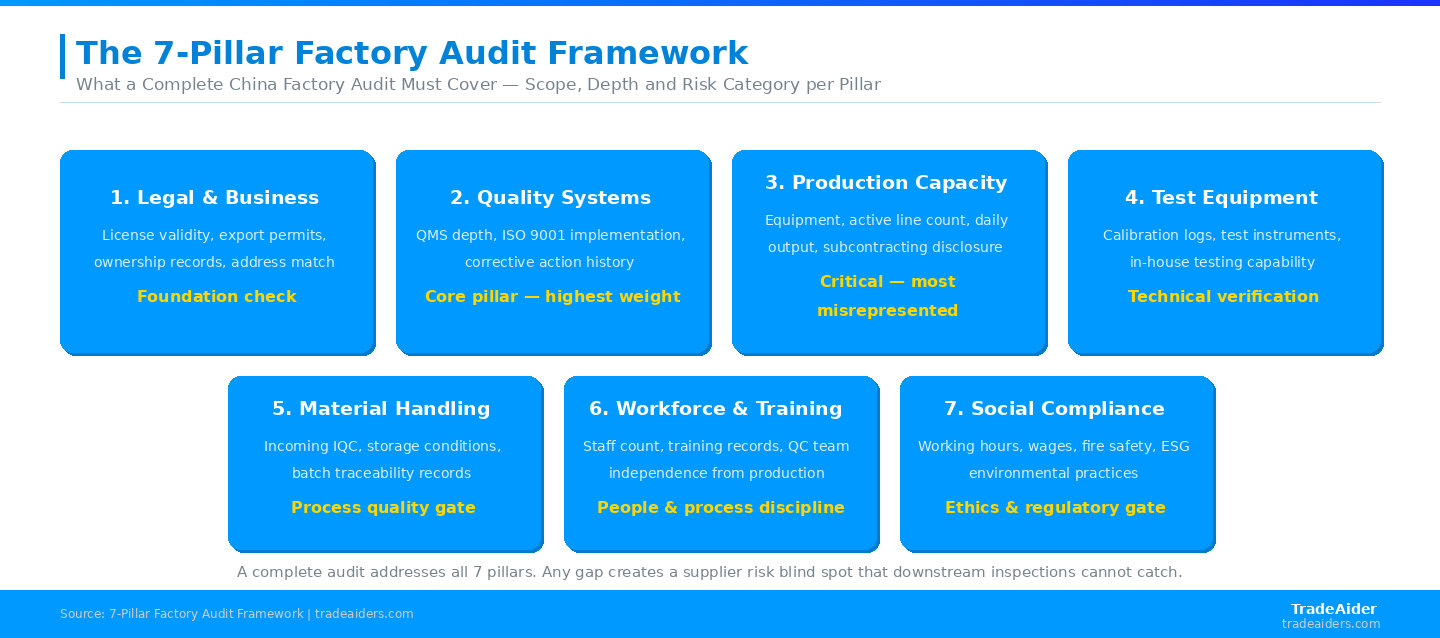 The 7-Pillar Factory Audit Framework: a complete audit covers all pillars — missing any one leaves specific risk categories unaddressed.
Pillar 1 — Legal and Business Legitimacy
The first pillar confirms that the supplier is a legally registered, actively operating manufacturer rather than a trading company, shell entity, or fraudulent listing. Auditors verify the factory's business license (including scope, expiry date, and whether the stated business address matches the audit location), export licenses, ownership structure, and any relevant certifications required for the specific product category. This is the foundation step: before evaluating operational capability, a buyer needs confirmation that they are dealing with a genuine, legally compliant manufacturer. As the U.S. International Trade Administration's China Standards Guide details, Chinese suppliers are subject to mandatory national standards and certification requirements — auditing their legal status confirms they are positioned to meet these obligations.
Pillar 2 — Quality Management System (QMS)
The second pillar evaluates the factory's quality management system against ISO 9001:2015 requirements. This is the most analytically demanding pillar because it examines not just whether a QMS is documented, but whether it is actively implemented on the production floor. Key checkpoints include: whether quality objectives are documented and tracked with measurable targets; whether the quality control department operates with independence from the production department; whether non-conforming products are systematically identified, segregated, and managed; whether corrective action procedures have been followed for past quality issues; and whether the "golden sample" (the approved buyer sample) is securely stored and used consistently in production checkpoints. ISO 9001:2015 Clause 8.4 places direct responsibility on the buyer to verify QMS effectiveness — a certificate from a third-party registrar is a starting point, not evidence of actual implementation.
Pillar 3 — Production Capacity and Capability
The third pillar physically verifies the factory's production capacity against its stated claims. Auditors count active production lines and workstations, assess daily output throughput against claimed capacity, verify that the specific production processes required for the buyer's product category are present and operational, check whether any production is outsourced or subcontracted without disclosure, and review production scheduling and order management records. This pillar directly addresses the most common misrepresentation in China supplier qualification: factories claiming capacity or capabilities they do not possess or that belong to a different facility. An on-site auditor walking every production area is the only reliable method for catching this category of discrepancy.
Pillar 4 — Equipment and Test Instruments
The fourth pillar assesses the technical adequacy of the factory's production equipment and in-house quality testing instruments. Auditors verify that critical equipment is properly maintained through calibration logs and maintenance records, that the factory possesses the testing instruments required to verify finished product specifications (e.g., tensile testers for apparel, electrical safety testers for electronics, dimensional measurement equipment for precision parts), and that those instruments are within calibration date and traceable to national standards. A factory without adequate testing equipment cannot reliably self-certify product quality — auditing this pillar reveals whether the factory has the technical infrastructure to conduct meaningful in-process and final quality checks.
Pillar 5 — Raw Material Handling and Incoming Inspection
The fifth pillar evaluates how the factory controls incoming materials before they enter the production process. Checkpoints include: whether incoming materials are inspected against specifications before acceptance (incoming quality control or IQC procedures); how materials are labeled, stored, and segregated to prevent contamination or mix-up; whether raw material traceability records allow specific batches to be tracked through production to finished goods; and whether the factory maintains approved supplier lists for key raw materials and evaluates those sub-suppliers. Weak incoming material controls are a frequent root cause of product quality failures — a factory may have good production processes but still ship defective goods because non-conforming materials entered the line unchecked.
Pillar 6 — Workforce, Training, and Key Personnel
The sixth pillar examines the human infrastructure of the factory's quality system. Auditors verify the presence of a dedicated quality manager with appropriate authority, review training records for production line staff (typically expecting current training within 12 months for at least 80% of staff), assess whether quality control personnel are incentivized by quality outcomes rather than production volume, and evaluate worker understanding of quality procedures through direct conversations. According to supplier audit guidance from Ramp, the audit closing meeting should include balanced feedback for staff — audits work best as engagement tools, not just as pass/fail assessments. A factory with strong documentation but inadequately trained workers will fail to implement those procedures consistently in production.
Pillar 7 — Social Compliance and Environmental Practices
The seventh pillar addresses ethical labor practices and environmental compliance. Standard checkpoints include working hours (verification against legal limits), wage documentation and timely payment records, worker contracts and freedom of association, fire safety equipment and emergency exit accessibility, hazardous material handling and chemical storage, and basic environmental compliance with waste management and pollution controls. Social compliance requirements are increasingly mandated by importing country regulations (including the U.S. Uyghur Forced Labor Prevention Act for China-sourced goods) and by major retailer supplier codes of conduct. For buyers selling into the U.S. or EU markets, auditing Pillar 7 is not optional — it is a compliance requirement that creates legal and reputational exposure if skipped.
What a Factory Audit Does NOT Cover
Understanding the scope limits of a factory audit is as important as understanding what it covers. Buyers frequently conflate different quality control tools — assuming an audit covers everything or, conversely, that it covers so little that it is not worth conducting. The comparison below clarifies the scope boundaries between factory audits and complementary quality tools.
| Quality Need | Factory Audit Covers? | Correct Tool for This Need |
|---|---|---|
| Verifying finished product specs against order requirements | No | Pre-Shipment Inspection (PSI) |
| Confirming CE, FCC, or ASTM product compliance | No | Accredited Laboratory Testing |
| Catching defects in a specific production run | No | During Production Inspection (DPI) |
| Verifying correct loading into shipping container | No | Container Loading Inspection (CLI) |
| Evaluating factory's overall QMS and capability | Yes — core purpose | Factory Audit (this tool) |
| Confirming legal registration and legitimacy | Yes — Pillar 1 | Factory Audit (this tool) |
| Assessing social compliance and labor practices | Yes — Pillar 7 | Factory Audit + Social Audit |
Based on this comparison, the data shows that factory audits and product inspections are complementary tools with non-overlapping scopes — not alternatives. A complete quality program for China sourcing combines an initial factory audit (to qualify the supplier) with ongoing pre-shipment inspections (to verify individual production runs). Buyers who use only audits have no per-shipment defect verification; buyers who use only PSIs have no supplier-level capability qualification. Knowing the scope of each tool is the starting point for designing an effective QC program. Learn how pre-shipment inspection services work alongside factory audits in a complete quality control framework.
How to Read and Act on a Factory Audit Report
A professional factory audit report should include: a scoring summary for each of the 7 pillars, detailed findings for each non-conformity identified, photographs documenting key observations, a Corrective Action Request (CAR) or Corrective Action Plan (CAP) specifying required improvements, and a recommended re-audit timeline. The overall audit score provides a relative supplier rating — most providers use a percentage or letter grade — but individual pillar scores are more actionable than the overall figure. A factory scoring 85% overall but 40% on QMS is a fundamentally different risk profile than one scoring 85% overall with QMS at 90%. According to supplier quality management research from Deltek, the Cost of Poor Quality stems significantly from supplier-related activities — a supplier with weak QMS scores will generate disproportionate downstream quality costs regardless of their overall audit grade.
When an audit identifies non-conformities, the appropriate response depends on severity. Critical non-conformities — expired licenses, confirmed subcontracting without disclosure, systematic QMS failures, major safety violations — typically warrant placing the supplier on probation, withholding new orders pending corrective action, and scheduling a re-audit within 30–60 days to verify compliance. Minor non-conformities can be addressed through a written corrective action plan with agreed deadlines and documented follow-up. Structured supplier audit evaluation frameworks typically categorize non-conformities by severity and track corrective action status over time, building a longitudinal supplier performance record that is more valuable than any single audit score. Access TradeAider's factory audit service to learn how on-site audits with real-time monitoring combine the 7-Pillar Framework with live buyer oversight during the audit day itself.
Who Is TradeAider?
TradeAider is a quality inspection, testing, and certification service provider in China. TradeAider operates across all of China, covering major manufacturing provinces including Guangdong, Zhejiang, Jiangsu, Shandong and Fujian, etc.
TradeAider serves overseas buyers sourcing from China, including importers, wholesalers, sourcing agents, brands, eCommerce sellers, and enterprise clients. Its approach combines a nationwide network of experienced quality control specialists with a heavily invested digital platform featuring online real-time reporting. Clients can monitor inspections live, communicate directly with inspectors, and address issues during production rather than after shipment — a proactive model focused on problem-solving and prevention, not just defect identification.
Pricing is transparent at $199/man-day all-inclusive for factory audit, Inspection & QA Services, with no hidden surcharges. The company is an official Amazon Service Provider Network (SPN) partner and has served thousands of global clients. Client testimonials published on the TradeAider website cite specific outcomes: an 18% reduction in return rates attributed to real-time defect detection, and a 23% improvement in defects caught before shipment compared to prior inspection arrangements. These are client-reported figures.
Frequently Asked Questions
What does a factory audit checklist include?
A complete factory audit checklist covers seven core areas: legal and business legitimacy (licenses, registration, export permits), quality management system effectiveness (ISO 9001 implementation, QMS documentation, corrective action records), production capacity and capability (equipment, output rates, subcontracting disclosure), test instruments and calibration records, raw material handling and incoming inspection procedures, workforce training and key personnel, and social compliance (working hours, wages, safety systems). Any checklist that covers fewer than these seven areas provides an incomplete picture of the supplier.
Can a factory audit replace a pre-shipment inspection?
No. A factory audit and a pre-shipment inspection serve different purposes and cannot substitute for each other. A factory audit evaluates the supplier's organizational capability — their quality systems, infrastructure, and compliance posture. A pre-shipment inspection verifies the specific finished goods produced for a specific order against agreed specifications. A complete quality program for China sourcing requires both: the audit qualifies the supplier, and the PSI verifies each production run.
What is the 7-Pillar Factory Audit Framework?
The 7-Pillar Factory Audit Framework is a structured audit model covering the seven categories that a complete China factory audit must address: legal legitimacy, quality management systems, production capacity, test equipment, raw material handling, workforce and training, and social compliance. The framework aligns with ISO 9001:2015 and ISO 19011:2018 auditing standards. Using this framework when evaluating audit proposals or reviewing audit reports helps buyers confirm that no significant risk category has been omitted from the assessment scope.
How often should I audit my China suppliers?
Most quality programs audit new suppliers before placing the first significant order, then conduct annual re-audits for all strategic suppliers. High-risk suppliers — those with prior quality issues, significant operational changes, or producing regulated or safety-critical products — should be re-audited every six months. Post-incident re-audits should occur within 30–60 days of any quality failure to verify corrective action implementation. Audit frequency should reflect supplier risk classification, with core suppliers receiving more frequent evaluation than general commodity suppliers.
Need a factory audit covering all 7 pillars? Contact TradeAider to schedule a comprehensive China factory audit at $199/man-day with real-time monitoring and same-day reporting.
Related Articles
Grow your business with TradeAider Service
Click the button below to directly enter the TradeAider Service System. The simple steps from booking and payment to receiving reports are easy to operate.

