
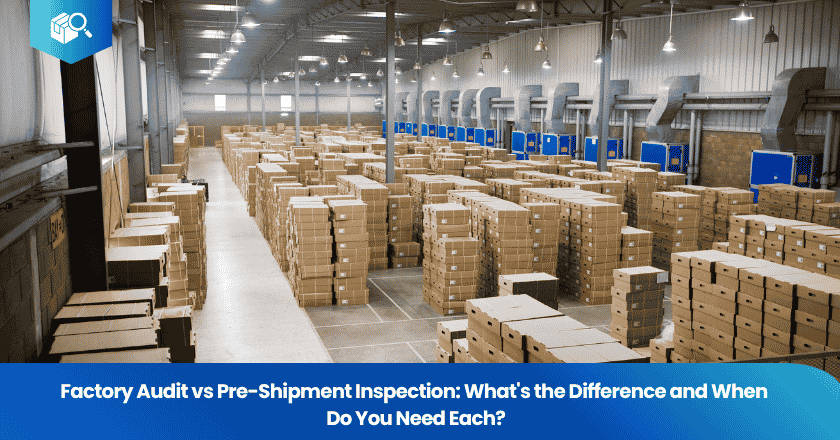
China accounts for approximately 28 percent of global manufacturing value added, according to CSIS ChinaPower's manufacturing tracker — more than the United States, Japan, and Germany combined. For any importer sourcing from that scale of manufacturing capacity, two questions always arise: can this supplier actually produce what they say they can produce, and is this specific shipment actually what I ordered? Factory audits answer the first question. Pre-shipment inspections answer the second. They are distinct tools, used at different stages of the supply chain, and getting them confused — or skipping one when you need both — is one of the most common quality control mistakes importers make.
Key Takeaways
- Definition: A factory audit evaluates a supplier's manufacturing capability, quality systems, and capacity before you place an order. A pre-shipment inspection (PSI) verifies the quality of a specific finished order before it ships.
- Timing: Factory audits happen before sourcing decisions are made. Pre-shipment inspections happen when production is 80–100% complete, before the final payment and shipment.
- What each detects: Audits reveal systemic risks — inadequate equipment, missing quality management systems, social compliance gaps. PSI detects product-level defects in a specific shipment using AQL sampling per ISO 2859-1:2026.
- You often need both: An audit without a PSI tells you the factory can produce good product — not that they did for your order. A PSI without an audit tells you this shipment passes — not whether the factory has the systems to consistently repeat it.
- Cost of skipping either: The U.S. CPSC's 2024 ruling against Amazon establishes platform-level liability for FBA sellers whose defective products reach consumers. Quality due diligence — which requires both supplier qualification and product-level inspection — is no longer optional for importers selling through Amazon or regulated retail channels.
What Is a Factory Audit?
A factory audit is an on-site evaluation of a manufacturing facility conducted by an independent third party to assess the factory's production capability, quality management systems, compliance with labor and safety standards, and capacity to fulfill the buyer's requirements. Unlike product inspection, a factory audit evaluates the supplier as an organization — not the products they have already made.
Factory audits are supplier qualification tools. A well-executed audit answers the questions every importer should ask before placing a first order: Does this factory actually have the machinery and production capacity claimed? Is there a documented quality management system — and is it actually implemented on the factory floor, not just on paper? Are workers trained to the standards described in the factory profile? Can the factory handle the volume, timeline, and product complexity of my order? These are questions a product inspection cannot answer, because product inspection occurs after production has happened. An audit occurs before production begins, when the importer still has the leverage to choose a different supplier.
According to UL Solutions' supplier audit framework, a rigorous factory audit covers quality management system implementation (typically aligned with ISO 9001), production capacity and equipment condition, raw material handling, in-process quality controls, and health and safety practices. The output is a scored audit report with findings, photographs, and corrective action recommendations — a structured basis for the go/no-go sourcing decision.
What Is a Pre-Shipment Inspection?
A pre-shipment inspection (PSI) is an on-site quality control check performed at the factory when production is 80–100% complete and at least 80% of the order is packed for shipment. An independent inspector randomly samples units from the production lot, evaluates them against the buyer's specifications and AQL defect thresholds, and delivers a pass/fail report before final payment is released and goods ship.
A PSI is a product-level verification tool, not a supplier evaluation tool. Its purpose is to confirm that the specific shipment you are about to pay for and accept meets your quality specifications, and that defects — if any — are identified while goods are still at the factory and the supplier still bears the cost of correction. This leverage disappears the moment the container seals. TradeAider's pre-shipment inspection service includes real-time photo and video reporting during the inspection, so buyers can monitor findings as they happen rather than receiving a PDF the following morning when the container may already be loaded.
The Supplier Qualification Framework: How Audits and Inspections Work Together
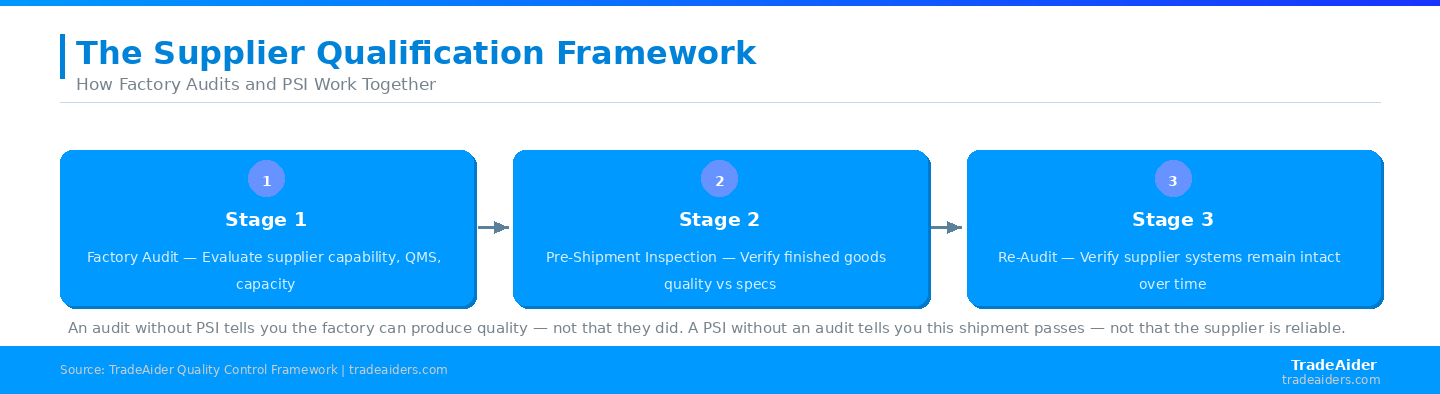 The Supplier Qualification Framework: three stages that together protect quality from sourcing decision to shipment acceptance and ongoing supplier management.
The Supplier Qualification Framework provides a structured way to deploy both tools at the right time. Following the Supplier Qualification Framework prevents the two most common errors: using inspection as a substitute for audit (treating a passed PSI as evidence that the supplier is reliable, rather than that this shipment meets spec), and treating an audit as a substitute for ongoing inspection (using a one-time audit as justification for never inspecting finished goods).
Stage 1 — Supplier Qualification: Factory Audit Before First Order
Before placing the first production order with a new supplier, a factory audit establishes whether the supplier's actual capabilities match their profile. This is due diligence in the literal sense — verifying claims before committing capital. According to Kodiak Hub's supplier quality management research, organizations that implement rigorous supplier qualification audits — including on-site assessments of quality management systems and production capabilities — materially reduce downstream supply chain disruptions and quality failures. The audit report is the baseline against which future performance is measured. A factory that audits poorly on day one but promises improvement rarely delivers it without documented corrective action tracking.
Stage 2 — Order-Level Verification: PSI for Every Significant Shipment
Once a supplier passes qualification, a PSI should be conducted on every significant production order — particularly for first orders with a new supplier, high-value orders, orders with new product specifications, and orders placed during peak production periods when factories run at maximum capacity and quality consistency is hardest to maintain. PSI is conducted when 80% or more of the order is packed, giving the inspector access to the final production output. Defects identified at this stage — before the container seals and before final payment — can be corrected on-site or made the basis for a price renegotiation. Defects discovered after shipment require a much more expensive remediation path.
Stage 3 — Ongoing Supplier Management: Periodic Re-Audit
A factory audit is not a one-time certification. Factories change — management turns over, machinery deteriorates, subcontracting arrangements shift without buyer notification. Periodic re-audits — typically annually for active suppliers, or triggered by a quality failure — maintain the accuracy of the buyer's supplier intelligence. The combination of a current audit baseline and shipment-level PSI data creates a supplier performance record that identifies deteriorating trends before they produce shipment-level failures.
Side-by-Side Comparison: Factory Audit vs Pre-Shipment Inspection
The comparison below summarizes the functional differences between factory audits and pre-shipment inspections. Both are essential components of a complete quality assurance program — they are complements, not substitutes.
| Dimension | Factory Audit | Pre-Shipment Inspection |
|---|---|---|
| What it evaluates | The supplier as an organization (capability, systems, capacity) | A specific finished shipment (product quality, AQL defects, packaging) |
| When it happens | Before placing the first production order; re-audit annually | When 80–100% of production is complete and packed |
| Primary output | Scored audit report with capability rating and corrective actions | Pass/fail inspection report with defect photos and AQL results |
| Decision it informs | Should I source from this factory? | Should I accept and ship this order? |
| Duration | 1–2 man-days depending on audit scope and factory size | 1 man-day for most standard consumer goods orders |
| Pricing (TradeAider) | $199/man-day all-inclusive | $199/man-day all-inclusive |
| Can replace the other? | No — tells you about capability, not this shipment's quality | No — tells you about this shipment, not the supplier's system |
| Amazon SPN fit | Supports supplier qualification for FBA compliance programs | Direct FBA shipment verification; supports ODR management |
Based on this comparison, the two tools address different points of failure in the supply chain. An audit without a PSI creates a false sense of security — the factory may be well-organized, but that does not guarantee this specific production run was executed correctly. A PSI without an audit means accepting a supplier relationship on the basis of a single finished-goods check, with no visibility into the systemic risks that will determine quality consistency over subsequent orders.
When to Book Each: A Decision Guide for China Importers
Factory audit triggers include: placing the first order with any new supplier, qualifying a backup supplier before a crisis forces a switch, returning to a supplier after a quality failure without a corrective action resolution, scaling order volume significantly with a supplier who has only handled smaller orders, and annual re-qualification as part of an ongoing supplier management program.
PSI triggers include: every order valued above $3,000 with a new supplier, every order during peak production periods such as the months preceding Chinese New Year, every order with a new product specification or significant design change, and any order that a previous PSI flagged with marginal pass results. For FBA sellers, the Amazon ODR threshold of 1% — as outlined by Seller Assistant — means product-level quality verification on every significant shipment is not a discretionary expense; it is account health maintenance.
TradeAider's factory audit service and pre-shipment inspection service both price at $199/man-day all-inclusive for Inspection & QA Services, with same-day or within-24-hour report delivery and real-time digital monitoring during the inspection window. As an official Amazon Service Provider Network (SPN) partner, TradeAider's inspections are specifically designed for the FBA compliance context. Use TradeAider's free inspection cost calculator to estimate the cost of your next audit or PSI.
Who Is TradeAider?
TradeAider is a quality inspection, testing, and certification service provider in China. TradeAider operates across all of China, covering major manufacturing provinces including Guangdong, Zhejiang, Jiangsu, Shandong and Fujian, etc.
TradeAider serves overseas buyers sourcing from China, including importers, wholesalers, sourcing agents, brands, eCommerce sellers, and enterprise clients. Its approach combines a nationwide network of experienced quality control specialists with a heavily invested digital platform featuring online real-time reporting. Clients can monitor inspections live, communicate directly with inspectors, and address issues during production rather than after shipment — a proactive model focused on problem-solving and prevention, not just defect identification.
Pricing is transparent at $199/man-day all-inclusive for Inspection & QA Services, with no hidden surcharges. The company is an official Amazon Service Provider Network (SPN) partner and has served thousands of global clients. Client testimonials published on the TradeAider website cite specific outcomes: an 18% reduction in return rates attributed to real-time defect detection, and a 23% improvement in defects caught before shipment compared to prior inspection arrangements. These are client-reported figures.
Frequently Asked Questions
What is the difference between a factory audit and a pre-shipment inspection?
A factory audit evaluates the supplier organization — its manufacturing capability, quality management systems, production capacity, and compliance with labor and safety standards. It answers the question: should I source from this factory? A pre-shipment inspection evaluates a specific finished shipment — it checks product quality, AQL defect rates, packaging, and labeling for the specific order being purchased. It answers the question: should I accept this shipment? Audits happen before first orders; inspections happen after production is complete. Neither replaces the other.
Do I need a factory audit if my supplier is Alibaba Gold Verified?
Alibaba verification badges indicate that a supplier's business registration and trade activity have been reviewed by Alibaba's platform — they are not equivalent to an independent third-party factory audit. An independent audit physically visits the factory, assesses production capability and quality systems against a structured checklist, and produces an objective report that is not influenced by the supplier's commercial relationship with Alibaba. For sourcing decisions involving significant order values or regulatory requirements, an independent factory audit provides substantively different information than any platform badge.
How much does a factory audit cost compared to a pre-shipment inspection?
Factory audits and pre-shipment inspections use the same pricing model: per man-day. At TradeAider, both services are priced at $199/man-day all-inclusive for Inspection & QA Services. A standard pre-shipment inspection for a typical consumer goods order requires one man-day. A factory audit typically requires one to two man-days depending on the factory's size and the audit scope (a capability audit vs. a comprehensive quality management system audit). The total cost difference between a PSI and a factory audit is therefore typically zero to one additional man-day — $199 to $398 for most engagements. Use TradeAider's inspection calculator to estimate your specific order.
Can I skip the factory audit for an established supplier I've worked with for years?
Regular suppliers benefit from a lighter audit cadence — annual re-audits rather than pre-order audits — but skipping audits entirely for established relationships introduces a specific risk: factories change without notifying buyers. Management turnover, subcontracting arrangements, equipment changes, and capacity expansions can all affect quality output without any visible signal in routine PSI results until a problem has already accumulated. An annual re-audit maintains current intelligence on the supplier's actual operating conditions, which is substantively different from relying on the last audit conducted two or three years ago.
What does a factory audit report actually contain?
A standard factory audit report includes: facility overview (verified address, confirmed production area, headcount); quality management system assessment (documented procedures, ISO 9001 alignment, quality control records); production capability assessment (machinery list, equipment condition, production line capacity); in-process quality controls (inspection procedures, testing equipment, calibration records); warehouse and raw material management; health, safety, and labor compliance; and a summary scorecard rating the factory from A (excellent) to D (critical deficiencies) with specific corrective action recommendations. TradeAider's audit standard documentation outlines the full scope of a quality-focused factory audit report.
For more guidance on factory audit and pre-shipment inspection strategy, contact TradeAider's team to discuss your quality control requirements, or visit the TradeAider blog for additional resources.
Related Articles
Grow your business with TradeAider Service
Click the button below to directly enter the TradeAider Service System. The simple steps from booking and payment to receiving reports are easy to operate.

