
A factory handoff is the point where finished-goods evidence is reconciled before a buyer authorizes shipment. For Australia and Canada orders, the practical risk is rarely a missing attachment by itself. It is that the approved market file, the retail-facing package, the carton list, and the goods on the floor describe different versions. Treat the handoff as a product-identity check, then let each market requirement and inspection activity attach to that same physical range.
A Market Handoff Needs One Product Identity, Not a Stack of Files
A shipment is ready for market handoff only when the documents, retail-facing label, carton identifiers, and actual product all describe the same sellable version.
A factory can assemble the handoff evidence, but the importer or market owner must confirm the applicable market requirement and release instruction.
That distinction prevents a common failure: treating a signed artwork PDF as proof that every carton carries the approved label. It is not proof unless a product version and carton range connect the file to the goods. Start with a short market applicability note for each destination, then use a single version identifier on the approved artwork, packing record, carton map, and shipment file. If one item differs, pause the handoff until the difference is explained and bounded.
- Confirm the product category and destination before approving label artwork.
- Assign one version ID to the sellable product and its retail-facing package.
- Map that version to a lot, production window, or carton range.
- Compare a physical package with the approved file before release.
Requirements discovered only after packing are expensive to separate. TradeAider's pre-production inspection planning is where a buyer can move the market-file and label-version conversation ahead of mass production, while changes are still easier to control.
Canada: Preserve Traceability and Confirm the Exact Label Rule
Canada's Consumer Product Safety Act requires commercial manufacturers, importers, advertisers, sellers, and testers to prepare and maintain specified documents, with the general retention period extending six years after the end of the relevant year. Read section 13 of the Act.
This does not turn a carton mark into a legal conclusion. It does mean the factory handoff should preserve the route by which a buyer can identify the product, the counterparty, and the released range. A practical file normally names the supplier, buyer entity, product version, production or packing window, and carton identifiers. For consumer products, keep the record set usable after the container leaves the factory rather than leaving the only version history in a chat thread.
Canada's Consumer Product Safety Act contains a separate incident-reporting requirement when a commercial person learns of an incident related to a consumer product. Read section 14 of the Act.
The handoff lesson is narrow: traceability should be designed before an issue appears. It helps the importer establish what was supplied and which records describe it. Product category, safety status, and any reporting obligation still need to be assessed against the applicable Canadian rule, not inferred from a generic quality-inspection report.
Do Not Treat Bilingual Labelling as a Generic Sticker Task
For prepackaged non-food consumer products subject to the federal Consumer Packaging and Labelling Act, the guide identifies product identity, net quantity, and dealer information as mandatory statements and explains the English-and-French rule and its exceptions. See the Competition Bureau guide.
The scope matters. Do not apply an English-and-French sticker rule to every product without first confirming whether the product and package fall within the relevant framework and whether a stated exception applies. In the handoff file, retain the market owner’s approval of the actual label version, the product category used for that decision, and photos of the version on the physical package. The factory should not be asked to interpret a rule from a screenshot; it should be asked to apply an approved version to a defined range.
Australia: Separate Import Trade Descriptions From Product-Specific Standards
The Australian Border Force says certain imported goods need a correct trade description before importation, while not all imported goods need one; it explains that required descriptions must be in English, prominent, and legible. Review Australian Border Force labelling requirements.
A trade description is an import label description required for certain Australian goods. The right handoff question is therefore not “did we add an Australia label?” It is “does this product category require a trade description, and does the package or product now carry the approved description in the form needed for this import?” The answer can differ by product, so record the category decision beside the artwork approval rather than relying on a familiar format from a previous order.
Australia's Product Safety guidance states that relevant mandatory standards can cover performance, composition, packaging, or labelling and must be met before legal supply for the covered product. Check ACCC Product Safety guidance.
That is a second check, not a substitute for the trade-description check. A product may need a category-specific standard review even when the import label is complete, and many products do not share the same mandatory-standard path. Put the product category, applicable requirement reference, evidence owner, and final version ID in the Australia handoff sheet. Where the requirement needs test evidence or specialist review, do not replace it with an appearance check.
A Correct Label Can Still Be the Wrong Label for the Goods
Australian government guidance says label information depends on the product and must be truthful, clear, and accurate; it also notes product-specific rules for areas such as safety warnings and pre-packaged goods. See Australia’s product-labelling guidance.
Use that rule to control version drift. Compare the approved market file against one current physical package, then check whether the same version is associated with every carton range being released. A textually accurate label attached to the wrong model, pack revision, or destination carton is still a handoff failure. The market owner decides the applicable content; the factory provides implementation evidence; the buyer decides whether the evidence describes the released goods.
Build a Handoff Dossier That Can Reconcile Back to Cartons
A handoff dossier is decision-ready only when one product identity can be reconciled across the market requirement, approved label, product version, carton range, and shipping file.
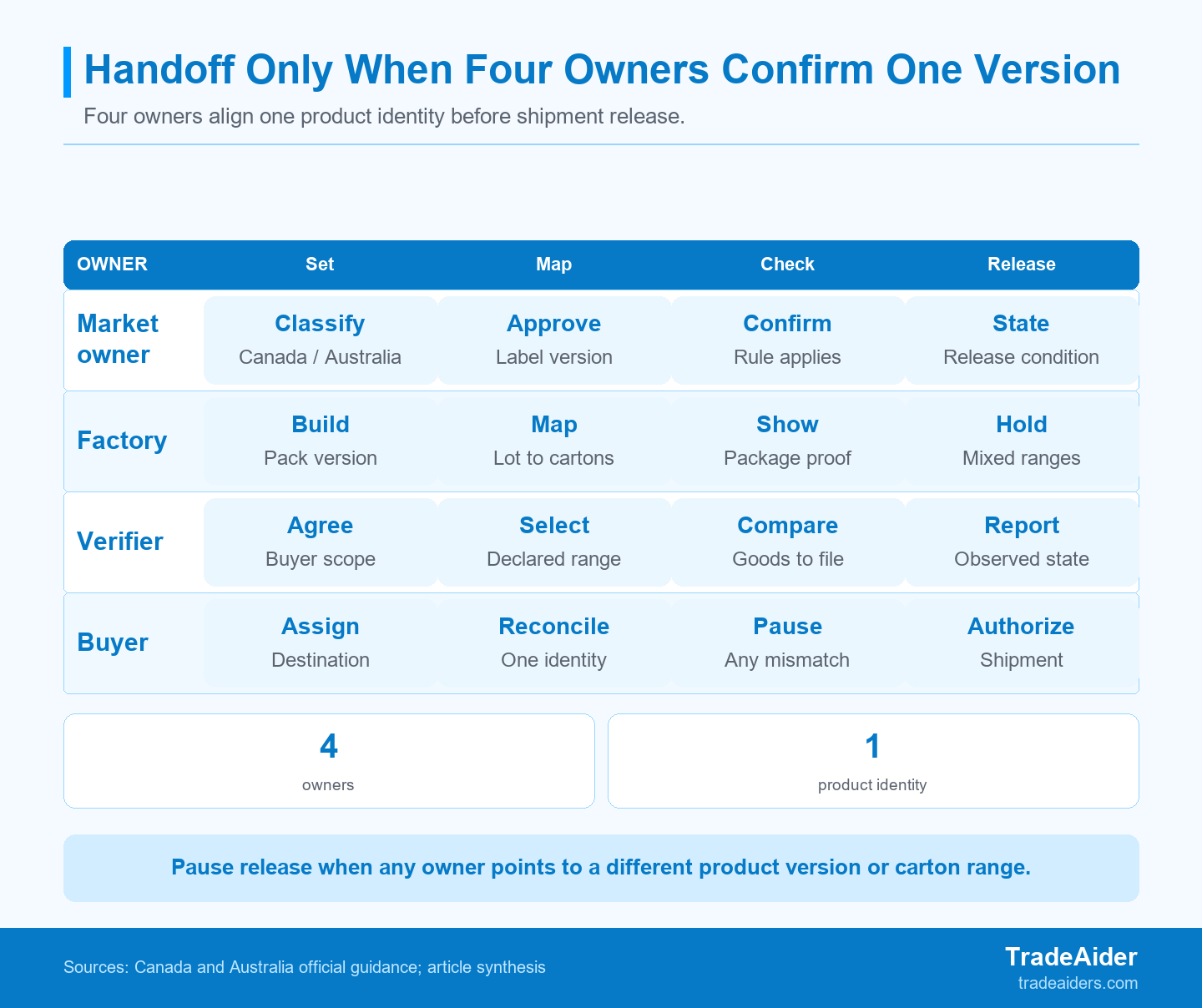
The handoff becomes release-ready only when four owners can reconcile the same product version and carton range.
Think of the dossier as six linked fields, not six attachments. The market requirement explains why a particular label, document, or test record is needed. The approved label identifies the reader-facing version. The product version identifies what was made. The production or packing window locates when it was made. The carton range locates where it is packed. The shipping file identifies what is being released. If a buyer cannot move through those fields without changing the SKU, revision, quantity, or destination, the handoff contains an unresolved mismatch.
| Handoff field | Question it answers | Evidence to retain | Release risk if it conflicts |
|---|---|---|---|
| Market applicability | Which destination rule or category review applies? | Market owner’s category note and requirement reference | Wrong control applied to the order |
| Approved package | Which reader-facing label version is approved? | Controlled artwork file and approval date | Outdated or unapproved retail-facing package |
| Product and lot | Which production or packaging window does it describe? | Version ID, lot or work-order reference | Evidence cannot be tied to goods |
| Carton range | Which cartons can move under this version? | Carton map, marks, numbers, and quantities | Mixed versions enter the same release |
| Shipping file | What is actually being handed to the carrier? | Packing list and final destination allocation | Documented shipment differs from physical shipment |
Version checks work better before the final packing day. During-production inspection checkpoints can help a buyer make packaging, label, and product changes visible while the factory can still separate them by production window. At handoff, the task is narrower: reconcile the final state rather than assume that an earlier approval remained unchanged.
Lot Control Is the Bridge Between a Document and a Physical Shipment
Lot control is a physical-document link: the identifier is useful only when it can be traced from the handoff record to the cartons or units being released.
Lot control is a record-and-identifier method that links a production or packaging range to physical cartons or units. It does not have to be a complicated system. A work-order number, packaging date, carton-number sequence, version code, or controlled combination can work if the factory uses it consistently and the buyer can test it against the shipment. A lot label that never appears on a carton map is only a reference number, not a release boundary.
Choose an identifier that survives the handoff. It should remain visible on the record after cartons are palletized, and it should not be replaced by an internal nickname that the buyer cannot interpret. When the buyer defines final checks, align the physical comparison with inspection-standard criteria so the package, carton marks, and sampled product are reviewed against the same stated conditions.
Record the Identifier Before You Need to Investigate
A release record should name the production or packaging window, label version, carton range, and evidence owner before it is used to support shipment handoff.
For example, “Canada label V3 / pack window 18–19 Aug / cartons CA-041–CA-090 / factory packing lead” is more useful than “Canada order complete.” The first form lets a buyer ask a specific question when one carton photo or package sample differs. It also lets the factory isolate a range if a late correction affects one part of the run. Keep the record simple enough to be updated when the line changes, but specific enough to be checked without interpretation.
Test the Identifier Against a Physical Carton
A physical carton check is the test of whether the handoff identifier actually describes the goods that will move.
Take a sample from each declared version range. Compare the external carton mark, the retail-facing package, the product or model reference, and the handoff record. If the carton is not supposed to carry the retail label, use the carton map to identify the package inside and check that package instead. A single positive match does not prove the entire shipment, but it tests whether the mapping is operational enough to support a buyer-defined final verification scope.
Illustrative Scenario: A Label Revision Conflicts With the Carton Record
Correct the Version Conflict Before You Approve the Handoff
Illustrative example, not a TradeAider client case or a market approval: An importer is shipping 3,600 private-label small appliances in 180 cartons to Australia and Canada. The factory has completed packing when the market owner approves a corrected Canadian label file. Two market label versions now exist under one SKU, and the carton list does not identify a clean version boundary. Carton photos show the newer label on several boxes, but the shipping file could describe cartons whose retail-facing label is not the approved one. A signed PDF does not prove that every carton carries that version, so the buyer pauses the handoff, isolates all 180 cartons assigned to the shared SKU, and asks the factory to rebuild the carton map by packaging version.
In the illustrative scenario, a market-label revision cannot be approved when the carton list mixes the revised and unrevised product windows. A release instruction would turn a document conflict into a shipment risk because the product-to-carton link is missing.
The buyer resumes the handoff only after carton mapping, package evidence, and the approved market label point to the same product range. The factory attaches the approved label version to the packing record, assigns a carton range to each version, and provides package photos plus physical samples from both ranges. The buyer can then define a pre-shipment verification scope that checks the reconciled goods, packaging, and cartons before release. This illustrative example supports a factual handoff check; it does not replace the importer’s product-specific compliance or commercial decision.
Use a Four-Owner Handoff Check Before the Goods Leave the Factory
A usable handoff check assigns the market requirement, factory evidence, carton mapping, and physical verification to named owners before shipment release.
- Market owner: confirm the destination, product category, approved label version, and any required specialist evidence.
- Factory: provide the final packing record, carton range, version ID, and package evidence for each released range.
- Inspection partner: verify the buyer-defined physical product, package, carton marks, and observed range without claiming legal approval.
- Buyer: reconcile the handoff file and issue the release, hold, or correction instruction.
TradeAider can inspect the buyer-defined physical and documentary handoff points, then report observable findings against the agreed scope. If the dossier already identifies the destination, product version, carton range, and desired checks, request a market-handoff inspection plan.
Frequently Asked Questions
Do all Canadian products need bilingual labels?
No, bilingual requirements depend on the product and the applicable rule; for covered prepackaged non-food consumer products, the federal packaging and labelling rules describe mandatory information and exceptions. Confirm the product category and the exact package that reaches the consumer before approving artwork. Keep the market owner’s decision with the approved version ID, because a bilingual-looking file does not prove that it applies to the shipped product or that every carton carries it.
Does every Australian import need a trade description?
No, the Australian Border Force says certain imported goods need a trade description, while not all imported goods need one, so the importer should check the product's category before shipment. Where one applies, compare the approved description with the actual package or product and the assigned carton range. Do not convert an Australia handoff into a generic label task, since the import rule and any product-specific standard may be separate questions.
Can a packing list serve as a lot-control record?
It can support lot control only if it identifies a stable carton or unit range that connects to the actual product version and the handoff evidence. A quantity total alone does not show which label, product revision, or production window is inside a carton. Add the version and carton range, then test at least one physical carton from each declared range before using the list to support a release decision.
Can an inspection provider approve compliance for both markets?
No, an inspection can verify buyer-defined physical and documentary checks, but the importer or market owner must confirm the applicable product requirements and release decision. Use the inspection scope to ask whether the approved package, product, carton identifiers, and records match. Use product-specific regulatory or professional advice when the question is whether the market requirement itself has been satisfied.
Related Articles



Grow your business with TradeAider Service
Click the button below to directly enter the TradeAider Service System. The simple steps from booking and payment to receiving reports are easy to operate.

