
Reliable China inspection services should give buyers a clear scope, trained inspectors, correct sampling, product-specific checklists, real-time evidence, usable reports, transparent pricing, and a practical release path. The wrong provider only tells you pass or fail; the right provider helps you decide ship, hold, rework, sort, or reinspect.
Many buyers search for inspection services only after a supplier says the goods are ready. At that point, the provider is asked to solve problems that should have been defined earlier: what to inspect, which AQL level to use, what counts as critical, whether packaging and labels matter, how fast evidence is needed, and who will follow up if the result is not clean.
ISO/IEC 17020 is a useful reference because it focuses on competence, impartiality, and consistent operation of inspection bodies. Even when a buyer does not require formal accreditation, the same questions help evaluate whether a service is disciplined.
Sampling also matters. ISO 2859-1:2026 is the current standard for AQL-indexed lot-by-lot sampling by attributes. A provider that cannot explain sample size, defect classes, and acceptance limits is not giving the buyer enough control.
- Start with scope: define product, order stage, lot size, packed status, checklist, and destination risk before booking.
- Check evidence quality: require photos, measurements, sample math, defect details, carton marks, and label checks.
- Check communication: real-time visibility matters when the buyer must decide release, rework, or hold quickly.
- Check business fit: a reliable provider should match inspection type to buyer risk, not sell the same checklist to every order.
What Makes a China Inspection Service Reliable?
To find reliable China inspection services, compare providers by inspection scope, product-category experience, sampling method, defect classification, inspector competence, report evidence, communication speed, pricing transparency, corrective-action support, and ability to help the buyer make a shipment release decision.
CBP Reasonable Care is not an inspection-service standard, but it reminds importers that import responsibility cannot be outsourced blindly. A good inspection provider helps the buyer keep better evidence, not avoid responsibility.
ISO 9001:2015 is also relevant at a process level because it emphasizes consistent ability to meet customer and applicable requirements. The buyer should look for repeatable inspection process, not only a cheap factory visit.
The ISO 9000 family gives additional context for quality management language, while ISO 10005 is useful because it focuses on quality plans. Those ideas help buyers ask whether an inspection service can work from a defined plan rather than a vague quality request.
TradeAider's service pages show the main inspection timing options buyers usually compare: Pre-Production Inspection, During Production Inspection, and Pre-Shipment Inspection. Choosing the wrong timing is one reason buyers blame the service when the real problem was a weak inspection plan.
Reliable China Inspection Service Selection Checklist
Use the table to test whether a provider can support a real release decision.
| Selection Area | Strong Signal | Weak Signal | Question to Ask |
|---|---|---|---|
| Scope clarity | Product-specific checklist and risk points | Generic quality check | What exactly will be inspected? |
| Sampling | Lot size, AQL level, defect classes explained | No sample math | How is sample size chosen? |
| Timing | PPI, DPI, PSI, or loading matched to risk | Only final visit suggested | Which risk appears at this stage? |
| Inspector fit | Category experience and clear instructions | Inspector assigned without context | Has the team checked this product type? |
| Report evidence | Photos, counts, measurements, carton and label proof | Short pass/fail PDF | Can the report support release? |
| Communication | Real-time updates and issue escalation | Wait until final PDF | How fast will red flags be shared? |
| Pricing | Clear man-day or service pricing | Vague add-ons | What is included and excluded? |
| Follow-up | Rework, sort, hold, or reinspection path | No action support | What happens after fail or hold? |
The checklist deliberately avoids judging providers only by brand size or price. A large provider can still deliver a generic report if the scope is weak. A low-cost provider can still be expensive if poor evidence forces the buyer to reinspect, sort at destination, or argue with the supplier.
The practical question is whether the service helps the buyer make a better decision before money and goods move. If the report cannot support a release, hold, rework, or reinspection decision, it is not strong enough for a serious importer.
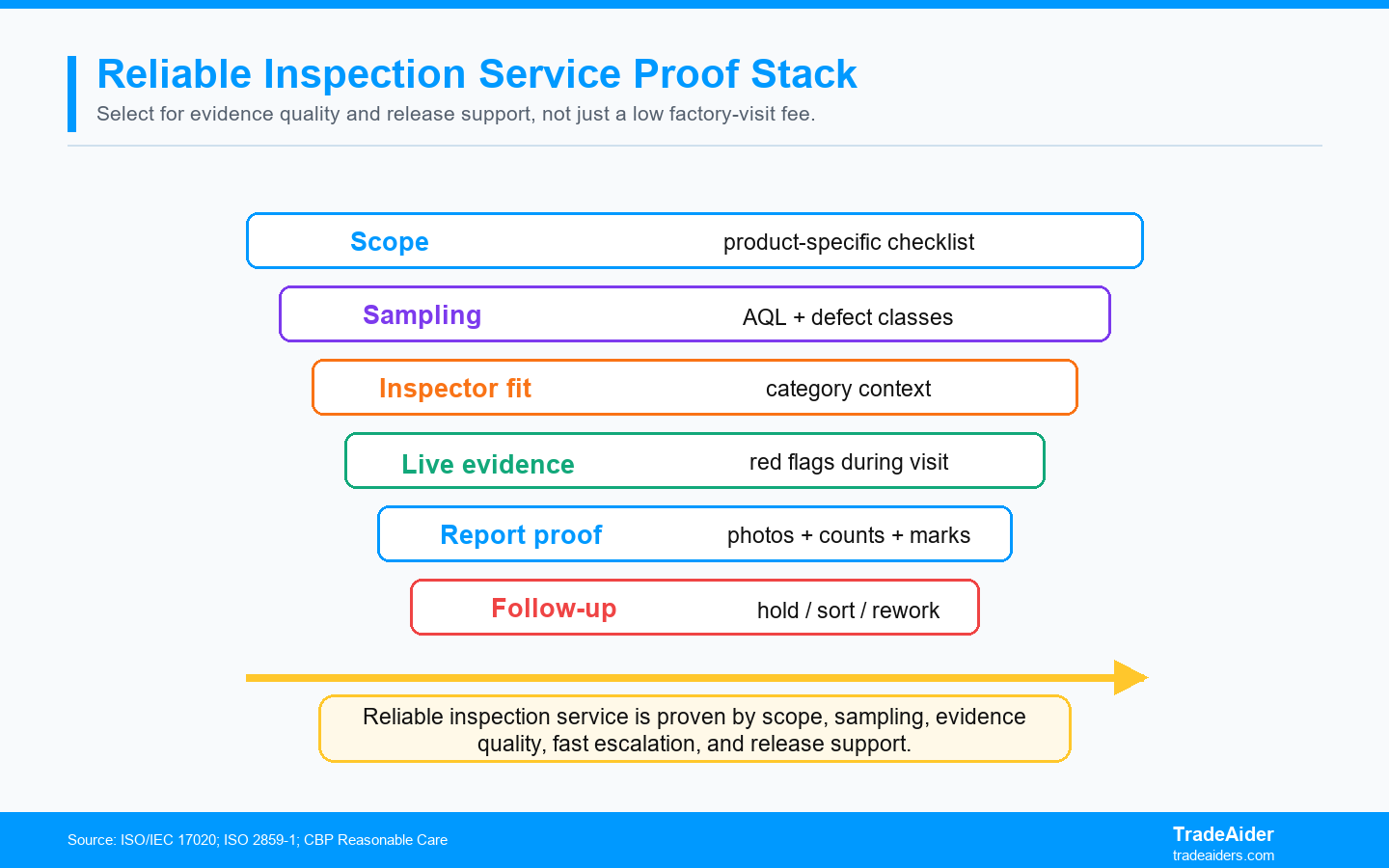
Reliable inspection service is proven by scope, sampling, evidence quality, fast escalation, and release support.
Step 1: Define the Inspection Job Before Comparing Providers
You cannot choose a reliable service until you know what decision the inspection must support.
Match inspection type to order risk
If the supplier is new and materials are uncertain, a final inspection may be too late. If the goods are already packed and the buyer only needs release evidence, PSI may be correct. If loading accuracy matters after goods pass inspection, container loading supervision may be the missing checkpoint.
Before asking for quotes, write down the product, quantity, supplier location, production stage, packed status, destination market, main defect risks, required documents, and final payment date. A provider that cannot adapt scope to those facts is not acting as a quality partner.
Define the release decision in advance
The provider should know what decision the buyer must make after the visit. Release the goods? Hold final payment? Request sorting? Require rework? Reinspect corrected cartons? Escalate to lab testing? Without that decision target, the report may become descriptive but not actionable.
This is especially important because the buyer is not only choosing a vendor; the buyer is choosing whether the next shipment decision will be supported by evidence. If the scope does not name the release decision in advance, a provider can deliver a tidy report that still leaves the buyer unsure whether to ship, hold, rework, or reinspect.
Step 2: Review Report Evidence, Not Just the Provider Website
A sample report reveals more than a marketing page.
Look for lot identity and sample math
A reliable report should identify the inspected lot: supplier, factory, PO, SKU, packed quantity, available quantity, sample quantity, inspection date, location, and cartons sampled. If the report does not prove what was inspected, the verdict is weak.
Sample math matters because a pass/fail result depends on lot size, inspection level, AQL limit, and defect class. The buyer does not need to calculate everything manually, but the provider should be able to explain it clearly.
Look for product-specific photos and measurements
Generic factory photos do not prove product quality. The report should show the actual product, labels, packaging, defects, measurements, accessories, functional checks, carton marks, and any special test evidence. For regulated or marketplace-sensitive products, labels and documents may be as important as workmanship.
A good report also separates observations from decisions. The inspector reports evidence; the buyer decides commercial action based on severity, supplier history, and shipment urgency.
Step 3: Check Communication and Escalation Speed
Inspection value drops when red flags arrive after the buyer's decision window closes.
Real-time visibility is not a luxury for time-sensitive shipments
If the inspector finds wrong labels, missing accessories, mixed SKUs, incorrect carton count, or a critical safety issue, the buyer may need to decide within hours. Waiting for a final PDF can waste the narrow window where the factory can still sort or rework.
Ask how the provider shares in-progress findings, who receives urgent alerts, what evidence is sent immediately, and how supplier follow-up is handled. Real-time communication matters most when the shipment is near loading or final balance payment.
Escalation should be tied to the defect class
Not every issue deserves panic. A minor cosmetic issue may be noted for the next order. A wrong warning label may block shipment. A missing accessory may require sorting. A functional failure pattern may require rework and reinspection. The provider should help the buyer see severity, not flatten everything into pass/fail.
The buyer should define who has authority to approve concessions. Without a decision owner, factories often pressure the inspector or the buyer's junior staff to accept shipment because the truck is waiting.
Transparent pricing should include the limits of the visit
Price comparison is useful only when the buyer knows what is included. A quote should clarify the inspection type, man-day coverage, location assumptions, overtime rules, travel or remote-area charges, sample size basis, report language, photo volume, special test limits, and whether reinspection or supplier follow-up is included. A cheap quote with unclear exclusions can become expensive once the factory visit becomes more complicated.
The buyer should also ask what the inspector will not do. For example, an on-site inspector may not perform accredited lab testing, legal compliance certification, destructive testing beyond the agreed method, or customs classification advice. Clear exclusions are not a weakness; they prevent the buyer from expecting one service to solve every supply-chain risk.
Original Selection Rule: A Cheap Inspection Is Expensive If It Cannot Support a Hold Decision
The hidden cost of poor inspection is not the service fee; it is weak leverage after the report.
Imagine a $25,000 shipment with a $199 inspection fee and a $120 cheaper alternative. If the cheaper report lacks SKU photos, sample math, and defect details, the buyer may have to pay for reinspection, accept weak evidence, or sort at destination. One unclear report can erase the small fee difference.
A practical break-even rule is this: if the expected cost of a shipment error is more than 5 to 10 times the inspection fee difference, choose the provider that produces better evidence and faster escalation. For first orders, custom packaging, regulated goods, and marketplace products, that threshold is usually reached quickly.
This rule does not mean always buy the most expensive service. It means evaluate inspection as decision protection. The buyer pays for evidence quality, timing, and control, not just a person standing in a factory.
Evidence quality is also reusable. A strong report can feed supplier scorecards, corrective-action history, next-order checklists, and internal risk review. A weak report disappears after the shipment because nobody can tell what was actually checked. That difference matters when the same supplier produces the next PO under a tighter deadline.
Where TradeAider Fits in Choosing China Inspection Services
TradeAider fits by giving importers a practical mix of transparent pricing, real-time visibility, and shipment-ready evidence.
TradeAider is relevant when buyers need more than a generic final PDF. Its Pre-Shipment Inspection service can check finished goods when the lot is complete and at least 80% packed for export, giving the buyer evidence before final balance payment or shipment release.
For earlier control, buyers can use Pre-Production Inspection or During Production Inspection depending on whether the risk is inputs, process drift, or finished-lot release. If shipment loading is the weak point, Container Loading Supervision can document carton count, container condition, loading sequence, and seal evidence.
The business fit is simple: TradeAider helps the buyer turn inspection into a release decision. The buyer should prepare product specs, approved sample photos, defect concerns, PO, quantity, supplier contact, and production status so the inspection scope can be specific rather than generic.
SPAR Scenario: A Reliable Service Saved the Buyer from a Weak Release
The buyer needed evidence fast, not a decorative report.
Situation: A UK importer orders 5,500 private-label bathroom accessories from a new supplier in China.
Problem: The supplier says the goods are ready, but the buyer changed barcode artwork twice and worries the wrong retail boxes may have been packed.
Action: The buyer asks TradeAider for PSI with barcode scan, SKU split, carton mark, retail box version, accessory count, and photo evidence sent during the inspection if mismatch appears.
Result: The inspection finds two carton groups with old artwork. The buyer holds those cartons for sorting and releases only the corrected lot, preventing a warehouse receiving problem.
Action Card: Questions to Ask Before Booking a China Inspection Service
Use these questions before choosing a provider, especially for first orders or shipment-sensitive products.
- What exact checklist will be used for this product and order stage?
- How will sample size and defect limits be selected?
- Which photos, measurements, labels, and carton evidence will be included?
- How fast are urgent red flags shared during the inspection?
- What is included in the quoted price and what costs extra?
- What happens if the result is fail, hold, rework, or reinspection?
A good inspection provider should make these questions easier to answer, not harder. If the service cannot explain scope, sampling, evidence, communication, and follow-up, the buyer is buying uncertainty.
For serious importers, the inspection report should become part of the order file: supplier evidence, product file, sample reference, defect record, corrective action, and release decision. That file is what improves the next shipment.
If you are comparing China inspection services for an upcoming order, send TradeAider the product spec, order quantity, supplier location, production stage, packed status, destination market, and biggest release risk. The next step is to ask TradeAider to recommend the inspection scope before you book the factory visit.
Frequently Asked Questions
What makes a China inspection service reliable?
A reliable service provides clear scope, correct sampling, trained inspectors, product-specific checks, strong photo evidence, fast communication, and useful release guidance.
Should I choose the cheapest inspection service?
Not automatically. A cheaper inspection can cost more if the report lacks evidence, sample math, or fast escalation when defects appear.
Is pre-shipment inspection enough?
Pre-shipment inspection is enough only when the main risk appears in the finished lot. New suppliers, custom inputs, or process risks may need earlier checks.
What should a good inspection report include?
A good report should include lot identity, sample size, defect classes, photos, measurements, packing checks, label checks, carton evidence, and a clear result.
Can TradeAider help if the inspection fails?
TradeAider can document findings and support next-step decisions such as hold, sort, rework, reinspection, or shipment release after correction.
Articles Connexes

Développez votre entreprise avec le Service TradeAider
Cliquez sur le bouton ci-dessous pour accéder directement au Système de Service TradeAider. Les étapes simples de la réservation et du paiement à la réception des rapports sont faciles à utiliser.

