
An Amazon product quality checklist should verify the sellable unit, barcode, packaging, set handling, accessories, function, customer-facing appearance, carton records, compliance labels, AQL findings, and the final release decision before shipment. The goal is to catch FBA receiving problems and customer-return risks while the supplier can still fix them.
Amazon sellers need a checklist that connects factory quality with marketplace reality. A normal factory inspection may check workmanship, but FBA shipments also need barcode accuracy, carton consistency, prep readiness, set labeling, accessory containment, and listing-promise match. If these details fail, the product may create receiving problems or customer returns even if the factory says the goods look acceptable.
The checklist below is designed for pre-shipment use. It should be customized for the product category, marketplace, Seller Central shipment plan, and supplier history. A seller of electronics, baby products, apparel, glassware, or bundles should add category-specific checks rather than treating a generic checklist as complete.
- Identity: confirm the product is the exact SKU the seller plans to send.
- FBA readiness: verify barcode, prep, carton, and set requirements.
- Customer quality: inspect function, appearance, completeness, and packaging.
- Release decision: document ship, rework, reinspect, hold, or concession.
The Direct Answer
Before every Amazon shipment, inspect identity, barcode, packaging, accessories, function, appearance, carton accuracy, compliance labels, AQL result, and release action.
Amazon public FBA guidance emphasizes barcode identity and packaging/prep controls, including scannable codes, secure packaging, set labeling, and avoiding wrong outside barcode scans. Sources: barcode guidance and packaging guidance.
Amazon public discussions also note that US FBA prep and item labeling services are discontinued from January 1, 2026. Sellers should confirm current account-specific details in Seller Central, but factory-side inspection should not assume Amazon will fix prep gaps. Source: FBA prep service discussion.
The checklist should be sent before inspection day. The inspector should not have to guess the listing promise, barcode logic, accessory count, or packaging requirement. The seller should provide files: PO, SKU list, FNSKU labels, artwork, carton marks, packing list, approved sample, listing photos, and known defect history.
Who Owns Each Checklist Area
A strong Amazon checklist assigns responsibility before the inspection starts.
Many checklist failures happen because the seller, supplier, prep center, and inspector assume someone else owns a detail. The seller should own requirements, the supplier should own production and packing execution, the inspector should verify physical evidence, and the seller should make the final release decision. Clear ownership prevents late blame-shifting.
| Checklist Area | Seller Provides | Supplier Provides | Inspector Verifies |
|---|---|---|---|
| Identity and SKU | PO, SKU list, ASIN/FNSKU files | Correct product and carton segregation | Product, label, carton, and packing list match |
| Packaging and prep | Artwork, set rules, prep requirements | Retail pack, closure, set label, carton packing | Photos and nonconformity notes |
| Accessories and function | Approved sample and function criteria | Complete parts and working units | Sample checks and defect classification |
| Compliance labels | Warning, rating, age, material, or market files | Correct labels and inserts | Physical match to approved files |
| Release action | Decision authority and tolerance rules | Correction plan if needed | Evidence for release, rework, reinspect, or hold |
This ownership table also helps after a failure. If a barcode is wrong, the seller checks whether the wrong file was supplied, the supplier checks whether the correct file was applied, and the inspector's evidence shows what was physically on the goods. That is much faster than arguing from memory.
15-Point Amazon Product Quality Checklist
Use this list as a shipment-release checklist, then customize it by product category.
#1 SKU, ASIN, model, color, and size identity match the PO and shipment plan.
Identity errors are expensive because the wrong product can enter the wrong listing, carton, or shipment plan. Check product name, model, color, size, variation, kit composition, and any label version against the seller's files. Do not rely on the supplier's product nickname.
#2 FNSKU, UPC/EAN, or manufacturer barcode decision is correct and scannable.
Barcode checks should include placement, print quality, scannability, label text, and whether the correct identifier is used for this SKU. If the seller uses FNSKU labels, the inspector should photograph representative units clearly enough for review.
#3 Old or irrelevant outside barcodes are covered or made unscannable.
Old supplier logistics codes, manufacturer barcodes, or carton barcodes can cause receiving confusion when they remain exposed. The inspector should verify that irrelevant outside codes are covered, removed, or made unscannable according to the seller's plan.
#4 Retail package matches approved artwork, warning text, and country-of-origin requirements.
Packaging is part of the Amazon customer experience. Artwork, claims, warnings, model numbers, inserts, and country-of-origin marks should match approved files and the listing promise. A good product in the wrong package can still fail commercially.
#5 Set products are packaged together and marked as one sellable unit.
Bundles and sets must behave like one sellable unit. If components can separate during receiving, storage, or picking, the customer may receive an incomplete order. Inspect both physical packaging and visible set wording.
#6 Accessories, screws, cables, inserts, and small parts are complete and secured.
Accessories create a high return risk because the product may look fine until the customer tries to use it. Count parts inside sampled retail packs and check whether small items are bagged, fixed, or otherwise contained.
#7 Product function, assembly, fit, and core use are checked on sampled units.
Function checks should reflect the product's core promise. For simple products, this may be fit, assembly, opening, closing, or load-bearing. For electronics, it may include power-on, charging, buttons, indicator lights, and included accessories.
#8 Visible finish, color, size, and customer-facing appearance match the listing promise.
Customers judge what they see. Check color, finish, visible scratches, stains, odor, deformation, size, and presentation against the listing photos and approved sample. Premium or giftable products need stricter cosmetic standards.
#9 Fragile, sharp, glass, liquid, or heavy items have appropriate protection.
Protection should match handling risk. Fragile, sharp, glass, liquid, heavy, or delicate items need packaging that can survive domestic and fulfillment handling. Photograph cushioning, closures, edge protection, and warning labels.
#10 Carton marks, carton quantity, gross weight, and packing list match shipment records.
Carton records connect factory output to FBA shipment planning. Carton mark, SKU, quantity, weight, and packing list should agree. Mismatches can cause receiving delays, inventory errors, or supplier disputes.
#11 Case packs do not mix SKUs, conditions, or quantities unless planned.
Case-pack mistakes are easy to create when suppliers pack multiple SKUs at once. Verify that carton contents match case-pack logic and that mixed cartons are used only when planned and documented.
#12 Poly bags, closures, suffocation warnings, and bundle rules are checked where applicable.
Prep requirements vary by product. Poly bags, seals, bands, suffocation warnings, and bundle labels should be checked where applicable. The seller should provide account-specific instructions from Seller Central.
#13 Compliance labels, rating labels, age labels, or safety warnings match product evidence.
Compliance labels must match the real product version. Rating labels, age labels, safety warnings, material claims, and model numbers should agree with the product, packaging, manual, and available test evidence.
#14 Defect photos, sample counts, and AQL results are clear enough for a release decision.
The report should show what was sampled, what failed, what passed, and what photos prove the finding. A vague report is weak evidence for supplier correction or release approval.
#15 The seller documents release, rework, reinspection, hold, or concession before shipment.
The checklist is not complete until the seller writes the action. Release, rework, reinspection, hold, or concession should be documented before the shipment moves.
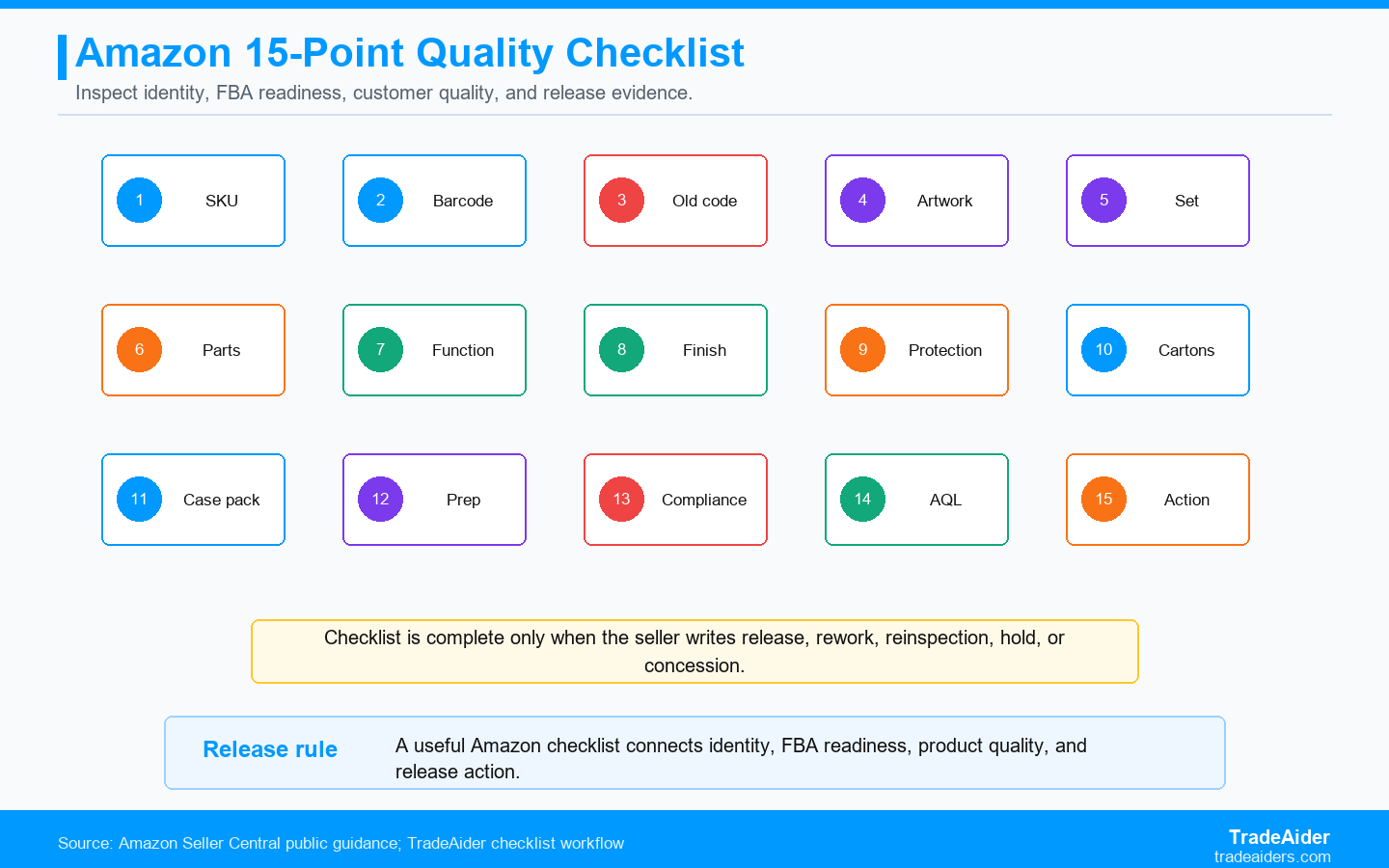
A useful Amazon checklist connects identity, FBA readiness, product quality, and release action.
How To Use The Checklist Without Slowing Every Shipment
Use the full checklist for first orders and high-risk shipments; focus repeat orders on changed or historically weak points.
A first order should use the checklist broadly because the seller does not yet know which supplier mistakes are likely. A repeat order can be more focused if the supplier history is clean and nothing changed. However, any change in component, packaging, barcode, color, factory line, or subcontractor should reset risk thinking.
The seller should also tag each checklist item to a failure cost. Barcode and carton issues affect FBA receiving. Accessories and function affect returns. Packaging and appearance affect reviews. Compliance labels affect account health. This turns a long checklist into a release tool rather than a paperwork exercise.
Where TradeAider Fits In Amazon Shipment Inspection
TradeAider fits by turning the checklist into inspection evidence before goods enter FBA.
TradeAider can use this checklist during Pre-Shipment Inspection to verify the finished lot, document photos, classify defects, and help the seller decide release, rework, reinspection, hold, or concession.
If defects appear before final packing, During Production Inspection can catch process drift earlier. For Amazon-specific workflows, e-commerce quality solutions align inspection with FBA labels, packaging, and customer expectations.
The business fit is execution. A checklist is only useful if someone verifies it on real goods and turns the result into a decision. TradeAider helps sellers make that jump from checklist to evidence.
SPAR Scenario: The Checklist Caught Three Small Problems
None of the issues looked dramatic alone; together they would have hurt FBA launch.
Situation: An Amazon seller prepares 4,500 desk organizers for FBA. The supplier reports that production is complete and asks for shipment release.
Problem: TradeAider PSI uses the seller's checklist and finds three issues: old carton barcode still exposed, one accessory bag loose in sampled packs, and one color variant using outdated insert text.
Action: The seller requires the supplier to cover old barcodes, secure accessory bags, replace inserts for the affected color, and provide corrected cartons for reinspection.
Result: The shipment is released after correction. The checklist catches operational and customer-facing risks before they become FBA receiving problems or returns.
Action Card: Build Your Amazon Checklist
Make the checklist specific enough that the inspector can verify it without guessing.
- Send SKU list, barcode files, shipment plan notes, packaging artwork, carton marks, and approved sample references.
- Mark which checklist items are critical, major, and minor.
- Add known return reasons and review complaints from previous shipments.
- Require photos for barcode, packaging, accessory, carton, and defect evidence.
- Document release, rework, reinspection, hold, or concession before shipment.
After each shipment, update the checklist. Remove low-value checks that never affect decisions, keep checks that prevent real losses, and add return-driven checks from customer feedback. A strong Amazon checklist becomes sharper with every order.
Keep the checklist version with each inspection report so future teams know which requirements were active when the shipment was released.
If you want a product-specific Amazon inspection checklist, send TradeAider the product files, FBA label requirements, packaging artwork, shipment plan, defect history, and launch timing. The next step is to ask TradeAider to turn your Amazon shipment requirements into a PSI checklist.
Frequently Asked Questions
Do I need all 15 checks for every shipment?
Use all 15 for first orders, changed products, or high-risk shipments. Stable repeat orders can focus on changed and historically weak points.
Should barcode checks be part of quality inspection?
Yes. For FBA sellers, barcode accuracy is a shipment-readiness and inventory-control issue, not just a label detail.
Can a prep center replace factory inspection?
Not fully. A prep center may help with labeling or packaging, but it may not catch factory function, workmanship, component, or compliance defects before shipment.
Can TradeAider customize the checklist?
Yes. TradeAider can customize the checklist around SKU, category, FBA requirements, supplier history, and the seller's known return risks.
Articles Connexes


Développez votre entreprise avec le Service TradeAider
Cliquez sur le bouton ci-dessous pour accéder directement au Système de Service TradeAider. Les étapes simples de la réservation et du paiement à la réception des rapports sont faciles à utiliser.

