
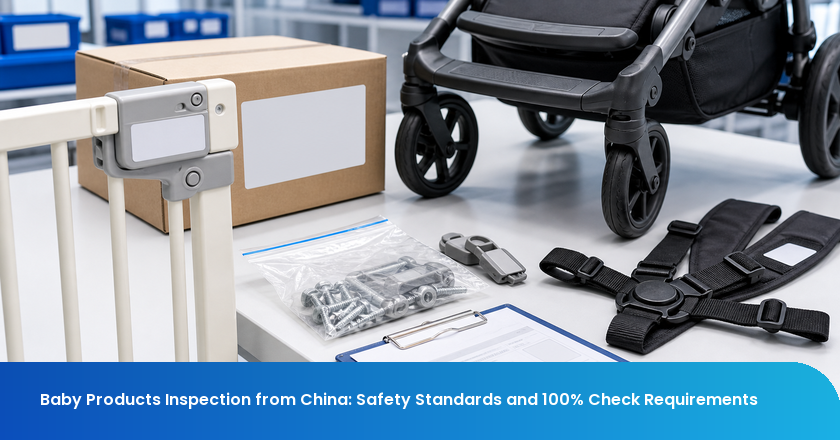
Baby products inspection should treat AQL as only one layer; safety evidence, tracking labels, warnings, restraints, locks, and small-parts risk need separate release gates because a passed sample count cannot excuse a critical child-safety failure.
Baby products create a different inspection problem from ordinary consumer goods. A stain, scratch, or carton dent can follow sampled AQL limits, but a missing warning, failed lock, loose small part, wrong tracking label, missing restraint, or certificate mismatch can stop release even if the ordinary defect count passes.
CPSC guidance for children's products, durable infant or toddler products, small-parts risk, and tracking labels shows why the buyer must connect safety evidence to the physical shipment. Pre-shipment inspection cannot replace required third-party testing or Children's Product Certificate control, but it can verify whether the packed lot still matches the approved file.
Key Takeaways
- AQL is not the release system: baby products need separate critical gates for safety features, warnings, labels, locks, restraints, and small parts.
- Evidence must match the shipment: CPC, test reports, tracking labels, artwork, model identity, and carton marks should point to the same lot.
- 100% checks should be targeted: use them for binary critical features, not for every minor workmanship issue.
- Documentation matters: photos of labels, warnings, locks, restraints, hardware, and packaging make the release decision traceable.
Start With Safety Evidence and Product Identity
A baby product lot should not move from factory to shipment until the physical product, labels, packaging, and safety evidence identify the same item.
The buyer should begin by classifying the baby product: toy, feeding item, durable infant or toddler product, soft good, carrier, gate, high chair, stroller accessory, bath product, or nursery item. Each category may trigger different rules, test expectations, warnings, labels, and certificate requirements.
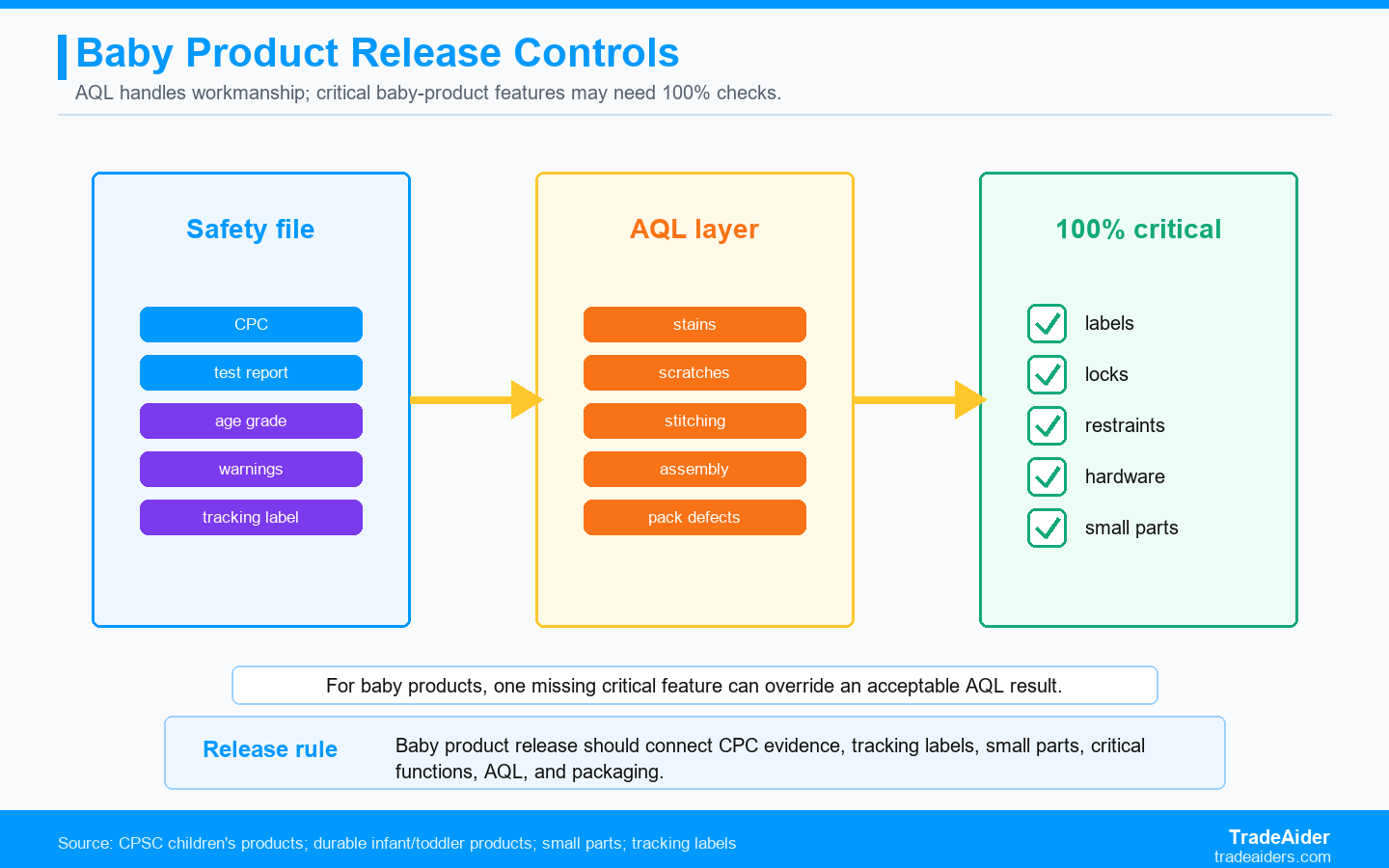
Baby product release should separate AQL workmanship from 100% critical checks for labels, small-parts risk, locks, restraints, tracking marks, and safety evidence.
Children's product evidence should be tied to the exact model
CPSC children's product guidance explains that products designed or intended primarily for children age 12 or younger can trigger specific testing and certification obligations. The inspection team should not create the certificate, but it should verify whether the physical lot matches the model, label, artwork, warnings, and packaging identity the buyer intends to certify.
If the factory changes material, color, hardware, strap, printed warning, carton, or manufacturing location after approval, the buyer may need to review whether the evidence still applies. The inspection report should make such changes visible before shipment.
Tracking labels need legible product and package evidence
CPSC tracking-label guidance says children's products should bear distinguishing marks that are visible and legible, permanently affixed where practicable, and provide identifying information such as manufacturer or private labeler, production location and date, batch or run number, or other source details. Inspection should capture these marks on the product and packaging.
A tracking-label issue is not just artwork neatness. It affects recall traceability. If a component later creates a safety problem, the buyer needs to identify affected lots quickly. That is why illegible, missing, or inconsistent tracking marks should be treated as release issues.
The inspection report should show product-level and package-level marks separately because one can pass while the other fails. A master carton label may identify the order, but the product itself may still lack a durable batch clue. For baby products, that gap matters because the buyer may need unit-level traceability after the retail pack is separated from the shipping carton.
Durable infant or toddler products may need extra label and registration checks
Durable infant or toddler products can carry additional obligations beyond general product labels. The buyer should define which product category applies and what warning, registration, instruction, or package elements must be present. Inspection should verify presence, readability, placement, and model consistency.
This does not mean every baby product needs the same checklist. It means the inspection plan should be category-specific. A baby gate, high chair, carrier, feeding cup, and soft nursery item have different critical features, even if all are baby-related.
Use 100% Checks Only for Critical Binary Features
A 100% check is powerful when the feature is critical, visible, and binary; it becomes wasteful when used to replace a well-defined AQL plan for ordinary workmanship.
Small-parts risk should not be averaged into AQL
CPSC small-parts guidance exists because small objects can create choking hazards for young children. Inspection should flag loose detachable parts, broken pieces, accessible small components, weak seams, loose caps, exposed hardware, or packaging items that may create risk. The exact testing requirement depends on product category and intended age, so the buyer should define the applicable rule before inspection.
A small-parts-related failure should not be treated like a minor scratch. If the buyer's critical check finds a loose component on any unit, the lot may need hold, sorting, rework, or engineering review even when ordinary AQL results look acceptable.
Locks, restraints, straps, and hardware need functional confirmation
Baby products often rely on locks, latches, buckles, straps, screws, clips, brakes, hinges, folding joints, or restraint systems. These features should be checked in a defined way: present or absent, engaged or failed, correct or wrong, secure or loose. That makes them suitable for targeted 100% checks on critical SKUs or affected lots.
The check should be realistic. An inspector can confirm basic engagement, visual condition, assembly, and obvious looseness. The inspector should not invent a certified strength result unless a defined test method and equipment are part of the scope.
A good 100% check sheet uses binary language that the factory and inspector can execute: buckle locks or does not lock, warning present or missing, screw present or absent, strap threaded correctly or incorrectly. That avoids subjective arguments during rework and makes the corrected-lot evidence easier for the buyer to approve.
Warnings and instructions should be checked as release evidence
Warnings, age grading, assembly instructions, cleaning instructions, registration cards where relevant, choking-hazard labels, and destination language should be inspected against the approved artwork. A wrong warning can make an otherwise clean product unreleasable because the user receives incomplete safety information.
The report should include close photos of key warnings and instructions. If labels are applied after inspection or changed during rework, the buyer should require reinspection evidence before release.
Buyers should define the photo set before inspection: product warning, retail-pack warning, instruction front page, tracking mark, age statement, and any category-specific registration or safety insert. That photo set becomes the release record. It also prevents a supplier from fixing only the visible sample while leaving mixed labels or outdated inserts in unopened cartons.
AQL Still Controls Workmanship and Packing Defects
Once critical safety gates are separated, AQL can do its proper job: sampling ordinary defects consistently across the lot.
AQL remains useful for baby products, but only after safety-critical gates are defined. It can control visible workmanship and packaging issues without pretending to solve certification or child-safety evidence.
Ordinary workmanship should follow agreed defect classes
Stains, loose threads, scratches, color variation, poor printing, carton dents, missed accessories, rough finishing, or retail-pack defects can be sampled and classified. The buyer should define which are minor, major, or critical based on product use and customer expectation.
This separation keeps the inspection report readable. The buyer can see which findings affect normal appearance and which findings stop release because they touch safety, identity, warnings, or traceability.
A scenario estimate shows why critical gates save recall exposure
Illustrative calculation: assume a 3,000-unit baby accessory order has one missing warning label per 100 units. That is only 30 units, but if the warning is required for safe use, every affected unit may need sorting, relabeling, and recall traceability if shipped. A 100% label check on the affected SKU can be cheaper than trying to identify mislabeled units after distribution.
This estimate does not replace legal review. It shows why critical identity and warning checks should not be diluted into a normal AQL count. The decision impact is release control, not statistical elegance.
Baby Product Release Checklist
The checklist below separates evidence, AQL, and 100% critical checks so the buyer can make a defensible release decision.
| Release Layer | What To Check | Release Rule |
|---|---|---|
| Safety evidence | Applicable rules, test report, CPC, model identity, destination file | Do not release if the lot no longer matches evidence |
| Tracking label | Product and package marks, batch, date, location, source code, legibility | Hold missing or inconsistent traceability marks |
| Small-parts risk | Loose parts, detachable components, broken pieces, caps, hardware, seams | Treat failed critical checks as release holds |
| Locks and restraints | Latches, straps, buckles, brakes, hinges, screws, assembly | Use targeted 100% checks for critical features |
| AQL workmanship | Stains, scratches, printing, loose threads, carton defects, accessories | Accept, reject, or rework by agreed class |
| Warnings and pack | Age label, warnings, manual, registration elements, retail and master carton | Release only when user-facing safety information matches |
Where TradeAider Fits In Baby Product Inspection
TradeAider can help baby product buyers with pre-shipment inspection that checks AQL workmanship, labels, warnings, tracking marks, assembly, locks, restraints, accessories, packaging, and release photos. Buyers should provide the applicable product category, approved sample, label artwork, test or CPC references, defect classes, and any buyer-defined 100% checks.
When production is still active or the order contains safety-sensitive features, during-production inspection can verify labels, parts, assembly, and packaging before the full lot is finished. For new suppliers, a factory audit can help evaluate traceability, process control, and corrective-action discipline.
SPAR Scenario: The Lot Passed AQL but Failed a Critical Check
Situation: A buyer ordered baby safety accessories with warning labels, instruction sheets, tracking marks, and small hardware packs.
Problem: The sampled workmanship defects were within AQL limits, but inspection found that one carton group had missing warning labels and mixed hardware bags.
Action: The buyer held the affected carton group, required 100% sorting for label and hardware presence, and requested reinspection photos after correction.
Result: The lot shipped only after critical label and hardware evidence matched, and the buyer added those features as binary release gates for future orders.
Baby Product Inspection Checklist
- Confirm the product category and applicable safety evidence before PSI.
- Photograph tracking labels on product and packaging.
- Use targeted 100% checks for warnings, locks, restraints, and small-parts risk.
- Keep ordinary stains or carton defects in the AQL layer.
- Require reinspection evidence after safety-critical rework.
Who Is TradeAider?
TradeAider is a quality control service provider for importers, brands, and e-commerce sellers sourcing from China and other Asian supply markets. Its services include pre-shipment inspection, during-production inspection, pre-production inspection, factory audit, container loading supervision, product testing coordination, and real-time inspection reporting.
For buyers who need a practical release decision rather than a generic pass/fail file, TradeAider can help turn product specifications, approved samples, defect classes, packing requirements, and destination-market evidence into a focused inspection scope. Buyers can start with a TradeAider inspection request when the lot is packed or when production risk needs earlier visibility.
Frequently Asked Questions
Should baby products use 100% inspection?
Use 100% checks only for critical binary features such as required labels, locks, restraints, hardware presence, small-parts risk, tracking marks, or affected rework groups. Ordinary cosmetic and workmanship defects can usually follow AQL sampling if defect classes are well defined.
Can baby product PSI replace a Children's Product Certificate?
No. PSI cannot replace required testing, certification, or CPC control. It verifies whether the physical shipment, labels, warnings, tracking marks, and packaging match the buyer's approved evidence file before release.
What baby product findings should block shipment?
Shipment should be held for missing or wrong warnings, failed locks, missing restraints, loose small parts, inconsistent tracking labels, mixed hardware, certificate mismatch, or any finding that breaks the link between the product and its safety evidence.
What should buyers provide before baby product inspection?
Provide product category, intended age, approved sample, label artwork, warnings, instruction files, tracking-label requirements, CPC or testing references, defect classes, packing method, and the list of features requiring 100% checks.

Articles Connexes
Développez votre entreprise avec le Service TradeAider
Cliquez sur le bouton ci-dessous pour accéder directement au Système de Service TradeAider. Les étapes simples de la réservation et du paiement à la réception des rapports sont faciles à utiliser.

