

A camping chair order needs more than a weight-capacity label and an attractive fabric sample. Buyers need to know that the packed frame secures as designed, the fabric attachments carry their intended loads, and the complete chair returns to its supplied carry bag. A frame that stays straight can still have a failing seat pocket; a working transport latch says nothing about the lock used while sitting.
This camping chair inspection checklist covers static load, securing mechanisms, fabric seams, feet, pinch points and the carry bag. Choose the checks for the actual construction: a hinged folding frame and a frame assembled from separate tubes do not use the same connections. The guide covers ordinary adult camping chairs; children's chairs and specialized reclining or rocking designs need additional assessment of their particular risks.
The Camping Chair Checks to Complete Before Shipment
Use the checklist to agree inspection coverage for each construction in the order. Provide the approved chair, instructions, drawings and limits for loads, cycles, tolerances and sample quantities. Where the capacity basis is missing, request it before booking; the inspection team should not invent a load from the advertised rider weight.
- Static load: apply the specified load through the prescribed contact surface and position. Record frame displacement, joint movement, seat damage and the condition after unloading. Compare with the agreed structural and deformation limits.
- Folding locks and connections: fully open or assemble the chair using its instructions. Check every fitted latch, brace and tube connection, then repeat the specified opening and closing sequence. Engagement must match the approved design without an improvised adjustment.
- Fabric seams and attachments: inspect seat corners, sleeves, webbing, backrest joints and stitching before and after loading. Record broken threads, fabric tearing, yarn movement or attachment damage separately, with the location and extent.
- Feet: verify that each required cap or foot is present, correctly fitted and retained. Check contact on the specified inspection surface, then inspect again after the functional sequence for cracks, detachment or exposed tube ends.
- Pinch points: observe hand positions and moving gaps throughout normal unfolding, adjustment and folding. Use the applicable assessment method for clearances; never test a closing gap with a finger.
- Carry bag: repack the actual chair and all included parts using the instructed sequence. Close the bag and check seams, zipper or drawcord, handles and straps under the agreed carrying check.
Ask for findings tied to a component and test stage, such as a seat-pocket opening after the specified load sequence. This lets the buyer distinguish a frame defect from an attachment failure and identify the relevant supplier correction. Before-and-after photographs should retain any intervention that changed the sampled chair.
Match the Securing Check to the Frame Construction
Inspect the chair's actual securing arrangement before loading it. A hinged frame may use a latch, sliding collar or over-center brace; a lightweight take-apart chair may rely on fully seated tube joints and correctly fitted fabric pockets. Mark a lock check as not applicable only when the approved construction has no separate lock, and still examine the connections that hold that design together.
Some products also lock for transport. On such a design, a working transport lock does not demonstrate that the open-position lock is engaged. Identify and test the intended function of each locking position.
The report should establish whether the packed chair reaches its intended securing position using the supplied sequence. A reluctant latch, trapped fabric or incomplete engagement needs to be recorded before a technician intervenes. A click alone is insufficient when the engagement cannot be confirmed.
For segmented frames, include tube-to-hub seating and the correct seat-pocket locations in the scope. The internal elastic cord may keep parts together in the bag without securing the assembled joint. Ask the report to identify the connection examined, rather than simply mark a separate folding lock as absent.
If the securing function changes during the agreed cycles, require the cycle stage and affected joint in the finding. A sample that works after filing a bracket or replacing a rivet describes a modification. Ask which production goods need the same correction and how their original securing function will be rechecked.
What Does the Capacity Evidence Demonstrate?
A static load check holds a specified load under defined conditions; impact and cyclic durability use separate methods. Request the basis behind the capacity claim and identify which part the factory visit can verify. A person briefly sitting on the chair does not supply the load arrangement, duration or acceptance criteria needed for that decision.
For adult outdoor seating, the public scope of BS EN 581-2:2026 includes strength, reliability and stability for camping, domestic and contract use. It excludes resistance to ageing and degradation from light, temperature and moisture. Select the applicable use category and full test method; a factory static check does not establish complete compliance or outdoor weather resistance.
For a useful load result, require the frame and seat configuration, applied load and contact arrangement, duration, and before-and-after findings. Deflection is displacement under load. Joint opening, frame spreading, attachment movement or seat damage should remain visible even if the measured deflection meets its limit. Controlled equipment and competent personnel are needed, with people kept outside the potential collapse area.
Separate recoverable flexing from permanent deformation using the product's limits. Fabric sag can also affect the result: the seat may approach a cross-member or pull a corner out of position even if the metal tubes remain intact. Stop if a component cracks, support is lost or the setup becomes unsafe. Record an interrupted test as interrupted and describe why it stopped.
If seat, backrest or armrest loads are required, identify each method separately. Passing a centered seat load does not prove stability while leaning sideways or strength when pushing on an armrest. Repeated loading, impact and stability tests answer additional questions and should be commissioned with their prescribed equipment and conditions when required by the product specification.
A Straight Frame Does Not Clear the Seat Attachments
Prioritize the points where the seat transfers load into the frame: corners, pole pockets, sleeves and webbing junctions. Ask whether their reinforcement and seam construction match the approved reference. Neat stitching does not resolve a misplaced supporting pocket or a fabric edge barely caught by the seam.
After the agreed load sequence, describe what changed. Broken stitching means the sewing thread has failed. Seam slippage means fabric yarns have shifted at the seam, producing an opening that can occur while stitches remain intact. A fabric tear is a rupture in the material itself. These observations help the supplier examine the relevant construction; they do not, by themselves, prove the root cause.
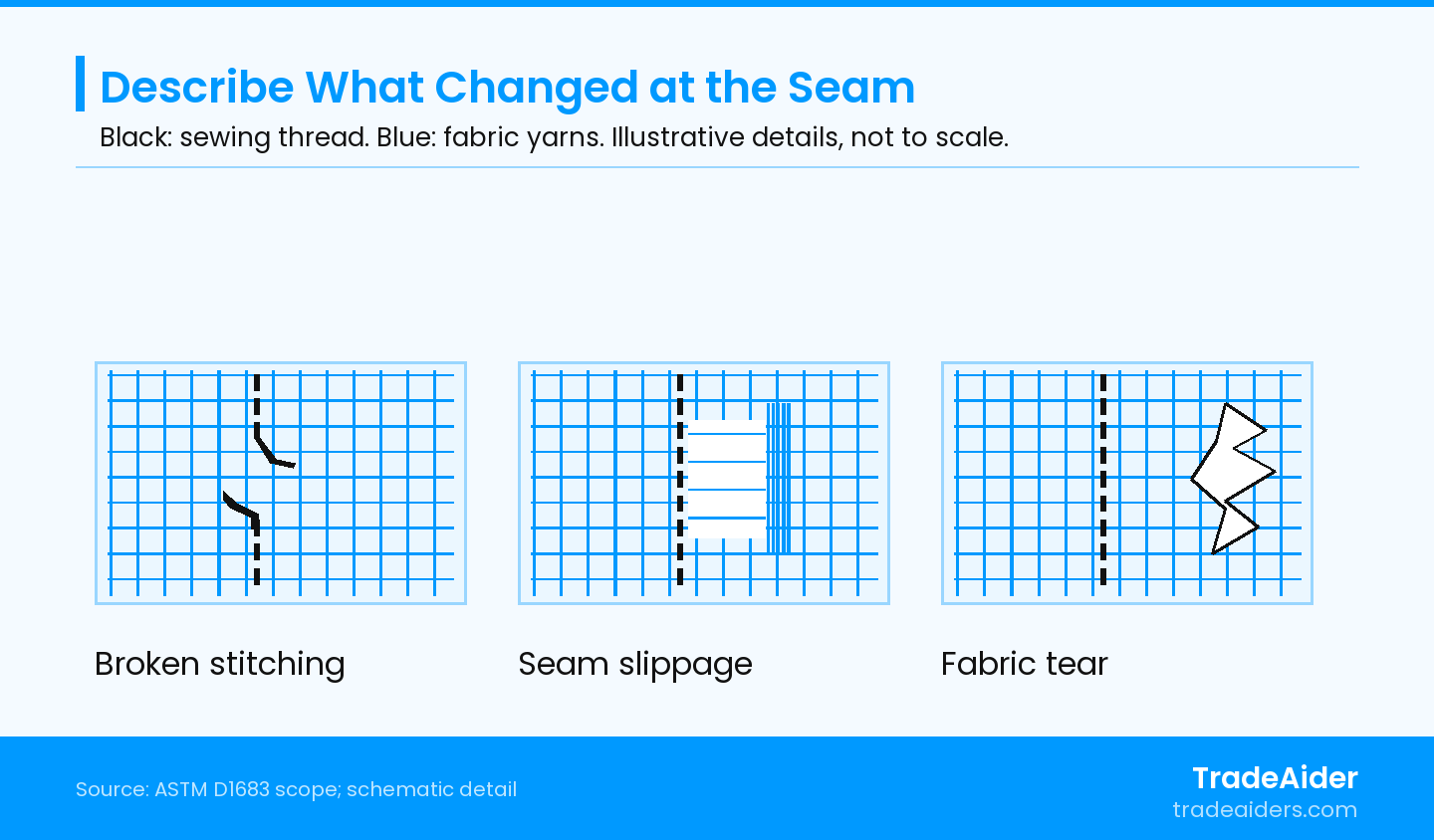
Illustrative woven-fabric details. Record the location and extent of the change; these appearances alone do not establish its cause or a laboratory strength result.
For laboratory assessment of woven seams, ASTM D1683/D1683M-22 measures sewn-seam strength with force applied perpendicular to the seam and addresses stitching failure and yarn slippage. Its scope also states that it does not predict actual seam wear. A visual factory check or informal hand pull is not that test; select a method suitable for the actual woven, knitted or mesh construction.
Check load-bearing straps and their connections as carefully as the seat panel. In its February 2018 Stargaze recall, CPSC identified failure of seat straps as a fall hazard on the specified NEMO camping chairs. This historical recall does not characterize other chairs; it shows why inspecting only the visible fabric panel can miss a supporting component.
Hypothetical example: a chair completes the agreed static load sequence without bent tubing, but the post-test photograph shows an opening beside one seat-pocket seam. The stitches remain continuous while the fabric yarns have moved. Record the seam opening and compare it with the specified limit; do not accept the chair solely because the frame is straight. The supplier should examine that seam assembly, then the corrected construction should undergo the relevant repeat checks.
Separate Loose Feet from Poor Ground Support
A foot can be securely attached yet sit unevenly, and a chair can stand evenly while a cap is loose. Inspect both conditions. Confirm the correct foot type, count and orientation, then check retention by the agreed method. Look for splits around the tube, incomplete seating, loose inserts and sharp metal exposed through a damaged cap.
An inspection on a specified firm, flat surface can separate frame or foot geometry from outdoor-ground behavior. Request the contact result before and after loading and the location of any rocking. An unapproved shim changes the configuration rather than correcting the chair as supplied.
Soft-ground suitability is a separate question. Broad feet or an optional ground sheet may be intended for sand or soil, but success on a hard floor does not validate that use. Define the surface, accessory and assessment conditions if the buyer requires a soft-ground check. Avoid presenting one informal test on nearby grass as proof of performance on all outdoor terrain.
Observe Moving Gaps Throughout Folding and Adjustment
Pinch-point inspection follows the movement of the chair, not just its fully open position. Observe where a user's hands are directed by the instructions and where tubes, hinges, braces or sliding collars approach one another. Look for fabric or handles that encourage a grip near a closing gap and for guards that shift during operation.
Accessible surfaces also need attention. BSI's overview of BS EN 581-1:2017 describes general safety requirements for adult outdoor seating and tables, including protected edges and corners in the intended use position. Check the applicable full standard and product instructions for the assessment being commissioned; a smooth edge alone does not resolve a moving pinch or shear hazard.
A pinch concern should identify the operating step, intended hand position and closing mechanism. Competent assessors need the specified probes and method where a formal clearance assessment applies. Hands must stay clear; an informal finger test or defeated guard cannot establish acceptability.
An unclear hand-placement instruction, damaged guard and hazardous mechanism are different findings. Ask for the appropriate correction and assessment instead of treating an extra warning label as an automatic solution. A sampled functional check can expose a concern, but the design may need a broader safety evaluation before the buyer can resolve it.
Check the Carry Bag as Part of the Product
Include the actual chair, all included parts and the specified packing sequence in the bag check. The buyer needs to know whether the set closes and carries without a strained zipper, puncture-prone tube end or insecure strap. A bag shown around an incomplete chair does not demonstrate that the retail set fits.
Packing sequence can affect fit. The Helinox Chair One guide instructs users to fold the seat, place the disassembled frame on it, roll them together and then put them into the carry bag. That sequence is specific to the model. Use the ordered chair's instructions rather than forcing the frame into the bag or omitting a part to close it.
Where carrying checks are specified, request the resulting condition of bag seams, closures, straps and the chair itself. Distinguish a missing included accessory from an optional item sold separately. Dampness, mold or contamination needs documented follow-up before repacking, rather than being hidden by a successful closure demonstration.
Agree the Follow-Up from the Actual Finding
A failed frame connection, a seam opening and a torn storage pocket do not have the same consequence. Identify what the affected part does, document the observed defect and use the buyer's agreed classification and sampling plan. Keep any modified or damaged test sample identifiable, and distinguish the original result from a result obtained after repair.
TradeAider's inspection standard guidance connects inspection arrangements with customer requirements and sampling. Specify the visual sample quantity and any separate quantity for assembly, loading or destructive checks. A sampling plan does not supply the missing load, seam or clearance criteria for a camping chair.
For pre-shipment inspection, the order quantity must be 100% complete and at least 80% packed for export. Provide the chair specification, instructions, approved references, test conditions and included-parts list so the inspection can cover both use and packing.
Contact our team to arrange a camping chair inspection and confirm the checks and reporting scope for your shipment.
Frequently Asked Questions
Is the advertised weight capacity the inspection test load?
Not automatically. A capacity claim needs a supporting test basis, while the inspection method defines the load, contact area, position, duration and criteria. Request that basis and agree the factory procedure. Do not apply an arbitrary multiplier to the label or assume a brief seated trial verifies it.
Should every camping chair have a separate folding lock?
No. Securing arrangements vary by construction. Inspect the latches, braces, joints and seat attachments required by the approved design. If the expected securing function is unclear, resolve it against the drawings and instructions before concluding that either the presence or absence of a latch is acceptable.
Does a mechanical inspection prove outdoor durability?
No. Mechanical checks do not establish resistance to sunlight, moisture, corrosion or fabric ageing. Match any weather-resistance claim to suitable material or product testing and the intended exposure. Keep those results separate from the sampled chair's assembly and load observations.
Can a carry-bag defect justify corrective action?
Yes, when the bag is part of the specified product and fails an agreed requirement. Describe whether the issue prevents closure, causes loss of contents, weakens carrying attachments or is cosmetic. Its classification depends on that consequence and the buyer's criteria, rather than treating every bag defect as equally serious.

Articles Connexes


Développez votre entreprise avec le Service TradeAider
Cliquez sur le bouton ci-dessous pour accéder directement au Système de Service TradeAider. Les étapes simples de la réservation et du paiement à la réception des rapports sont faciles à utiliser.

