
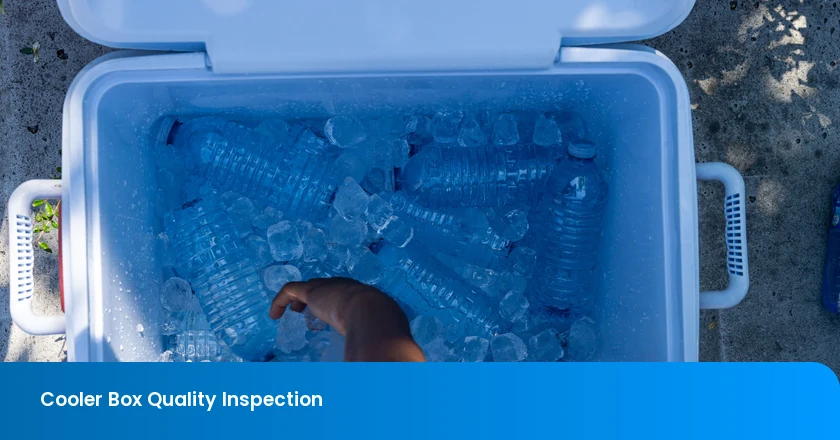
A cooler box order needs both a sound physical assembly and credible evidence for its retention claim. A lid that latches does not prove the seal is complete, and a cold box at the end of a short factory demonstration does not establish the advertised duration. Buyers should agree what thermal result is being claimed and how it will be verified before scheduling the inspection.
Cooler box quality inspection should then cover lid sealing, thermal retention, hinge operation, loaded handles, the drain assembly and packed-product protection. A useful report separates production defects requiring correction from performance claims awaiting evaluation. These checks cover passive rigid portable coolers; powered refrigeration requires additional product-specific evaluation.
The Six Checks to Include in the Cooler Inspection
Use the inspection sheet to agree the checks, criteria and resources with the supplier and inspection team. The buyer needs model requirements; the team needs suitable equipment and time. Identify long thermal evaluations separately from the physical factory checks so a short visit does not silently reduce the performance requirement.
CheckFactory operationCompare withLid sealCheck seating, seal continuity and latch engagement; perform any specified spill test.Approved closure geometry and applicable leakage criterion.Insulation retentionLog the defined internal temperature and ambient conditions over the required duration.The specified load, starting conditions, measurement positions and endpoint.Hinge cyclesOpen and close through the prescribed angle and cycle sequence.Required cycles and post-test alignment, attachment and function.Handle loadApply the prescribed loaded-box lifting or carrying procedure.Total test mass, configuration and attachment/deformation limits.Drain plugInspect the complete assembly, check drainage and test the closed drain.Approved parts, operating positions and defined leak conditions.Carton testsTest the complete packed unit using the selected handling protocol.Required orientations and severity, then product and packaging condition.
EN 12546-2:2000 is a possible reference when its scope and the buyer's specification match. NEN lists it as current and describes portable domestic insulated boxes, chests and bags for generally packaged food or drinks. The scope excludes heat-producing or heat-removing devices, industrial or catering containers, and several other container types. Obtain the complete adopted method; the catalog description does not supply universal inspection loads, cycle counts or thermal limits.
Does the Closure Provide the Intended Seal?
The lid seal check should establish that the closure matches the intended design around the whole opening. Where a gasket is fitted, inspect this sealing strip for missing sections, cuts, twisting, poor joints or areas pulled out of their seat. For designs without a separate gasket, compare the mating lid and body surfaces with the approved sample instead of adding a seal requirement the product never had.
For an uneven closure, ask the report to locate the gap, lifted corner or distorted gasket with the lid normally closed and latched. Debris removal should not become seal modification. Tightening a latch or reseating a gasket may explain a change, but the original production condition and the corrected result both matter to the buyer.
If the product claims spill resistance, use the specified fill level, orientation, exposure time and leakage criterion in a stable fixture or catch tray. An upright drain-leak check does not test the entire lid perimeter. Conversely, turning an ordinary cooler upside down is not a valid universal test: use an inversion or tilt procedure only when the design and agreed requirement call for it. Do not improvise a pressurized air or water test.
Photograph the location of any gap or leak before adjustment. If changing latch tension or reseating the gasket corrects the observation, retain both conditions and ask the supplier why the production unit needed adjustment. Assess fresh units after the correction. Closure appearance and spill performance can support a specific lid finding, but neither replaces the controlled insulation-retention test.
Decide What the Retention Claim Means Before Comparing Results
If the required retention test lasts longer than the visit, arrange its completion separately. Agree sample control, environment, logging and reporting before booking. The factory visit may document the setup or review completed results, but neither is the same as supervising the full duration.
Specify whether acceptance concerns remaining ice, internal-air temperature or the temperature of a defined test load, and identify the endpoint. These are different results. Ask the supplier which complete method supports the duration claim and which cooler sizes and constructions it covers before arranging a production comparison.
A concrete manufacturer example shows why the setup matters. Igloo's published testing method describes filling a cooler to 90% capacity with ice initially at 10°F, keeping the lid closed, and continuously tracking internal temperature in a 90°F environment at 70% ± 5% humidity. It concludes the test at an internal temperature of 40°F. Those conditions define that manufacturer's stated method; they are not acceptance requirements for every cooler.
For comparable reports, check preconditioning, ice or cooling-pack quantity, contents, starting temperatures, ambient conditions and lid-opening schedule. A different size, insulation version or prepared load should not inherit a duration result by name alone. The report must identify the actual model and preparation.
The temperature log must state what was measured and where because sensor placement changes what the result describes. An air probe clear of the wall, ice and contents is not interchangeable with a sensor touching the liner or inserted in the load. Request sensor locations and a separate ambient record, and check that sensor wiring did not change the lid seal. Without those details, different-looking curves may describe different tests rather than different insulation quality.
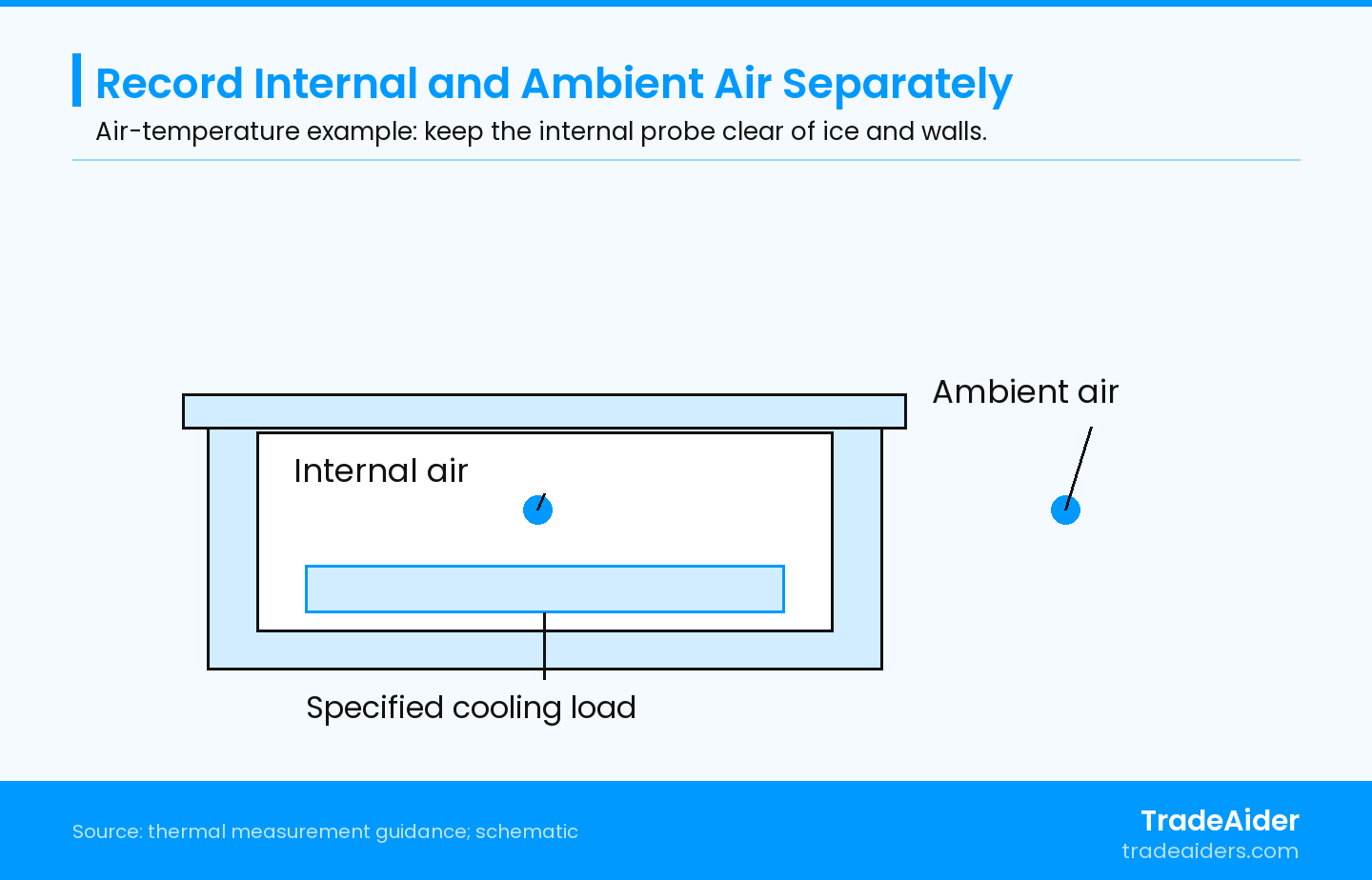
Air-temperature setup example, not to scale. Use the positions and measured medium required by the actual method; this is not a prescribed standard test arrangement.
Review the logger's timing, sampling interval, missing readings and suitable calibration or verification status before accepting an endpoint. If the limit falls between readings, the report should state the observed interval rather than claim an exact unmeasured time. A setup or data gap needs clarification or a valid repeat, rather than an automatic product rejection.
Hypothetical Example: Two Temperature Logs That Cannot Be Compared
Suppose the buyer requests an internal-air temperature comparison under the same load and ambient conditions. One factory unit has its probe suspended in the prescribed air space; the other has the probe resting against an ice pack. The second log stays colder, but it is measuring a different condition. The apparent advantage cannot establish better insulation in that unit.
The inspector identifies the placement difference, retains both initial logs and repeats the comparison on suitably prepared samples with matched sensor positions. The new results can then be judged under the agreed method. If a difference remains, investigate the box construction and closure rather than assuming the misplaced probe explained every variation. This hypothetical example concerns comparable measurement; it is not a measured client result or a suggested thermal acceptance limit.
Hinge Wear Matters When It Changes Lid Fit
A hinge-cycle test should reproduce the opening movement defined for the cooler and assess the assembly afterward. Inspect hinge pins, fasteners, mounting areas and the lid stop before starting. Confirm that the lid opens and closes without forcing it past its intended travel. Record existing looseness so later movement is not confused with a condition already present.
For a cycle result, require the defined opening movement, return position, speed, latch operation and cycle count. That lets the buyer distinguish a short function check from the durability claim. A fixture that adds unintended side load or support can make the result unsuitable for the comparison.
After cycling, examine cracks, pin movement, fasteners backing out, increasing play and damage at the lid stop. Close the lid again and compare its alignment and latch operation with the initial condition. A hinge that still moves is not necessarily acceptable if the lid now seats poorly. Where the test plan calls for a post-cycle seal or thermal check, complete that defined check; do not infer the result from hinge appearance.
Do not tighten fasteners midway through a continuous endurance sequence unless the method permits it. If a repair is needed, record the completed cycles and failure condition. The buyer should decide the correction and repeat-test scope rather than treating the repaired sample as if it completed the original sequence without intervention.
Check the Carrying Claim for the Complete Loaded Box
Handle load testing needs a defined total mass and a defined way of lifting or carrying the box. Include the cooler itself in the total mass calculation, along with the prescribed contents or test weights. A capacity label in liters or quarts describes volume; it does not by itself establish the mass the handles must withstand.
Confirm which handle or combination of handles the carry method covers and how the contents were restrained. A two-person lift and a single-handle suspension apply different conditions. The fixture and distribution should reproduce the approved method without moving weights or introducing an unintended off-center load.
Operator safety is separate from product strength. CCOHS compact-load guidance recommends planning a clear path, obtaining a secure grip and avoiding twisting during a lift. It does not set a cooler-handle strength threshold. Use appropriate fixtures or assistance for the prescribed test, keep people clear of a possible falling load, and do not make an inspector's ability to carry the box the acceptance criterion.
Apply the specified load, direction, duration and repetitions. Check afterward for cracked mounting areas, pulled-out fasteners, permanent bending, strap damage or a grip that no longer operates correctly. Record where the damage appears and whether the box was lifted in the required configuration. Retightening an attachment after it moves should be documented as an intervention, with the original result retained.
A Replacement Cap May Not Resolve a Drain Leak
Drain inspection should cover the cap, sealing components and the connection through the cooler wall. Check that the correct parts are present, threads engage normally, the sealing surface is clean, and any tether does not interfere with closure. Inspect the surrounding liner and outer shell for cracks or gaps. A cap that screws on can still belong to an incompatible assembly.
For example, Igloo's threaded drain assembly listing identifies compatible cooler sizes and includes a cap, grommet, washer and threaded collar as well as the drain plug. That is a product-specific parts example, not a universal construction requirement. For the ordered cooler, compare the complete assembly with its approved parts list and drawing.
Require the leak location, fill level, operating position and observation duration. Distinguish the cap seal from the through-wall fitting and from water left on the exterior during filling. Replacing a cap cannot verify a correction if the original leak came through the fitting's connection to the wall.
Open the drain and confirm the intended flow and operating position. If drainage requires tilting, follow the instructions and use safe support; do not impose a zero-residual-water requirement on a design that was not specified to achieve it. Close the drain again and complete any required repeat leak check. Keep a drain-leak finding separate from a lid spill finding, even when both observations are reported for the same cooler.
Connect Carton-Test Damage with Cooler Function
Carton testing should evaluate the actual shipping arrangement, including the cooler, accessories, inserts, bag, closure and outer carton. Check carton identity, dimensions, condition and the packing layout first. Protect protruding handles, latches and the drain fitting according to the approved design. An empty-carton result cannot establish how those parts behave inside a packed unit.
ISO 2248:1985 describes a vertical drop method for complete filled transport packages, with atmosphere, drop height and package orientation predetermined. The public scope supplies that testing distinction, not a universal drop height or a complete shipping qualification. Use the complete selected method and product criteria; add compression, vibration or other tests where the distribution plan requires them.
The package-test result should identify the complete packed configuration, orientations, sequence and severity. Require the cooler's condition before and after, including lid alignment, handle mounts and drain fittings. A report on a different insert arrangement cannot establish the protection of this order's pack.
Repeat the functional checks required by the protocol after the packing test. A dented corner may be cosmetic, while a shifted lid or cracked drain fitting may change use; judge each against the written criteria. Do not silently replace damaged inserts during the sequence. If the supplier changes packing materials, the buyer needs a defined check of the revised arrangement, not merely a photograph of a fresh carton. Keep tested units separate pending their disposition.
Turn Cooler Findings into Specific Supplier Actions
Give the supplier a finding it can investigate: a gasket lifting at one corner, a temperature test with mismatched probe positions, a cracked handle mount after the prescribed load, or seepage around the drain fitting. Identify the sample, method and failed comparison. The next step depends on what the observation actually establishes.
- Physical defect: preserve the original condition, identify the affected construction or packing feature and check the supplier's defined correction on fresh samples.
- Invalid test setup: resolve the differing load, environment, sensor position or operating sequence before comparing performance.
- Required test not completed: arrange the outstanding evaluation and keep that result unresolved rather than treating a short demonstration as a pass.
TradeAider's inspection-standard guidance explains sampling and checks tailored to customer requirements. Use it to agree sample coverage and defect classification; sampling does not supply thermal endpoints or mechanical test limits.
TradeAider's pre-shipment inspection takes place when the order quantity is 100% complete and at least 80% packed for export. This provides access to finished coolers and actual packing. Confirm fixtures and the available test duration when arranging the scope.
Send the model specification, approved sample, thermal method, hardware loads and cycles, drain requirements and shipping-test plan. Contact TradeAider to arrange your cooler inspection and confirm which checks fit the factory visit and which need separate testing.
Frequently Asked Questions
Does ice remaining at the end prove the required contents stayed cold?
No. Remaining ice, internal-air temperature and the temperature of the specified contents are different endpoints. Use the result required by the purchase claim and its defined method. A photograph of ice can support that observation, but it does not replace a temperature record for a test load. Conversely, a contents-temperature result should not be restated as an ice-retention duration unless that was actually evaluated.
Can one cooler size's thermal report cover every size in the range?
Not automatically; the buyer needs a technical basis for the models covered. Size changes can alter the load arrangement and surface geometry, while lid, liner or insulation changes may alter construction. Compare the tested configuration with each claimed variant and ask a qualified reviewer to justify any grouping. A shared product-family name alone does not establish equivalent thermal performance.
Can water-tested coolers be packed immediately afterward?
Dry and inspect them according to the agreed handling procedure before returning eligible units to packing. Identify the tested samples, remove test liquid and check accessible recesses, the drain and packing-contact surfaces. Do not put damp inserts back into cartons. If a test damaged or contaminated a unit, its separate disposition must be resolved instead of assuming that drying makes it saleable.
Does passing a cooler performance standard establish food-contact suitability?
No, a performance result does not by itself establish suitability for the intended food contact. Determine whether use involves packaged drinks, wrapped food or direct contact with the liner, water or ice, then obtain the relevant material and destination-market support. Match that documentation to the actual construction. Insulation, handle and package results answer different questions from the permitted use of food-contact materials.
Articles Connexes

Développez votre entreprise avec le Service TradeAider
Cliquez sur le bouton ci-dessous pour accéder directement au Système de Service TradeAider. Les étapes simples de la réservation et du paiement à la réception des rapports sont faciles à utiliser.