
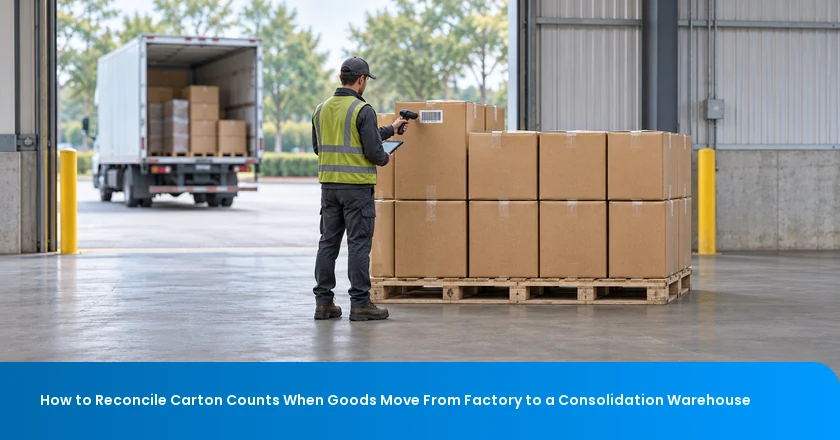
Compare the factory’s actual dispatch tally with the consolidation warehouse’s physical receipt, using the same transfer, counting unit and carton identifiers. Then trace the confirmed cartons to the lot covered by the inspection report. Hold unexpected, damaged or unverified cartons out of the loading list while you resolve the differences. An equal count can hide a missing carton if another one arrived in its place.
Collect the three records for the same movement
Use the inspection report, actual factory dispatch tally and actual warehouse receipt for the same transfer. A consolidation warehouse receives goods for combination into an onward shipment. Its receipt may cover several vehicles, origins or orders, so isolate the movement you are reviewing before comparing quantities.
- Inspection report. Record the report ID and date, factory, product and lot, quantities presented, and carton ranges or group identifiers if shown. Note the sampled carton IDs if recorded, and the checks or limitations attached to them.
- Factory dispatch tally. Request what the factory actually handed to the carrier by carton or verified group, with the pickup time, transfer reference and any items left behind. Keep the carrier’s acknowledgment and the scope it covers with the tally.
- Warehouse receipt. Request the physical tally, observed carton IDs or mapped groups, arrival time, receiving bay and visible condition. Keep exception notes and any counts added after the initial receipt as separate dated entries.
The GS1 logistics interoperability standard describes an inbound receipt notification as a comparison of actual goods received with what the shipper had notified as sent. In a simple manual process, keep the expected shipment list and the counted receipt as separate columns. Record where the factory’s actual handoff differs from the advance list and retain each version of the records.
Use TradeAider’s inspection standard when agreeing how the original inspection and its physical scope should be recorded. For a report already issued, use the references it actually contains and request the linked packing or staging record if carton identity is unclear.
Compare factory dispatch with actual warehouse receipt
Reconcile what was sent and received before checking whether the current cartons fall within the original inspection scope. Match records by purchase order, source factory, product code, transfer reference and delivery cutoff. Compare carton counts with carton counts. If a record is in pieces or pallets, document how it connects to cartons before using it in the reconciliation.
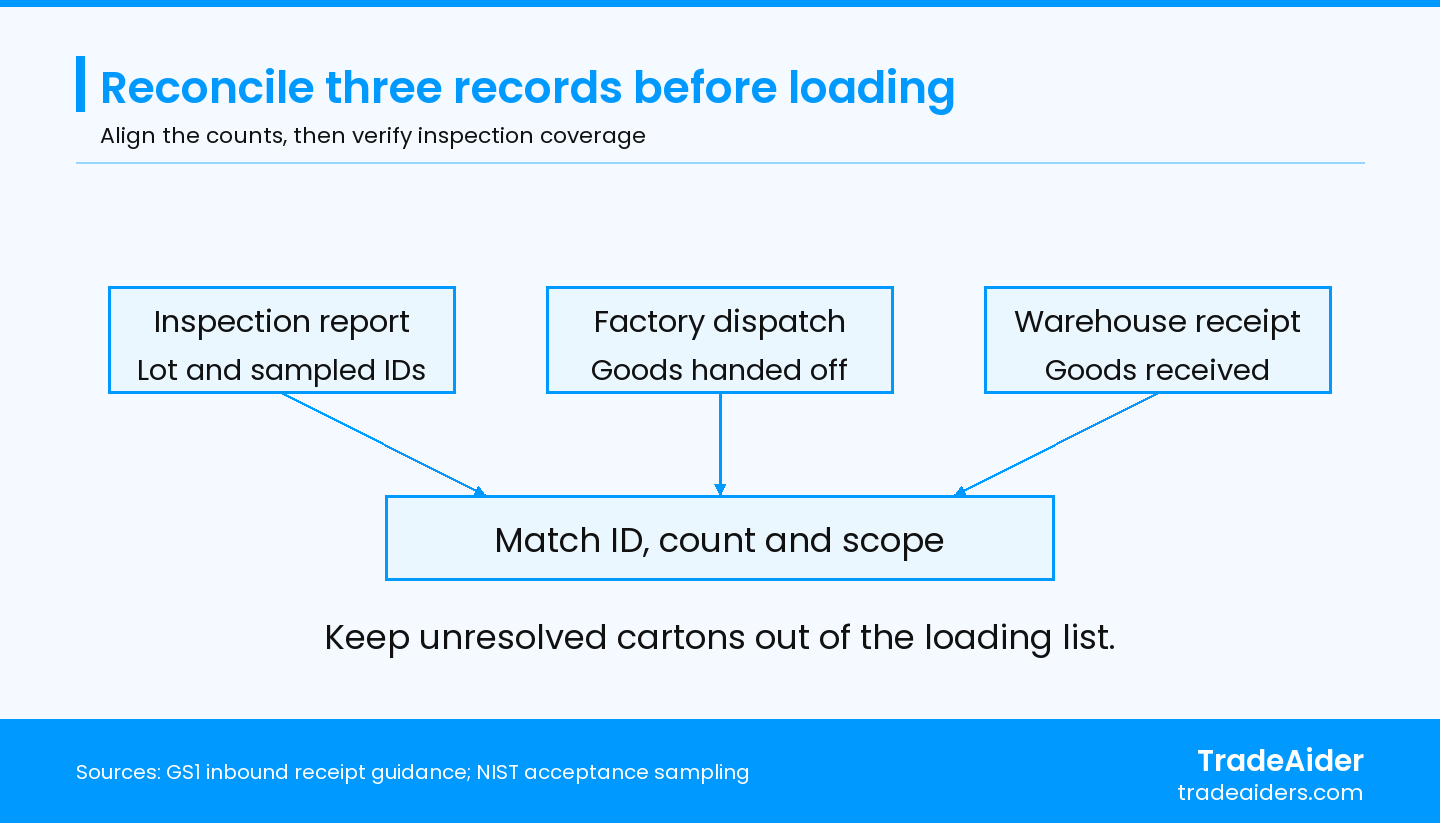
Match what left the factory to what arrived, then trace the confirmed cartons to the earlier inspection lot. Keep unresolved cartons out of the proposed load.
TradeAider lists quantity and packaging checks among its container loading supervision checkpoints. Give the loading supervisor the reconciled scope and the holds before loading. Agree which visible checks and counts the supervisor will be able to witness at that later handoff.
Recount by transfer, carton and location
Compare physical receipts and unique identifiers rather than raw scan events or expected counts. Freeze the comparison at a defined time, and have the warehouse recount the affected bay or staging lane. Compare the exact marks on the cartons to the dispatch tally. If a unique ID appears twice in the scan log, check whether the same carton was scanned twice or two cartons actually carry the same identifier. Keep both event records until that difference is resolved.
In an example in the GS1 Global Traceability Standard, the receiving team scans pallet identifiers and compares them with previously registered information. If your warehouse receives at pallet level, identify which pallet each carton group belongs to and record what was directly counted. A pallet scan identifies the pallet. To use its manifest for carton quantities, verify the link to the contents and document any limits on seeing or counting them.
Trace received cartons to the original inspection lot
Keep original lot coverage and physically sampled carton identities separate in the reconciliation. An inspection lot is the defined group of goods the inspection decision covers. Use the report and corroborating packing records to check whether the factory’s dispatched cartons came from that lot. Preserve any sampled IDs as observations about those cartons. When a sampled carton is missing, keep the original report and ask the quality owner to consider what the departure means for the next decision.
The NIST Engineering Statistics Handbook describes acceptance sampling as drawing a sample from a defined lot to support a decision about that lot. An earlier lot result remains a record of that inspection. When the shipment population changes, review the trace and the applicable acceptance requirements before relying on it for the goods now offered. Treat any additional check as a dated result with its own observed scope.
Route discrepancies before the goods are staged for loading
Record quantity, identity and physical condition differences before authorizing affected stock for loading. For each difference, list the carton or group, expected and actual condition or quantity, source observations, owner and open action. Ask the warehouse to keep held goods out of the available stock and identify them physically wherever they are staged.
| Difference found | Evidence to ask for | Action before loading |
|---|---|---|
| A scan repeats an ID | Warehouse physical count and both event records | Correct the tally only if it was a repeat scan of the same carton |
| An expected carton is absent or an extra carton arrives | Factory pickup list, carrier handoff records and warehouse recount with IDs | Keep the expected shortage open and hold the unexpected carton pending trace |
| Carton identity is unreadable or changed | Old and new marks, lot evidence and dated label or group records | Verify the mapping or hold the affected cartons |
| Expected carton arrives damaged | Receiving photos and any earlier condition record | Count it as arrived and hold it from loading pending condition review |
Compare handoff times and the scope of each record to locate where the evidence stops agreeing. A signature may acknowledge a pallet or vehicle and leave carton-level counts unverified. Request the underlying tally before relying on the signed total. If the records still leave an identity or condition gap, have the buyer or designated quality owner specify whether to extend the hold or arrange an inspection of the affected stock.
The total is 96 on both sides, but one carton is different
Illustrative scenario. A factory hands off 96 cartons of roll-up tool pouches, RL001 through RL096. The factory inspection report covers that defined lot, and RL036 is one of the sampled cartons recorded in it. At the warehouse, the raw log contains 97 scan events. The receiving lead recounts 96 physical cartons at the delivery bay and checks the unique carton marks.
An equal received total can conceal a missing carton and an unexpected carton. In this example, there are 95 carton IDs that match the factory tally. RL036 is missing and RX101 is present instead. The extra scan event is a repeat of RL085, which the receiving lead confirms is one physical carton.
- Keep the original 97 scan events. Record the confirmed duplicate as an explanation for the count of 96 on the receipt.
- Keep RL036 listed as missing. Ask the factory and carrier to check loading, transfer and arrival records for its last verified point.
- Hold RX101 and record its actual marks and condition. Confirm its origin independently. An identical product code on the carton would leave its lot identity unresolved.
The physical receipt of 96 consists of 95 matching cartons and one held unexpected carton. The missing carton stays open as a shortage against the dispatch. Because it was sampled earlier, ask the quality owner to review the original inspection scope and check whether the evidence points to broader handling or identity risks. The buyer may consider loading the 95 matched cartons only after confirming their scope and separation and approving a documented partial shipment.
Approve the actual loading list by carton or group
Give the loading team an approved list of the exact cartons or verified groups cleared to load. Link each row to the dispatch and receipt references, any valid carton mapping and the original report scope. List verified counts, revised loading quantity and the excluded or pending IDs. Keep physically present held cartons separate and identify their location so the next shift can find them.
Record the approver, time and reason for any partial release, and document the exact goods still open. Keep the original receipt and inspection result as historical evidence. If another delivery reaches the warehouse or a carton’s status changes, update the proposed loading list before those goods can be loaded.
To discuss a follow-up check, contact TradeAider with the factory tally, current receipt, original report and exception list. Specify which cartons can be seen at the warehouse and what needs to be verified before loading.
FAQ
Can pallet counts substitute for carton counts?
Use a pallet tally only at the level it actually verifies and record how the carton quantity under it was established. If stretch wrap prevents a reliable direct count, document the pallet ID, observed packing integrity and the associated packing record. Agree what additional access or confirmation the buyer needs for the carton-level decision.
What if a warehouse label replaced the factory carton number?
Use a verified old-to-new identifier map before treating the carton as a confirmed match. The mapping should identify the old mark, new mark, time, person making the change and evidence tying both marks to the same physical carton. Retain the reference to the factory lot and inspection record.
How do you record a carton that arrives after the first receipt?
Post a dated follow-up receipt against the same transfer and record exactly what arrived. Check its identity and condition before closing the shortage. If the approved loading scope changed meanwhile, obtain the applicable authorization before adding the carton to the current load.
Articles Connexes
Développez votre entreprise avec le Service TradeAider
Cliquez sur le bouton ci-dessous pour accéder directement au Système de Service TradeAider. Les étapes simples de la réservation et du paiement à la réception des rapports sont faciles à utiliser.