
Amazon sellers should respond to a failed Pre-Shipment Inspection by separating FBA-readiness defects from customer-quality defects, classifying severity, pausing shipment release, requiring supplier correction, and reinspecting when the correction affects launch, receiving, reviews, or return risk. A supplier discount is not enough if the failed finding will still reach Amazon customers.
A failed PSI feels urgent for Amazon sellers because inventory timing is tied to launch dates, ranking momentum, advertising plans, storage planning, and cash flow. The supplier may push to ship anyway. The seller may worry about stockout. The freight forwarder may already be waiting. This is exactly when a structured response matters.
The seller should not read a failed PSI as a single yes-or-no event. The real question is what failed and where that failure will hurt. A wrong FNSKU label creates FBA receiving risk. A loose accessory creates customer-return risk. A missing warning label creates compliance and account-health risk. A minor cosmetic scuff may be negotiable. The response should follow the risk.
- First move: pause final release until the failed finding is classified.
- Second move: separate FBA receiving, prep, compliance, and customer-quality risks.
- Third move: require supplier correction with evidence and a deadline.
- Fourth move: reinspect when the correction must be proven before Amazon receives inventory.
The Direct Answer
After a failed PSI, Amazon sellers should choose one of five paths: rework and reinspect, relabel and verify, split shipment, accept with concession, or hold/reject.
Amazon public Seller Central guidance says FBA inventory uses barcode identification and discusses manufacturer barcodes, Amazon barcodes, and Transparency codes. That makes label failure a real operational risk, not only a cosmetic issue. Source: FBA barcode guidance.
Amazon packaging guidance also points to secure packaging, set labeling, and covering or rendering irrelevant outside barcodes unscannable. Those are exactly the kinds of issues a failed PSI may uncover before shipment. Source: FBA packaging and prep guidance.
For an Amazon seller, a failed PSI should become a release meeting. The seller should review the report, supplier response, FBA shipment plan, product listing promise, launch deadline, and final payment status. Then the seller should document one action path in writing.
Failed PSI Response Matrix
The response depends on whether the failed finding threatens FBA receiving, customer experience, or compliance.
| Failed Finding | FBA Risk | Seller Response | Reinspection Needed? |
|---|---|---|---|
| Wrong FNSKU or exposed old barcode | Receiving scan error or inventory mismatch | Relabel, cover wrong codes, verify scan photos | Yes, if label scope is broad |
| Set not packaged or marked correctly | Components may be separated or received incorrectly | Repack as sellable unit and mark set | Usually yes |
| Major function defect | May pass receiving but drive returns and reviews | Sort, rework, test corrected sample | Yes |
| Compliance label or warning mismatch | Listing, safety, or account-health risk | Hold until corrected and documented | Yes |
| Minor cosmetic issue | Possible customer dissatisfaction if visible | Accept only if bounded and commercially tolerable | Maybe |
| Mixed SKU carton | Receiving and fulfillment errors | Separate cartons, fix packing list, verify carton marks | Yes |
This matrix keeps the seller from accepting the wrong compromise. A discount may offset a small cosmetic issue, but it does not fix inventory that Amazon cannot receive correctly or customers will return. The seller should negotiate only after containment is clear.
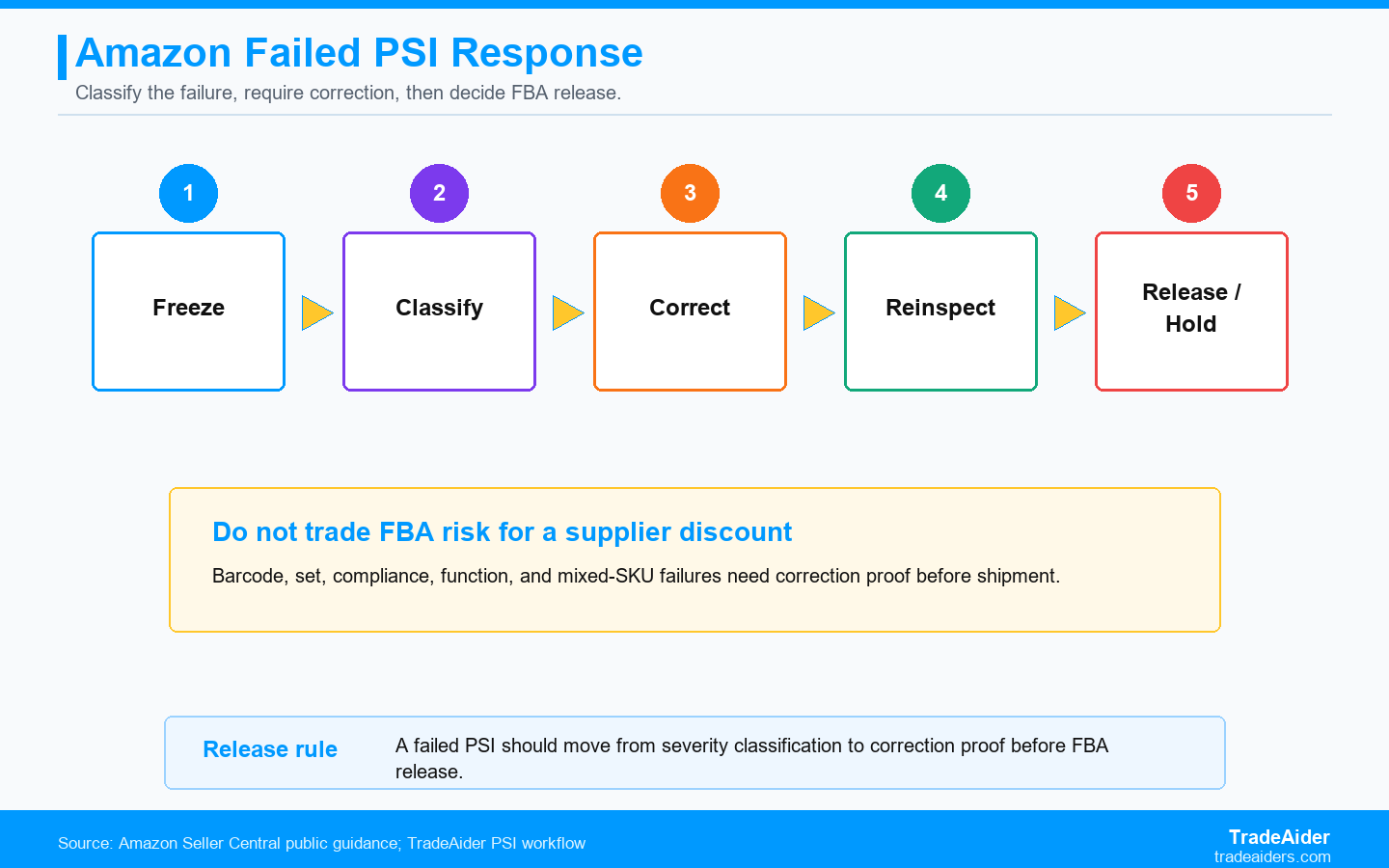
A failed PSI should move from severity classification to correction proof before FBA release.
Step 1: Freeze Shipment Release
Do not let the supplier convert the failed report into a shipping-pressure conversation.
The first response is simple: pause release while the finding is reviewed. This does not always mean cancelling the shipment. It means the seller does not release final balance, freight handoff, or FBA shipment approval until the report is translated into an action. A rushed release usually benefits the supplier more than the seller.
Freezing release also protects evidence. If cartons move, labels change, or goods are loaded before the seller documents the problem, the report becomes harder to use. The seller should save the original report, defect photos, AQL details, carton references, and supplier messages in the same folder as the shipment plan.
Step 2: Classify The Failure For Amazon Risk
Amazon sellers need a different lens than general importers because fulfillment and reviews amplify small errors.
Some failed PSI findings are Amazon-specific. A wrong barcode, wrong set label, exposed old barcode, or mixed case pack can create receiving errors before the customer ever sees the product. These should be corrected before FBA delivery because inventory stuck in the wrong status is expensive to fix.
Other findings are customer-specific. Loose parts, poor finish, weak adhesive, missing accessories, wrong insert, and function failures may pass warehouse receiving but create returns, negative reviews, and support tickets. These findings should be judged against the listing promise and customer expectation, not only the supplier's factory tolerance.
A third group is compliance-sensitive. Warning labels, age grading, battery marks, material claims, model numbers, and safety statements should match the product and documentation. A seller should not accept these issues for a discount because the downstream risk can involve account health and product suppression.
Step 3: Ask For Corrective Action, Not Reassurance
The supplier should explain scope, correction method, timeline, and proof.
A supplier may say the problem is small or already fixed. That is not enough. The seller should ask which cartons, SKUs, production dates, colors, or label ranges are affected. The supplier should state how goods will be sorted, relabeled, repacked, reworked, or replaced. The seller should ask who will verify the correction and when.
For label and FBA prep defects, correction evidence should be visual and specific. The seller should receive close-up photos of the corrected unit label, carton label, covered old barcode, set label, accessory packaging, and carton marks. But photos from the supplier may not be enough when the failure was broad. Independent reinspection protects the seller from shipping a claimed correction.
What To Put In The Supplier Correction Request
A failed PSI response should tell the supplier exactly what must change before release.
A weak message says the inspection failed and asks the supplier to improve quality. A strong message names the failed finding, defect class, affected scope, correction method, evidence required, deadline, and reinspection condition. This turns the conversation from emotion into execution.
Amazon sellers should be especially specific with label and prep issues. For example, do not ask the supplier to fix labels generally. Ask them to replace the wrong FNSKU on SKU A, cover exposed supplier barcodes on all master cartons, apply set labels to the retail pack, and send a corrected packing list. Specificity saves time and reduces the chance of a second failed inspection.
| Correction Request Field | What To Write | Why It Matters | Evidence Needed |
|---|---|---|---|
| Failed finding | Name the defect and cite report photo or sample count | Prevents vague supplier denial | Report page and photo reference |
| Affected scope | SKU, color, carton range, production date, or label version | Controls whether split release is possible | Packing list and carton mark |
| Correction method | Relabel, rework, sort, replace, repack, or hold | Makes supplier action measurable | Before/after photos |
| Verification rule | Supplier photos plus TradeAider reinspection if release risk remains | Prevents claimed correction from shipping unchecked | Reinspection report |
The seller should also state that acceptance of one shipment does not reset the standard for future orders. If a concession is allowed, write the concession as shipment-specific. Otherwise the supplier may treat the compromise as a new tolerance and repeat the same issue on the next PO.
Step 4: Decide Between Reinspection, Split Shipment, Or Concession
The next step should match the risk remaining after correction.
Reinspection is appropriate when the supplier changes physical goods after a failed PSI: relabeling, repacking, sorting, replacing accessories, repairing function, or reworking packaging. It is also appropriate when the seller's launch depends on avoiding FBA receiving problems. Reinspection answers whether the correction worked.
A split shipment can work if the affected and unaffected goods are clearly separated. For example, one SKU fails label verification but three SKUs pass. The seller may release the clean SKUs and hold the affected SKU. This requires carton-level identification and a corrected packing list; otherwise the split creates more risk.
Acceptance with concession should be reserved for bounded, noncritical issues that do not threaten receiving, compliance, function, or customer acceptance. The seller should document that the concession applies only to this shipment and does not change the standard for future orders.
Where TradeAider Fits After A Failed PSI
TradeAider fits by helping the seller convert a failed report into a controlled correction path.
TradeAider's e-commerce quality solutions are relevant when Amazon sellers need FBA-ready label, packaging, accessory, and product-quality evidence before inventory enters fulfillment.
If the report failed at final inspection, TradeAider can support reinspection after supplier correction. If the failure shows process drift, During Production Inspection may be added on the next order. For finished goods, PSI remains the release gate.
The business fit is urgency with discipline. Amazon sellers often have time pressure, but TradeAider helps make the next action evidence-based: relabel, rework, reinspect, split, accept with concession, or hold.
SPAR Scenario: The Seller Did Not Ship The Failed Lot
The seller protected launch quality by delaying two days.
Situation: A private-label seller orders 5,000 silicone food-storage lids for US FBA. The launch date is close, and the supplier asks for shipment release.
Problem: PSI fails because one color has the wrong FNSKU label and sampled units show loose accessory bands. The supplier offers a small discount if the seller ships immediately.
Action: The seller freezes release, asks the supplier to relabel the affected color, secure accessories, and provide a corrected packing list. TradeAider reinspects the affected SKU and label scope.
Result: Shipment is delayed two days, but the seller avoids FBA receiving confusion and customer complaints. The failed PSI becomes a controlled correction, not a launch disaster.
Action Card: Failed PSI For Amazon Sellers
Respond with a release decision, not a vague supplier negotiation.
- Freeze shipment release until the failed finding is classified.
- Separate FBA receiving risk, customer-return risk, compliance risk, and minor cosmetic risk.
- Require supplier corrective action with affected scope and proof.
- Use reinspection when relabeling, repacking, sorting, or rework affects release.
- Accept a concession only when the remaining defect is bounded and does not damage FBA or customer outcomes.
After the shipment is resolved, update the Amazon inspection checklist. A failed barcode should become a mandatory label proof. A loose accessory should become a packing-line check. A function defect should become a DPI or PSI test point. The next order should not repeat the same failure.
If your Amazon shipment failed PSI, send TradeAider the report, SKU list, FNSKU files, shipment plan notes, supplier response, final payment status, and launch deadline. The next step is to ask TradeAider to turn the failed PSI into a rework, reinspection, split-shipment, or hold decision.
Frequently Asked Questions
Should I ever ship after a failed PSI?
Yes, but only when the defect is bounded, noncritical, documented, and acceptable for FBA receiving and customers. Many barcode, set, compliance, and function failures should be corrected before shipment.
Is a supplier discount enough after failed PSI?
Not when the defect still creates receiving errors, returns, reviews, or compliance exposure. Discount should follow containment, not replace it.
When should Amazon sellers reinspect?
Reinspect when the supplier relabels, repacks, sorts, repairs, replaces accessories, or claims a failed defect pattern has been corrected.
Can TradeAider help review the failed report?
Yes. TradeAider can help sellers interpret the report and define the next action path before shipment release.
Articles Connexes
Développez votre entreprise avec le Service TradeAider
Cliquez sur le bouton ci-dessous pour accéder directement au Système de Service TradeAider. Les étapes simples de la réservation et du paiement à la réception des rapports sont faciles à utiliser.

