
A portable electric heater pre-shipment inspection, or PSI, should check the actual finished model against approved assembly, rating-label, function and packaging references. Separate what the inspector observes from measurements made with an agreed test setup and from laboratory safety evidence. A heater that starts and produces warmth has demonstrated those functions; it has not, through that demonstration alone, established protection against overheating or an internal electrical fault.
Three distinctions to keep in the heater inspection brief
- Match the heater build, plug, labels and accessories to the destination version.
- Agree safe operating checks and any equipment-based tests before the visit.
- Keep missing tests and unresolved safety evidence visible in the shipment report.
Freeze the heater model and inspection references
Portable household electric heaters include several constructions with different inspection needs. The International Electrotechnical Commission, or IEC, lists convection, fan, radiant and liquid-filled designs in its public scope for IEC 60335-2-30. That public abstract identifies the room-heater safety subject; it does not supply a complete test procedure. Confirm the applicable standard, national adoption and product configuration with the responsible technical party rather than treating one standard number as approval for every destination.
Use this checklist for the approved portable household configuration. A fan heater needs airflow and fan-control checks; an oil-filled radiator needs attention to its body, supports and visible leakage. Apply only the features present. Fuel-burning heaters, permanent-installation-only heaters and industrial heating systems need a different brief. A similar enclosure or shared brand name does not make their safety evidence interchangeable.
Before inspection, identify the model and current construction revision, order quantity, variants, destination, supply rating and plug version. Collect the approved sample or drawings, parts list, rating and warning artwork, operating instructions, accessory list and packing specification. Ask which laboratory or certification records cover this build, and which routine checks the buyer requires. Assign an owner to resolve missing references before the relevant work starts.
For TradeAider PSI, the order quantity is 100% complete and at least 80% packed for export. The packing threshold does not mean production can be only 80% complete. Confirm accessible goods and the actual sampling basis. Use the inspection sampling reference to discuss lot definition and selection; electrical or protective-function checks may have separately agreed quantities and methods.
Check assembly, the guard and the power-cord path
A heater assembly check should follow the parts that support the appliance, contain heat and protect the power connection. Compare feet, casters, base fasteners, handles, grille and enclosure joints with the approved build. Record missing hardware, distorted guards, cracked supports, loose parts and sharp exposed edges. Check the intended standing configuration on the agreed surface without inventing a tilt angle or stability-test method.
Trace the accessible cord path from the housing entry to the plug. Look for pinching, cuts, damaged insulation, missing entry protection, distorted pins and an incorrectly fitted strain-relief part. Photograph the location and unit identity. A visual examination is different from a specified cord-anchorage pull test. Do not open a plug, remove a guard or dismantle an energized heater to investigate a suspected problem; any authorized internal examination needs competent personnel, isolation and an agreed restoration procedure.
The US Consumer Product Safety Commission, or CPSC, describes internal heater-plug connection inconsistencies found during investigations of thermally damaged plugs, including crimping, welding or soldering problems. Those investigated plugs do not establish a defect rate for all heaters. They do show why an intact-looking plug cannot establish the quality of its hidden connections. Escalate a construction concern for the relevant component records or properly arranged investigation.
| Heater feature | Check against the approved reference | Record or follow-up |
|---|---|---|
| Base and guard | Correct parts, fastening, fit and visible condition | Unit photo; missing or distorted part |
| Cord and plug | Accessible routing, entry protection, insulation and plug version | Damage location; separate anchorage-test result if agreed |
| Rating label | Model, electrical rating and destination artwork | Legible image and artwork revision |
| Normal controls | Present modes, heating response and shutdown sequence | Observed sequence and operating conditions |
| Accessories | Required supports, hardware, remote and instructions | Count, version and assembly fit |
| Packing | Approved inserts, orientation, restraint and carton marks | Opened-pack photos and packing reference |
Use agreed defect classifications and the actual inspection plan when assessing workmanship. The acceptance quality limit, or AQL, is an index for a sampling scheme, not a permitted shipment defect percentage. The AQL sampling calculator can support that plan once its inputs are agreed. It does not choose the quantity or acceptance criteria for a separate electrical test.
Match rating labels, warnings and supplied accessories
A heater rating label must identify the version actually being inspected. Compare the physical product, carton, manual and approved artwork side by side. Verify the model, rated voltage and frequency, and the input power or current shown in the approved specification. Check the required manufacturer or importer details, warnings and other markings for the applicable destination. Do not copy a generic marking list across markets or assume every field applies to every design.
Record whether labels are present, legible, correctly positioned and matched to the intended surface. Check adhesion or durability only by the agreed method; rubbing a label informally cannot establish compliance with a specified durability test. Preserve clear images of the complete label and any mismatch. If the carton says one rating and the heater says another, establish the actual build before deciding which printed item needs correction.
A certification mark needs a matching verification record. UL describes Product iQ as a tool for verifying UL certification of products and components. Where UL certification is claimed, ask the responsible party to verify the exact manufacturer, finished product, model and relevant scope. A component record for a switch or cord does not by itself establish certification of the complete heater.
For supplied accessories, compare the packing list with what is actually in the box. Check the correct feet or casters, fastening hardware, remote control and instruction version where provided. Assemble detachable supports according to the instructions using the supplied parts. Similar-looking screws or a generic replacement base may change the configuration. Record an incomplete or incompatible kit rather than borrowing parts from another box and reporting the original kit as complete.
Keep the label images, accessory findings and reference revisions together so the overseas buyer can trace the discrepancy.
Run basic functions under the approved setup
Basic heater function checks need a safe, model-appropriate setup. In its US consumer advice, the CPSC recommends keeping portable heaters clear of combustible materials and using a wall outlet rather than an extension cord or power strip. This is consumer-use guidance, not a factory test-bench specification. The factory setup still needs a competent operator, suitable supply and connections, and the approved work instruction. An improvised adapter or a nearby packing carton is not an acceptable substitute.
Before energizing, confirm the heater rating against the available supply and the agreed operating configuration. If the required supply or safe setup is unavailable, record the check as not performed and state why. Do not change a plug, bypass a protective device or modify the unit to make a demonstration possible. Identify who must arrange suitable facilities and whether a properly prepared follow-up visit is needed.
Follow the normal operating sequence in the exact manual. Check on/off action and each supplied heat setting, fan-only mode, oscillation, timer, display, remote or thermostat function where applicable. Record what the heater actually does: an illuminated indicator is not evidence that the heating element responds. Compare audible behavior, airflow and control response with the approved reference; stop for smoke, arcing, abnormal noise or another unsafe observation under the site safety procedure.
If input power or current measurement is included, agree the meter, measurement arrangement, supply conditions, selected mode, observation period and acceptance criteria in advance. Record the actual reading with those conditions and the equipment reference. A nameplate figure alone does not define every allowed reading at every mode or supply condition. There is no universal run time, wattage tolerance or surface-temperature limit supplied by this checklist.
Keep normal-operation observations separate from measured values in the report. For example, “heat setting selected; heating response observed” and a recorded input-power measurement answer different questions. Confirm which of these checks the visit can validly cover through Pre-Shipment Inspection services. Agree the methods and resources before execution so an unavailable measurement is visible in the scope rather than discovered only when the report arrives.
Separate protective-function checks from safety validation
A normal heating cycle cannot establish performance under abnormal conditions. Health Canada’s portable electric heater assessment addresses overheating hazards associated with internal faults and nearby or covering flammable materials in its Canadian safety context. That distinction supports asking for appropriate protection evidence. It does not authorize recreating those faults during an ordinary PSI or applying Canadian test conditions unchanged to another destination.
Distinguish the normal thermostat, which controls ordinary heating, from a protective thermal cutout intended to interrupt an overheating condition. Observing ordinary thermostat cycling does not show that the separate cutout operates correctly. Do not deliberately cover the heater, block airflow, jam the fan or bridge an interlock as an improvised inspection check. Fault-condition and temperature-rise evaluations belong to the applicable approved method and suitable facilities.
Where the model has a tip-over protective function, include a check only with a model-specific, approved controlled procedure and competent personnel. Agree the setup, trigger condition, expected response, reset behavior and records beforehand. An ad hoc energized tilt demonstration can create hazards and may not represent the specified test. If the method or setup is missing, report that limitation rather than invent an angle or call the protection satisfactory.
Electrical checks also depend on construction. Protective-earth continuity concerns an applicable earthed design; it should not be imposed indiscriminately on a double-insulated design. Dielectric withstand, sometimes called a hipot test, applies a specified high test voltage to evaluate insulation under its method. Insulation resistance and leakage-current checks are different measurements. Agree which checks apply, their current procedure and criteria, calibrated suitable equipment, fixtures and trained operators. Do not derive settings or test duration from a supplier’s generic checklist.
Keep three evidence records for the same heater build: physical observations, method-specific equipment tests and relevant laboratory or certification documentation. For a laboratory report, match the model, construction, tested configuration, applicable scope and any later changes. A borrowed report for a visually similar heater leaves that link unresolved. Where on-site testing is unavailable or outside the agreed scope, identify the evidence required and its responsible owner instead of turning a basic run into a safety verdict.
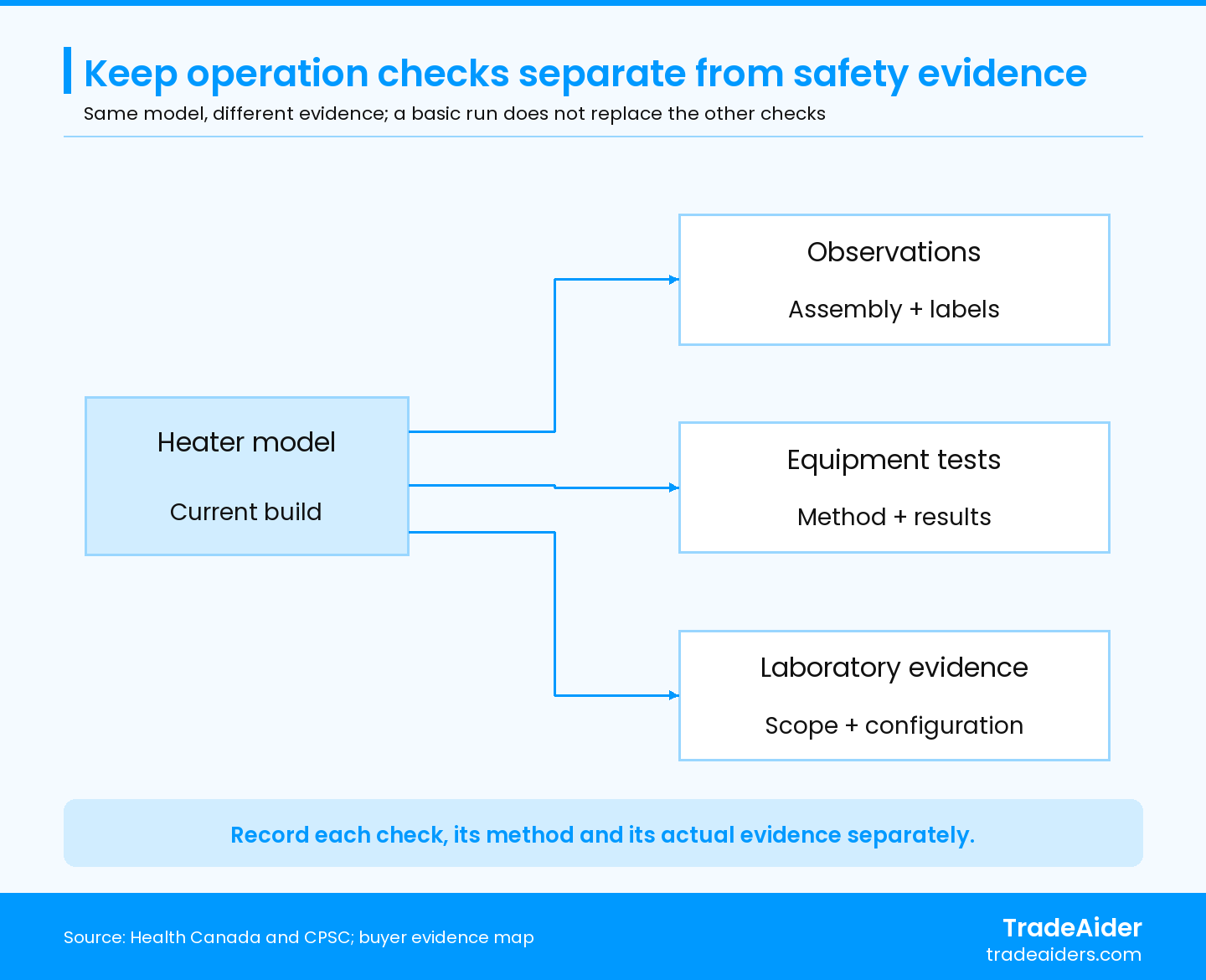
Buyer evidence map for the same heater model. Observations, agreed equipment tests and relevant laboratory evidence answer different questions. A basic heating run does not replace an unperformed protection or electrical-safety check; the required scope follows the actual product and destination.
Check packaging against the actual heater and route
Heater packaging should restrain the actual product without loading vulnerable parts. Compare the carton and insert revision with the approved packing specification. Check support around the base and body, protection for the grille, controls and handle, and separation of loose accessories. The cord should be restrained without being pinched or rubbing against a sharp grille edge. For an oil-filled model, also record visible leakage or contamination found when opening the pack.
Open the selected packs and photograph the layer arrangement before removing the product. Confirm the intended orientation, correct insert material and shape, accessory compartment, instruction pack and closure. Check carton marks, model, quantity and destination version against the order. Record dimensions or gross weight where specified, with the actual method and criteria. Repack examined units correctly; a photograph of the original arrangement does not ensure the product was restored to it.
Transport-performance evidence needs a procedure suited to the product, package and distribution route. The International Safe Transit Association, or ISTA, distinguishes package-test approaches and procedure selection according to the intended outcome and distribution hazards. Visual carton inspection can identify a missing insert or wrong box. It cannot establish performance through a transit simulation, and an improvised carton drop is not evidence that a complete ISTA procedure was passed.
Ask whether the available transit-test evidence covers this heater weight, support arrangement and package revision. A different carton, thinner insert or heavier product may require technical review of that evidence. If a buyer specifies an on-site drop or other package test, settle the exact method, specimen condition, equipment, safety arrangements and post-test checks first. Record package damage separately from any damage or functional change to the heater. No universal drop height applies to all heater packages.
Record results that support the shipment decision
A useful heater inspection report separates observations, measurements, document checks and work not performed. Tie each result to the sampled unit or carton, current reference and actual method. If a required safety check cannot be validly completed, preserve its missing conditions and obtain the specified evidence or properly arranged follow-up. A normal heating demonstration cannot close that open requirement.
Illustrative scenario: A heater starts, its controls respond and heating is observed. The buyer also requires a specific routine electrical check, but the factory cannot confirm the equipment arrangement, approved settings or acceptance criteria. These are hypothetical facts, not a TradeAider client case. Retain the normal-operation observation. Mark the required electrical check “not performed” with the reason, and refer it to the buyer’s technical owner for an approved setup or other specifically accepted evidence. Do not report the unperformed test as passed or describe every unit as electrically defective.
| Report field | Fill with actual evidence | Decision or follow-up |
|---|---|---|
| Identity and reference | Unit/carton, model/build, specification and method revision | Confirm which goods and criteria the finding covers |
| Observation | Assembly, labels or operating sequence; photo reference | Classify the actual mismatch under the agreed plan |
| Measurement | Reading, units, setup, conditions, equipment and criterion | Compare the valid result with the specified limit |
| Document evidence | Issuer, report/model/configuration and relevant scope | Resolve a mismatch or missing coverage |
| Not performed / unresolved | Named check, missing condition and reason | Owner, required evidence and follow-up arrangement |
Agree who makes the shipment decision and how required open items affect it. Confirm the final recipient, language, report format and acceptance requirements. An inspection report records the agreed checks; acceptance for a platform, certification or customs purpose depends on the specific recipient’s rules and cannot be assumed.
To prepare the visit, contact the TradeAider team with available product, order, factory, destination and timing information. You can start an inquiry before every technical file is ready. Before execution, settle the actual build, references, feasible checks, safe test resources, criteria and report requirements. The agreed inspection report should show what was checked and what remains unresolved.
FAQ
Why does the fan keep running after heat is switched off?
Some models use a documented fan overrun for cooling; compare the sequence with the exact model’s instructions. Distinguish continued airflow from continued heating. Follow the specified shutdown sequence rather than interrupting a required cooling stage. If the behavior is undocumented or differs from the reference, record the sequence and seek technical clarification before assigning a satisfactory result.
Can a wall-mountable heater use this checklist when shipped as freestanding?
Only where the approved instructions and evidence cover the actual freestanding configuration. Verify the correct base or supports, supplied hardware and installation instructions for that version. A fixed-installation-only heater does not enter this portable-heater scope merely because it can be placed on a table. Ask the technical owner to confirm configuration coverage before planning the checks.
What if the supplier changes the plug or cord after inspection?
Reopen the affected configuration and evidence checks before relying on the earlier findings. Obtain the replacement part references and change record, then ask the technical owner what assessment and follow-up verification are required. Preserve the original inspection history. A replacement label or an unchanged model name cannot demonstrate that the changed cord assembly is covered by the earlier observations or safety documentation.
Articles Connexes
Développez votre entreprise avec le Service TradeAider
Cliquez sur le bouton ci-dessous pour accéder directement au Système de Service TradeAider. Les étapes simples de la réservation et du paiement à la réception des rapports sont faciles à utiliser.