
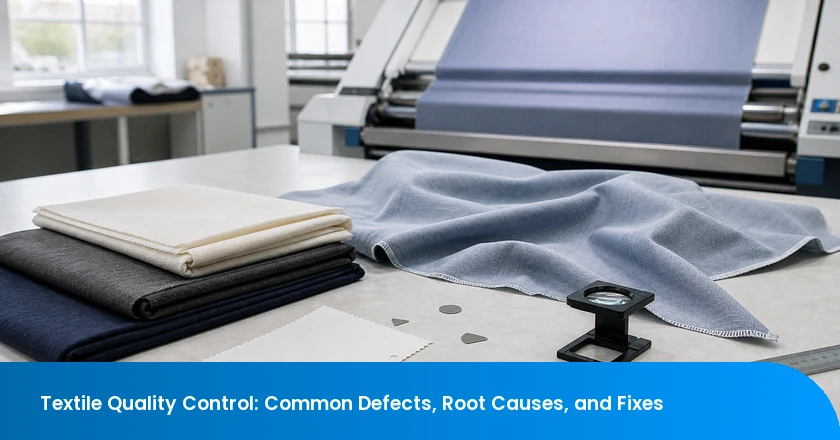
Textile quality control should connect appearance, performance, identity, and lot traceability to an agreed acceptance decision. A traceable lot is the identifiable group of goods tied to the same records and conditions. When that link is missing, a buyer can see a defect yet still be unable to say which cartons are safe to cut, pack, or release.
A defect alone does not always explain the real quality risk. The bigger problem is often a mismatch between the written requirement and the approved reference, an unclear inspection method, or missing records linking affected goods to a specific lot. Effective textile quality control starts before final inspection and uses documented evidence to support the decision to correct, hold, or release the shipment.
Textile Quality Control Must Prove More Than Visual Appearance
Start with an acceptance brief that separates four questions: Does the product look like the approved reference? Does it perform as the buyer expects? Does its fiber, label, and claim information match the market? Can the buyer identify the exact rolls, units, and cartons to which the evidence applies? A defect list is useful only after those questions have an owner, a method, and a release consequence.
For relevant U.S. sales, the FTC says textile labels must disclose fiber content, business identity, and country of processing or manufacture. Read the FTC Textile Fiber Rule. For EU sales, Regulation (EU) No 1007/2011 similarly ties prescribed fibre names and compliant labeling or marking to market availability. The practical lesson is not that every textile uses one global label. It is that label evidence belongs in the product brief before bulk packing begins.
If a team writes “same as sample” without identifying the sample version, color standard, measurement points, test conditions, and allowed variation, it has not created an acceptance rule. It has moved the argument to the factory floor. For a useful starting point, buyers can review a practical inspection-standard framework and then adapt it to the material, end use, and destination market.
- Appearance: shade, print, weaving, surface condition, workmanship, and measurement must be compared with a named reference.
- Performance: weight, shrinkage, strength, colorfastness, or other properties need an agreed method and pass rule.
- Identity: fiber, label, care, and origin information must match the product and the applicable market requirements.
- Scope: each result must state which roll, production date, carton, or finished lot it represents.
Turn Defect Names Into Testable Failure Modes
A buyer should not accept “shade issue,” “poor hand feel,” or “wrong size” as the entire quality finding. Each phrase needs a failure mode: what differs, compared with which approved reference, under what condition, across what population, and what decision follows. That turns an inspection report from a list of complaints into a tool for deciding whether to correct, hold, retest, or release.
AATCC maintains separate textile methods for color difference and dimensional change, so a buyer should name the method that fits the failure. See AATCC testing standards. “Color is acceptable” is not a complete instruction if the order needs a shade standard, a viewing condition, and a decision about variation between rolls. Likewise, “shrinkage tested” is incomplete if the buyer has not stated the fabric, laundering condition, sample source, and acceptance limit.
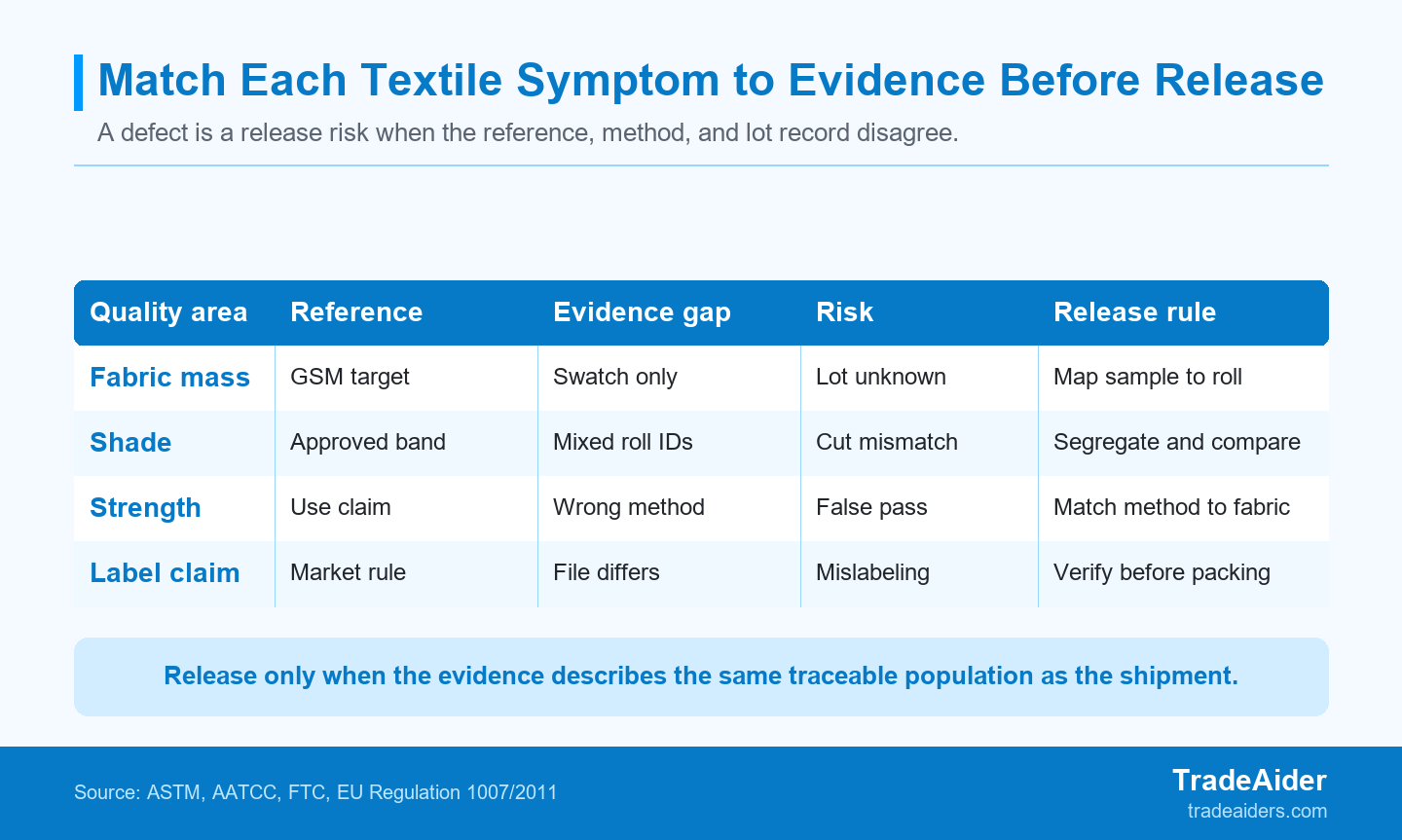
A textile symptom becomes controllable only when the reference, verification method, and lot record support the same release decision.
When a buyer cannot connect a defect to an approved reference, a test method, and a traceable lot, the safe containment scope becomes wider. That does not mean every visual difference requires a full-order hold. It means a buyer cannot safely narrow the hold to a few pieces until the evidence shows which goods share the same material, process, and exposure.
Common Textile Defects, Causes, and Solutions
Textile defects can occur during weaving, knitting, dyeing, finishing, or handling. Identifying these issues early helps buyers reduce rework, avoid inconsistent product quality, and make better-informed shipment decisions.
The following table outlines common textile quality issues, their potential causes, and practical ways to control them.
| Common Textile Defect | Possible Causes | Recommended Quality Control Measures |
|---|---|---|
| Color Variation | Differences between dye lots, inconsistent dyeing conditions, or uneven finishing | Compare fabric against an approved color standard under consistent lighting. Record shade differences by roll or batch. |
| Excessive Shrinkage | Inadequate pre-shrinking, unstable fabric construction, or unsuitable finishing processes | Conduct dimensional stability tests using agreed washing or conditioning procedures before bulk approval. |
| Pilling | Fiber characteristics, yarn structure, fabric construction, or surface abrasion | Select an appropriate pilling test method and evaluate results against the agreed acceptance criteria. |
| Weaving or Knitting Defects | Broken yarns, incorrect machine settings, or inconsistent yarn tension | Inspect fabric surfaces for holes, missing yarns, slubs, and other visible defects. Record defect locations and affected roll quantities. |
| Poor Colorfastness | Unsuitable dyes, insufficient dye fixation, or inadequate finishing | Test colorfastness to rubbing, washing, or other relevant exposures according to the product's intended use. |
| Uneven Fabric Weight or Thickness | Variations in yarn density, fabric construction, or finishing | Measure fabric weight, such as grams per square meter (GSM), and thickness where relevant, against the specified tolerances. |
| Stains and Oil Marks | Contamination during production, machine lubrication, or improper handling | Check fabric surfaces under adequate lighting and review cleaning, handling, and storage practices. |
| Fabric Distortion or Skewing | Uneven tension during processing, finishing issues, or fabric construction | Check fabric alignment and dimensional stability against the product specification. Confirm whether the applicable tolerance is defined for the fabric or finished product. |
The appropriate inspection and testing methods depend on the textile material, product application, and agreed specifications. Visual inspection can identify many surface defects, but performance-related issues such as shrinkage and colorfastness may require laboratory testing. Establishing clear acceptance criteria before mass production helps buyers and suppliers evaluate results consistently.
Appearance Defects Need a Lot-and-Location Record
A visible textile defect needs an approved reference, a location, and a traceable population before the buyer can define a fair hold. For shade variation, record the roll ID, cut-panel location, lighting condition, and comparison standard. For a weaving fault, record the defect type, repeat distance, fabric direction, and affected roll. For sewing or trim problems, identify the line, operation, bundle, and production window. Those details turn “fix this” into a checkable correction request.
Do not confuse a defect count with a root cause. Several short yarn defects on one roll may be a local material issue. The same defect across several rolls and days may point to a process setting, raw-material batch, or inspection escape. The release decision should follow that pattern, not the most convenient explanation.
Performance Defects Need an Agreed Method and Condition
The current AATCC manual includes TM135-2025 for dimensional changes of fabrics after home laundering. See the AATCC manual update. The named method is a useful starting point, but it is not a pass grade. The buyer still needs to define the product configuration, test condition, sample location, tolerance, and whether the result applies to a development sample, a production roll, or finished goods.
This distinction matters when a supplier shows a passing sample from a different dye lot or a small cutting from a different part of the roll. A valid report may describe that sample accurately while still leaving the bulk-order question unanswered. Match the test sample to the production population before treating a result as release evidence.
Trace the Root Cause to the Earliest Controllable Stage
The most useful corrective action is the one assigned to the earliest stage that can prevent the defect from recurring in the affected population. A late cosmetic repair may make a few sampled pieces look better, but it cannot prove that unexamined rolls, bundles, or cartons were not exposed to the same cause.
Use a simple root-cause map. Material symptoms include inconsistent fiber, fabric mass, width, surface faults, or shade between incoming rolls. Process symptoms include recurring measurement drift, seam damage, print registration issues, or uneven finishing tied to a line or shift. Post-process symptoms include packing mix-ups, label mismatch, stains, moisture, or damage after goods passed an earlier check. The corrective action should change the source of recurrence, while the verification step confirms whether it worked.
When a pattern appears while production is still active, the buyer needs evidence before the entire order is packed. A third party can use a during-production inspection checkpoint to compare active output with the approved reference, isolate the spread of the issue, and document whether the supplier’s correction has reached the line. This is not a substitute for factory process ownership; it is a way to give the buyer a current, independent decision point.
Build Controls Around Materials, Process, and Release
Pre-production approval, during-production verification, and final release each answer a different textile quality question. Combining them into one late visit makes it harder to tell whether a failure began in the material, the line, finishing, or packing.
| Checkpoint | Question It Answers | Evidence to Keep | If It Fails |
|---|---|---|---|
| Before bulk work | Are materials, trims, labels, and references aligned? | Approved sample, specification, color or construction reference | Correct before scale-up |
| During production | Has a recurring issue spread? | Line, roll, bundle, and correction records | Contain and verify the correction |
| Before release | Does the finished shipment match the accepted population? | Sample plan, final findings, carton and lot status | Approve, hold, or release conditionally |
At the first checkpoint, the practical objective is not to inspect every future defect. It is to make later comparison possible. Buyers who need an independent review of labels, packaging, workmanship references, or material readiness can ask TradeAider to set the pre-production inspection scope before output becomes expensive to rework.
Textile Inspection Methods
Effective textile quality control combines visual inspection, defect grading, and laboratory testing. Each method serves a different purpose: visual inspection identifies visible defects, the 4-point system helps grade fabric imperfections, and laboratory testing evaluates properties that cannot be reliably confirmed by appearance alone. The appropriate inspection plan depends on the fabric type, intended use, buyer specifications, and agreed acceptance criteria.
The 4-Point System for Fabric Inspection
The 4-point system is a commonly used method for grading visible fabric defects. ASTM D5430, Standard Test Methods for Visually Inspecting and Grading Fabrics, describes procedures for inspecting and grading fabrics. The selected scoring option matters because different options may produce different scores for the same fabric.
Before inspection, buyers and suppliers should agree on the applicable ASTM D5430 edition, scoring option, inspection procedure, and acceptance criteria. The same scoring option should be used when comparing results or reviewing a quality dispute.
How Does the 4-Point System Work?
Under ASTM D5430 Option A, fabric defects are assigned penalty points according to their length. The applicable scoring procedure should be agreed upon by the buyer and supplier before inspection.
| Defect Length | Penalty Points |
|---|---|
| Up to and including 3 inches (75 mm) | 1 |
| Over 3 inches (75 mm) and up to and including 6 inches (150 mm) | 2 |
| Over 6 inches (150 mm) and up to and including 9 inches (230 mm) | 3 |
| Over 9 inches (230 mm) | 4 |
Option A also includes special rules for certain defects. In the publicly available ASTM D5430-13(2017) text, the rules include:
- Maximum points per linear length: No more than 4 points may be assigned to any one linear meter or yard of fabric, regardless of the number or size of individual defects.
- Continuous running defects: A continuous defect exceeding 9 inches (230 mm) is assigned 4 points for each consecutive linear meter or yard in which it occurs.
- Insufficient usable width: Fabric with a usable width below the specified minimum is assigned 4 points per linear meter or yard.
- Seams and full-width defects: Each seam or other full-width defect is assigned 4 points, where applicable.
The current edition of ASTM D5430 should be consulted to confirm the applicable requirements before using these rules for formal acceptance decisions. The inspection procedure should also define how defects are identified, measured, and recorded, including any specific requirements for holes, tears, continuous defects, and multiple defects.
How Is the Fabric Defect Score Calculated?
When results are expressed as points per 100 square yards, the calculation is:
Points per 100 sq yd = Total penalty points × 3,600 ÷ (Inspected length in yards × Fabric width in inches)
For example, if 100 yards of fabric measuring 60 inches wide receive 50 penalty points, the score is:
50 × 3,600 ÷ (100 × 60) = 30 points per 100 square yards
The result should be compared with the buyer's agreed acceptance limit. A limit of 40 points per 100 square yards is used in some fabric inspection specifications, but it is not a universal requirement under ASTM D5430. Buyers and suppliers should agree on the acceptance threshold, the scoring option, and whether results are assessed roll by roll or across the entire lot before inspection begins. These conditions should be documented in the purchase specification or inspection instructions to help prevent disputes over fabric acceptance.
Visual Fabric Inspection
Visual fabric inspection helps identify surface and construction defects before fabric is released for cutting or further production. Depending on the inspection requirements, fabric may be examined on an inspection machine or under suitable lighting conditions.
Common checks include:
- Color variation: Compare the fabric with the approved color standard under consistent lighting. Record differences between rolls or dye lots.
- Holes, tears, and broken yarns: Identify defects that may affect fabric usability or create problems during cutting and sewing.
- Stains and contamination: Look for oil marks, dirt, and other visible imperfections that may be difficult to remove.
- Weaving and knitting defects: Check for missing yarns, slubs, irregular structures, and other visible fabric construction problems.
- Fabric width and distortion: Check fabric width, alignment, and visible distortion against the agreed specification.
Findings should be recorded with the relevant roll identification, defect location, and inspection result. This information helps buyers and suppliers identify affected material and investigate recurring production issues.
Visual inspection has limitations. It cannot reliably determine every material or performance property. Its effectiveness also depends on lighting, inspection conditions, fabric characteristics, and the agreed criteria. Where a defect may affect product performance or use, additional measurement or laboratory testing may be necessary.
Laboratory Testing for Textile Quality
Visual inspection can identify visible defects, dimensional differences, labeling errors, and workmanship patterns. However, it cannot establish every material or performance property by sight alone. The right question is not simply whether testing is necessary, but which product claim, use condition, or potential customer failure would be costly to discover after sale—and which test method can provide the relevant evidence.
Fabric Weight and GSM Testing
GSM, or grams per square meter, expresses fabric mass over a defined area. It is an important specification for many textile products, but a test result must be interpreted in the context of how the sample was obtained.
ASTM D3776/D3776M addresses the measurement of fabric mass per unit area. Its small-swatch method notes that a result applies to the sample and does not necessarily represent the entire lot. See ASTM D3776/D3776M.
If GSM is a buying requirement, clarify whether the laboratory sample represents a full roll, a controlled lot sample, or only a cutting submitted for evaluation. The sampling scope affects what the result can demonstrate about the supplied material.
Tensile Strength and Method Selection
Tensile strength testing evaluates how a textile responds to a specified pulling force. However, the test method must suit the fabric construction and stretch characteristics.
ASTM D5034 is not recommended for knitted or other high-stretch textiles exceeding 11% stretch. See ASTM D5034. This limitation highlights the importance of selecting a method that fits the material rather than relying on a familiar test name.
For a performance testing program, document the test method, conditioning requirements, test direction, sample origin, and acceptance criteria together. Where the selected method is unsuitable for the fabric, the results may not provide a reliable basis for evaluating compliance with the product specification.
Shrinkage, Colorfastness, and Pilling Tests
Other common textile tests address performance issues that visual inspection alone cannot settle:
- Dimensional stability and shrinkage testing: Measures changes in fabric dimensions under specified washing, drying, or other treatment conditions.
- Colorfastness testing: Evaluates resistance to color change or color transfer under relevant conditions, such as rubbing or washing.
- Pilling resistance testing: Assesses the tendency of a fabric surface to form pills under specified test conditions.
- Tear strength testing: Evaluates resistance to tearing where this property is relevant to the intended use.
The applicable method and acceptance criteria should be selected according to fabric composition, construction, end use, buyer specifications, and relevant industry requirements. Results obtained under different methods or conditions may not be directly comparable.
Chemical Testing and Textile Product Requirements
Chemical testing may be necessary when buyers need evidence relating to specified substances or market-specific requirements. The applicable scope depends on the product, intended use, destination market, and relevant requirements.
OEKO-TEX STANDARD 100 is a voluntary textile program that tests for harmful substances, with requirements that vary according to intended use. See OEKO-TEX STANDARD 100. It is one example of a textile-related program, not a universal requirement for every product or market.
Chemical, flammability, and other compliance needs should be determined according to the product and destination market. A test or certification program should not be assumed to cover every applicable requirement.
When a visual check cannot answer the relevant question, buyers can match a laboratory test to the product requirement before relying on a shipment decision.
How Should Laboratory Results Be Used?
Laboratory results should be reviewed alongside the approved product specification, sampling scope, test method, and acceptance criteria. A fabric may have few visible defects but still show excessive shrinkage, inadequate colorfastness, or a performance result outside the agreed limits.
Combining visual inspection, defect grading, and appropriate laboratory testing provides a more complete basis for evaluating textile quality. Documenting sample origin, test conditions, results, and acceptance decisions also helps buyers and suppliers investigate problems and determine the appropriate corrective action before further production or shipment.
Example: When a Shade Problem Is a Containment Problem
Map the Population Before You Approve Rework
In the illustrative 2400-piece scenario, the buyer maps roll-to-carton records before approving rework or a split release. A U.S. home-textile importer buying from a China supplier has ordered a woven viscose cushion-cover order using an approved color standard. Cutting has started and 4 cartons are packed, but the release decision has not been made.
The inspection sample covers 96 pieces across multiple roll IDs. 2 roll groups show a visible shade split. One packed carton cannot be matched cleanly to a roll record. The buyer should not average those observations into a single “acceptable” result. A shade band is the agreed range of acceptable color variation; it is meaningful only when the same reference and viewing conditions are used for the relevant population.
The physical difference may be limited to two roll groups, but the incomplete carton record creates a separate evidence problem. Hold the traceable groups and the unsupported carton, separate the rolls, and reconcile the record before deciding which goods can move. This is holding and separating the affected goods while the buyer verifies the scope, not an assumption that the whole order has failed.
The supplier can compare segregated goods with the approved shade standard under the agreed viewing condition, identify the process setting or lot source, and correct the cause before rework. Release only the population with a resolved roll-to-carton map and an accepted comparison after correction. This is an illustrative scenario, not a TradeAider client case; a real decision must follow the purchase order, agreed tolerance, and product-specific method.
Release Only Against the Documented Shipment Population
A release decision should match the agreed sample plan and acceptance criteria to the documented shipment population. A shipment may pass a visual check and still deserve a hold if the tested material, approved reference, label version, or carton mapping does not belong to the same goods being released.
A release packet should state the current order quantity, finished and packed status, sample plan, defect classification, test reports required for the product, correction evidence, and any excluded or conditional population. For finished goods, an independent final check can confirm whether the inspected sample matches the agreed scope. Buyers can define the pre-shipment release check when 100% of the order is complete and at least 80% is packed for export.
Sampling does not promise that every unit is free from every flaw. It applies an agreed decision rule to a defined population. Set that rule before the visit, record the inspection level and acceptance numbers, and keep the decision tied to the actual lot. If the team needs to make the sample rule explicit, it can calculate the sampling plan before the visit and attach the result to the inspection brief.
Prepare a Textile Inspection Brief That Produces a Decision
An inspection brief produces a better release decision when it states the approved reference, lot status, sample plan, and testing needs. Attach the current specification, approved sample or shade standard, roll and carton mapping, buyer-defined defect rules, packaging and label files, and any laboratory reports or required methods. Those inputs let an inspector distinguish a correctable local finding from a problem that needs a broader hold.
TradeAider can help buyers translate those inputs into an independent inspection scope for goods produced in China. If your order is approaching production, correction, or shipment, request a textile inspection plan.
FAQs
1. What Are the Most Common Textile Quality Defects?
Common textile defects include color variation, excessive shrinkage, pilling, weaving or knitting defects, poor colorfastness, uneven fabric weight, stains, and fabric distortion. Some defects are visible during inspection, while others require testing to evaluate fabric performance. The relevant checks depend on the material, product requirements, and intended use.
2. How Do You Check Fabric Color Consistency Between Rolls?
Fabric color consistency can be checked by comparing rolls against an approved color standard under consistent lighting conditions. Inspectors should record shade differences, identify affected rolls or batches, and confirm whether the results fall within the agreed color tolerance. For products with strict color requirements, instrumental color measurement may supplement visual assessment.
3. Which Tests Are Commonly Used for Textile Quality Control?
Common textile tests include dimensional stability or shrinkage testing, colorfastness to rubbing and washing, pilling resistance, fabric weight measurement, and tensile strength testing where relevant. The selection depends on fiber composition, fabric construction, end use, buyer specifications, and applicable requirements. Test methods and acceptance criteria should be agreed upon before testing.
4. What Is the Difference Between Textile Inspection and Laboratory Testing?
Textile inspection typically involves checking visible defects, workmanship, dimensions, labeling, and other specified product characteristics. Laboratory testing evaluates measurable properties such as colorfastness, dimensional stability, strength, or the presence of specified chemical substances. These methods serve different purposes and may be used together when visual inspection alone cannot verify product performance.
5. Can Pre-Shipment Inspection Detect All Textile Quality Problems?
No. Pre-shipment inspection can identify many visible defects and check specified product characteristics in the inspected samples, but it cannot guarantee that every unit in a shipment is defect-free. Some performance issues require laboratory testing, while defects that develop during production may be easier to identify through in-process inspection. Combining appropriate production checks, pre-shipment inspection, and testing can provide a more comprehensive view of product quality.

Articles Connexes


Développez votre entreprise avec le Service TradeAider
Cliquez sur le bouton ci-dessous pour accéder directement au Système de Service TradeAider. Les étapes simples de la réservation et du paiement à la réception des rapports sont faciles à utiliser.