
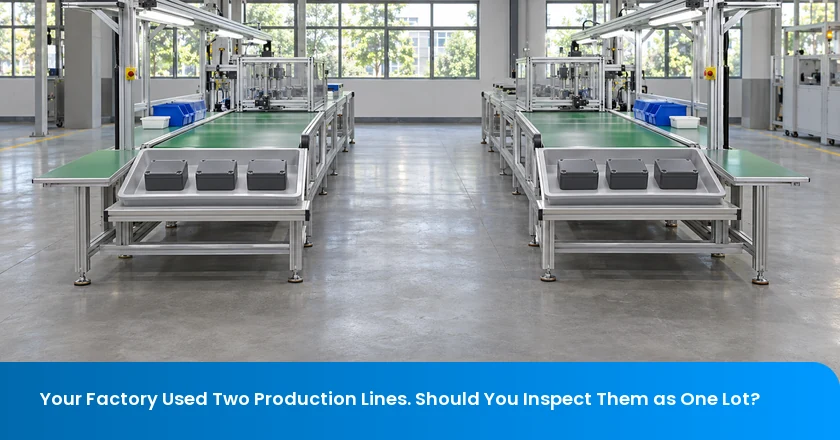
Inspect two production lines as one lot when you can show that their output is comparable for the agreed checks, identify the goods from each line, and draw the sample under a plan that covers both. If a material, tool, process or rework change affects only one line, define the affected group before sampling. Inspect separately if it needs its own acceptance decision. If you cannot identify the affected stock, pause the proposed release and ask the factory to recover the production and packing records.
One inspection lot means one acceptance decision
Treat two lines as one inspection lot only when there is evidence their output is comparable for the agreed checks and the combined sampling plan covers both lines. The lot is the group of units presented for one acceptance decision. The purchase order (PO) tells you what was bought. The production batch and line records tell you how the goods were made. Use both to define the goods that the inspection can actually cover.
- Verify how each line made the characteristics you plan to inspect.
- Preserve a traceable link from the finished stock to its line and relevant production window.
- Agree on the sample selection and the decision scope before anyone draws units.
Acceptance sampling uses selected evidence to decide the disposition of a defined lot. The NIST Engineering Statistics Handbook explains that purpose. If both lines form one lot, the acceptance result applies to the combined population covered by the plan. A line name on a sample sheet can help with follow-up, but it does not give that line its own acceptance result.
Start with the goods available and eligible for selection. Agree which units, cartons or pallets are in scope, and check for cartons already held aside or moved to another location. A factory may say that its production batch covers the entire PO even though some goods are inaccessible at the inspection site. Write the actual presented quantity and any exclusions into your confirmed scope. Use TradeAider’s inspection standard as a reference when reviewing sampling terms. The buyer and provider still need to agree what the sample will represent for this order.
Compare the two lines before pooling output
Compare the controls on each line for the features you intend to inspect, and retain the link from each line’s output to the cartons presented. Start with the same item and specification revision, then ask what could change the actual product or your ability to detect a defect. Two machines can use different tooling IDs and still run the same qualified process. Two lines with identical equipment can use different material, settings or rework procedures.
Ask the factory for documents that cover the physical goods available on inspection day. Compare the approved materials, tooling revisions, relevant settings, first-piece approvals and in-process checks. A first-piece approval is the documented check of a part produced at a line setup or restart. Check whether either line had a setup change, stop and restart, unresolved process alarm, repair or sorting event. For each difference, identify what characteristics it could affect and when it began and ended.
The GS1 traceability framework connects events in the movement or transformation of goods to recorded data about those events. For this inspection, look for the line-to-carton link at packing and after any repacking. Accept the factory’s existing unit, inner-pack or carton identifiers when the supporting records are reliable. A uniform outer label can still work if a verified packing record identifies which units went into that carton.
Copy one set of worksheet rows for each line and fill in the evidence alongside the prompts. If a change occurred mid-run, make a separate copy for each affected production window.
What to verifyRecord for each lineIf the evidence differs or is missingProduct and criteriaItem, revision, drawing or sample, and acceptance checksResolve the controlling requirement before combining goods.Materials and setupMaterial references, tooling and process checks, setup releaseTie each relevant change to the checks it could affect.Time and exceptionsRun times, change times, rework, sorting and open issuesDefine the affected production window and stock.Packed goodsQuantity, unit marks, carton or pallet IDs, storage and accessReconcile the map to the physical goods before drawing units.
If a quality-relevant change is visible in the records and affected units are traceable, consider a separate lot for that group. The relevant boundary may be only part of a line’s run. If line identity is needed to isolate a known risk and you have mixed cartons with no reliable mapping, holding the potentially affected stock gives you time to reconstruct that boundary.
Plan how each line will enter the sample
Once the lot is defined, set the plan before drawing units. For one lot, agree how every eligible part can enter selection and how you will record the line origin. For separate lots, agree the plan and decision rules for each lot. Arrange carton access for both lines; a pallet that cannot be reached changes what can actually be sampled.
ISO 2859-1:2026 defines acceptance quality limit (AQL)-indexed schemes for lot-by-lot inspection by attributes. Attributes inspection classifies units or counts nonconformities according to the applicable plan. Before the visit, confirm which plan and edition the order uses, along with the inspection level, applicable severity, defect categories, sample size and acceptance and rejection criteria. The AQL is a plan index. It gives no permission to ship a stated percentage of known defective units.
ASQ describes Z1.4 as an attributes acceptance-sampling system using switching rules for a continuing stream of lots. If the contract refers to Z1.4, use its applicable edition and rules. Confirm any inspection-history requirement with the buyer before applying a scheme to redefined lots. A new line designation or lot label alone supplies no history.
In stratified random sampling, the population is divided into nonoverlapping groups and a random sample is selected independently within each group. If your plan permits line-based stratification for a common lot, agree the allocation in advance and select randomly within each line group. Use the approved rounding rule when whole units must be assigned. An inspector who handpicks accessible pieces from each line has not applied that random draw.
Some plans draw from the combined population without a fixed count per line. In that case, preserve each sampled unit’s line identity and check any explicit coverage requirement before starting. If the buyer needs guaranteed evidence from both lines, agree on a permitted method that provides it. A targeted check of suspect output can answer a separate risk question. Keep those observations outside the acceptance sample count unless the agreed plan explicitly provides for including them.
TradeAider performs pre-shipment inspection when the order quantity is 100% complete and at least 80% is packed for export.
Confirm site readiness and sample access separately. Meeting the packing threshold tells you how much has been packed. Ask the factory to present the named groups and show where the eligible cartons from both lines are stored. If only one line’s goods can be reached, record the limitation before starting any inspection planned for both.
Two lines producing 1,000 housings: one order, two possible plans
A change on one line can alter the lot decision while the order number, item code and quantities stay the same. The key question is whether each group can be evaluated under the same acceptance decision.
Illustrative scenario. One factory presents 1,000 molded utility housings of the same specification. Line A made 800 units and Line B made 200. Both outputs are accessible, and carton IDs match the line and run records. The buyer compares approved material references, production settings, setup checks and the fit and finish requirements. In the first case, these checks support a common lot and neither line has an unresolved change.
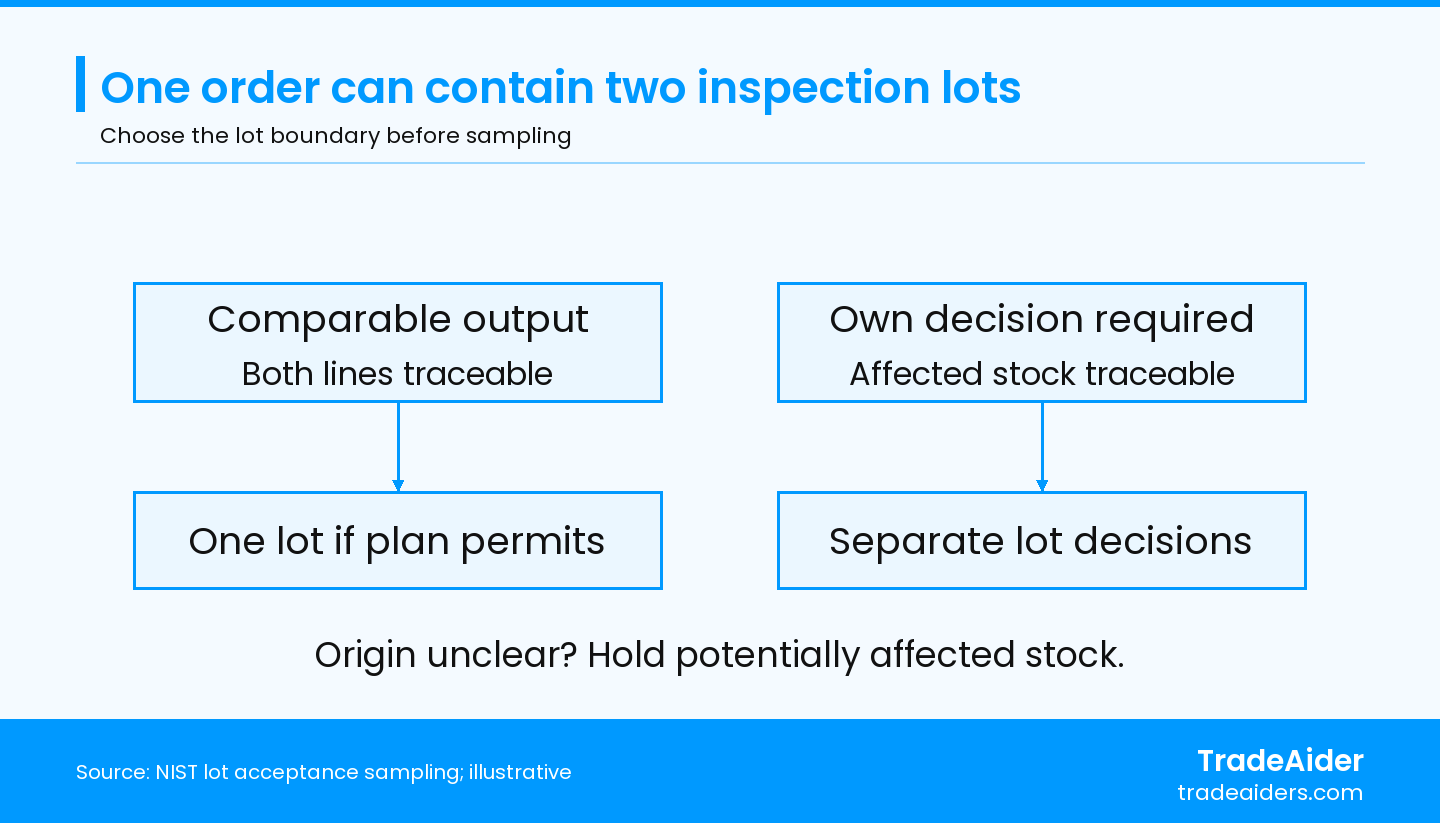
Use the combined route only when the agreed plan covers both lines. If the affected stock cannot be identified, establish the scope of the hold before choosing a new lot boundary.
Common lot. Suppose an agreed plan already calls for 50 units and permits allocation proportional to line output. Then 800 of 1,000 units gives Line A 40 sample places, and 200 gives Line B 10. Select units randomly within each line group under the agreed procedure. Record the 40 and 10 by line and apply the agreed combined decision rule to the 50-unit sample. The example illustrates allocation only. Use the actual adopted plan to obtain sample size and decision criteria. The AQL calculator can help review plan inputs once the lot and applicable rules are set.
Changed line. Now suppose Line B used a replacement mold insert from the start of its run. The factory has records linking its 200 units to a distinct group of cartons, and the replacement may affect lid fit. If that change needs independent verification, define separate lots and set a plan and acceptance criteria for each. The original 40 and 10 allocations were part of a combined plan and do not authorize separate release decisions. If only part of Line B used the replacement, use the corresponding run window and carton map to define the affected group.
If the factory combined the two lines into cartons and can no longer identify the products made with the replacement insert, the buyer cannot limit the problem to the recorded Line B quantity by assuming those units stayed together. Hold the potentially affected stock, establish what can be traced, and decide how to verify the goods that remain unresolved.
Keep line origin and scope visible in the inspection report
Record the lot boundary, the line source of each sample, and the scope of the resulting acceptance decision. Include the presented quantities, the records used to confirm comparable controls, any risk groups or excluded goods, and the actual sample by line. Attach the carton map or keep a reference that someone can use to locate the same stock after the inspection.
A lot acceptance sampling plan combines a sampling scheme with rules for deciding the lot’s disposition, as NIST’s guide to acceptance plans explains. Show the decision once for a combined lot and separately for each separately inspected lot. Keep any targeted checks separately identified and state why they were performed. Line-level observations can guide containment or investigation when a finding clusters on one line.
For a combined inspection, an example scope statement is “One lot covering the identified Line A and Line B cartons, with samples recorded by line under the agreed plan. Cartons listed as inaccessible are outside the reported decision.” If you agreed separate lots, write each status against the units covered. A second group’s acceptable result is useful only if the goods remain separable and all other shipment conditions are met.
If the original sample raises a concern, preserve the findings and the plan used. Hold or contain the affected stock according to the agreed process. Before an additional inspection, confirm what changed, how the new groups are physically identified, and which new evidence the reviewer needs. Avoid retroactively relabeling portions of a pooled sample as independent passing lots.
If you are arranging an inspection in China, contact TradeAider with the product revision, both line quantities, a carton map and any process changes. Share the planned decision scope so the team can discuss access, sample selection and the coverage the report will document.
FAQ
Can two lines share an inspection visit and report?
Two lines can share a visit and report while retaining separate lot identifiers, samples, acceptance criteria, and results. Confirm the available time, crew and site access before booking. Where there are two distinct decisions, tell the factory which goods should be presented together for each decision. The schedule and report format can be shared without pooling the goods.
What if the random sample includes nothing from Line B?
Check whether Line B was eligible for selection and whether the approved plan required a sample from each line. A valid unrestricted draw can miss Line B by chance. Record the actual counts and keep the agreed decision rule. If Line B was inaccessible or required coverage was missed, report the deviation and agree how to complete the inspection. Log any targeted follow-up separately unless the plan provides for including it.
Can you split a lot after the combined sample finds a problem?
You can contain traceable groups after a failure, but any new acceptance decision needs evidence and rules for the redefined lots. Retain the original combined result. Record which cartons were sorted, repaired or held, and verify their identities before authorizing a new draw. Ask the responsible quality owner how those goods should be presented for reinspection under the agreed plan.
Articles Connexes
Développez votre entreprise avec le Service TradeAider
Cliquez sur le bouton ci-dessous pour accéder directement au Système de Service TradeAider. Les étapes simples de la réservation et du paiement à la réception des rapports sont faciles à utiliser.