- À Propos de Nous

- Nos Services
- Votre Industrie
- Ressources
- Actualités et Blog
Factory Audit (FA)
In global sourcing, sending an initial deposit payment (typically 30% of the purchase order value) to a new, unverified manufacturer is a massive leap of faith.
A sleek website, professional Alibaba profile, and fast-talking sales representative are easy to fake. In reality, you could be dealing with an unlicensed middleman, a struggling workshop, or a straight-up online scammer.
To eliminate this catastrophic risk, experienced buyers never release funds without first conducting a Factory Audit (FA)—also referred to as a Supplier Evaluation or Factory Audit Check.
This guide explains what a Factory Audit is, what on-site auditors verify on the factory floor, and how auditing your supplier early prevents legal disasters, quality fade, and supply chain delays.
What is a Factory Audit (FA)?
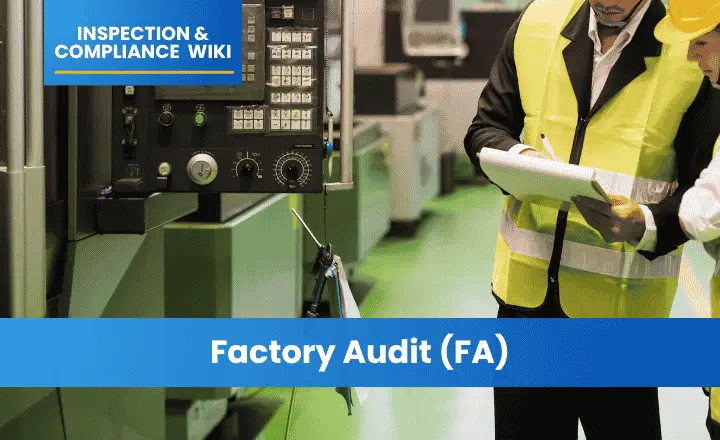
A Factory Audit (FA) is an on-site, comprehensive evaluation of a manufacturer's physical facilities, legal status, production capabilities, and internal quality control systems. It is executed by an independent, third-party auditor before you place a purchase order or send any deposit money.
Unlike a product inspection, which only looks at the quality of finished physical goods, a Factory Audit evaluates the infrastructure, legitimacy, and capability of the manufacturer itself. It is designed to answer one fundamental question: Does this factory have the machinery, workforce, and quality systems to produce my order safely and on schedule?
Why Importers Must Never Skip the FA
Failing to audit a factory before signing a contract exposes your sourcing budget to three common, highly expensive business failures:
Reason A: It Verifies Legal Legitimacy and Eliminates Scams
Many "factories" found online do not actually exist as physical manufacturing entities. They are often shell companies or trading brokers operating out of a small office. An FA ensures the factory has a legitimate, government-issued business license, a physical workshop, and the legal right to export goods.
Reason B: It Assesses Real Production Capacity
A supplier might claim they can easily produce 20,000 smartwatches per month. An auditor physically walks the production floor, counts the active assembly lines, audits the number of workers, and reviews their machine list to verify if their actual capacity matches their claims.
Reason C: It Prevents Quality Fade Over Time
If a factory does not have a robust Quality Management System (such as ISO 9001 guidelines), they cannot maintain consistent quality over multiple shipments. A Factory Audit evaluates the factory's internal testing labs, raw material incoming checks, and finished goods warehouse processes to ensure they have the systems in place to prevent quality degradation.
Audit Before You Pay: Verify Supplier Legitimacy On-Site. Evaluating factory capabilities, legal status, and quality control systems on-site. ➔ Book a Factory Audit
The On-Site Factory Audit Checklist: What the Auditor Reviews
During a standard on-site Factory Audit, a professional auditor spends a full day investigating the factory and executing a five-step checklist:
Step 1: Legal Verification & Company Profile Audit
The auditor reviews official legal documents, including business licenses, tax registrations, export licenses, land ownership or rent agreements, and international quality certifications (e.g., ISO 9001, ISO 14001, or BSCI).
Step 2: Sourced Material & Inventory Management Check
The auditor checks how the factory stores and audits incoming raw materials. Do they keep raw plastics in humid environments? Are they sorting electronic components in climate-controlled rooms? Poor material storage on day one leads to defective products later.
Step 3: Production Lines & Machine Assessment
The auditor documents the active assembly lines, machinery models, maintenance logs, and workforce capacity. They verify whether the factory performs all manufacturing processes in-house or secretly outsources key steps to unverified, low-quality subcontractors.
Step 4: Quality Control (QC) System Check
The auditor evaluates the factory’s internal quality control procedures. They check if the factory has a dedicated QC team, clear standard operating procedures (SOPs) on the assembly line, and an active laboratory equipped with calibrated testing machinery (e.g., salt spray testers, tensile strength machines, or drop test rigs).
Step 5: Finished Goods & Storage Audit
The auditor reviews the finished goods warehouse. They ensure packed cargo is stored safely, protected from humidity or water leaks, and organized logically to prevent shipping mix-ups.
Factory Audit (FA) vs. Pre-Shipment Inspection (PSI)
To build a reliable quality control plan, you must understand how a Factory Audit coordinates with a Pre-Shipment Inspection:
| Operational Metric | Factory Audit (FA) | Pre-Shipment Inspection (PSI) |
|---|---|---|
| Operational Timing | Before placing a PO or sending a deposit. | After production is 80% to 100% finished and packed. |
| Primary Goal | To verify supplier legitimacy, capacity, and QC systems. | To verify individual product cosmetics, function, and packaging. |
| Operational Focus | Focuses on the factory's infrastructure. | Focuses on the individual product batch. |
| Actionable Result | Helps you choose the right partner or reject a bad vendor. | Helps you release the final balance payment or hold it for rework. |
Conclusion: Build Your Foundation on Trusted Partners
In global sourcing, your brand's reputation is entirely dependent on the weakest link in your supply chain. Choosing the wrong manufacturer can lead to lost deposits, unsellable defective goods, and legal lawsuits in your destination market.
By implementing an on-site Factory Audit as your very first sourcing step, you remove the guesswork, protect your capital, and build your business on a foundation of legitimate, capable, and trusted manufacturing partners.
Related Knowledge Base
TradeAider