
- About Us

- Our Services
- Your Industry
- Resources
- News & Blog
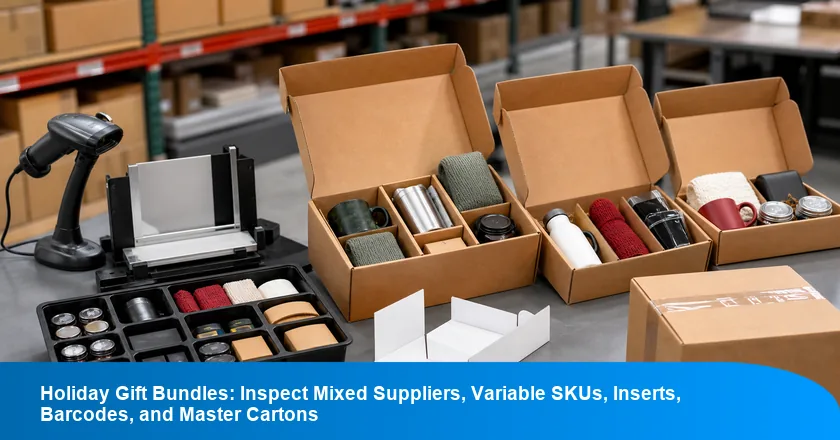
A holiday gift bundle inspection is a release decision for a new sellable configuration, not a quick check of component appearance. Several suppliers, an updated insert, or a late substitute can leave the outside box looking unchanged while the set inside is no longer the one a buyer approved. The inspection therefore has to compare the packed offer with one current approval record.
The Bundle Is a New Release Population
A bundle identity is the approved combination of components, retail information, and packing form sold as one set. Its release population is the exact units or cartons supported by the same release evidence. A bundle should ship only when component status, approved substitutions, retail-level identity, and carton evidence still agree. The practical question is not whether a mug, ornament, snack, or card can pass alone. It is whether the precise combination a shopper receives still matches the approved bill of materials, insert, barcode decision, and pack-out record.
- Component control: Record the supplier, lot, count, condition, and approval state for every item that enters the set.
- Change control: Treat a substitute as a bundle-identity question before it becomes a packing-line convenience.
- Retail proof: Compare the completed set, current insert, barcode, and presentation against one approved version.
- Carton scope: Release only the master cartons that can be linked to that same physical version.
Use the Bundle Identity Release Map
The Bundle Identity Release Map follows one sellable set from its component records to the specific master cartons selected for release. GS1's General Specifications describe a predefined assortment as a fixed composition of different trade items. For a buyer, that means the release record must connect each included component, the retail configuration, and the outgoing carton range instead of assuming that a passed component list automatically describes the finished offer.
The map has five evidence links: source each component, approve any change, prove the retail set, map the master cartons, then decide whether the identified range can release. It is deliberately a release method rather than a universal marketplace rule. A retailer, marketplace, and destination can impose additional requirements, but none of them make a mismatched physical set acceptable merely because its carton count is correct.
| Evidence Link | Physical Check | Record to Retain | Release Question |
|---|---|---|---|
| Component source | SKU, lot, count, condition | Approved component list | Did the intended item enter the kit? |
| Change decision | Substitute against approved reference | Approval and scope | Does the change alter the sellable set? |
| Retail identity | Insert, barcode, presentation | Artwork and barcode map | Does the shopper-facing set match approval? |
| Carton map | Count, marks, sealed contents | Master-carton list | Which cartons carry this exact version? |
Release Components Before Kitting
Mixed suppliers do not create a single release population until every component record is tied to the intended bundle. GS1 US explains that packaging levels represent how products are packed, sold, shipped, and scanned; the same discipline is useful before a gift set is sealed. Create a component register with the supplier, purchase-order line, item code, lot where relevant, approved sample or artwork revision, physical count, and intended bundle version.
Do this while components are still separable. Once identical-looking ornaments, cards, cosmetic accessories, or snack items have been fed into a kitting line, a finding can become a carton-wide tracing problem. A during-production inspection can be scoped to reveal a repeated wrong component, short count, or artwork drift before the complete range loses that traceability.
Approved Substitutions Need an Identity Decision
A component substitution needs an identity decision before an unchanged retail barcode can represent the revised bundle. The GS1 rule for predefined assortments states that changing, adding, or replacing an item in such an assortment requires a new item identifier under that rule. Buyers should confirm the applicable identity decision with their trading partner and channel requirements instead of assuming the original barcode artwork is still valid.
Write the substitution rule before production: which components are fixed, which may vary, who approves a change, what evidence proves equivalence, whether the retail insert or imagery changes, and how the changed range will be marked. A substitute that is commercially acceptable can still need a separate retail version, revised insert, or isolated carton map. Approval without a range is not a release instruction.
Prove Retail-Level Identity Before Sealing
Retail-level proof links the completed components, insert revision, bundle barcode, and presentation to the approved sellable set. Pull a finished kit from the actual line, open it against the signed reference, and record the component order, protective material, count, color or flavor where relevant, insert revision, warning placement, and exterior label. A TradeAider inspection scope can use that one current reference to keep the reported physical version explicit. A photo without an item list is weak proof because it cannot show which variation the photo represents.
For seasonal bundles, retail presentation is not just cosmetics. An insert can describe a component, a flavor, a warning, a promotion, or a redemption condition that no longer fits the packed set. The finished-sample check should therefore use the current approved reference rather than an earlier showroom sample or a generic packing list.
Match Inserts and Food Components to Their Own Requirements
Food and non-food components should be separated in the inspection brief because destination-specific food labeling duties may apply to the food component. For the United States, the FDA notes that food labeling is required for most prepared foods. That is a route-specific boundary, not a blanket clearance for every gift set or destination.
For a bundle containing cocoa, tea, confectionery, or another food item, record the food component separately from the mug, ornament, or other non-food item. Compare the current food label, relevant insert wording, sealed condition, count, and destination against the buyer's approved evidence. Escalate an unclear ingredient, allergen, date, language, or destination question to the responsible compliance owner; a routine inspection should report the observed configuration, not certify a legal outcome.
Scan the Bundle, Not Just Its Parts
A readable barcode is not enough when its bundle identity, component map, or packaging level does not match the physical set. A GTIN, or Global Trade Item Number, identifies a trade item. GS1 describes GTIN assignment as giving retailers and marketplaces a unique way to refer to a trade item in their systems, which is why a scan must be compared with the approved bundle record rather than treated as a stand-alone pass.
Use a barcode map with four columns: component code, bundle code, retail-pack location, and master-carton identifier. Scan the final bundle where the buyer expects it to be scanned, then compare the decoded result, human-readable text, and artwork revision with the approved map. If component codes remain exposed or the bundle code points to a prior version, document the exact state and stop the affected pack-out until the identity rule is resolved.
Make Master Cartons Prove the Same Bundle
A master carton becomes release evidence only when its marks, count, bundle identity, and packing record describe the same physical contents. The GS1 Logistic Label Guideline distinguishes a logistics-unit identifier from trade-item information. In a bundle inspection, that distinction prevents an outer-carton scan or shipping mark from being mistaken for proof of the consumer set inside.
Open cartons from every relevant version, then retain the carton mark, count, bundle code, packing-list line, and sample photographs together. If the bundle has retailer, destination, language, or substitution variants, keep their carton maps separate. After that evidence is fixed, container loading supervision can help preserve the verified carton selection through dispatch; it cannot repair an unproven carton identity after loading starts.
Separate Retail Barcodes From Carton Identity
Retail barcodes and master-carton identifiers answer different questions and should be recorded separately. An SSCC, or Serial Shipping Container Code, identifies a logistics unit such as a case, pallet, or parcel. GS1 US case guidance also keeps upper-level packaging connected to its child GTINs, reinforcing the need to preserve the hierarchy rather than collapse it into one number.
Record the retail bundle barcode for what the shopper buys; record the master-carton mark, count, and any logistics identifier for how that group moves. If a buyer permits mixed master cartons, add an explicit carton-content rule and destination handling instruction. Do not copy a single-SKU carton mark onto a mixed carton merely because the total quantity is correct.
Sample Across the Bundle Build, Not Only Finished Cartons
Bundle sampling must cross component lots, insert revisions, barcode states, and carton versions instead of inspecting only finished cartons. GS1 US recommends recurring barcode validation and verification to reduce failed scans. The operational extension is to place those scans where a bundle can still change: at component receipt, first finished kit, mid-run revision point, and sampled sealed cartons.
Set the sample plan against the buyer's defined risks. Pull at least one finished bundle for each component lot, insert revision, retail barcode state, and carton version represented in the chosen release range. Then use the buyer's agreed inspection standard for the wider quantity and workmanship sample. This is not a universal sample-size formula; it is a way to make sure an AQL-style product sample does not miss a version change that sits outside a random carton draw.
Illustrative Scenario: One Substitute Changed 600 Holiday Bundles
When a traceable component substitution changes 600 bundles, the affected 50 master cartons can be held and verified separately from the unchanged range. The following scenario is illustrative; its purpose is to show why the evidence map matters when a late change reaches a packed seasonal order.
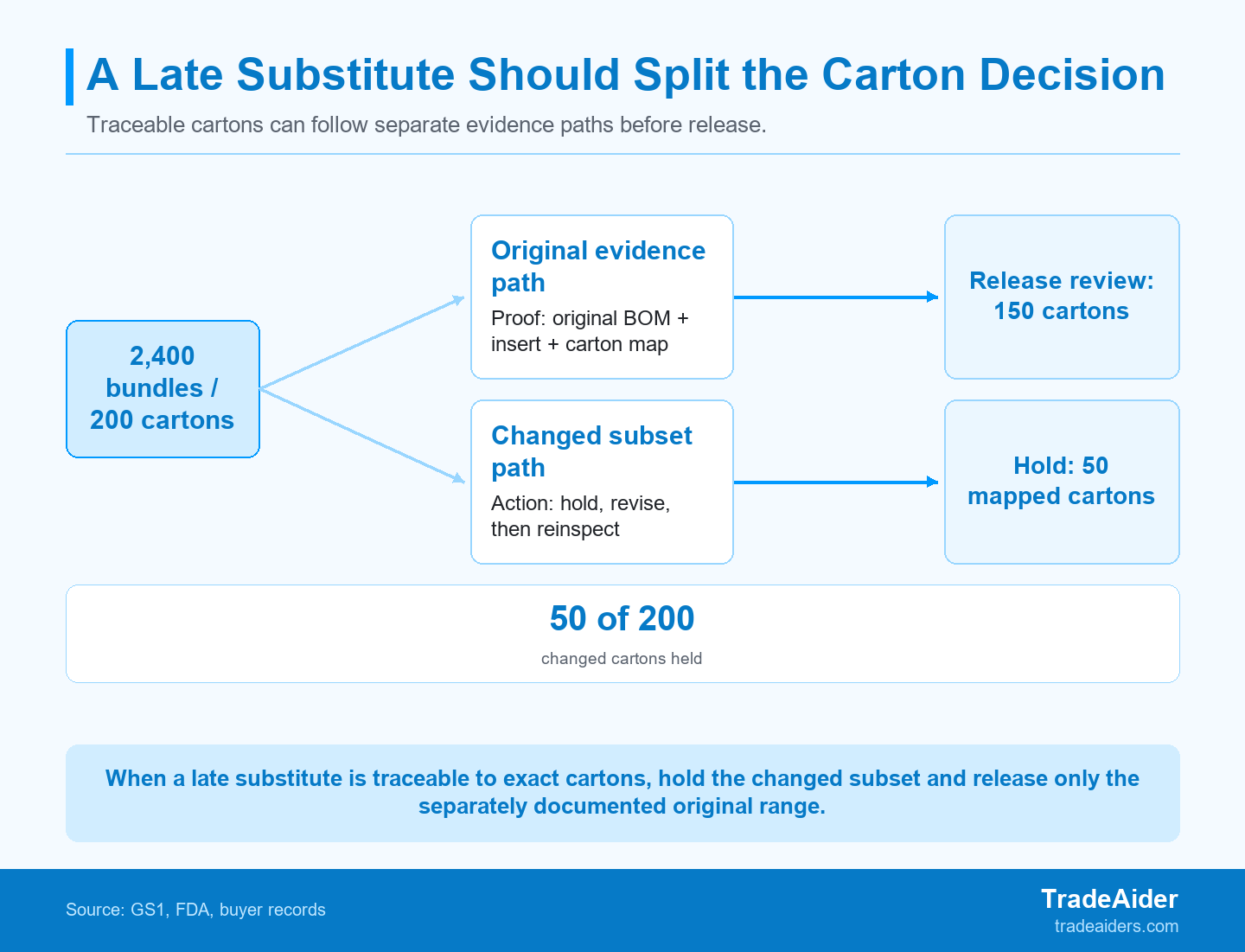
When a late substitute maps to 50 of 200 cartons, hold the changed subset and separately review the 150 cartons supported by the original bundle record.
Why the Hold Follows the Bundle Identity
The hold follows the traceable changed subset because the unchanged range has its own documented bundle identity.
A marketplace quality manager is preparing one four-component holiday bundle for two retail destinations. The original set contains a ceramic mug, a decorative ornament, a message card, and a vanilla cocoa sachet; all four items, the retail insert, and the barcode artwork were approved before kitting. The illustrative order contains 2,400 bundles packed 12 per master carton, or 200 cartons in total. Three days before dispatch, the cocoa supplier ships a spiced cocoa sachet for 600 sets because the original flavor is unavailable. The original bundle BOM, retail insert, barcode artwork, and master-carton list were approved before kitting.
The factory can map that substitute lot to 50 cartons, while the other 150 cartons contain the original approved sachet. The retail barcode still scans, and the carton count is still correct, but the old insert names vanilla cocoa and does not identify the changed set. The buyer also finds that the substituted 50-carton range was packed after the first completed-kit sample. That timing means a passed earlier sample cannot represent the changed range, even though the physical carton artwork is unchanged. Under these assumptions, 600 changed bundles divided by 12 bundles per carton equals 50 affected cartons. The traceable lot-to-carton map creates a smaller release population: the buyer can evaluate 150 cartons against the original approved identity instead of treating all 200 as an unknown mixture.
Hold the 50 mapped cartons and continue release review for the 150 independently documented cartons. The decision is not that every cocoa flavor change fails; it is that the changed retail configuration cannot borrow approval from a different physical set. For the held range, reconcile the substitute approval, destination-specific food-component review, insert revision, bundle identity decision, carton map, and any required marketplace or retailer instruction. Repack or relabel only after the responsible owner approves the revised configuration.
Reinspect the corrected 50-carton range against the revised bundle record. Verify the actual sachet, insert, retail barcode decision, carton marks, and sealed contents together before releasing that subset. This is an illustrative operational scenario, not a statement that every cocoa substitute has the same labeling or marketplace outcome. If the substitute cannot be mapped reliably to exact cartons, the hold boundary should expand rather than pretend a split release is defensible.
Send a Bundle-Specific PSI Brief Before Peak Dispatch
A usable bundle PSI brief names every component source, approved substitution rule, insert revision, barcode hierarchy, carton map, and release boundary. A Pre-Shipment Inspection is most useful once the completed order is representative of the actual packed release population; TradeAider's stated PSI timing is 100% of order quantity completed and at least 80% packed for export.
Send the approved bundle BOM, component register, approved substitutions, current insert and artwork, barcode map, retailer or destination instructions, carton-version list, sample plan, and dispatch window. Ask the report to identify the exact physical version checked, not simply a generic pass or fail. A pre-shipment inspection can then compare the packed set and carton map with that brief. Where food, electrical, children’s-product, or other regulated components are present, name the separate technical or compliance evidence the buyer expects to compare.
Who Is TradeAider?
TradeAider can translate a bundle bill of materials and pack-out requirements into an inspection scope before shipment. TradeAider is a quality inspection, testing, and certification service provider in China. TradeAider operates across all of China, covering major manufacturing provinces including Guangdong, Zhejiang, Jiangsu, Shandong, Fujian and other regions.
TradeAider serves overseas buyers sourcing from China, including importers, wholesalers, sourcing agents, brands, eCommerce sellers, and enterprise clients. Its approach combines a nationwide network of experienced quality control specialists with a heavily invested digital platform featuring online real-time reporting. Clients can monitor inspections live, communicate directly with inspectors, and address issues during production rather than after shipment — a proactive model focused on problem-solving and prevention, not just defect identification.
Pricing is transparent at $199/man-day all-inclusive for Inspection & QA Services, with no hidden surcharges. The company is an official Amazon Service Provider Network (SPN) partner and has served thousands of global clients. Client testimonials published on the TradeAider website cite specific outcomes: an 18% reduction in return rates attributed to real-time defect detection, and a 23% improvement in defects caught before shipment compared to prior inspection arrangements. These are client-reported figures.
When the bundle BOM, current artwork, barcode map, and dispatch timing are ready, request a bundle-specific PSI scope.
Frequently Asked Questions
Can a passed component release a holiday gift bundle?
No, a component pass does not release a holiday bundle unless the component record is tied to the exact bundle version and carton range. The final check must also confirm the completed set, current insert, retail identity, and carton evidence. A component can remain acceptable on its own while no longer matching the approved seasonal set.
Is a readable barcode enough for a gift set?
No, barcode scanning should compare the completed bundle identity with the approved barcode hierarchy, not merely confirm that a symbol reads. Record which code belongs to the component, retail set, and master carton. Retain the scan result with the sampled bundle record. A readable retail code can still be wrong for a revised or mixed physical configuration.
How should inspectors handle revised gift-bundle inserts?
Inspect every current insert revision that appears in the sampled bundle because insert language and claims must match the approved retail configuration. Pair the insert with the actual components and exterior barcode in the same record. If a late component change affects a claim, flavor, warning, or destination wording, isolate the affected version for review.
Can mixed master cartons be released for holiday bundles?
A mixed master carton can be managed only when its contents, identity, and destination handling rule are explicitly documented for that carton. Mark and map the mix so receiving teams can tell what is inside without assuming a single-SKU carton. If that evidence is absent, isolate the carton until the buyer decides how to reconcile or repack it.

Related Articles



Grow your business with TradeAider Service
Click the button below to directly enter the TradeAider Service System. The simple steps from booking and payment to receiving reports are easy to operate.

