
- About Us

- Our Services
- Your Industry
- Resources
- News & Blog
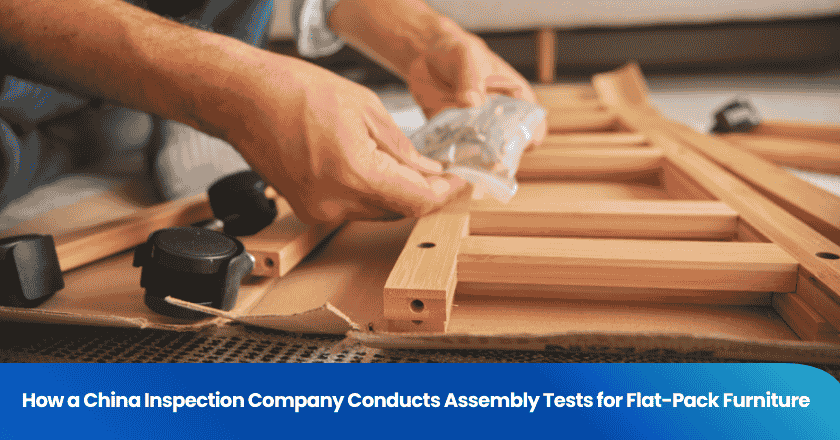
Flat-pack furniture dominates the global furniture market because it ships efficiently and sells at competitive prices. But For importers, the fact that a product arrives disassembled in a flat box does not guarantee it customer will have the same experience at the factory. Assembly testing during quality inspection catches the problems that cause returns, negative reviews, and liability claims — issues that cost far more than the savings from flat packaging.
This guide explains how assembly tests work during flat-pack furniture inspection in China, what inspectors look for, the step-by-step testing process, and how to set up an effective assembly test protocol for your products.
Key Takeaways
- Assembly testing verifies that flat-pack furniture can be correctly assembled using provided instructions, without missing hardware or structural failures
- The test process has five key stages: parts verification, trial assembly, stability testing, functionality check, and re-packing evaluation
- Stability testing under load is the most critical phase — simulating real-world use to catch structural weaknesses that visual inspection alone cannot detect
- Missing hardware and incorrect hole alignment are the two most common assembly defects found during inspection
- Pre-shipment inspection catches assembly problems at the factory, before flat-pack furniture enters a shipping container
Why Assembly Testing Matters for Flat-Pack Furniture
The Gap Between Factory Assembly and Customer Assembly
When furniture is assembled at the factory, quality control checks the on fully assembled pieces. But flat-pack furniture is designed to be assembled by the end customer — and that assembly process introduces a completely different set of potential failure points. A factory worker who builds 50 tables a day develops muscle memory for alignment and fit. A customer opening their first box does not have that advantage.
Assembly testing during inspection simulates the customer experience. The inspector follows the provided instructions step by step, using only the hardware and tools included in the package. This reveals problems that matter most to the end user — missing dowels, misaligned holes, vague instructions, and hardware that does not create secure joints.
Common Assembly Failures in Flat-Pack Furniture
Assembly defects in flat-pack furniture follow predictable patterns. Here are the most frequently found issues during inspection:
- Missing or incorrect hardware — wrong screw sizes. missing dowels. incorrect cam locks. or insufficient quantities of each fastener type
- Hole misalignment — pre-drilled holes that do not line up between panels. forcing misaligned parts together stresses joints and reduces structural integrity
- Tolerance stack-up — small dimensional errors in individual panels accumulate during assembly. causing visible gaps. uneven surfaces. or drawers that do not slide smoothly
- Instruction clarity issues — assembly diagrams that are ambiguous. steps that skip critical information. or hardware callouts that do not match the actual parts included
- Structural weakness after assembly — joints that wobble. shelves that bow under moderate weight. or frames that rack when lifted from one end
The 5-Step Assembly Test Process
A thorough assembly test during quality inspection follows a structured process designed to evaluate every aspect of the flat-pack experience. Here is how an experienced inspection team conducts these tests.
Step 1: Parts Verification and Completeness Check
Before any assembly begins. the inspector verifies that all components are present and undamaged. This means opening every box and cross-checking the contents against the packing list:
- All panels. boards. shelves. and structural components accounted for
- Hardware bags opened and counted — screws. dowels. cam locks. brackets. hinges
- Instructions and assembly diagrams present and legible
- Finish condition of all visible surfaces — no scratches. chips. or finish defects that occurred during shipping or handling
Missing parts discovered at this stage can be resolved before the inspection continues — but if missing hardware is a pattern across the batch. it indicates a systemic packing problem at the factory that needs to be addressed at the source.
Step 2: Trial Assembly Following Instructions
The inspector assembles one complete unit using only the provided instructions and included hardware. No additional tools. no prior knowledge of the specific product. This simulates the exact conditions your customer will face.
During assembly. the inspector evaluates:
- Instruction clarity — can each step be understood on the first read? Are diagrams accurate? Is the hardware clearly identified?
- Part fit and alignment — do panels align correctly? Do holes line up? Do joints fit snugly without forcing?
- Assembly time and difficulty — how long does full assembly take? Are any steps frustratingly difficult or physically demanding?
- Hardware adequacy — do the provided fasteners create secure joints? Are there enough of each type? Do any screws strip when driven into hard materials?
Step 3: Stability and Structural Testing
Once assembled. the furniture undergoes stability testing that simulates real-world use. This is where assembly testing differs most from visual inspection — it evaluates structural integrity under stress. The inspection standards for furniture typically include:
- Horizontal load test — applying weight to shelves and tabletops to verify they can support rated capacity without excessive deflection. A typical bookshelf should support 15-20 kg per shelf without visible bowing
- Rack test — lifting the assembled unit from one end to check for racking or joint separation. A well-assembled bookcase or cabinet should maintain structural integrity when lifted from one side
- Drawer slide test — opening and closing all drawers repeatedly to check for smooth operation. proper alignment. and secure mounting
- Door alignment test — verifying cabinet doors close properly. align with the frame. and latch correctly
- Level surface test — placing the assembled unit on a flat surface to check for rocking or uneven legs
Stability failures at this stage indicate either manufacturing defects (misaligned holes. warped panels) or design issues (insufficient fasteners for the joint type). Both need to be documented with photos and measurements.
Step 4: Functionality and Finish Verification
After structural testing. the inspector checks that all functional elements work correctly:
- All moving parts operate smoothly — drawers. doors. hinges. adjustable shelves
- Hardware is properly tightened and secured — no loose screws. wobbly legs. or unstable joints
- Surface finish is intact after assembly — no scratches from tools. no chips from hardware installation. no scuff marks from handling
- Edges and corners are aligned properly — no gaps between panels. no overhanging edges. no exposed hardware
Step 5: Re-Packaging Evaluation
The final step evaluates whether the furniture can be successfully disassembled and re-packed for shipping. This matters because:
- Parts should come apart without damage — hardware should be reusable. not stripped or deformed
- Re-packing should fit back into original packaging — no components left over. no forcing parts into too-small boxes
- Packaging should still protect the product — corner protectors. foam inserts. and wrapping should be intact and effective
A furniture item that assembles correctly but cannot be re-packed for shipping without damage will create problems at fulfillment centers and increase your packaging costs.
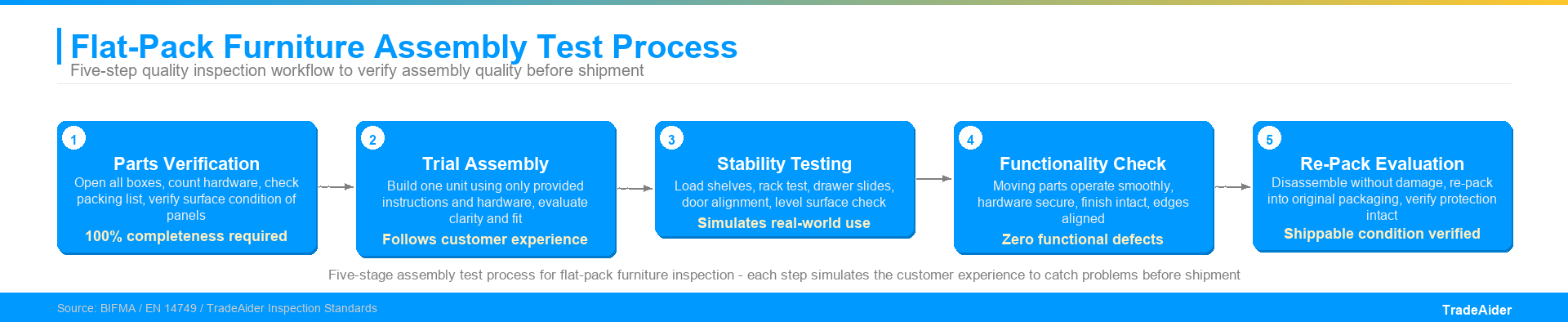
The five-stage assembly test process for flat-pack furniture inspection — each step builds on the previous to simulate the complete customer experience
Assembly Test Checklist for Inspectors
| Test Phase | Check Point | Pass Criteria |
|---|---|---|
| Parts Check | All components present | 100% match with packing list |
| Parts Check | Surface condition | No scratches. chips. or finish defects |
| Assembly | Hole alignment | All holes align without forcing |
| Assembly | Instruction clarity | Each step understandable on first read |
| Stability | Shelf load capacity | No visible bowing under rated weight |
| Stability | Rack test (lift from one end) | No joint separation or racking |
| Functionality | Drawer operation | Smooth open/close. no sticking |
| Functionality | Level surface standing | No rocking. stable on flat surface |
| Re-Pack | Disassembly without damage | All hardware reusable. no stripping |
Setting Up Your Assembly Test Protocol
Define Your Product-Specific Requirements
Generic assembly test protocols catch common problems. but the highest-value inspections are tailored to your specific product. Before the inspection. create a product-specific checklist that includes:
- Assembly time target — set a maximum acceptable assembly time based on your target customer profile. A bookcase that takes 3 hours to assemble might be acceptable for some brands. unacceptable for others
- Load capacity specifications — define weight limits for each shelf. drawer. and surface based on intended use and market expectations
- Hardware tolerance — specify whether any stripped screws or slightly damaged dowels are acceptable (usually they are not) or whether hardware must be pristine after assembly
- Instruction quality standard — define what constitutes acceptable assembly instructions. including minimum font size. diagram clarity. and step-by-step completeness
When you book a pre-shipment inspection. provide these specifications to the inspection team in advance so the inspector arrives at the factory with clear. measurable criteria rather than subjective judgment.
Common Questions
What does an assembly test check during furniture inspection?
An assembly test during furniture inspection verifies that flat-pack products can be correctly assembled using provided instructions and hardware. without missing parts. structural failures. or functional problems. It simulates the customer experience by having the inspector assemble the furniture using only what is included in the package.
Why is assembly testing important for flat-pack furniture?
Assembly testing is important because the factory tests fully assembled furniture. while the customer receives disassembled parts. The assembly process introduces unique failure points — hole misalignment. missing hardware. vague instructions. and tolerance stack-up — that visual inspection of individual panels cannot detect. Only by actually building the furniture can these issues be found.
How many units should be tested during assembly inspection?
Follow AQL sampling standards. typically using AQL 2.5 for major assembly defects and AQL 4.0 for minor issues like slightly vague instructions. The sample size depends on your total order quantity. but typically 3-5 units are fully assembled during a standard pre-shipment inspection for flat-pack furniture.
Can assembly testing be done during production instead of pre-shipment?
Yes. and it is often more valuable when done earlier. A during-production inspection that includes assembly testing can catch systemic problems — like a batch of panels with misaligned holes — while the production line is still running. giving the factory time to correct the issue before the entire batch is completed.
Protect Your Flat-Pack Furniture Quality
Assembly testing catches problems that no other inspection type can detect. Missing hardware. misaligned holes. confusing instructions. and structural weakness under load — these issues only appear when someone actually builds the furniture. For importers shipping flat-pack products from China. this test is the most direct way to simulate your customer's experience and catch problems before they become returns and negative reviews.
TradeAider provides on-site furniture inspection in China at $199 per man-day. including assembly testing as part of the inspection protocol. Real-time reporting means you see assembly results — photos of each step. stability test videos. and hardware counts — as they happen on the factory floor. Schedule your furniture inspection to include assembly testing on your next order.

Related Articles

Grow your business with TradeAider Service
Click the button below to directly enter the TradeAider Service System. The simple steps from booking and payment to receiving reports are easy to operate.

