
Inspect every order from new suppliers; drop to every second order after six proven shipments; move to every third order only after twenty consistent lots; and reset to every-order cadence after any failure. That is the Risk-Frequency Framework used by experienced quality managers — and it is how you match inspection spending to actual risk rather than paying a flat tax on every shipment. This guide walks you through the five supplier tiers, the triggers that move you between them, and the escalation rules that protect you when things change.
Key Takeaways
- Framework name: The Risk-Frequency Framework classifies suppliers into five tiers based on order history, defect rate, and current risk conditions, mapping each to a specific inspection cadence.
- New supplier rule: Inspect 100% of orders for the first three shipments regardless of product category — this is where defect patterns reveal themselves.
- Graduation criteria: Move from "every order" to "every 2nd order" only after six orders at under 2% defect rate; move to "every 3rd order" after twenty orders at under 1%.
- Reset rule: Any single failed inspection drops the supplier back to Tier 1 cadence (every order, tightened AQL) for three consecutive shipments — non-negotiable.
- Risk escalation: Chinese New Year, factory management changes, and new product launches trigger temporary "high-risk period" status — inspect every order plus tightened AQL regardless of tier.
Why Frequency Matters More Than Rigor
Most importers ask the wrong question. They ask "should I use AQL or 100% inspection?" when the more important question is "how often am I inspecting?" A standard AQL inspection on 100% of orders catches far more defects over a year than a premium 100% inspection done on every fifth order. Defect detection compounds with frequency.
The stakes are real. The Consumer Product Safety Commission's recall database shows a consistent pattern: most recalled goods came from suppliers with either no inspection history or gaps in inspection cadence. ITIF analysis reports Chinese imports account for 33% of CPSC-jurisdiction consumer imports but more than 75% of violations — a mismatch driven largely by inspection gaps, not by differences in the inspection method used.
Introducing the Risk-Frequency Framework
The Risk-Frequency Framework gives you a repeatable rule for deciding "should I inspect this order?" without relying on gut feel. Every supplier sits in one of five tiers; each tier has a defined inspection cadence; movement between tiers follows specific, documented triggers.
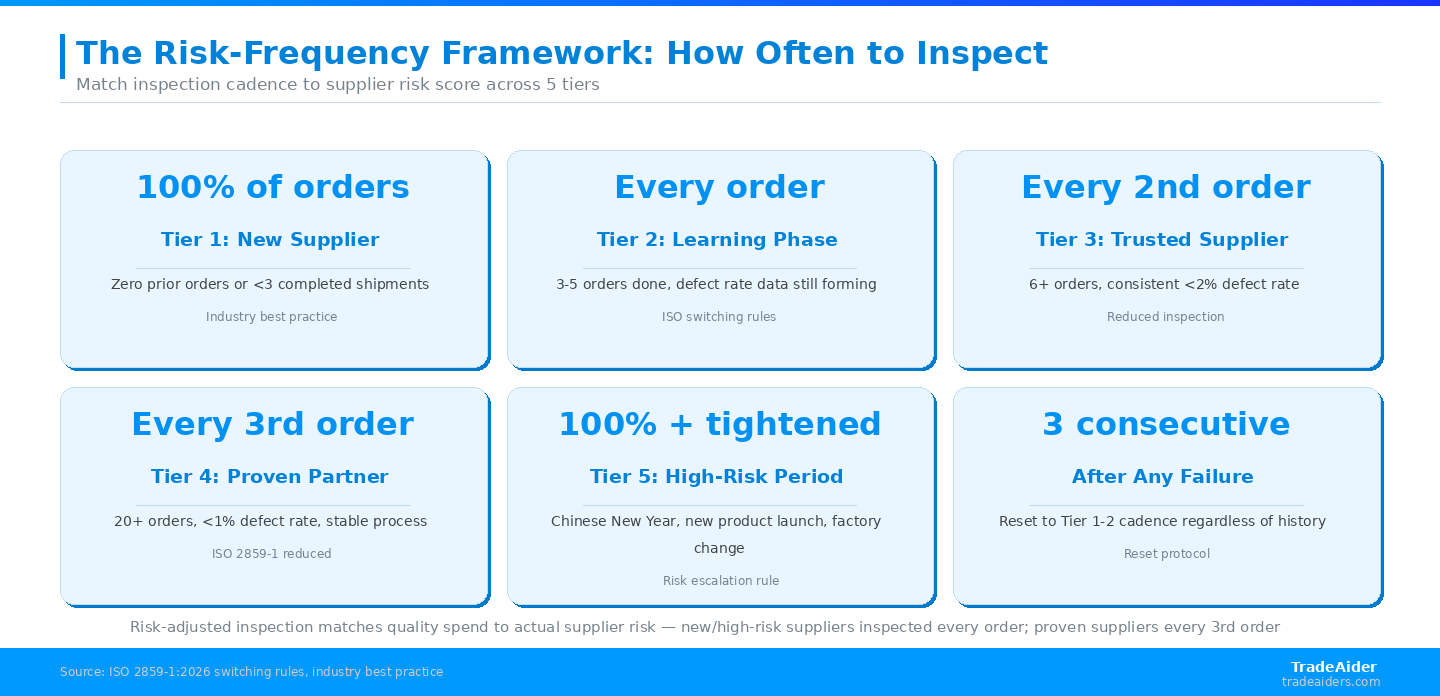
Five tiers of the Risk-Frequency Framework plus the non-negotiable failure reset rule.
Tier 1: New Supplier (0–2 Orders) — Inspect 100% of Orders
Until you have completed three shipments with a supplier, you have no data. The first order could be lucky; the second could be catch-up after they fixed a problem; the third is where the true baseline emerges. For all three, inspect at Level II AQL minimum, and consider tightened Level III if the product category carries any safety sensitivity.
New-supplier orders are also where you document the supplier's specific failure modes: the wrong glue, the misaligned logo, the packaging gap. These defects become items on your customized inspection checklist for every future order, regardless of tier.
Tier 2: Learning Phase (3–5 Orders) — Every Order, Still Level II
By the third order you are starting to see patterns. Does the supplier handle rush production the same way as standard production? Do defect rates spike around Chinese holidays? Does a specific SKU cluster have more problems than others? The Learning Phase is where these questions get answered. Inspect every order, but you can usually relax from tightened back to standard AQL Level II assuming the first three orders passed. A standard pre-shipment inspection at this stage gives you the data stream needed to move to Tier 3 confidently.
Tier 3: Trusted Supplier (6+ Orders, <2% Defect Rate) — Every 2nd Order
After six completed orders at consistent sub-2% defect rates, the supplier has earned a reduction in inspection frequency. Drop to every second order — still at standard AQL Level II. Under ISO 2859-1:2026 switching rules, this is the formal "reduced inspection" threshold: five consecutive lots passing at normal inspection.
Important: "every second order" means you still inspect at minimum 50% of shipments. It does not mean skipping inspection on alternating orders without replacement. The orders you skip should be randomly selected, not predictable, to prevent suppliers from timing quality relaxation.
Tier 4: Proven Partner (20+ Orders, <1% Defect Rate) — Every 3rd Order
After twenty orders at under 1% defects, you have earned the right to Tier 4 cadence. Inspect every third order. This tier is reserved for genuinely proven relationships — typically 18 months or more of consistent performance, where the supplier has demonstrated quality stability across seasons, staffing changes, and production volume fluctuations.
Even Tier 4 suppliers should still receive one inspection per quarter minimum regardless of order volume. This prevents the "cold start" problem where six months between inspections lets quality drift unnoticed.
Tier 5: High-Risk Period — 100% + Tightened AQL (Any Tier)
Tier 5 is not a supplier classification — it is a risk condition that overrides whatever tier the supplier is in. Any of the following triggers a temporary move to 100% inspection at tightened AQL:
Chinese New Year period. The two weeks before and after CNY see rushed production, temporary staff, and reduced supervision. Every shipment in this window deserves extra scrutiny regardless of how good the supplier normally is.
Factory management or ownership changes. A new plant manager means new processes, new quality incentives, and potentially new defect patterns. Reset to Tier 1-2 cadence until you have three clean orders under the new management.
New product launches from an existing supplier. A supplier you trust for Product A has zero track record on Product B. Treat Product B orders as a new supplier relationship regardless of the overall relationship tier.
Seasonal capacity spikes. Q4 production for holiday season often uses overflow lines or subcontracted capacity. Know whether your order is on the supplier's main line or their overflow — and inspect accordingly.
The Non-Negotiable Reset Rule
Any single failed inspection, at any tier, drops the supplier back to Tier 1 cadence (every order, Level II minimum, tightened if the failure was severe) for the next three consecutive shipments. This is the core safety mechanism of the Risk-Frequency Framework — the thing that prevents a good supplier from silently becoming a bad supplier.
Importers commonly resist this rule because it feels punitive. It is not. A failed inspection is information: something changed in the supplier's process. Until you verify the fix held across three shipments, you do not know whether the failure was a one-off or a systemic shift. Three clean consecutive inspections give you the data to return to the pre-failure tier.
Applying the Framework: A 12-Month Walkthrough
Here is what the Risk-Frequency Framework looks like in practice for an overseas buyer sourcing from a new supplier over a 12-month period, assuming one order per month:
| Month | Tier | Inspection Action | Defect Rate |
|---|---|---|---|
| 1 | 1 (New) | Full PSI + tightened AQL | 3.5% (passed) |
| 2 | 1 (New) | Full PSI + tightened AQL | 1.8% (passed) |
| 3 | 1→2 | Full PSI + standard AQL Level II | 1.2% (passed) |
| 4–6 | 2 (Learning) | Every order, Level II | 1.1–1.5% (all passed) |
| 7–8 | 3 (Trusted) | Every 2nd order | Month 7 skipped; Month 8: 1.3% |
| 9 | 5 (CNY Risk) | 100% + tightened (CNY override) | 4.2% (FAILED) |
| 10–12 | Reset to 1 | Every order, tightened AQL | 2.1%, 1.6%, 1.3% (re-qualifying) |
The CNY-triggered escalation in Month 9 caught a defect spike that would have been missed under the "every 2nd order" cadence. The reset rule then kept the supplier under close watch for three months until consistent performance was re-established. Without the framework, this supplier might have had 2–3 bad shipments reach customers before the importer noticed.
Adapting the Framework to Your Product Category
The framework above assumes a standard consumer-goods product with moderate risk. Adjust the thresholds based on category:
High-risk categories (electrical, toys, baby goods, food contact): Never leave Tier 1-2. Inspect every order regardless of history; use tightened AQL as the default, not standard Level II. The FDA recall dashboard confirms why: regulated categories tolerate zero inspection gaps.
Low-risk categories (apparel, homeware, accessories under $20): Can accelerate the tier progression. Move to Tier 3 after four orders instead of six if defect rates are consistently clean.
High-value categories ($200+/unit): Add 100% full inspection to whatever cadence your tier calls for. Tier alone does not override unit-value risk.
For overseas buyers sourcing from China — importers, wholesalers, sourcing agents, Amazon FBA sellers, Shopify brands, and eCommerce importers — applying this framework consistently is one of the clearest ways to reduce total quality spend while actually improving defect detection. With $214 billion in annual U.S. consumer-goods imports from China, even small improvements in inspection targeting compound into significant cost savings across a sourcing program.
Who Is TradeAider?
TradeAider is a quality inspection, testing, and certification service provider in China. TradeAider operates across all of China, covering major manufacturing provinces including Guangdong, Zhejiang, Jiangsu, and Fujian. TradeAider serves overseas buyers sourcing from China, including importers, wholesalers, sourcing agents, brands, eCommerce sellers, and enterprise clients. Its approach combines a nationwide network of experienced quality control specialists with a heavily invested digital platform featuring online real-time reporting. Clients can monitor inspections live, communicate directly with inspectors, and address issues during production rather than after shipment — a proactive model focused on problem-solving and prevention, not just defect identification.
Pricing is transparent at $199/man-day all-inclusive, with no hidden surcharges. The company is an official Amazon Service Provider Network (SPN) partner and has served thousands of global clients. Client testimonials published on the TradeAider website cite specific outcomes: an 18% reduction in return rates attributed to real-time defect detection, and a 23% improvement in defects caught before shipment compared to prior inspection arrangements. These are client-reported figures.
Frequently Asked Questions
How often should I inspect a new China supplier?
Inspect every single order from a new China supplier for the first three shipments minimum, using tightened AQL (ISO 2859-1 Level III) on at least the first order. The first three orders establish the supplier's true defect baseline; shortcuts here are how importers discover problems only after defective units reach customers. Move to standard AQL Level II after three clean passes.
When can I safely skip inspections?
You can safely skip inspections only after a supplier has completed six orders at under 2% defect rate, and even then only on every second order — never two orders in a row. Moving to every third order requires twenty completed orders at under 1% defect rate plus stable supplier management. A single failed inspection resets you to every-order cadence for the next three shipments.
Should I inspect more often during Chinese New Year?
Yes — the two weeks before and after Chinese New Year (late January to mid-February) warrant 100% inspection plus tightened AQL regardless of your supplier's normal tier. CNY is when factories rush production to clear orders before the seven-day national shutdown, use temporary staff, and cut corners on supervision. Defect rates consistently spike during this window across the industry.
Does the framework apply to low-volume or infrequent sourcing relationships?
Yes — but you will always be in Tier 1 because you never accumulate the order history needed to graduate. When order volume with a given supplier remains limited, inspect every single shipment at tightened AQL. The cost of the inspection (typically $199–$350) is trivial compared to the cost of a failed shipment from an unknown supplier.
What counts as a "failure" that triggers the reset rule?
A failure is any inspection result that falls below your accept threshold at the chosen AQL level — this includes critical defect counts above zero, major defects exceeding the AQL 2.5 accept number for your sample size, or quantity shortfalls beyond contracted tolerance. Partial rework before final acceptance still counts as a failure for framework purposes; the point is to detect process instability, not to assign blame.
Bottom Line
The Risk-Frequency Framework turns "how often should I inspect?" from a gut-feel decision into a repeatable rule tied to supplier history, defect rate, and current risk conditions. Inspect every order from new suppliers; graduate in measured steps only after proven performance; reset immediately on any failure; escalate automatically during known high-risk windows. Most importers overspend on low-risk suppliers and underspend on high-risk ones — the framework fixes both.
If you want help building your supplier tier map or running the first three orders' worth of inspections that anchor the whole framework, contact the TradeAider team for a quote on your specific supplier list and product categories.
Related Articles
Grow your business with TradeAider Service
Click the button below to directly enter the TradeAider Service System. The simple steps from booking and payment to receiving reports are easy to operate.

