
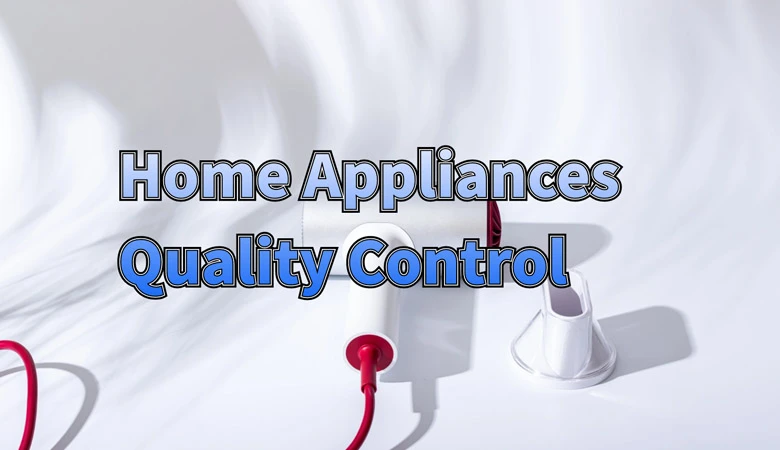
China is a major manufacturing base for household appliances, including kitchen appliances, cleaning equipment, personal care devices, and other electrical products. For international buyers, maintaining consistent product quality across different production batches is essential to protecting customer satisfaction and brand reputation.
However, choosing a quality control partner for home appliances involves more than comparing inspection prices. Electrical and electronic products may require functional checks, component verification, workmanship inspection, and laboratory testing against specific safety or performance requirements.
The right quality control partner should understand your product category, follow clearly defined inspection criteria, provide reliable evidence, and help you identify when additional laboratory testing or certification review is needed.
This guide explains six factors buyers should consider when selecting a home appliances quality control partner in China.
Define Your Home Appliance Quality Control Requirements
Before comparing service providers, clarify what you need them to check and when you need quality control support.
Home appliances vary considerably in construction and function. An electric kettle, air purifier, blender, and washing machine have different components, operating principles, and quality requirements. A general inspection checklist may not cover the specific risks of every product.
Start by defining three areas:
Product requirements: Identify the product model, specifications, materials, critical components, approved samples, functional requirements, and packaging instructions.
Market requirements: Identify the destination market and determine which product safety, electrical, energy efficiency, environmental, or labeling requirements apply. These requirements depend on the product type and target market.
Service requirements: Decide whether you need a factory audit, pre-production inspection, during-production inspection, pre-shipment inspection, laboratory testing, or a combination of these services.
| Your requirement | Service to consider |
|---|---|
| Assess factory quality management and production capabilities | Factory Audit |
| Verify materials, components, and production preparation | Pre-Production Inspection (PPI) |
| Check assembly quality and identify production problems early | During Production Inspection (DUPRO/DPI) |
| Evaluate finished products before shipment | Pre-Shipment Inspection (PSI) |
| Verify specific electrical safety or performance requirements | Laboratory Testing |
| Review existing product test reports and certification documents | Document and Certification Review |
Not every order requires every service. The inspection and testing plan should reflect the product's complexity, production risks, order requirements, and destination market.
Look for Experience with Electrical and Household Appliances
Experience in general merchandise inspection does not automatically mean a provider has the technical knowledge required for household appliances.
A suitable partner should understand the characteristics of electrical and electronic products, including component assembly, product functionality, workmanship, and the importance of identifying potentially safety-related defects.
When evaluating a provider, consider the following:
- Relevant product experience: Has the provider handled similar appliance categories, such as kitchen appliances, cleaning equipment, or personal care devices?
- Technical understanding: Can the inspection team understand product specifications, operating instructions, critical components, and functional requirements?
- Inspection capability: Can inspectors follow product-specific checklists and identify deviations in appearance, assembly, accessories, and basic functions?
- Testing coordination: Can the provider explain when laboratory testing is necessary and help arrange appropriate testing services?
Ask for relevant inspection report samples or examples of previous work involving similar products. This is more useful than relying solely on general claims of industry experience.
Understand the Difference Between Inspection, Testing, and Certification
One of the most important considerations when choosing a home appliances quality control partner is understanding the scope of its services.
Inspection, laboratory testing, and product certification serve different purposes. A provider should explain these differences clearly instead of presenting them as interchangeable services.
| Service | Main purpose | Typical scope |
|---|---|---|
| Product Inspection | Evaluate products against agreed specifications and inspection criteria | Appearance, assembly, workmanship, dimensions, accessories, labeling, packaging, and defined functional checks |
| Laboratory Testing | Evaluate specific product characteristics using defined test methods | Electrical safety, insulation, leakage current, durability, performance, and other applicable tests |
| Product Certification | Evaluate conformity with a particular certification scheme or regulatory framework | Assessment and certification under applicable product-specific requirements |
| Factory Audit | Assess factory operations and quality management arrangements | Quality procedures, production processes, equipment, personnel, and related management controls |
For example, an inspector may check whether an appliance powers on and whether its controls operate as specified. However, this does not replace laboratory testing for electrical insulation, leakage current, abnormal operation, or other safety characteristics.
Similarly, a pre-shipment inspection report does not automatically establish that a product complies with all regulations in its destination market.
Before engaging a provider, confirm exactly which services it performs directly and which require a separate laboratory or certification organization.
Verify Relevant Qualifications and Technical Competence
Credentials matter, but buyers should evaluate them according to the actual service being provided.
Different standards apply to different types of organizations and activities. For example:
| Standard or framework | What it relates to | What buyers should understand |
|---|---|---|
| ISO 9001 | Quality management systems | Indicates that an organization operates a quality management system; it does not independently prove technical competence in every inspection or testing activity |
| ISO/IEC 17020 | Inspection bodies | Provides requirements concerning the competence, impartiality, and consistent operation of inspection bodies |
| ISO/IEC 17025 | Testing and calibration laboratories | Relates to laboratory competence and the validity of testing and calibration results |
A quality control partner does not necessarily need every accreditation listed above. The relevant qualifications depend on whether the provider performs inspection, laboratory testing, or other specialized services.
If laboratory testing is required, check the laboratory's accreditation status and, importantly, whether the specific test methods and product scope are covered by its accreditation.
For product certification, verify the certification body's authorization and the applicable certification scheme. Do not assume that an inspection company, testing laboratory, or ISO 9001 certificate automatically provides product certification authority.
Evaluate Inspection Reports, Communication, and Problem Handling
A quality control partner should do more than issue a pass-or-fail result. Buyers need clear findings and enough supporting information to understand the actual condition of their products.
Before choosing a provider, request a sample inspection report and assess whether it includes:
- Product identification, model, quantity, and inspection date.
- Inspection scope, sampling method, and acceptance criteria.
- Clear descriptions of defects and non-conformities.
- Supporting photographs, measurements, and functional check results where applicable.
- A summary of inspection findings and the overall result.
Also consider how the provider communicates when problems are identified.
For example, if an inspector discovers an assembly issue during production, can the buyer receive the findings while production is still underway? Can the supplier be asked to correct the issue? Is a follow-up inspection available to verify the corrective action?
A practical quality control process should support the complete sequence:
Identify the issue → Report the findings → Arrange corrective action → Verify the improvement → Close the quality loop.
Real-time communication is particularly valuable when buyers are located overseas and cannot visit the factory themselves.
Compare Service Coverage, Response Time, and Pricing
Home appliance manufacturing is distributed across different industrial regions in China. A quality control partner should be able to arrange inspections in the relevant manufacturing locations and provide a clear service scope and schedule.
Consider these practical factors when comparing providers:
| Evaluation factor | Questions to ask |
|---|---|
| Geographic coverage | Can inspections be arranged at the factory's location? |
| Scheduling | How quickly can an inspector be assigned? |
| Reporting | Are findings available during inspection, and when is the official report delivered? |
| Service scope | Are inspection, testing, factory audits, and follow-up inspections clearly distinguished? |
| Pricing | Does the quotation explain inspection days, travel expenses, testing fees, and other possible charges? |
| Problem follow-up | Can the provider support corrective action verification and re-inspection? |
Do not select a provider based on the lowest quotation alone. An unclear inspection scope, limited reporting, or slow communication may create additional costs when problems occur.
Instead, compare the actual services included, the quality of the evidence provided, and the provider's ability to respond when quality issues arise.
How TradeAider Supports Home Appliance Quality Control in China
TradeAider provides third-party inspection, product testing, and factory audit services for international buyers sourcing products from China.
For home appliances, quality control requirements can vary significantly by product type. TradeAider arranges inspection activities according to the buyer's specifications, approved samples, inspection criteria, and production stage.
Depending on the order, buyers can consider the following services:
- Pre-Production Inspection (PPI)
Checks production preparation and relevant materials, components, and approved references before mass production begins.
- During Production Inspection (DUPRO/DPI)
Evaluates product quality while manufacturing is underway, helping buyers identify workmanship and production problems before the order is completed.
- Pre-Shipment Inspection (PSI)
Checks finished products against agreed requirements, including appearance, workmanship, dimensions, accessories, packaging, and specified functional checks.
- Factory Audit
Assesses a factory against the buyer's defined requirements, helping buyers understand its production arrangements and quality management practices.
- Product Testing
Supports the evaluation of product performance and chemical or physical characteristics through appropriate laboratory testing arrangements. Electrical safety and other specialized tests should be defined according to the product and applicable requirements.
TradeAider's online reporting system provides buyers with access to inspection progress and findings, including photographs, videos, measurements, and defect information. An official PDF report is normally provided within 24 hours after the on-site inspection is completed.
When issues are identified, buyers can review the findings while inspectors are still on site and provide instructions on the next steps. Corrective actions can be followed by verification or re-inspection when required.
With a nationwide network of professional inspectors across China, TradeAider helps buyers gain clearer visibility into the quality status of their home appliance orders.
Frequently Asked Questions
What should I look for in a home appliances quality control partner in China?
Look for relevant appliance inspection experience, technical understanding, clear inspection procedures, reliable reporting, suitable geographic coverage, and the ability to coordinate laboratory testing when necessary. Also verify that any claimed accreditation or certification applies to the actual service being provided.
Can a third-party inspection company test electrical appliances?
An inspection company can perform defined on-site checks, such as checking appearance, assembly, accessories, and specified basic functions. Specialized electrical safety and performance tests generally require appropriate laboratory equipment, methods, and technical competence.
Is ISO 9001 enough to prove that a quality control partner is qualified?
No. ISO 9001 relates to an organization's quality management system. It does not by itself demonstrate competence in every inspection or laboratory testing activity. Buyers should evaluate qualifications relevant to the specific service, including ISO/IEC 17020 for inspection bodies and ISO/IEC 17025 for testing laboratories where applicable.
Should home appliances be inspected during production or only before shipment?
The appropriate timing depends on product complexity and production risk. During-production inspection can help identify assembly and workmanship issues before the order is completed, while pre-shipment inspection evaluates finished products before shipment. For new suppliers or higher-risk products, using both stages may be appropriate.
Can a pre-shipment inspection guarantee that home appliances are safe?
No. A pre-shipment inspection evaluates products within an agreed scope and sampling method. It cannot replace all required laboratory tests or establish full regulatory compliance. Buyers should arrange the necessary testing and certification activities separately.
Conclusion
Choosing the right home appliances quality control partner in China requires more than checking prices or collecting certificates. Buyers should evaluate product-specific experience, inspection capability, technical competence, reporting quality, service coverage, and the ability to coordinate appropriate testing.
Most importantly, inspection, laboratory testing, and product certification should be clearly distinguished. A well-defined quality control plan helps buyers identify problems at the right stage, understand the actual condition of their products, and make better-informed decisions before shipment.
TradeAider supports international buyers with third-party inspection, factory audit, and product testing services in China, helping them maintain greater visibility over product quality throughout manufacturing. Contact now.
Related Articles
Grow your business with TradeAider Service
Click the button below to directly enter the TradeAider Service System. The simple steps from booking and payment to receiving reports are easy to operate.