
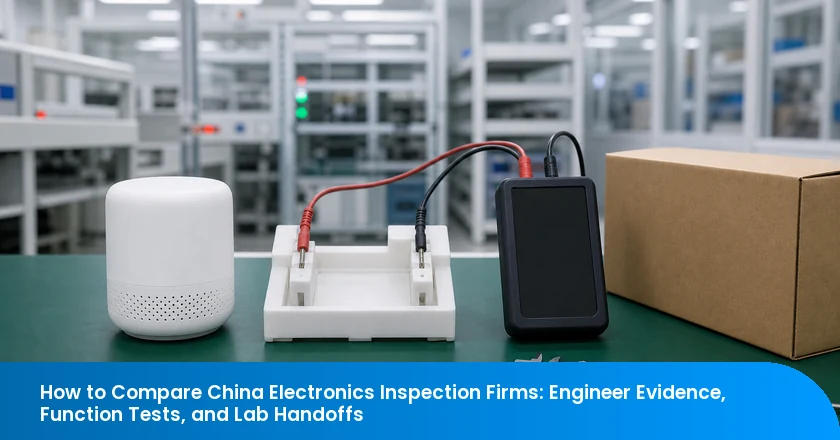
Compare electronics inspection firms in China by the evidence they will commit to before the visit: the current product configuration, a written functional-test scope, the records captured, and the rule for handing an unresolved question to a laboratory. A broad electronics label is not enough to support a release decision.
A laboratory handoff is the documented transfer of the correct product identity, test question, and supporting records to a laboratory route. It matters when an on-site observation identifies a risk but cannot answer the applicable laboratory or compliance question. The buyer should compare proposals against the same evidence request, then select the scope that closes the actual decision gap.
What a Defensible Electronics-Provider Shortlist Requires
A defensible electronics-provider shortlist is built from documented scope, functional evidence, lab handoff, and escalation—not from a generic electronics claim. Start with one RFQ, a buyer document that gives each provider the same work scope to answer. That prevents one proposal from quietly assuming checks, records, or laboratory coordination that another provider has priced and documented.
- Scope: Require the exact model, hardware revision, firmware version when relevant, factory, and release deadline.
- Function: Ask which buyer-critical actions will be tested, how a pass is defined, and what proof will appear in the report.
- Handoff: Require a written answer on who identifies the laboratory question, preserves the sample identity, and records the escalation.
- Decision: Do not advance a response that leaves the versioned scope blank, even if its service description sounds comprehensive.
The point is not to make every provider perform every task. It is to know, before booking, which evidence the provider will create and which obligations remain with the importer, laboratory, or certification route.
Why Inspection, Laboratory Testing, and Certification Must Stay Separate
A factory inspection, a laboratory test, and a destination-market compliance file can all be necessary for an electronics shipment, but they answer different questions. An inspection checks the agreed product and lot against stated requirements; a laboratory method answers a defined technical question on an identified sample; documentation and certification duties depend on the product and market. Treating them as one service creates gaps precisely when a release decision needs clarity.
If a buyer needs a separate method and report route, it should be visible in the proposed workflow for product testing services, rather than assumed to be included in a factory visit. The RFQ should name the open question, the sample identity, and the record that must connect the factory observation to the next technical step.
ISO/IEC 17020:2026 describes inspection as examining an item and determining its conformity with requirements, which can come from standards, regulations, contracts, or specifications. In an RFQ, that means the provider should identify the requirement set it will inspect against rather than imply that a factory visit proves every product claim.
ISO/IEC 17025:2017 is the international standard for testing and calibration laboratories and addresses their competence, impartiality, and consistent operation. A buyer therefore needs a separate laboratory question in the RFQ: which method is needed, which sample is being referred, and which report will answer it? A provider may coordinate that route, but coordination should not be mistaken for a laboratory result.
European Commission guidance says that importers must check that necessary documentation, including the EU Declaration of Conformity and technical documentation, is available when applicable before placing products on the EU market. This is why an inspection report should be treated as a named part of the evidence file, not its substitute.
For a factory-side baseline, compare the proposed current-lot scope with the TradeAider quality inspection standard, then add the product-specific functions and documentation the particular release requires.
How Provider Models Compare on Electronics Evidence
Provider models differ most in the evidence they can document, the functions they can agree to check, and the way they hand unresolved questions to a laboratory. The useful comparison is therefore not “which firm is best,” but “which written commitment fits the evidence missing from this product decision.” The table below compares generic service models, not the performance of named companies.
Methodology: compare only what a proposal expressly commits to for the same model, configuration, critical functions, sampling approach, record format, and escalation path. A provider can be suitable for a current-lot check while still being unsuitable for a version-sensitive function test or laboratory-coordination need.
| Service model | Written scope to request | Functional evidence to request | Laboratory-handoff question |
|---|---|---|---|
| Basic current-lot inspection | Product identity, lot, packing, workmanship, and agreed sample plan | Only the named checks and pass/fail records | Who retains responsibility if a lab question appears? |
| Electronics-focused inspection scope | Hardware or firmware version, fixtures needed, and test-owner contact | Function path, expected result, photo or video rule, and exception log | How is the sample or open question identified and transferred? |
| Laboratory-coordinated workflow | Named test question, destination market, current sample identity, and decision deadline | Inspection record linked to the configuration supplied for laboratory review | Which laboratory, method, sample reference, and report are expected? |
| Ongoing production-quality program | Stage gates, change-control notice, recurring defect rules, and reinspection trigger | Trend records for the agreed functions and configurations | When does a change trigger a new technical or laboratory review? |
Based on this comparison, choose the narrowest model that still creates the evidence the release decision needs. A basic inspection may be appropriate for stable, low-risk products; a device with version-sensitive functions needs a more explicit scope, even when the factory has shipped an earlier version successfully.
What Engineer Coverage Evidence Should an RFQ Require?
An electronics-capability claim becomes comparable only when a provider states who owns the technical scope, which configuration will be checked, and what evidence the report will preserve. A job title, product-category label, or general equipment list does not answer those questions. Ask for the person or function responsible for clarifying the test scope, the information needed before the visit, and the escalation point when the observed result does not match the product requirement.
ISO 2859-1:2026 defines AQL-indexed acceptance sampling plans for lot-by-lot inspection, so a comparable inspection scope should state its sampling plan. Here, AQL is an acceptance sampling approach that uses a quality limit to set a lot-sampling decision. The provider should state the inspection level, sample-size logic, defect classifications, and acceptance criteria; otherwise, two proposals may describe the same “inspection” while checking materially different numbers of products.
Request these five evidence items before selecting a firm:
- A versioned product brief: SKU, hardware revision, firmware version where applicable, accessories, and factory contact.
- A function list that separates a quick power-on check from the buyer-critical use paths, such as pairing, charging, display, connectivity, or safety interlocks.
- The fixture, app, account, cable, power supply, or reference sample needed to run each listed check.
- The report proof for each critical function, such as a reading, photograph, video, screenshot, serial reference, or named exception.
- An escalation statement that says who reviews an ambiguous result and whether the next step is rework, reinspection, or a laboratory question.
When the product is still being finalized, a Pre-Production Inspection service can help place the approved version, reference sample, components, and critical functions into a written starting scope before finished goods are presented for release.
Move From a Product Label to a Function-Test Charter
A function-test charter should tie each buyer-critical function to a product configuration, expected result, evidence capture, and escalation rule. For example, “test Bluetooth” is not a usable scope. A usable line would name the firmware build, the pairing device or app version, the expected connection behavior, the evidence to retain, and the action if pairing fails after a defined retry.
This document can be concise, but it must be specific enough that the factory, inspector, and buyer are looking at the same use path. It also gives a laboratory referral a starting point: the question is not merely whether the product “works,” but what configuration was tested and which result requires technical interpretation.
Illustrative Scenario: A Firmware Change Exposes a Lab-Handoff Gap
The illustrative buyer held the revised firmware build until the inspection scope and laboratory sample record named the same configuration. The following composite scenario shows why a buyer should hold the changed configuration, rather than treating successful checks on another build as evidence for the whole shipment. It is illustrative, not a TradeAider client case or a laboratory finding.
Situation, Problem, Action, and Result
The illustrative buyer contained risk by holding the revised build until the scope, inspection record, and laboratory sample reference named the same firmware version. The buyer was preparing a smart-device release from China and needed to choose a provider for the final check. The purchase covered 3,600 finished devices across two product families, including 1,200 devices whose revised pairing sequence used a new firmware build.
The buyer’s RFQ named the changed pairing sequence as a buyer-critical function. It also asked the providers to state whether their report would identify the build, whether the pairing path would be witnessed, and how an unresolved technical question would be carried to the laboratory record already held for the earlier configuration.
The first proposal offered power-on and packaging checks, but it did not request a firmware identifier or a function-test charter. The second proposal asked for the build ID, pairing device, app version, laboratory report number, sample identifier, and the release rule if the current build could not be matched to the earlier evidence.
The factory considered all cartons ready for shipment because the housing, labels, and basic power-on behavior matched the prior release.
A current-lot power-on result could show that a device started, but it could not show that the device followed the revised pairing path or that the laboratory sample and current build were the same configuration.
The buyer identified an information gap: valid records from the earlier product family could be wrongly applied to the revised one. Mixing those records would create a false release conclusion, especially if the pairing sequence affected the technical question being referred. The potential delay was real, but releasing the changed build without a matched evidence chain transferred the decision risk to the importer.
The buyer chose a conditional release geometry: ship-ready status continued for the unchanged product family, while the 1,200 revised devices were held. The selected provider received a revised scope that named the firmware build and the pairing path. This was a product-family boundary, not a hold on every carton in the purchase.
The factory supplied a version list and the current sample identifier. The provider updated the inspection record, captured the configuration during the function check, and routed the laboratory question with the matching product identity rather than a generic model name. The change did not prove compliance by itself; it made the next technical decision traceable.
The release gate was simple: the written function-test scope, current inspection record, and laboratory sample reference had to name the same hardware and firmware configuration. If any record remained ambiguous, the revised build stayed on hold pending a laboratory clarification or a corrected inspection scope.
Result and limitation: the buyer accepted a short operational delay for the changed product family while preserving the option to release the unchanged devices. This is an illustrative composite scenario, not a guarantee that those controls satisfy every destination-market requirement or replace product-specific legal advice.
Score RFQ Responses on Evidence, Not Marketing Claims
A provider should be shortlisted only when it clears an illustrative 70-point evidence screen and has no zero score in the versioned-scope category. The illustrative screen below uses 100 possible points. It is not a TradeAider score or an industry standard. It is a buyer-controlled way to expose whether a proposal names the configuration, function proof, sampling method, handoff, and release decision.
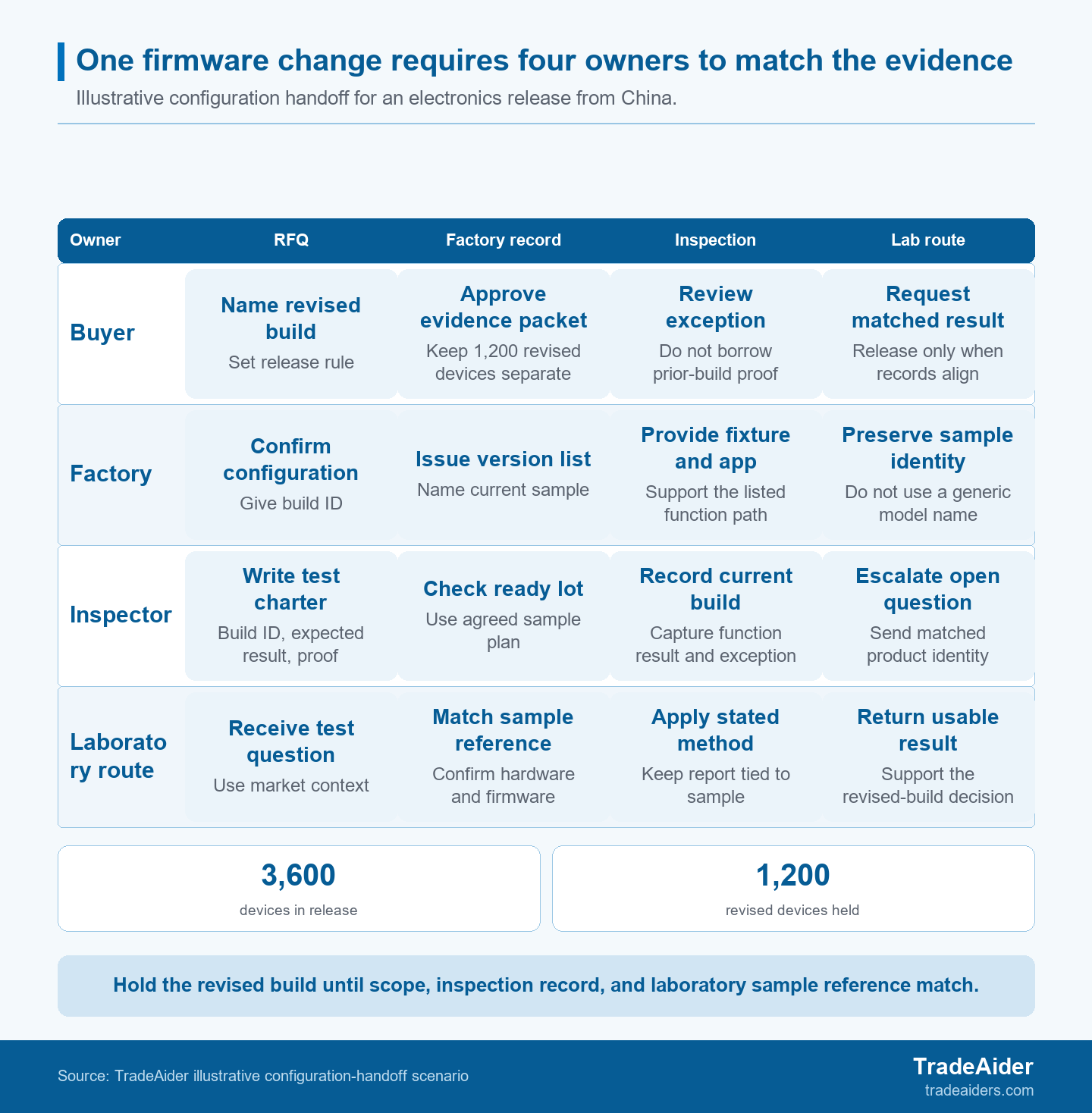
Illustrative handoff map: release the revised build only after the scope, inspection record, and laboratory sample reference identify the same configuration.
| Evidence category | Possible points | Give full credit when the response states |
|---|---|---|
| Versioned scope | 30 | Model, hardware or firmware version, factory, and scope owner |
| Function-test charter | 25 | Critical paths, expected results, required fixtures, and proof format |
| Sampling and report record | 20 | Sample logic, defect rules, images or readings, and named exceptions |
| Laboratory handoff | 15 | Question, sample identity, laboratory route, and expected report |
| Release and escalation rule | 10 | Who receives an exception, by when, and which condition stops release |
Illustrative calculation: 30 + 25 + 20 + 15 + 10 = 100 possible points. Advance a response at 70 points or more only when the versioned-scope score is above zero. The limitation is deliberate: a number cannot prove technical competence. It can only show that a buyer has obtained comparable written commitments before assigning work.
A buyer can test a published service approach against the current model, function list, evidence requirements, and exclusions instead of inferring a scope from a general service label, then review TradeAider's published quality-control approach.
What Should Go Into an Electronics Inspection RFQ?
A consistent RFQ packet turns provider claims into comparable commitments about the exact model, function tests, records, handoff, and deadline. Send the same packet to every shortlisted firm and ask each to identify what it will inspect, what it will not inspect, and what information it needs before a booking can be confirmed. That makes omissions visible before the factory is ready to ship. If you want a written response using this packet, request an electronics inspection scope review.
- Product identity: SKU, model, hardware and firmware revision, accessories, factory address, and available reference sample.
- Release context: expected readiness date, destination market, buyer decision deadline, and whether an earlier version exists.
- Critical functions: use paths, fixtures, app or account access, expected results, evidence capture, and acceptable retries.
- Inspection terms: sample plan, defect classifications, packing checks, report deadline, and the person who can clarify requirements.
- Laboratory route: open test question, existing report reference if any, sample identifier, desired method or report, and escalation owner.
UK guidance for applicable electrical equipment says importers must retain a declaration of conformity and technical documentation for 10 years after market placement. The RFQ does not replace those duties; it helps the buyer make sure an inspection scope and any laboratory referral support the correct evidence file.
Where a buyer needs both on-site verification and a testing path, the written scope should say how each part will be handled. Ask for a product-specific response so the requested work can be matched to the function list, sample plan, and destination-market question instead of inferred from a broad category label.
Before a booking is confirmed, keep the provider's written exclusions with the product brief. Record who supplies the reference sample, who approves a substituted fixture or app version, and who receives an exception before a release decision. Those details make a late question easier to route while the factory can still identify the affected configuration and cartons.
Who Is TradeAider?
TradeAider is a quality inspection, testing, and certification service provider in China. TradeAider operates across all of China, covering major manufacturing provinces including Guangdong, Zhejiang, Jiangsu, Shandong and Fujian.
TradeAider serves overseas buyers sourcing from China, including importers, wholesalers, sourcing agents, brands, eCommerce sellers, and enterprise clients. Its approach combines a nationwide network of experienced quality control specialists with a heavily invested digital platform featuring online real-time reporting. Clients can monitor inspections live, communicate directly with inspectors, and address issues during production rather than after shipment — a proactive model focused on problem-solving and prevention, not just defect identification.
Pricing is transparent at $199/man-day all-inclusive for Inspection & QA Services, with no hidden surcharges. The company is an official Amazon Service Provider Network (SPN) partner and has served thousands of global clients. Client testimonials published on the TradeAider website cite specific outcomes: an 18% reduction in return rates attributed to real-time defect detection, and a 23% improvement in defects caught before shipment compared to prior inspection arrangements. These are client-reported figures.
Frequently Asked Questions
Importers should ask which laboratory, method, sample identity, and report will support the required product decision, then confirm whether the laboratory's stated scope fits that exact work. These answers help buyers close common gaps without turning a generic electronics inspection label into an unsupported promise about regulatory conformity or laboratory coverage.
How can I verify electronics inspection expertise before booking?
Verify electronics inspection expertise by asking for a product-specific scope that names the current model or revision, functional checks, sample plan, evidence format, and escalation route. Then give every candidate the same function list and request a written response. A credible answer distinguishes the checks it will perform from laboratory questions or documentation duties it will not own. Do not rely on an electronics category label, a generic sample report, or a broad service list as proof of fit.
Can an on-site inspection replace laboratory product testing?
An on-site inspection cannot automatically replace laboratory product testing because it checks an agreed factory lot and function scope, while laboratory work follows a stated method and sample context. The two activities can support the same product decision, but each has a different evidence boundary. Ask whether an open question needs an observation at the factory, a laboratory result, a document review, or more than one of those. Applicable destination-market requirements determine the final route.
What should an electronics inspection RFQ include?
An electronics inspection RFQ should include the model or SKU, current revision, factory location, destination market, critical functions, sample plan, available test records, and the decision deadline. Include the fixtures, app access, reference sample, or account credentials required to perform the named checks. If the product has a changed hardware or firmware configuration, specify it separately. The provider should respond with its exclusions and escalation route as well as its quoted service scope.
Why does firmware identification matter during inspection?
Firmware identification matters because a power-on or pairing result is useful only when the inspection record identifies the same configuration that will be shipped or handed to a laboratory. A revised build can change a use path while leaving packaging and basic appearance unchanged. Include the build identifier in the function-test charter and report, then hold only the affected configuration if the evidence chain is incomplete. That gives the buyer a narrower, more defensible decision than stopping every product family by default.
Should importers ask for laboratory accreditation documents?
Importers should ask which laboratory, method, sample identity, and report will support the required product decision, then confirm whether the laboratory’s stated scope fits that exact work. Accreditation material can be relevant, but it does not by itself show that the laboratory will test the correct model, configuration, or method. Start with the product question and destination market, identify the needed evidence, and then ask for the laboratory information that verifies the proposed route.

Related Articles

Grow your business with TradeAider Service
Click the button below to directly enter the TradeAider Service System. The simple steps from booking and payment to receiving reports are easy to operate.

