
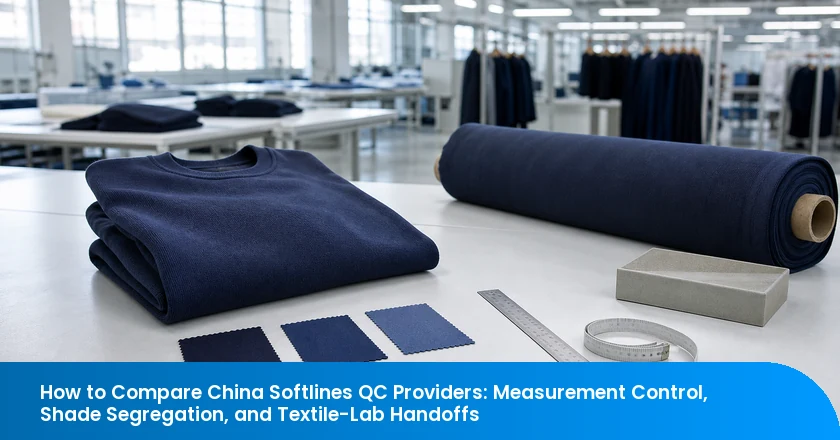
The hard part of comparing China softlines QC providers is not finding a company that can inspect clothing. It is proving that a current tech-pack revision, a separately identified shade lot, and any laboratory sample will remain connected in the records used for release. If those identities are missing, a plausible measurement report, shade review, or test result can be applied to the wrong evidence.
For a sourcing team, the safer approach is to send one complete request for quotation (RFQ) to every candidate. The RFQ should make the written scope comparable by identifying what each candidate will preserve and whether the proposed work needs a factory check, a laboratory route, or both.
What a Defensible Softlines Provider Comparison Requires
A softlines provider comparison is defensible only when the buyer can match the current measurement specification, shade-lot record, and laboratory handoff. In practical terms, every candidate should respond to the same product packet and show how its report will identify the approved revision, the sample group, the colourway or lot, and any test sample.
- Ask for records, not category claims. “Apparel QC” is not a commitment to inspect the correct size range, keep two dye lots separate, or route a test sample correctly.
- Separate the evidence questions. Measurements compare product dimensions with a specification; a shade decision compares a colourway or lot with an approved reference; a laboratory route addresses a stated method question.
- Make omissions visible before price comparison. A candidate that cannot state its report fields, sample identity, and exception route has not yet supplied a comparable scope.
- Use conditional choices. A factory-lot inspection can be useful without replacing a method-specific textile test, and a laboratory report can be useful without proving the condition of the packed lot.
Shortlist the provider that can show how one approved product identity survives from the tech pack to the colourway record and, where needed, to the laboratory sample.
Why Measurement, Shade, and Laboratory Evidence Must Stay Separate
Factory-lot inspection, shade-lot control, and laboratory testing should be treated as separate but connected evidence layers. An inspection scope can document what was observed in a defined product group. A shade-lot record can document what was compared against an approved reference. A laboratory handoff is the written transfer of a test question and identified sample to a laboratory route. None of these records automatically proves what the other two record.
ISO/IEC 17025 addresses laboratory competence, while textile methods are method-specific rather than a generic inspection label. The ISO/IEC 17025 overview defines the laboratory-competence context, while AATCC publishes method-specific textile test methods and evaluation procedures. That boundary matters when a candidate says it can “handle testing”: ask which test question will be sent, which sample will be identified, and what report is expected. Do not treat a laboratory reference as a promise that the finished lot has been inspected, or treat a factory observation as a laboratory result.
A useful written scope therefore has three connected fields: the inspection scope for the factory lot, the shade rule for each applicable colourway or lot, and the laboratory handoff for any defined test question. When the buyer already has a test need, a provider should say how it will coordinate with product testing services or another appropriate laboratory route without blurring those responsibilities.
How Softlines Provider Models Compare on Evidence
Provider models should be compared by promised evidence, laboratory handoff, and stated limitation rather than by unverified category claims. The table below compares scope models, not named companies. A capability is unconfirmed until the candidate supplies a product-specific written response.
| Scope model | Best use | Proof to request | Laboratory handoff | Main limitation |
|---|---|---|---|---|
| Visual lot inspection | Stable finished goods with clear requirements | Lot identity, agreed appearance checks, quantity, packing, and exceptions | May refer a question, but should not imply a test result | Can miss revision-specific measurement or shade evidence |
| Specification-led softlines scope | Apparel, footwear, or accessories with size and workmanship controls | Tech-pack revision, POMs, tolerances, sample groups, and report format | States what information moves to a test request | Still needs a clear shade-lot and test-method boundary |
| Laboratory route | A defined textile performance or colourfastness question | Method, sample identity, acceptance criterion, and report need | The laboratory process is the primary route | Does not by itself prove packed-lot condition or shade segregation |
| Coordinated evidence scope | Multi-size or multi-colourway programmes needing both layers | Linked specification, lot, shade, and sample records | Written handoff from factory evidence to the stated test question | Requires disciplined buyer inputs and explicit exception rules |
Choose a specification-led scope when the missing evidence is the current factory lot’s size, workmanship, or colourway control. Use a laboratory route when the missing evidence requires a stated method and report. Use a coordinated evidence scope when the measurement record, shade lot, and test sample must identify the same product evidence. Before adding product-specific checks, buyers can review a baseline TradeAider quality inspection standard.
What Measurement-Control Evidence Should an RFQ Require?
Measurement capability becomes comparable when the scope names the approved revision, POMs, tolerances, sample group, and treatment of exceptions. A point of measure (POM) is a named location on the product where a dimension is checked. That definition sounds simple, but a measurement row cannot be interpreted reliably if the report does not also say which size, grade, component, or current tech-pack revision it represents.
Textile conditioning and fabric measurement are method-bound activities, so the buyer should request the relevant conditions and sample treatment instead of assuming a generic result applies everywhere. ISO 139 defines standard atmospheres for conditioning and testing textiles. For fabric mass per unit area, ASTM D3776 shows why sample treatment matters: it distinguishes several procedures, and a small swatch result applies to that sample rather than necessarily to the lot. The buyer does not need to force every candidate into one method. The buyer does need to ask what condition, sample, and report context the proposed scope will preserve.
For early alignment, a Pre-Production Inspection service can help confirm the tech pack, approved sample, measurement points, and packaging expectations before bulk goods make a later report harder to interpret. The provider-selection question is narrower: can the candidate demonstrate how those approved inputs will carry into its inspection report?
Start With the Current Specification, Then the Sample Group
A measurement annex should connect the approved revision to the POM list, size group, tolerance, observed value, and exception record. Request a short example before booking. It should show the revision date or ID, the sizes included, the units used, the buyer’s tolerance, the observed result, and a clear disposition for each exception. It should also distinguish product variants that share a style name but use different materials, patterns, or grading instructions. If an inspection report only says “measurement checked,” ask what it will allow the buyer to trace later.
When Shade Segregation Needs a Separate Release Rule
A colourway needs a separate decision when a shade-lot record cannot show the approved reference, lot identity, viewing rule, and mismatch action. A shade lot is a separately identified production colour batch that needs its own evidence record. Treating all navy goods as one evidence group may be convenient, but it is unsafe when different lots cannot be traced back to the same comparison reference and observation conditions.
Colour-difference and laundering-colourfastness methods answer defined technical questions; neither by itself documents that two shade lots were segregated for release. ISO 105-J03 covers calculation of colour differences using CMC formulae and notes that an allowable difference depends on the end use and required closeness of match. ISO 105-C06 addresses colour fastness to domestic and commercial laundering. Set the buyer’s acceptance rule in the approved specification, then ask the provider to record the lot and action against that rule.
Where the programme is still moving through cutting, sewing, or finishing, a During Production Inspection service can provide a timely route to identify a developing issue. The RFQ should still state whether the provider will isolate a shade lot, compare it against the approved reference, report the result by colourway, and escalate a mismatch before packing mixes the evidence further.
Record the Reference, Lot, and Viewing Rule Together
A shade record should name the approved reference, lot identity, viewing rule, result, and mismatch action together. Ask whether the reference is a buyer-approved swatch, a signed sample, or another agreed standard; how the lot will be identified; where the comparison takes place; and what happens when the record is inconclusive. A provider need not claim a universal colour threshold to make this record useful. It needs to preserve the buyer’s agreed decision rule.
A colourfastness result can answer a laundering question. It cannot substitute for a record showing which navy lot was compared, against what reference, and how that lot was handled.
Illustrative Scenario: A Navy Jersey Programme Hides Two Evidence Gaps
In the illustrative navy jersey programme, a merged shade-lot record, an unversioned measurement report, and an unspecific laboratory request create an evidence gap. This is a composite example, not a TradeAider client case, laboratory result, or release recommendation. It shows why the buyer should hold only the evidence that cannot yet be matched rather than treat every record as interchangeable.
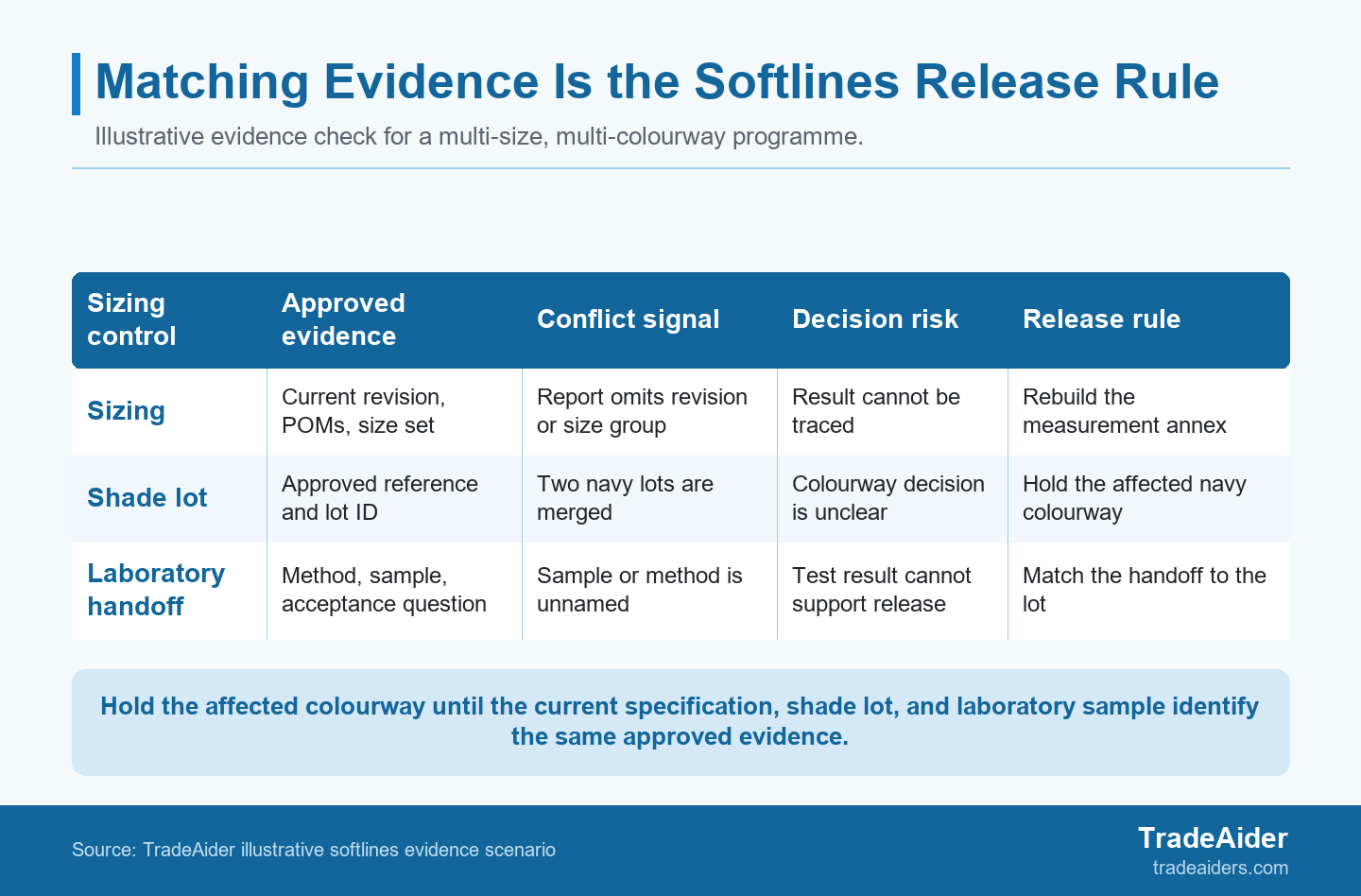
Illustrative evidence rule: hold the affected colourway until the measurement record, shade-lot record, and laboratory sample can be matched.
Situation, Problem, Action, and Result
The illustrative buyer holds the affected navy colourway while the other two colourways remain outside the hold until matched records are rebuilt. The programme has 6 graded sizes across 3 colourways. One navy colourway contains 2 separately identified shade lots, and the buyer is comparing written softlines scopes before choosing the provider for the final factory check.
Both candidates receive the same current tech pack, size matrix, colourway list, and question about a laundering-related colour concern. The factory says the goods are ready, but it has treated the two navy lots as one colourway. This is the point at which a generic “visual shade check” becomes too vague for a release decision.
One proposal names POMs but not the current tech-pack revision or the size-set sample. Its shade check is under factory lighting, with no stated approved reference. Its laboratory request says only “colourfastness.” The buyer cannot see whether the measurement result, shade observation, and test request would describe the same product evidence.
The second proposal asks for a revision ID, size-set identifier, shade-reference record, lot label, and the laboratory sample ID. It also asks the buyer to state the method question and acceptance criterion rather than assume that every colour concern needs the same test.
The difference is not that one scope sounds more technical. It is that only the second scope supplies a chain through which the buyer can reconcile the three evidence layers after an exception appears.
The buyer identifies a mixed-lot evidence problem. A valid measurement record could belong to the wrong size group; a valid shade observation could apply to a different navy lot; and a valid laboratory result could refer to an unnamed sample. Combining them would create a false conclusion even if each individual record was genuine.
The buyer keeps the other 2 colourways outside the hold and holds the 1 affected navy colourway. The decision is not a statement that the navy goods fail. It is a split-release boundary: no release decision is made for that colourway until the relevant evidence can be matched.
The factory supplies the current revision and size-set identifier. The selected provider creates a separate shade record for each navy lot, tied to the buyer-approved reference and agreed viewing rule. It then routes the laboratory question with a named sample, the relevant method, care context where relevant, and the buyer’s acceptance criterion.
The verification gate is simple: the current tech-pack revision, the measured size group, the shade-lot record, and the laboratory sample reference must point to the same approved colourway evidence. If they do not, the affected navy colourway remains on hold while the other colourways can be considered on their own evidence.
Result and limitation: the buyer has contained the scope mismatch without declaring a product pass or fail. This illustrative composite does not establish a universal tolerance, certify a laboratory result, or guarantee compliance for any destination market.
Score Softlines RFQ Responses on Evidence, Not Category Claims
An illustrative 70/100 written-evidence score, with no zero in measurement or shade control, can identify candidates ready for a technical scope call. It is not a TradeAider score, an industry standard, or a performance ranking. It is a buyer-controlled screen that exposes whether a proposal has made the required evidence commitments visible.
| Evidence category | Possible points | Give full credit when the response states |
|---|---|---|
| Measurement control | 30 | Current revision, POMs, tolerances, size coverage, and exception record |
| Shade-lot control | 25 | Approved reference, lot ID, viewing rule, result, and mismatch action |
| Workmanship and variant sampling | 20 | Style, size, colourway, and defect treatment stated in writing |
| Laboratory handoff | 15 | Test question, sample identity, method route, and acceptance criterion |
| Escalation and recheck | 10 | Who receives an exception, which evidence is held, and how verification is recorded |
Score only what the candidate states. Do not award points for a general statement such as “we inspect textiles.” A response below 70 can be revised, but a zero for measurement control or shade-lot control should stop the technical scope call because the buyer would be unable to identify the evidence needed for the central release decision.
What Should Go Into a Softlines QC Provider RFQ?
A complete RFQ packet turns softlines capability claims into comparable written commitments. Give each candidate the same current tech-pack revision; approved sample and POM list; size, style, and colourway matrix; workmanship requirements; packing requirements; planned inspection timing; and the report format expected by the buyer.
A method-specific textile handoff should identify the test question and relevant care-treatment context where that context affects the question. AATCC’s laundering resources illustrate why the test question must be specific, while ISO 3758 provides a care-symbol context for textile articles. This does not create a destination-market labelling rule. It tells the buyer what information to clarify when the request involves laundering, shrinkage, appearance, or colour performance.
- Current tech-pack revision and approved sample reference.
- Size, style, material, colourway, and shade-lot matrix.
- POMs, tolerances, workmanship-defect criteria, and packaging requirements.
- Inspection timing, sample grouping, report fields, photos, and escalation route.
- For each laboratory need: test question, identified sample, relevant method, care context where relevant, acceptance criterion, and required report.
When this packet is ready, request a softlines inspection scope review with the tech pack, size and colourway matrix, approved shade reference, destination market, and test need. The useful output is a written scope that states what will be checked, what will be reported, and what must be reconciled before a release decision.
Who Is TradeAider?
TradeAider is a quality inspection, testing, and certification provider in China, with operational coverage across Guangdong, Zhejiang, Jiangsu, Shandong, and Fujian.
TradeAider supports Amazon sellers, e-commerce brands, importers, wholesalers, and retailers with a nationwide inspection network, real-time reporting, and 24/7 support.
TradeAider charges $199/man-day all-inclusive for Inspection & QA Services. As an Amazon Service Provider Network (SPN) partner, TradeAider reports client outcomes including an 18% reduction in returns and a 23% improvement in defects caught before shipment. See Amazon Service Provider Network (SPN) partner details.
Frequently Asked Questions
Residual softlines provider-selection questions should be resolved in the same written evidence packet. Add unanswered requirements to the RFQ instead of assuming that a general service description includes them.
How Can I Verify Softlines QC Expertise Before Booking?
Ask each provider for a written scope that names the current tech-pack revision, POM coverage, size and colourway matrix, shade-lot rule, report example, and laboratory-handoff process. Then compare the responses against the same packet. A useful response states what the report will identify and how an exception is escalated; a generic category statement does not establish that level of control.
Do Shade Checks Replace Textile Laboratory Tests Completely?
No: a shade check supports a colourway decision, while a laboratory test answers a method-specific question using a traceable sample and stated acceptance rule. A visual record should say what reference and lot were compared. A laboratory handoff should say what question is being tested. Keep both records linked when they affect the same release decision.
What Must a Softlines Measurement Report Show?
A usable measurement report should identify the approved specification revision, POMs, tolerances, sampled sizes, observed values, exceptions, and the product group to which the record applies. It should also show enough context to distinguish one size set, material, or style from another. Ask for a sample report and confirm that the report fields match the buyer’s approval file.
How should one RFQ cover sizes and colourways?
Give every candidate the same size and colourway matrix, then require it to state how each sample group, shade lot, and exception will appear in the report. Do not leave the grouping to a generic “apparel inspection” label. The answer should explain whether lots are separated, how mixed evidence is held, and when a recheck is needed.
What should a textile laboratory handoff include?
The handoff should state the test question, relevant method, identified sample, care context where relevant, acceptance criterion, and the report needed for the buyer’s decision. It should also name the product evidence to which the sample belongs. That lets the buyer avoid applying a valid laboratory result to a different lot, size group, colourway, or specification revision.
Related Articles
Grow your business with TradeAider Service
Click the button below to directly enter the TradeAider Service System. The simple steps from booking and payment to receiving reports are easy to operate.

