
Buyers comparing factory audit companies in China often receive proposals that sound alike: a site visit, an auditor profile, a checklist, and a report. Those items are not yet comparable. The useful question is whether each provider will collect the evidence needed for one defined supplier-onboarding decision—and what happens when the audit finds a material gap.
Start with the decision, then set the review boundaries, credentials evidence, and corrective-action verification route. This prevents a familiar mistake: treating a completed audit, certificate, or corrective-action response as a blanket supplier approval. It may be relevant evidence, but it is not the approval decision by itself.
What a Defensible Factory-Audit Comparison Requires
A factory-audit comparison is useful only when each proposal states the decision it will support, the evidence it will examine, and the verification route for material corrective actions. The audit scope is the agreed question, location, evidence, and criteria the audit will cover; it is not a generic list of factory departments. For example, “Can this supplier be onboarded for this product family?” is too broad until the buyer states which controls matter: process capability, traceability, social requirements, security requirements, environmental controls, or another defined requirement.
- Choose the supplier decision before choosing an audit label.
- Request method, criteria, sampled records, report fields, and escalation evidence—not a generic capability promise.
- Keep material findings open until named proof is reconciled through the agreed verification route.
Use one comparison sheet for every proposal. Require each provider to state: the decision it can inform; the audit criteria; the records, people, and processes it expects to sample; the finding severity logic; the report fields; and the method for verifying a corrective action. A provider can then be a good fit for a narrow decision without being presented as the best answer to every supplier risk.
Buyer rule: Compare evidence paths, not audit labels. A proposal is stronger when a finding can be traced from criterion to observation, owner, corrective action, proof, and a stated recheck or closure decision.
Match Audit Scope to the Supplier-Onboarding Decision
ISO 9001 identifies quality-management-system requirements, ISO 14001 environmental-management-system requirements, while SA8000 and SMETA define social-accountability and ethical-trade audit approaches. The distinct quality and environmental scopes are described by ISO 9001 and ISO 14001.
Quality-system, social, security, and environmental audits therefore answer different buyer questions and should not be treated as interchangeable supplier approvals. A quality-system review may help a buyer examine how the supplier controls work, records, corrective actions, and process changes. Security scope may be specified separately where it is material to the buyer. An environmental scope is another distinct review.
An audit-method description can clarify how a review will be conducted, but it does not automatically approve a factory for a buyer’s particular product, market, or order. Ask the provider to connect the stated method to the site evidence and decision boundary in the RFQ.
The buyer should name the decision first and ask which questions must be answered before the supplier moves forward. For a quality-system or environmental scope, request the criteria and records to be examined rather than assuming a certificate or audit label covers every control.
A buyer can translate this into a short scope brief. TradeAider’s audit standard resource is one place to start when turning supplier expectations into documented criteria. The provider proposal should then show how each requested criterion will be evaluated—not simply repeat the label of the audit.
| Buyer decision | Scope to request | Evidence to name in advance | Do not infer |
|---|---|---|---|
| Assess management controls | Quality-system or capability audit | Procedures, records, traceability, process controls | That every product requirement is satisfied |
| Assess responsible-business requirements | Defined social-audit methodology | Code, sampling boundaries, interview and record approach | That capability or final-product conformity was verified |
| Assess environmental controls | Environmental management scope | Relevant permits, controls, records, and criteria | That social or product-quality issues were covered |
Compare Credentials as Evidence, Not as a Promise
A provider credential becomes decision-useful only when the buyer can connect it to the audit method, criteria, evidence sampled, report fields, and escalation route. Credentials can be relevant, but a logo, membership, or broad statement of experience does not tell the buyer what will be checked at a specific site. Ask for a method-level explanation: What qualification or competence evidence is relevant to this scope? Which checklist or criteria version will be used? How will the auditor record a finding? Who reviews an unclear observation? What triggers an escalation, laboratory test, or targeted revisit?
ISO/IEC 17021-1 contains principles and requirements for the competence, consistency, and impartiality of bodies providing audit and certification of management systems. The ISO/IEC 17021-1 overview gives a buyer a bounded credential question to ask; it does not decide whether a supplier is suitable for the buyer’s specific product and sourcing decision.
Then ask to see a redacted reporting example that preserves the chain of evidence. A decision-useful report normally distinguishes observation from conclusion, identifies the relevant criterion, attaches or describes the supporting record, and makes a finding traceable to a responsible owner and due date. If privacy rules limit sharing an example, request a field list and an explanation of how photographs, records, interview notes, and finding references are linked.
Use these three checks when comparing credentials:
- Method fit: Does the stated competence match the requested scope, rather than a different audit type?
- Evidence preservation: Can the report show which process, record, or control led to each material finding?
- Decision escalation: Does the proposal state who flags an unresolved risk and what evidence would be needed before the buyer changes the onboarding decision?
This approach is fair to providers. It does not assume that one credential makes a provider universally stronger; it asks whether the available evidence makes the proposed work suitable for this buyer’s specified decision.
What Corrective-Action Support Must Show
A corrective-action response should not be treated as closed until named evidence shows that the owner, due date, implementation record, and verification method match the original finding. CAPA is a documented corrective-action process with a named owner, timing, evidence, and verification. It is useful because it turns a finding into a managed decision. It becomes weak when the response only says “corrected,” attaches a generic photo, or assigns a date without showing how the correction connects to the evidence observed during the audit.
ISO 45001 specifies requirements for an occupational health and safety management system. The ISO 45001 overview is not a factory-audit protocol or a CAPA certification; it helps keep a stated management-system scope separate from the buyer-defined evidence required to close a finding.
For each material finding, ask the provider to document five elements: the original criterion and observation; the supplier owner; the corrective action and due date; the implementation evidence; and the verification method. A document review may be sufficient for a low-risk administrative gap. A record-to-process mismatch, however, may require a remote walkthrough, a targeted on-site recheck, or another method that can reconcile the named evidence.
When correction changes work in progress, the CAPA plan should also say whether a During Production Inspection service is relevant. That is not a substitute for a factory audit; it is a separate way to observe whether a defined process correction is being applied while production continues. Its value is bounded: it can observe the specified in-process condition, but it cannot retroactively prove that an unrelated supplier-control question was resolved.
Closure language to require: “Closed after [verification method] confirms [named evidence] for [affected process or scope].” This makes it clear that the provider is verifying a stated condition, not promising that every supplier risk has disappeared.
How Factory-Audit Provider Models Compare
Factory-audit provider models differ most in the evidence they preserve and the follow-up they can verify, not in the generic word audit. Instead of ranking named companies without a common brief, compare generic service models against the same supplier decision. The table below is a procurement tool, not a performance ranking. A model can be appropriate when its evidence and follow-up method match the scope you set.
ISO 19011 provides guidance for auditing management systems. The ISO 19011 overview helps keep a method comparison separate from the generic word audit; it is not a provider ranking or supplier-approval standard.
| Provider model | Best use | Evidence to request | CAPA support to compare | Conditional fit |
|---|---|---|---|---|
| Single-checklist site visit | A narrow, stable buyer checklist | Checklist version, observations, photos, exceptions | Owner and evidence request for defined findings | Useful only if the checklist matches the buyer decision |
| Quality-system or capability audit | Process, record, and control review | Criteria, sampled records, process traceability, findings | Targeted verification of affected controls | Useful when process evidence drives onboarding |
| Multi-scope program audit | Several buyer requirements with clear boundaries | Scope map, method per scope, exclusions, reporting structure | Separate closure paths for different finding types | Useful when scope is explicit and not bundled into a vague approval |
| CAPA verification follow-up | Known material findings awaiting evidence | Original finding, named proof, recheck route, closure record | Verification is the core deliverable | Useful when the buyer needs a bounded close-or-hold decision |
A proposal should make its conditional fit visible. If a provider cannot explain its evidence boundary or follow-up route, the buyer cannot responsibly compare price, timing, or credentials with another proposal.
Illustrative Scenario: A CAPA Response Fails the Verification Gate
In the illustrative supplier-onboarding scenario, unmatched calibration records and an outdated operator record prevent a document-only CAPA response from proving that the affected process has been corrected. This illustrative composite is not a TradeAider client case or a supplier approval decision. It shows why a response and a verified correction are different. A buyer is onboarding a metal-storage supplier for a multi-market consumer-goods program.
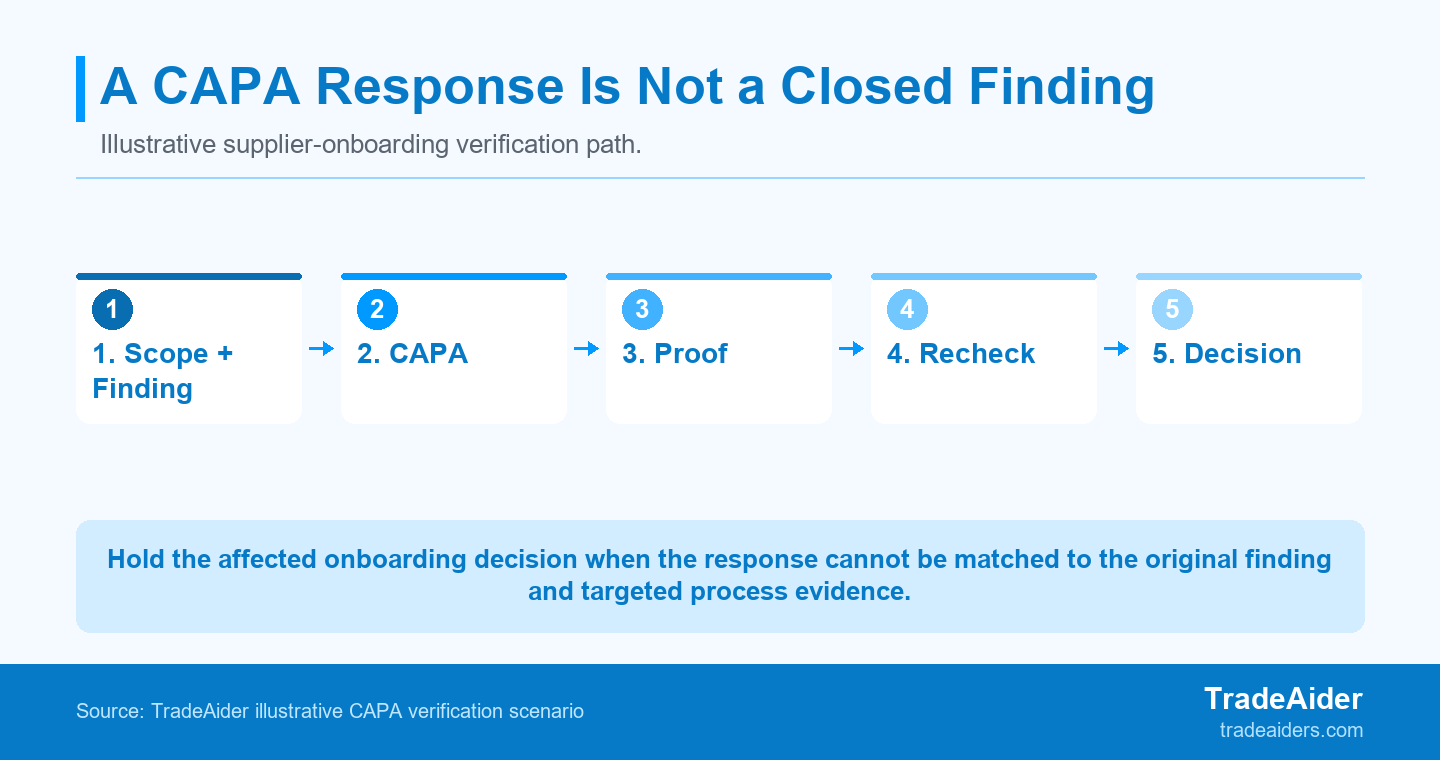
Illustrative CAPA rule: hold the affected onboarding decision until the corrective evidence and targeted recheck reconcile with the original finding.
Situation, Problem, Action, and Result
The buyer can close only the affected onboarding gate after a targeted recheck reconciles the calibration record, current operator instruction, and observed process setting. This keeps the conclusion bounded to the named process window rather than turning a limited review into an unsupported statement about the whole supplier.
Situation. A buyer is onboarding a metal-storage supplier for a multi-market consumer-goods program.
The supplier operates 3 assembly lines, and the buyer needs evidence before approving the supplier for the next sourcing cycle.
The supplier has submitted a corrective-action response after a capability audit.
Problem. Two calibration records identify gauges that cannot be matched to the gauges used on Line 2.
A revised work instruction is dated after the audit, but the sampled operator record still carries the older revision. These 2 unmatched records concern 1 affected line.
Why the documents do not close the finding. The submission shows intent to correct but cannot connect the claimed correction to the equipment and process records observed. The evidence gap is limited to the affected line; it does not establish a conclusion about every line, product, worker condition, or the supplier overall.
Action. The buyer requests a named owner and due date, a gauge register, acknowledgement of the current instruction, and a targeted Line 2 recheck. The provider’s task is to reconcile those named records with the observed process setting—not to re-audit unrelated scope.
Result. Keep supplier onboarding on hold for the affected process until targeted evidence is verified.
Close the finding only when the named gauges, current instruction, and sampled records reconcile. Once that targeted evidence is verified, the buyer can make a bounded close-or-hold decision.
This example does not certify product conformity, worker conditions, or overall supplier suitability.
What to Put in a Factory-Audit Provider RFQ
A shared factory-audit RFQ makes provider proposals comparable by fixing the supplier context, scope, criteria, evidence request, report fields, CAPA workflow, and verification rule before quoting. Send the same brief to each provider. This reduces hidden differences in what “factory audit” means and lets the buyer compare scope, evidence, turnaround, and follow-up on the same basis. Include the supplier location, product family, intended market, decision deadline, and any relevant supplier history; do not ask providers to guess the risk that matters most.
- Decision and scope: State the supplier-onboarding decision, criteria, locations, process areas, and exclusions.
- Evidence request: Name the records, process observations, interviews, photographs, and traceability checks that would make the decision usable.
- Report format: Require criterion, observation, evidence reference, finding severity, supplier owner, due date, and open/verified status.
- CAPA route: Define what a response must include and which finding types need document review, remote evidence, or a targeted recheck.
- Decision boundary: Ask the provider to state what the audit can inform and what it cannot establish.
After the scope is fixed, buyers can request a scoped factory audit service against the same evidence chain. Where supplier onboarding must connect to production readiness, a separate Pre-Production Inspection service can examine the agreed readiness conditions. Before dispatch, a Pre-Shipment Inspection service serves a different decision: the condition of the designated lot at that stage. None of these steps replaces another unless their scopes and evidence needs are explicitly aligned.
If you need help translating your decision into a supplier-specific brief, provide the product context, target decision, audit criteria, and the verification rule you expect for material findings, then request a factory-audit scope.
Who Is TradeAider?
TradeAider charges $199/man-day all-inclusive for Inspection & QA Services. As an Amazon Service Provider Network (SPN) partner, TradeAider reports client outcomes including an 18% reduction in returns and a 23% improvement in defects caught before shipment. For company context and terms, see Amazon Service Provider Network (SPN) partner.
TradeAider provides quality inspection, testing, and certification services in China, with coverage in Guangdong, Zhejiang, Jiangsu, Shandong, and Fujian. Its nationwide network, real-time reporting, and 24/7 support are presented for buyers managing sourcing and quality decisions across China. The pricing and outcome figures above are company-reported disclosures, not independent performance guarantees.
Frequently Asked Questions
A buyer should treat an audit report as one decision input and ask which findings, owners, proof, and follow-up checks remain before approving the supplier. That discipline keeps a report useful when it identifies evidence still needed, rather than disguising open risk as a complete supplier approval.
What should a factory audit report include?
A useful factory audit report identifies the scope, evidence reviewed, findings, owner, due date, and verification method for each material corrective action. It should separate observed evidence from the auditor’s conclusion, make each open finding traceable to the relevant criterion and supplier response, and state the limitations of the visit so the buyer does not read it as a universal approval.
Does an ISO certificate replace a factory audit?
No, an ISO certificate can support a management-system claim, but it does not address every buyer-specific capability or product-control question. It also does not settle every social, security, or record-traceability question. Define the buyer decision first, then decide whether a certificate is useful context, whether an audit is needed, and whether both sources should be reviewed together.
How should buyers verify corrective actions before supplier approval?
Buyers should verify corrective actions against named evidence, an accountable owner, a due date, and a recheck method that matches the risk of the finding. The closure record should say what was verified, for which affected process or scope, what records were reconciled, and what remains outside that conclusion after the recheck.
When should a buyer repeat a factory audit?
A buyer should repeat or target a factory audit when a material finding, scope change, process change, or prior corrective-action verification leaves supplier risk unresolved. A targeted recheck is often more useful than repeating unrelated review work when the remaining question is specific, evidence-led, and linked to a defined onboarding decision.
Related Articles

Grow your business with TradeAider Service
Click the button below to directly enter the TradeAider Service System. The simple steps from booking and payment to receiving reports are easy to operate.

