
A product can be treated as made in China for a shipment-control decision only when the physical goods, packaging, factory identity, commercial records, and lot-specific inspection evidence point to China together. A barcode prefix may raise a question, but it does not prove where the product was manufactured.
That distinction matters before final balance payment, marketplace listing approval, retail receiving, or a customs conversation. A brand can be registered in one country, a barcode can be allocated through another, and the goods can still be made in China. The practical importer question is therefore: What evidence ties this specific lot to the claimed production site and origin statement?
What Evidence Can Show a Product Is Made in China?
A made-in-China conclusion for a shipment should be supported by agreement among physical marks, packaging, factory and supplier identity, commercial records, and lot-specific inspection evidence. The strongest file does not ask one label or document to carry the whole conclusion. It asks whether each independent source describes the same product, SKU, factory, carton range, and shipment.
- Definition: Treat a barcode as an identifier clue, not an origin verdict.
- Evidence: Match the product and consumer package to factory and shipment records.
- Decision: Hold a contradictory evidence file for clarification before release.
- Boundary: Use qualified customs or legal advice when processing across countries affects the legal origin outcome.
A useful cross-check starts with the country-of-origin statement on the actual item, then moves outward: retail package, inner pack, master carton, manual or insert, factory details, commercial invoice, packing list, and inspection photos. Each layer can expose a different failure. A correct carton mark may coexist with the wrong retail insert; a matching invoice may name an exporter that did not manufacture the goods; a valid barcode may belong to the buyer's brand but say nothing about the production site. When TradeAider is asked to inspect a shipment, this same sequence turns the buyer's origin question into visible checks on the finished lot.
Which Origin Clues Are Strong Enough for a Release Decision?
Different origin clues answer different questions, so a buyer should cross-check rather than treat one clue as complete proof. The comparison below ranks each item by the decision it can support, its blind spot, and the next action it should trigger. It is a shipment-control method, not a legal sufficiency test.
For this comparison, “stronger” means closer to the actual lot and easier to reconcile with another independent record. A barcode may identify a company-number system. A product photo may show a mark. Only a connected file can show whether the mark, the goods, the factory, and the paperwork all refer to the same shipment.
| Evidence Item | What It Can Support | What It Cannot Settle Alone | Buyer Action |
|---|---|---|---|
| Product origin mark | The country stated on the item | Whether the statement fits every legal rule | Photograph the actual SKU |
| Retail package and insert | Consumer-facing wording and artwork version | Factory role or full shipment history | Match to approved artwork |
| Carton mark | Outer-shipment statement and carton reference | Retail-label compliance by itself | Reconcile carton and retail pack |
| Invoice and packing list | Declared seller, exporter, SKU, and quantity | The actual production site alone | Match names, quantities, and PO |
| Factory identity | Claimed production-site role | Legal origin without product evidence | Verify address and relationship |
| GS1 Prefix | Number-allocation or brand-control clue | Manufacturing country | Use only as a mismatch signal |
| Inspection photos | What was seen on the lot before shipment | A binding legal origin ruling | Tie images to SKU and carton range |
Based on this comparison, the practical release rule is to treat a single clue as incomplete until it agrees with the physical goods and at least one independent record. When two layers conflict, define the conflict precisely: is it a wrong label, an obsolete insert, an exporter-factory relationship gap, a shipment-document mismatch, or a legal-origin question? That diagnosis tells the buyer what to correct next.
Why Barcode Prefixes Cannot Prove Manufacturing Origin
A GS1 Prefix is the opening digits of an EAN or GTIN number assigned through a GS1 member organization; it identifies the allocation organization, not a factory address. GS1 says a GS1 Prefix does not show a product's country of origin or identify where the product was manufactured. GS1's country-of-origin guidance explains that the physical product may have been produced anywhere in the world.
A GTIN, or Global Trade Item Number, identifies a trade item; it does not encode the factory's address. The usual error is understandable: a buyer sees digits associated with a country and assumes they identify the country of manufacture. In a private-label supply chain, the brand owner, barcode license holder, exporter, and factory may all be different entities.
GTIN verification can help investigate brand-control mismatches, but it cannot prove the manufacturing country of the goods in a carton. Use it to ask a narrower question: does the barcode belong to the expected brand and approved product record? If the barcode owner, artwork, supplier invoice, and factory identity conflict, pause and collect the missing evidence. Do not turn that mismatch into an accusation or a country-of-origin conclusion.
How Should You Check Product and Package Origin Marking?
For US imports, origin marking is a physical-goods requirement with product-specific exceptions, and it is not the same analysis as a Made in USA advertising claim. 19 CFR 134.11 sets the general US marking rule for foreign-origin articles, while the FTC explains in its Made in USA guidance that CBP marking and US-origin advertising claims are not interchangeable.
Check the physical item, retail box, polybag, hangtag, manual, insert, inner pack, and master carton together. A statement such as “Designed in USA,” a US distributor address, or a foreign barcode allocation can sit beside a valid Made in China statement. The buyer needs to know what each phrase means and whether it appears on the correct object. If a non-origin country reference could confuse the reader of a US label, 19 CFR 134.46 is a useful US-specific reference on proximity and comparable size for the country-of-origin statement.
Product category also matters. Textile, wool, and fur products can have additional labeling contexts, so a buyer should not copy a general consumer-goods rule into a specialized product file. The FTC's textile and wool labeling guidance is one reminder that country-of-origin requirements can sit alongside other labeling rules.
A complex origin question involving processing in more than one country may require a fact-specific customs or legal analysis rather than an inspection conclusion. CBP's ruling database illustrates why country-of-origin analysis turns on the particular product and processing facts, while the FTC's Made in USA guidance keeps advertising claims separate from import marking. For an importer, inspection evidence supplies the factual record; it does not replace qualified advice or a ruling where substantial transformation—the legal test that can ask whether processing creates a new article with a different name, character, or use—tariff treatment, or destination-specific rules are material.
How Do Supplier and Factory Records Confirm the Evidence?
The exporter, seller, brand owner, and factory can be different entities, so a buyer should connect each record to the actual production site and lot. A trading company is not automatically a problem. The risk begins when the buyer cannot identify who produced the goods, which site packed the order, who controls the label artwork, and how the exporter relates to that site.
Ask for the factory's legal name, production address, contact details, business license, relationship to the exporter, relevant purchase order, and the SKU-to-carton map. Then compare those records with the product and package photos. A supplier file that looks credible in isolation is weak if the physical lot cannot be tied to it. This is why a finished-goods inspection should include the marked SKU, packaging, carton, quantities, and order references rather than only a defect count.
TradeAider can collect physical shipment and supplier evidence through inspection and factory verification, but legal country-of-origin determinations need qualified customs or legal advice when the facts are complex. CBP's fact-specific ruling approach illustrates that boundary. A Pre-Shipment Inspection can record the product label, retail package, carton marks, insert, SKU, packing condition, and photo evidence on the finished lot. If the named supplier and production site are unclear, a factory audit service can help document the facility role and the records available at that site.
Use an Origin Evidence Screen Before Release
The illustrative origin evidence screen uses a 70-point buyer threshold to trigger clarification when the physical and document evidence does not agree. It is an illustrative buyer checklist that weighs physical and document evidence for a shipment release meeting, not a legal country-of-origin test.
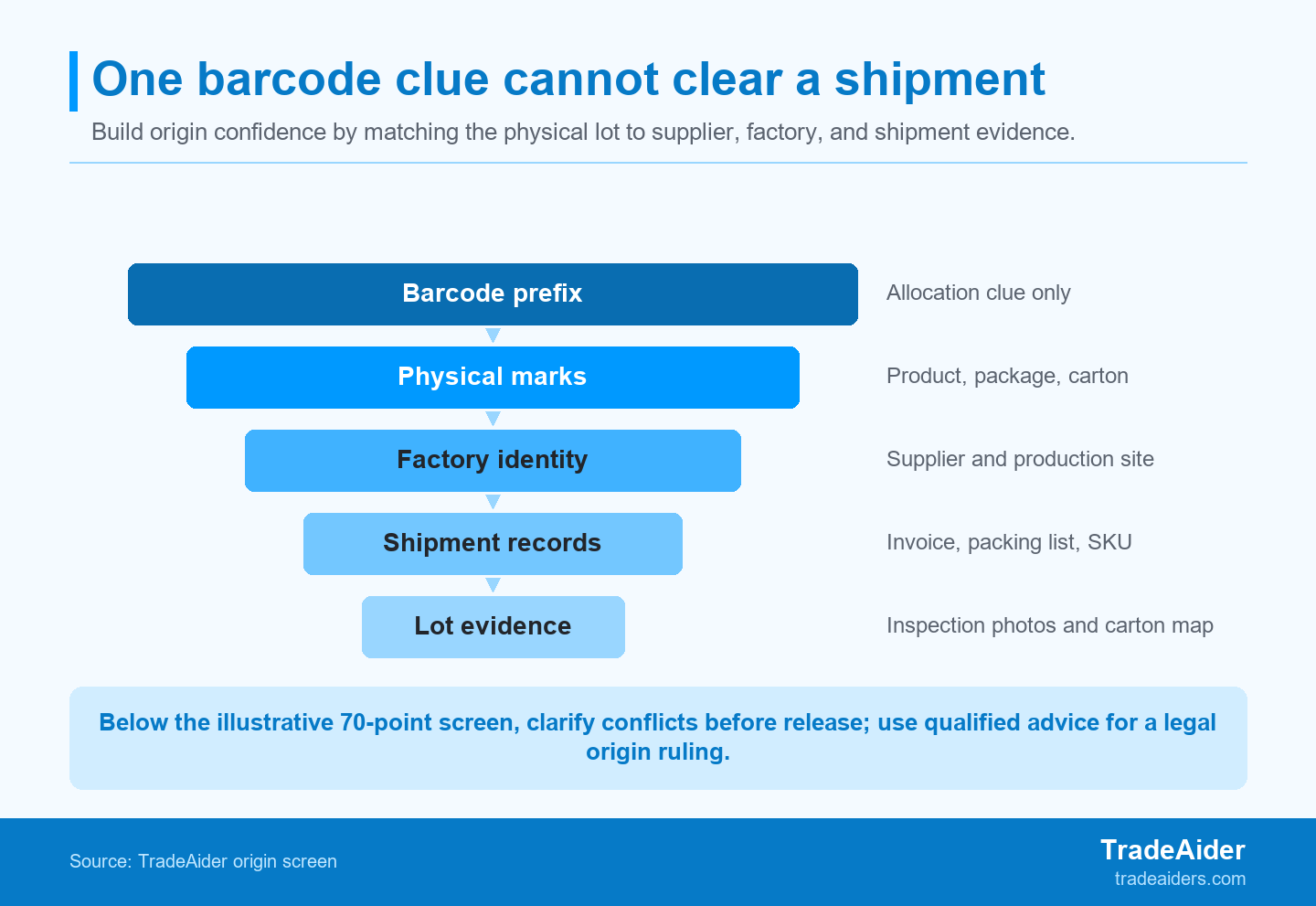
Use the evidence funnel as a release-control check, not as a legal country-of-origin ruling.
Allocate 25 points to the physical product mark, 20 to agreement between retail packaging and carton marks, 20 to factory identity, 15 to the invoice and packing list, 10 to barcode ownership consistency, and 10 to lot-specific inspection photos. A score below 70 does not prove that the goods are wrongly marked. It tells the buyer that too much of the release decision rests on a missing, inconsistent, or unverified record.
Use the screen with one hard-stop rule: a material contradiction overrides the arithmetic. For example, a 90-point file should still be held if the product says one country while the approved retail artwork says another. Conversely, a barcode-prefix mismatch alone should not fail a lot when the product mark, package, factory identity, invoice, packing list, and inspection photos all agree. The score organizes follow-up; it does not replace judgment.
Illustrative Scenario: A Foreign Barcode on China-Made Goods
Why the Barcode Was a Question, Not a Verdict
In the illustrative 6,000-unit scenario, a barcode owned outside China does not disprove China manufacture, while a missing origin statement on an insert can require correction before release. The example is a decision illustration, not a TradeAider client case or a legal origin finding. An Amazon seller has 6,000 kitchen accessories packed in 120 export cartons through a Chinese exporter, and the private-label barcode was allocated through a company outside China.
Order context: The shipment has 6,000 units in 120 cartons, one retail-package design, a supplier invoice, a packing list, and a current approved insert file. The 120 cartons containing that retail package are the affected scope while the corrected insert is verified.
Readiness state: The finished lot is already packed and awaits the buyer's release decision. No one should infer that a foreign allocation of the barcode proves a different manufacturing country before the product and records are checked.
Observation 1: Carton photos state Made in China, while the product insert has no origin statement. That is a physical-evidence conflict because the carton cannot stand in for every piece of retail material.
Observation 2: The barcode record identifies the buyer's brand ownership but says nothing about the production site or the missing insert marking. It answers a number-allocation question rather than an origin question.
The barcode identified brand-number ownership while the product, package, carton, and factory records were needed to establish the shipment evidence. The team separates the barcode-control question from the origin question, then checks whether the product, package, carton, factory identity, invoice, packing list, and lot photos support the claim made for this shipment.
Decision: The buyer pauses release for a one-day artwork correction rather than treating the barcode prefix as either proof of China manufacture or a reason to reject the lot.
Result: After the one-day hold, the recheck photographs the corrected insert, carton marks, SKU, invoice, packing list, and factory details, producing a verifiable record that those items point to the same lot before the buyer reconsiders release. The factory updates the insert, applies the approved origin wording where required, and separates the corrected cartons for that verification.
Verification gate: A targeted inspection photographs the product, retail package, corrected insert, carton mark, SKU, carton references, invoice, packing list, and factory identity before release is reconsidered. If any of those records conflict, the lot remains on hold while the underlying evidence is corrected.
Boundary: The outcome is illustrative. The buyer must obtain qualified customs or legal advice for an origin question that depends on substantial transformation, tariff treatment, or destination-specific marking requirements.
What to Request Before You Release a China-Sourced Shipment
A pre-shipment evidence brief should name the product and carton references, origin-marking locations, factory identity, commercial records, and photographs needed for the release decision. The buyer should give that brief to the supplier and inspection provider before the visit, not reconstruct it after a label conflict appears.
- List the SKU, PO, carton range, destination market, and approved artwork revision.
- Request photos of the product, retail pack, insert, manual, inner pack, and carton mark.
- Match factory legal name, production address, exporter, invoice, packing list, and quantities.
- State which mismatch requires a hold, correction, or legal escalation.
- Specify whether sampling should follow the buyer's plan or an AQL calculator reference.
For US-facing marketing claims, the FTC's Made in USA resources are a useful escalation point for the advertising boundary. If you need the physical evidence captured before release, ask TradeAider to check origin and label evidence before shipment release.
Who Is TradeAider?
TradeAider is a quality inspection, testing, and certification service provider in China. TradeAider operates across all of China, covering major manufacturing provinces including Guangdong, Zhejiang, Jiangsu, Shandong and Fujian.
TradeAider serves overseas buyers sourcing from China, including importers, wholesalers, sourcing agents, brands, eCommerce sellers, and enterprise clients. Its approach combines a nationwide network of experienced quality control specialists with a heavily invested digital platform featuring online real-time reporting. Clients can monitor inspections live, communicate directly with inspectors, and address issues during production rather than after shipment.
Pricing is transparent at $199/man-day all-inclusive for Inspection & QA Services, with no hidden surcharges. The company is an official Amazon Service Provider Network (SPN) partner. Client testimonials published on the TradeAider website cite an 18% reduction in return rates attributed to real-time defect detection and a 23% improvement in defects caught before shipment compared with prior inspection arrangements. These are client-reported figures, not a promise of the same outcome for every shipment.
Frequently Asked Questions
Origin questions that affect customs, product marking, or advertising claims should be answered with the relevant destination rule and shipment facts. The answers below provide practical evidence guidance, not legal advice.
Can a Barcode Tell Me If a Product Is Made in China?
A GS1 barcode prefix cannot show whether a physical product was made in China because it identifies allocation, not the manufacturing location. A barcode can help a buyer check brand ownership or an approved product record, but it cannot replace product marks, package evidence, factory identity, shipment documents, and lot-specific inspection photos. Treat a mismatch as a reason to investigate, not as an origin conclusion.
What Is the Strongest Proof a Product Was Made in China?
The strongest practical proof is a consistent evidence file that joins the product and package marks with factory identity, shipment documents, and lot-specific inspection photos. No single item is enough for every legal question, but agreement across independent physical and document evidence gives the buyer a much more reliable basis for a release decision. Complex customs questions still need qualified advice based on the destination and processing facts.
Does a Made in China Carton Mark Prove Retail Compliance?
A Made in China carton mark alone cannot prove that a retail item or consumer packaging meets the destination market's requirements. Buyers should compare the carton statement with the actual SKU, packaging, manual, and approved artwork. When several country references appear, check the relevant product and market rule before approving final packaging.
Can a Trading Company Sell Goods Made by Another Factory?
A trading company can sell goods made by another factory, provided the buyer can verify the real production site and records. Ask for the factory legal name, production address, order references, and evidence linking the named site to the actual lot. The concern is not the trading-company model itself; it is whether the roles and records can be verified.
Can an Inspection Company Make a Legal Country-of-Origin Determination?
An inspection company cannot issue a legal country-of-origin determination, but it can document product, package, factory, and shipment evidence. Inspection photos and records can make qualified advice more useful because they establish what was actually produced and packed. They do not decide questions involving substantial transformation, tariff treatment, or destination-specific legal requirements.
Related Articles



Grow your business with TradeAider Service
Click the button below to directly enter the TradeAider Service System. The simple steps from booking and payment to receiving reports are easy to operate.

