
- About Us

- Our Services
- Your Industry
- Resources
- News & Blog
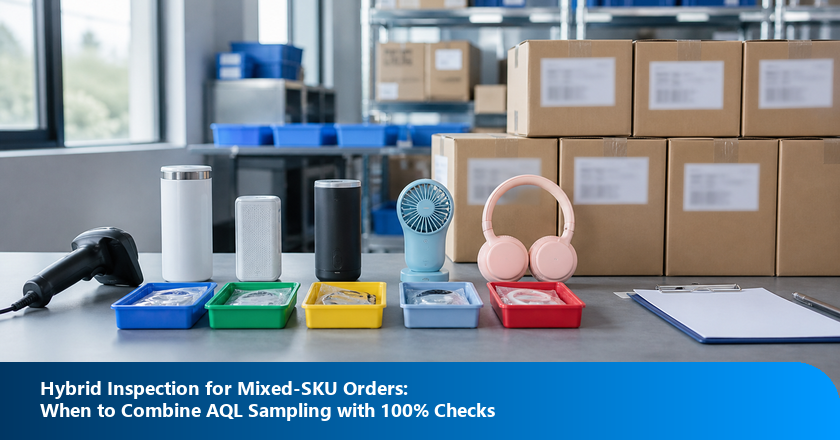
Mixed-SKU orders fail when one inspection method is asked to prove too many things at once. A general lot sample may help a buyer decide whether the finished goods meet agreed workmanship criteria. It does not automatically show that every carton contains the right variant, every insert matches the SKU, or every high-consequence label was checked. A practical hybrid plan separates those questions before the inspector arrives.
Hybrid inspection combines defined-lot sampling for a workmanship decision with a 100% check for one named, high-impact attribute across one named set of units, cartons, or records.
The point is not to inspect everything by default. It is to match the coverage method to the failure that matters. Sampling can be an efficient way to evaluate repeatable workmanship across a defined lot. Full verification is more useful when the buyer needs complete evidence for a discrete and observable condition, such as carton-to-SKU identity, a mandatory label, a count of sealed accessories, or a serialized record. The release decision should say which evidence applies to which population.
What a Hybrid Plan Must Accomplish
Hybrid inspection separates a lot decision from targeted exhaustive coverage. That separation reflects NIST’s boundary between a lot decision and an estimate of every unit, preventing a clean sample result from becoming an unsupported promise about every SKU or every carton in a mixed order.
- Name the workmanship lot. State which finished units are eligible for the lot sample and how random selection will occur.
- Name the exhaustive attribute. Define exactly what will be checked on every relevant carton, unit, or document, and what counts as a mismatch.
- Protect minority variants. Give materially different SKUs their own representation rule instead of letting total order quantity decide all sample attention.
- Set the release boundary. Record whether a failed full check holds a SKU group, a mapped carton range, or the whole presented lot until evidence is complete.
For an importer, the result is a booking scope that can be reviewed before production finishes: it identifies the lot, the SKU allocation rule, the full-check attribute, the inspection evidence, and the action if the evidence disagrees. It is operational guidance, not a substitute for the buyer’s product specification, regulatory obligations, or commercial approval process.
The Attribute-Coverage Hybrid Inspection Framework
AQL and 100% checks answer different coverage questions. AQL is acceptance sampling that uses a sample to reach a lot decision, while a 100% check answers a different coverage question. In the Attribute-Coverage Hybrid Inspection Framework, the buyer first separates a decision about lot workmanship from proof that a designated attribute was checked across a named population.
That distinction follows the purpose of acceptance sampling. The FDA’s quality-systems training material describes acceptance sampling as inspection of samples from a lot. NIST explains that the result supports a lot disposition decision rather than an estimate of every unit’s quality. In other words, a sample can support an agreed accept-or-reject rule for the lot; it cannot, by itself, create complete identity evidence for every unit that was not examined.
Use the framework in two passes. Pass one asks, “What lot-level decision will the sample support?” Pass two asks, “Which condition needs complete coverage because a missed mismatch would be expensive, unsafe, hard to trace, or impossible to fix after shipment?” The second pass must be narrow enough that an inspector can count it, observe it, and document it. “Check all quality” is not a full-check instruction. “Verify every master carton label against the approved SKU matrix” is.
The release population is the units, cartons, or records covered by the buyer’s release decision. It may be the entire shipment, one SKU group, or a mapped carton range. A release population is not automatically the same as the AQL lot. The framework works only when both populations are written down before inspection begins.
Use AQL to Sentence a Defined Workmanship Lot
AQL needs a defined lot, random selection, and Ac/Re rule. The AQL portion applies the lot decision described above; it is not a shorthand for “inspect some products.”
A reproducible plan identifies the finished lot size, the inspection level or sampling plan agreed by the buyer and supplier, the defect classifications, and the acceptance and rejection counts. Ac/Re means the acceptance number and rejection number attached to the selected plan: the sample result is compared with those counts to reach the stated result. As NIST describes it, a lot acceptance sampling plan combines a sampling scheme with decision rules based on the observed defects.
Keep the workmanship sample tied to a known presented lot. If a supplier has multiple finishes, factories, production shifts, or product families, do not silently treat them as one homogeneous pool. State which variation is inside the lot, which variation needs a separate SKU group, and which defects belong in the agreed checklist. Once those inputs are known, buyers can use the AQL calculator to document the starting sample plan and include the selected plan in the inspection brief.
Do Not Ask a Sample to Prove Identity Coverage
A random sample does not itself prove every SKU identity or carton configuration was represented. NIST describes acceptance sampling as a lot disposition tool rather than a lot-quality estimate, so the selected sample cannot demonstrate that each unselected carton carried the expected identifier, insert, or component set.
This matters most when a minority SKU is packed in the same shipment as a high-volume base model. A random sample can be statistically appropriate for the workmanship decision and still miss a carton-level mix-up confined to two cartons. That is not a defect in sampling. It is a different evidence question. NIST’s reminder that acceptance sampling is a decision tool rather than a full lot-quality estimate is the useful boundary here: the sample result should not be expanded into a claim it was never designed to support.
Before the visit, ask the supplier for the packing list, carton map, SKU matrix, approved artwork or insert version, and lot presentation status. Then decide whether identity is checked by every unit, every inner pack, every master carton, or every associated record. The correct answer depends on where a mismatch can occur and what object can be observed reliably. If the carton map cannot link labels to the packed goods, a carton-label check alone may be too weak; the brief should require the additional opening, scan, or reconciliation step needed to make the evidence meaningful.
Put 100% Checks on Discrete, High-Impact Attributes
A full check needs a named observable attribute and a named population. FAA guidance uses 100% inspection for safety characteristics in its aviation context; for a mixed-SKU order, the narrower lesson is that the buyer must name the characteristic and the set to be checked.
Start with the consequence of a missed failure. A 100% check is justified when the attribute is clear to observe, the affected population can be identified, and the cost of a miss is high relative to the additional inspection time. Examples include verifying a required country-of-origin label on every eligible carton, matching a retail SKU code to an approved carton label, confirming the presence of a sealed accessory pack, or scanning every serialized carton record in a defined range.
Mixed cases need this kind of disciplined language. GS1 US defines a mixed case as packaging with more than one item type and more than one GTIN. That does not prescribe an inspection plan for every importer, but it illustrates why “one carton” is not always one identity. The planned check should say whether the object of verification is the carton label, the contents, the unit identifier, the insert, or a combination of those items.
A full check is less useful for a failure that cannot be observed consistently in the available time or without a validated test method. For example, “verify every product will perform perfectly” is not an auditable instruction. Convert it into an observable attribute and a test condition, or move the risk earlier into process control, testing, or supplier corrective action. The Attribute-Coverage Hybrid Inspection Framework keeps the 100% portion specific so that the completed report can show what was actually covered.
Full Checks Need a Specific Attribute and Population
A full check needs a named observable attribute and a named population. The FAA’s safety-characteristic example illustrates why complete coverage needs an explicit response to a known mismatch. The instruction should make it possible for a second person to determine the denominator, the pass condition, the evidence collected, and the hold action.
Write the instruction in this pattern: “Verify attribute on every population against approved reference; record mismatches by carton or unit ID; hold release boundary until reconciliation.” For example: “Verify the carton SKU label and insert code on all 280 master cartons against the approved SKU matrix; record every exception by carton number; hold any carton range without a completed record.” This is inspectable, priceable, and reviewable.
Safety-critical industries show the outer edge of the principle. FAA aviation quality guidance calls for 100% inspection of safety characteristics and says known safety defects must not be accepted. That is aviation-specific guidance, not a consumer-goods rule. Its lesson for mixed-SKU importers is narrower: where the consequence is severe and the condition is observable, the inspection scope must state complete coverage and an explicit non-release response.
Allocate AQL Samples by SKU Risk, Not Only by Total Quantity
Mixed-SKU inspection needs explicit representation rules for materially different SKU groups. GS1 US’s mixed-case guidance helps show why item identity cannot be assumed from total quantity alone. A stratum is a defined group with a separate sample selected under an explicit SKU allocation rule because its materials, function, packaging, production route, or risk profile differ from the rest of the order.
Start with the purchase order, not the final total. Group SKUs only when the buyer can explain why they share the same workmanship risk and inspection reference. A color change may belong with the base SKU if the material, production line, packaging, and failure modes are genuinely alike. A low-volume variant with a different battery, lid mechanism, gift box, language insert, or supplier process should receive its own representation rule. The rule can set a minimum number of units, a separate sample, or a mandatory full check for the particular attribute at risk.
A fixed assortment must preserve its approved item composition and identifiers. GS1 US notes that a mixed case contains two or more unique GTINs, while its packaging guidance distinguishes cases with more than one item type and GTIN. A buyer should therefore treat the approved configuration as an identity question rather than merely a quantity question.
Use a simple order matrix with one row per SKU group: quantity, production route, customer-facing identifier, critical attribute, workmanship risk, AQL representation rule, full-check requirement, and release consequence. The matrix makes an invisible assumption visible. It also makes it easier for TradeAider to scope a pre-shipment inspection around the defined SKU strata, rather than commissioning a generic sample that cannot show how each important variation was handled.
Do not make “low volume” an automatic reason for 100% inspection. Lower quantity can mean a variant is more likely to be missed by an aggregate sample, but full coverage still needs a reason: high impact, a discrete observable attribute, a weak containment route, or a contractual requirement. If the risk is ordinary workmanship and the SKU is adequately represented in a defined sample plan, sampling may remain appropriate. If the risk is an incorrect identifier across a limited carton population, a targeted full check may be more defensible than expanding every workmanship check.
Use a Four-Question Decision Tree Before Booking
Defect consequence, observability, SKU variation, and containment route determine whether a hybrid method is appropriate. The Attribute-Coverage Hybrid Inspection Framework begins with the lot-specific purpose described in the FDA acceptance-sampling reference, then turns those four questions into a booking decision instead of an inspector’s last-minute preference.
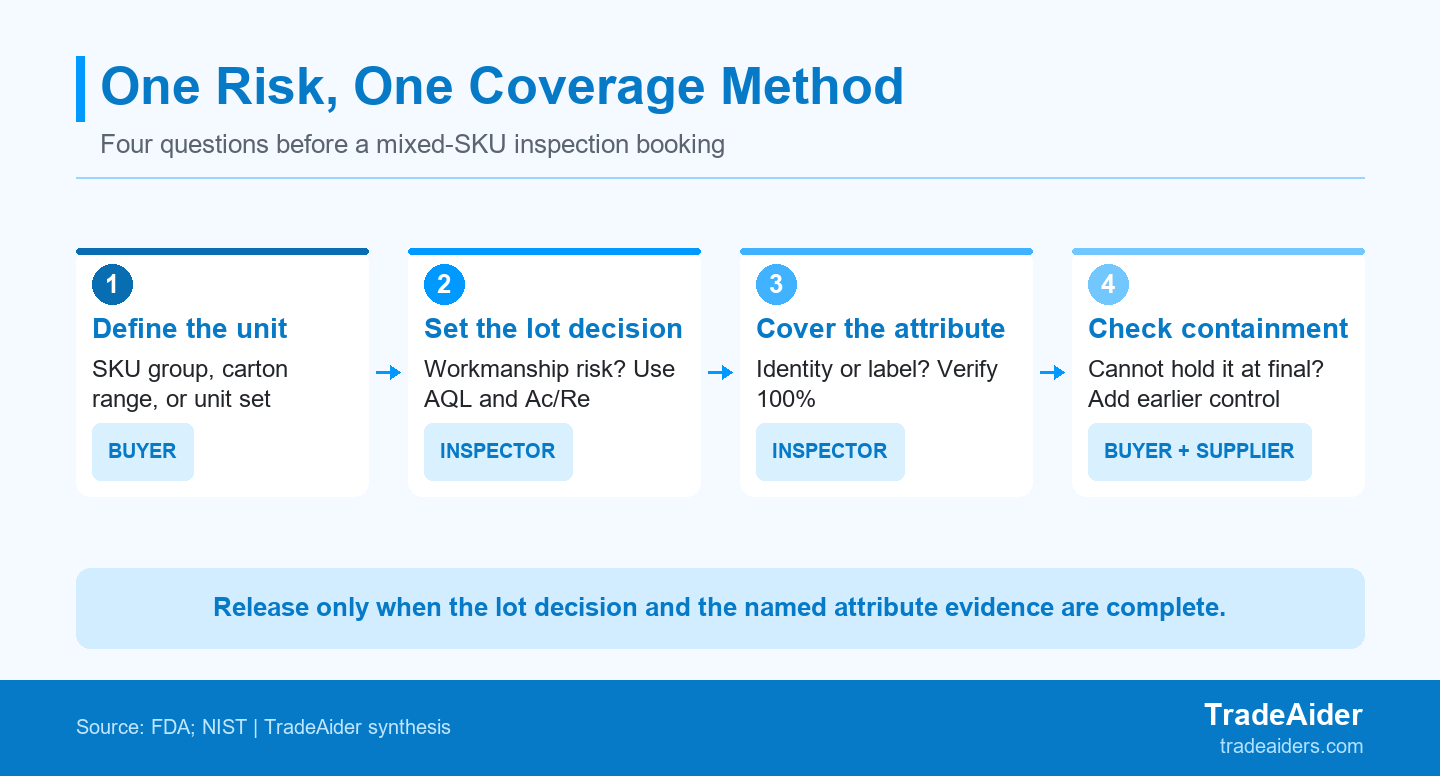
Use the four gates to assign each mixed-SKU risk to the evidence method that can actually cover it.
- What is the consequence if this condition is missed? If it can trigger a chargeback, a product listing problem, a safety concern, a contractual breach, or a return that cannot be sorted after arrival, flag it for separate coverage.
- Can the condition be observed consistently? Define the reference sample, pass condition, tools, photos, scans, or record needed. If the answer depends on a laboratory test or an unstable setup, a visual full check may not prove the needed result.
- Which SKUs or carton groups differ in a material way? Create strata for different product routes, packaging, identifiers, or critical components. Do not rely on the total order quantity to allocate attention to every variant.
- What can be isolated if a mismatch is found? If carton ranges, SKU records, or production batches cannot be traced reliably, the release boundary must expand. A buyer cannot safely release an unverified remainder simply because the sample passed.
The answer pattern sets the method. Use AQL sampling when the decision is about agreed workmanship across a defined, randomly selectable lot. Add a 100% check when a discrete attribute needs complete coverage across a named population. Escalate earlier when the condition is hard to observe at the end, repeat failures are appearing during production, or the supplier cannot show a stable control. In that situation, buyers can use during-production inspection to test the control before the final lot exists and avoid waiting until packed goods are the only evidence left.
The hold rule is as important as the inspection rule. Document whether one exception stops release of one carton, one SKU stratum, a mapped carton range, or the entire order. Include the evidence required to clear that hold: corrected label, recount, repack record, rescan, reinspection, or a new sample decision. This turns a hybrid method into a release control rather than a longer checklist.
Worked Example: A Mixed Assortment With Carton-Level Identity Risk
The illustrative scenario uses separate sample and identity evidence before release. The GS1 US mixed-case reference provides the item-identity context; the scenario shows why the same order can need both a workmanship decision and a carton-level verification task without calling for a blanket full inspection of every characteristic.
Illustrative scenario: A global e-commerce importer is preparing a home-fragrance gift assortment with six sellable SKU variants. The illustrative order has 8400 retail sets across six SKUs and 280 master cartons. Finished goods are presented with a SKU matrix, approved inserts, and a carton map. Two cartons marked for SKU C contain the SKU D insert; this is 2 of 280 master cartons. The buyer’s quality brief classifies gift-box finish and assembly workmanship as sample-based criteria, while carton SKU identity and insert version are named as high-impact release attributes because a marketplace shipment with the wrong variant can be difficult to sort after arrival.
The inspector assigns the six variants to SKU strata. Variants sharing the same gift-box material and assembly route may contribute to a defined workmanship lot, while a variant with a different insert or finish receives explicit representation. The AQL portion draws its sample from the agreed finished population and records workmanship defects against the agreed acceptance and rejection counts. The carton-identity portion is separate: every relevant master-carton label and its associated insert record is checked against the approved matrix. The methods serve different questions, so neither result is used to overstate the other.
During the identity check, two cartons marked for SKU C contain the SKU D insert. A visible workmanship finding is also concentrated in one gift-box finish rather than across all variants. The immediate conclusion is not “the whole order failed” and not “the AQL pass clears the cartons.” The buyer has two evidence streams: a sample result for workmanship in the defined strata and a confirmed identity mismatch in cartons that need reconciliation.
The response begins with evidence, not assumptions. Record the two carton IDs, the expected SKU, the observed insert, the current location, and the carton-map status. Ask whether the supplier can trace every carton that used the same packing instruction, label batch, or repacking area. If that trace is incomplete, do not draw a narrow release boundary from two visible cartons alone. The relevant unverified carton population remains on hold until the identity record is complete.
Hold the Unverified Carton Population Before Reconciliation
An identity mismatch can require a documented hold before release evidence is complete. The mixed-case identity context reinforces why, in this illustrative order, the hold applies to the unverified SKU C and SKU D carton population rather than to a loosely described “affected area.”
A global e-commerce importer is preparing a home-fragrance gift assortment with six sellable SKU variants. The illustrative order has 8400 retail sets across six SKUs and 280 master cartons. Finished goods are presented with a SKU matrix, approved inserts, and a carton map. Two cartons marked for SKU C contain the SKU D insert; this is 2 of 280 master cartons. The supplier first separates the cartons that cannot yet be matched to a reliable SKU-to-carton record. It then reconciles carton labels, inserts, and SKU records, corrects the mismatched cartons, and rescans the completed carton population against the approved matrix. The gift-box finish finding is handled through the agreed workmanship path: record the defect by stratum, compare the sample result with the Ac/Re rule, and identify whether the affected finish needs a broader hold under the buyer’s specification.
Hold the unverified SKU C and SKU D carton population, retain AQL sampling for agreed workmanship criteria within SKU strata, and verify every relevant master-carton identity record against the approved matrix. Release happens only when both paths are documented: the required sample decision for the relevant workmanship lot and the completed identity reconciliation for the carton population. If the supplier cannot establish the population or cannot produce usable records, the release boundary expands rather than shrinking to the two discovered cartons. This is an illustrative operational example, not a measured client case or a universal sampling plan.
Turn the Decision Tree Into a Release Brief
A usable release brief records the AQL plan, full-check attribute, SKU allocation, population, and escalation rule. That follows the sampling-plan principle that a scheme needs decision rules. It gives the buyer, supplier, and inspector one shared answer to what will be examined and what must happen when the evidence is incomplete.
Before booking, include the purchase-order quantities by SKU, the finished-lot definition, the approved product and packaging references, defect classifications, AQL level or plan, and the Ac/Re rule. Then add a separate line for every 100% task: attribute, population, observation method, record to be retained, exception owner, and hold boundary. For a carton-identity check, specify whether every carton is opened, whether a scan connects carton and insert records, and how corrected cartons are marked for recheck.
The escalation rule should be equally concrete. State who can authorize repacking, whether the supplier must provide a revised carton map, whether a reinspection is required, and whether the AQL sample must be rerun after the lot changes. A release brief does not transfer the buyer’s responsibility for the specification, but it gives every party a usable control point before freight is booked.
If the order matrix, risk attributes, and finished-goods status are ready, request a mixed-SKU inspection scope with the order matrix and risk attributes.
Who Is TradeAider?
TradeAider offers inspection, testing, and certification services for buyers sourcing from China. Its work is relevant when an inspection scope must translate product requirements, SKU variation, and release evidence into a practical supplier-side check.
TradeAider supports inspection and quality-assurance work in major Chinese sourcing regions, including Guangdong, Zhejiang, Jiangsu, Shandong, and Fujian. Its Inspection & QA Services are offered at an all-inclusive rate of $199 per man-day. For buyers managing marketplace, retail, or distributor requirements, the team can help make the order matrix, carton identity task, and workmanship sample part of one documented scope.
TradeAider is an Amazon Service Provider Network (SPN) partner. Based on client-reported outcomes, its customers have reported an 18% reduction in return rates and 23% more defects caught. Those reported figures are context, not a promise of the same result for every product or supplier; the appropriate scope still depends on the order’s evidence gaps and risk attributes.
Frequently Asked Questions
Does an AQL pass mean every SKU passed?
No, an AQL pass is a decision about the defined sampled lot and does not by itself prove that every SKU, version, or carton configuration was represented. The result supports the selected lot decision under the agreed sampling plan. It does not replace an identity check for a minority variant, an insert version, or a carton configuration that the sample did not examine. If those conditions matter to release, give them explicit representation or a separate 100% task.
Which attributes usually justify a full 100% check?
A 100% check is most useful for a named, observable attribute whose missed failure would be costly or difficult to contain through a general lot decision. Common examples include carton-to-SKU identity, required labels, a sealed accessory count, or a record that must match every serialized carton. The task needs a clear denominator, approved reference, pass condition, and hold action. A broad instruction to “check all quality” does not provide auditable full-check coverage.
Should every low-volume SKU receive full inspection?
No, a low-volume SKU needs explicit representation, but it needs full inspection only when its attribute risk, consequence, or containment limit makes sampling inadequate. First ask whether the variant has a different material, packaging, identifier, or production route. Then decide whether a dedicated sample, a minimum unit count, or a targeted full check closes the evidence gap. The total order quantity should not quietly erase the release risk of a smaller but materially different SKU.
Can a full check replace a standard pre-shipment inspection?
No, a full check of one attribute can complement but does not automatically replace a pre-shipment inspection that evaluates the agreed lot, workmanship, packaging, and release evidence. A complete carton-label check, for example, does not make a workmanship sample unnecessary when finish, assembly, or packaging condition still require a lot-level decision. Define each method’s purpose, population, and acceptance rule so the final report shows exactly what was and was not covered.
Related Articles


Grow your business with TradeAider Service
Click the button below to directly enter the TradeAider Service System. The simple steps from booking and payment to receiving reports are easy to operate.

