
- About Us

- Our Services
- Your Industry
- Resources
- News & Blog
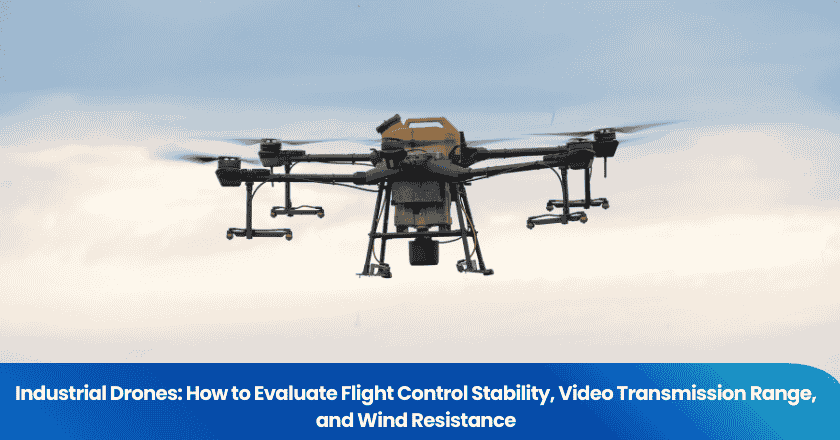
When a buyer sources industrial drones from a Chinese factory, three technical parameters have an outsized impact on whether the units will perform reliably in real-world missions: flight control stability, video transmission range, and wind resistance. Yet these are also the three claims most often overstated in spec sheets and product listings. A drone that hovers smoothly in an indoor test bay may oscillate dangerously near a wind turbine. A transmission range listed as "15 km" may drop to under 3 km the moment the operator moves behind a building. Understanding how each parameter is measured—and what to verify before you accept a shipment—saves you from expensive returns, warranty disputes, and field failures.
Key Takeaways
- Flight control stability is a system property, not a single spec — it depends on IMU count, sensor fusion, and the flight controller algorithm working together under real loads.
- Video transmission range should be verified under interference conditions, not in open-field manufacturer tests, because most operating environments contain RF congestion.
- Wind resistance ratings follow Beaufort or m/s standards — require documented wind tunnel test data and outdoor validation results, not just a quoted class number.
- Third-party inspection at the factory catches calibration failures, substandard components, and software deviations before they become field problems you cannot trace back to the supplier.
Why Industrial Drone QC Is Different From Consumer Drone QC
The Stakes Are Higher
Consumer drones fail gracefully — they fall in a park. Industrial drones operate near power lines, above workers, inside chemical facilities, and over critical infrastructure. According to research published in the journal Remote Sensing (MDPI, 2023), flight control stability — specifically the ability to maintain precise hovering near complex structures — is one of the hardest unsolved problems in industrial UAV design. A single flight controller calibration error that goes undetected at the factory translates directly into mission-critical instability in the field.
Industrial drones also carry payloads — thermal cameras, LiDAR units, gas sensors — that shift center-of-gravity and stress the control loop in ways that a bare-unit factory test will not reveal. This is why inspection protocols for industrial drones must test the fully assembled unit under load conditions, not just the airframe alone.
Manufacturer Spec Sheets Consistently Overpromise
Third-party supplier intelligence consistently shows that Chinese industrial drone manufacturers tend to rate their products under optimal conditions: calm air for wind resistance, open rural terrain for transmission range, and no payload for stability figures. Independent wind resistance testing confirms that manufacturer-quoted wind classes often represent best-case lab conditions rather than field-realistic performance. Buyers who rely solely on spec sheets without factory verification frequently discover discrepancies after units are already in country.
Flight Control Stability: What to Inspect and How
The Four Components of a Stable Flight Control System
Flight control stability in an industrial drone is not a single spec — it is the combined output of four interacting systems: the inertial measurement unit (IMU), the barometric altimeter, the GPS/GNSS receiver, and the flight controller algorithm that fuses all sensor inputs. A failure or calibration drift in any one of these degrades the whole. Buyers evaluating drone shipments from Chinese factories should ask the manufacturer to document all four subsystems separately, including the number of redundant IMUs (industrial-grade units should carry at least dual IMUs) and whether the flight controller uses a reference model-based algorithm — the approach described in MDPI research as most effective for high-altitude stability.
Factory Inspection Checkpoints for Flight Control
When commissioning a pre-shipment inspection for industrial drones, the following stability-related checks should be on the inspection checklist:
- IMU calibration verification against manufacturer tolerance records
- Hover test under full payload load — measured position drift over 60 seconds should not exceed 10 cm in GPS-enabled mode
- Compass calibration log — confirm this was performed within 48 hours of shipment
- Flight controller firmware version confirmed against the approved firmware list in the purchase order
- Dual IMU redundancy confirmed via diagnostic output, not visual inspection
What Competitive Analysis Misses
Most buyer guides focus on which drone model offers the best stability. What they skip is the production variance problem. Two units from the same model line, manufactured in the same week, can have meaningfully different stability performance if the IMU batch had calibration drift or if a firmware version was applied inconsistently across the production run. This is not a hypothetical — it is a documented quality issue in Chinese electronics manufacturing. The solution is not to change your drone model; it is to inspect the specific batch you are receiving.
Video Transmission Range: Verified Numbers vs. Marketing Claims
How Transmission Range Is Typically Tested (and Why It Misleads)
Industrial drone manufacturers test transmission range in open rural environments with zero RF interference, optimal antenna orientation, and the drone at altitude. Published specs for top industrial platforms commonly cite ranges of 12–20 km under these conditions. In realistic industrial environments — factories, substations, urban zones, coastal areas — effective range drops dramatically due to RF congestion, physical obstruction, and frequency hopping performance under load.
For buyers importing industrial drones, the key question is not "what does the spec sheet say" but "what was the transmission range tested under, and can the factory provide the data." Buyers should request test logs, not just quoted numbers.
Transmission System Variables to Verify at Factory
| Parameter | What to Request | Red Flag |
|---|---|---|
| Frequency bands supported | Confirm dual-band or triple-band; request frequency hopping documentation | Single-band only without hopping capability |
| Antenna configuration | Verify antenna placement against approved design drawings | Antenna repositioned from reference design without documentation |
| Range test conditions | Request test environment description and interference level | Range figures with no test condition documentation |
| Video latency under load | Latency spec at maximum range, not just at close distance | Latency only tested at short range or not tested with payload |
| Return-to-signal behavior | Confirm firmware includes automatic return-to-signal if feed drops | No documented behavior for signal loss scenario |
The Interference Test — A Check Most Buyers Skip
One check that rarely appears in standard inspection protocols — but significantly reveals real-world transmission performance — is an interference sensitivity test. This involves operating the drone's transmission system in the presence of a co-located 2.4 GHz or 5.8 GHz interference source (a commercially available RF signal generator or even a densely deployed Wi-Fi environment) and measuring the drop in effective range. Buyers importing drones for use near factory floors, electrical substations, or ports will encounter exactly these interference conditions. A drone that passes a clean-air range test but fails under interference is a product liability risk.
Wind Resistance: Standards, Classes, and What Factory Testing Actually Covers
Understanding Wind Resistance Classifications
Industrial drone wind resistance is typically expressed in one of three ways: Beaufort scale class (e.g., "Class 6"), meters-per-second (e.g., "max 15 m/s"), or miles-per-hour. These numbers are not equivalent across manufacturers, and the testing methodology behind them varies widely.
According to wind resistance testing methodology guidance, manufacturers use two test approaches: wind tunnel tests (controlled, repeatable, but simulate steady laminar flow) and open-field tests (realistic but variable). Industrial drone buyers should require evidence of both. A wind tunnel rating alone does not confirm that the drone will handle the gusts and turbulent airflow common near large structures. Field guides for industrial drone operations note that open-pit mines and coastal wind zones regularly generate gusts and thermals reaching 25–30 mph — conditions that expose the gap between wind tunnel specs and real performance.
Key Wind Resistance Inspection Points
For a pre-shipment inspection of industrial drones, wind resistance verification should include the following steps. First, the inspector should review the manufacturer's wind tunnel test report, confirming it was conducted at the rated wind class and that the test unit carried the same motor and propeller configuration as the production unit. Second, if feasible, an outdoor hover test in local ambient wind conditions (with wind speed measured on-site via anemometer) should be conducted for a minimum of 90 seconds, recording positional drift at a fixed GPS coordinate. Third, the propeller blade geometry should be visually and dimensionally checked against approved drawings — undersized or off-spec blades directly reduce wind resistance without any other system change. Fourth, motor output consistency should be verified across all motors; an unbalanced motor set produces asymmetric thrust that fails under crosswind before the rated wind class is reached.
IP Rating and Structural Resilience
Wind resistance cannot be assessed in isolation from the drone's IP rating and structural integrity. Industrial drone specifications guidelines note that an IP54 minimum rating is the practical standard for weather-resistant industrial operation. Factory inspection should confirm the IP rating was achieved through actual ingress protection testing, not just stated in the datasheet. Inspect frame joints, motor mount seals, and payload bay closures for material quality and fit consistency — these are the points where moisture and dust infiltration most commonly defeat rated IP protection in production units that deviated from design spec.
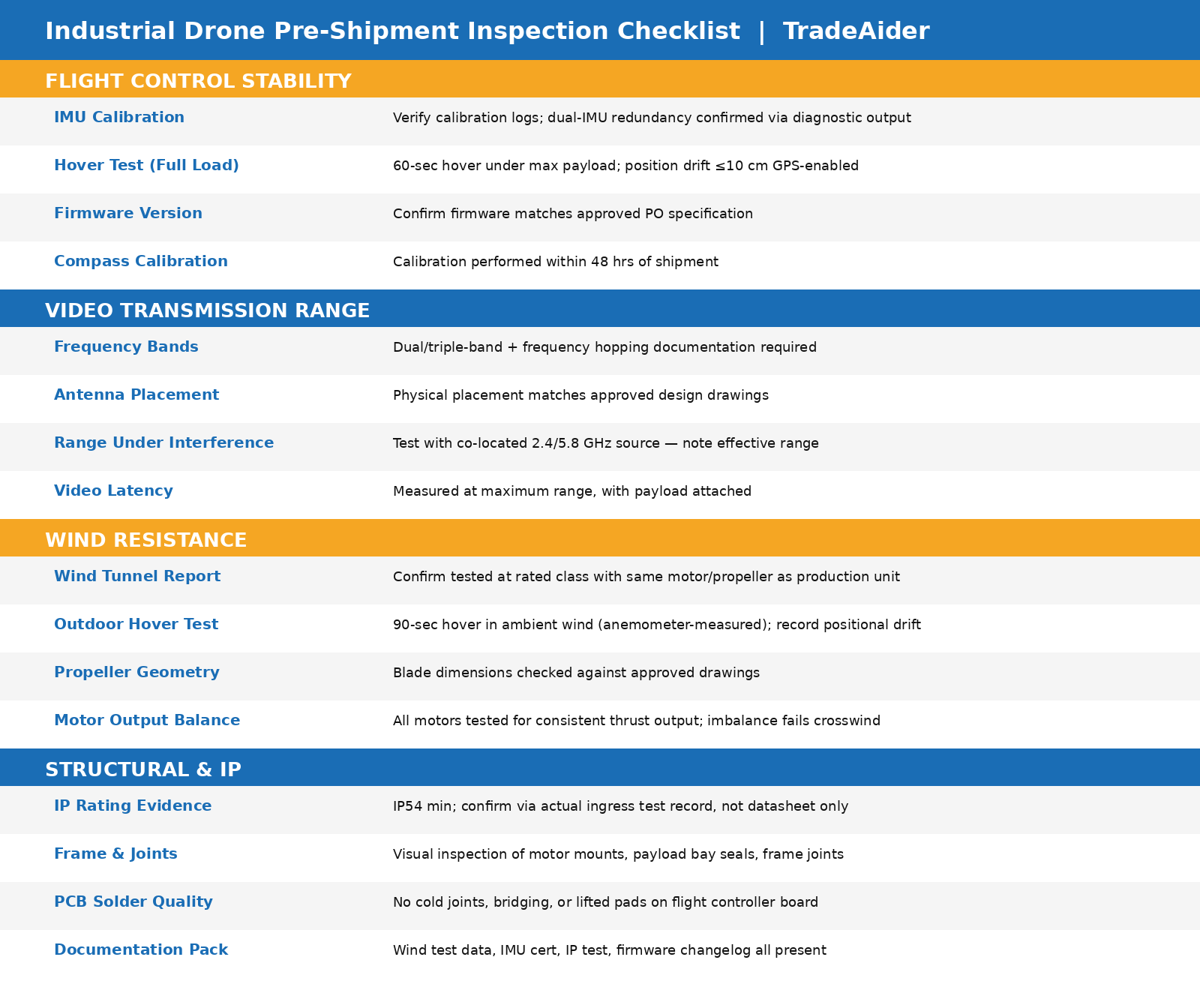
Key QC parameters for industrial drone pre-shipment inspection — grouped by subsystem
How Third-Party Inspection Catches What Self-Declaration Misses
The Self-Declaration Problem
Most Chinese drone manufacturers present buyers with a manufacturer quality certificate (MQC) or internal test report alongside each shipment. These documents record that the unit passed the factory's own tests. What they cannot tell you is whether the test was performed on a representative sample of the batch, whether the tester was independent of the production line, or whether the approved test version matches the firmware actually shipped. Self-declaration is not a substitute for third-party verification — it is the document a third-party inspector uses as the baseline to check against.
What a Pre-Shipment Inspection Covers for Industrial Drones
A structured pre-shipment inspection for industrial drones covers three tiers of verification. The first tier is workmanship and visual checks: frame integrity, solder joint quality on PCBs, antenna placement, payload bay construction, motor mounting, and propeller balance. The second tier is functional testing: flight controller calibration output, hover stability under load, transmission range and latency under controlled interference, and return-to-home behavior. The third tier is documentation verification: firmware version confirmation, IP rating test records, wind resistance test data, and compliance with the purchase order specifications. All three tiers must pass before the inspector signs off.
For buyers purchasing industrial drones for use in energy, infrastructure, or manufacturing inspection applications, a during-production inspection is also worth considering for large orders — it allows quality issues to be corrected before the full batch is assembled and packed, rather than after.
Common Defects Found in Industrial Drone Shipments
Based on inspection experience across Chinese electronics and aerospace-grade manufacturing, the most frequent quality issues in industrial drone shipments fall into these categories: IMU calibration drift not caught by the factory's own automated test (because the test threshold was set too loosely), motor winding inconsistency across a batch (often from a component supplier change mid-run), firmware version mismatch between the shipped unit and the approved specification, and antenna placement deviations that reduce effective transmission range by 20–40% without being detectable during a visual check. None of these are detectable from a spec sheet or a self-declared quality certificate. All of them are detectable during a structured third-party inspection.
Building Your Inspection Protocol: A Practical Framework
Define Acceptance Criteria Before the Order Is Placed
The most common reason industrial drone quality inspections fail to catch real problems is that the acceptance criteria were never defined in the purchase order. If the PO says "industrial drone with wind resistance Class 6" but does not specify the test method, test conditions, or acceptable position drift during the hover test, the inspector has no hard pass/fail threshold to enforce. Acceptance criteria for stability (maximum drift in meters per minute), transmission range (effective range under defined interference conditions), and wind resistance (specific test protocol and pass threshold) should all be written into the commercial agreement before production begins.
Use AQL Sampling to Scale Verification to Order Size
For large drone orders, 100% functional testing of every unit is typically impractical. The standard approach is AQL-based sampling — the same methodology used in general manufacturing quality control. For a product category with the risk profile of industrial drones, most experienced QC professionals recommend a tighter-than-standard AQL level for critical functional parameters (flight stability and transmission), with a broader sample size for workmanship checks. TradeAider's AQL Calculator can help buyers determine the right sample size for their order volume and risk tolerance.
Document Everything — For Warranty and Repeat Orders
Industrial drones have long service lives in the field. An inspection report that documents firmware version, motor serial numbers, and test performance data from the day of shipment becomes the reference baseline when a unit develops a field failure 12 months later. It also gives buyers negotiating leverage when requesting warranty service from a factory that might otherwise claim the failure was caused by operator error. Real-time inspection reports — accessible during the inspection, not days later — allow buyers to review findings and give instructions while the inspector is still on site. This is particularly valuable for technical products like drones where a second-look at a borderline result can save a disputed rejection.
Frequently Asked Questions
What wind resistance class should I require for industrial inspection drones?
For most industrial field applications, a minimum of Beaufort Class 5 (up to ~10.7 m/s or 24 mph) is the baseline, with Class 6 (up to ~13.8 m/s or 31 mph) recommended for coastal, elevated, or open industrial sites. More important than the class number is the test documentation: require wind tunnel test reports and outdoor validation data for the specific production batch, not just the model specification. The test should be conducted with the drone under full payload load, since an unloaded wind resistance rating does not reflect real mission performance.
How do I verify video transmission range claims from a Chinese drone factory?
Start by requesting the manufacturer's range test report and looking for the test conditions section — a credible report will specify open-field vs. urban environment, altitude, antenna configuration, and interference level during the test. Then commission a factory inspection that includes a transmission test under interference: a co-located RF source at 2.4 or 5.8 GHz will reveal whether the quoted range holds up in realistic deployment conditions. Pay particular attention to the behavior when the signal approaches its limit — a drone that maintains stable hover and initiates a documented return-to-signal behavior is safer than one that simply drops the feed without a defined response.
Can I rely on a manufacturer's quality certificate instead of hiring an inspector?
A manufacturer's quality certificate records that the factory tested its own products against its own thresholds. It does not tell you whether those thresholds match your purchase order specifications, whether the sample tested was representative of the batch, or whether the firmware and component configuration matches what you approved. Third-party inspection answers all three questions. For high-value industrial equipment with safety implications, self-declaration is a starting document for an inspector — not a substitute for independent verification.
What is the difference between a pre-production and pre-shipment inspection for drones?
A pre-production inspection verifies that raw materials and components meet specification before bulk manufacturing begins — this is where you catch a substandard IMU batch or an off-spec motor supplier before those components end up in 500 assembled units. A pre-shipment inspection verifies the finished, packed product against your purchase order specifications before it leaves the factory. For complex products like industrial drones, running both inspections on large orders is the most cost-effective approach: pre-production catches systemic component issues early; pre-shipment confirms the assembled unit meets performance criteria.
How does third-party inspection work for drones sourced from China?
A third-party inspector travels to the manufacturer's facility in China, draws a sample from the production batch according to AQL methodology, and conducts workmanship, functional, and documentation checks against the buyer's defined acceptance criteria. For industrial drones, functional testing includes hover stability under load, transmission range under interference, motor balance checks, and firmware version verification. The inspector submits a report — ideally in real time during the inspection so the buyer can review findings and provide instructions while the inspector is still on-site. Third-party QC services for technical and industrial products from China follow this same framework, adapted to the specific test protocol defined in the purchase order.
Related Articles
Grow your business with TradeAider Service
Click the button below to directly enter the TradeAider Service System. The simple steps from booking and payment to receiving reports are easy to operate.

