
- About Us

- Our Services
- Your Industry
- Resources
- News & Blog
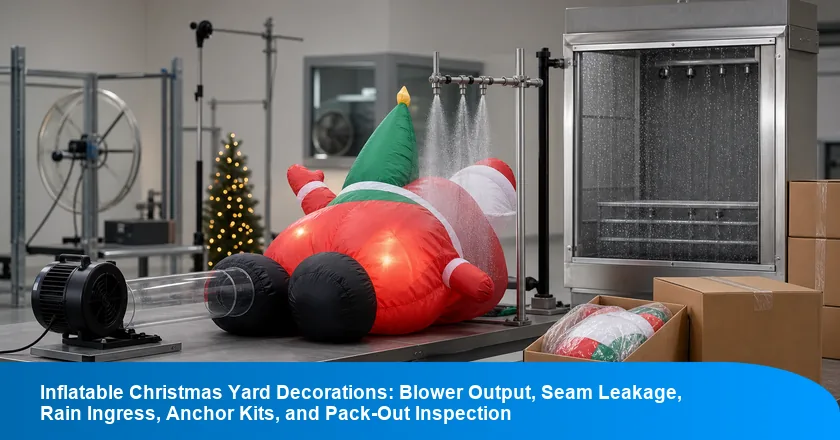
An inflatable Christmas decoration inspection is a live-system release check, not a quick review of whether a fabric shell looks attractive. The yard inflatable must rise to its approved shape with the specified blower, retain that shape through an agreed observation period, present the intended weather-facing electrical configuration, and arrive with the anchors, warnings, and accessories promised by its retail carton. A decoration can look acceptable on the factory floor while an incompatible blower, a leaking inflation route, a missing tether bag, or mixed carton contents still prevent a defensible shipment release.
What Must Agree Before an Outdoor Inflatable Can Ship?
An inflatable release decision must join live function, weather-facing electrical configuration, anchor completeness, and carton identity.
- Functional evidence: Record the approved blower and inflation route before judging shape; a brief inflation is not a universal pass.
- Weather boundary: Treat rain-facing housings, connectors, cord exits, and lights as a configuration question, not as proof of an IP rating.
- Pack-out proof: The physical stake and tether set, warning artwork, and accessory bag must match the approved bill of materials for the carton being released.
- Containment: When a physical carton contradicts its record, hold the identifiable version, reconcile it, and verify the corrected pack-out.
Use the Live-Inflatable Release Chain
The Live-Inflatable Release Chain treats blower, inflation route, weather-facing electrical points, anchor kit, warnings, and packed carton as one releaseable build. Start with the buyer-approved sample, specification, or build card. It should identify the blower model and rated route, fabric design, inflation openings and intended vents, lights or other powered components, accessory BOM, retail artwork, and carton version. The chain is complete only when the observed product and the packed retail configuration still agree with that reference.
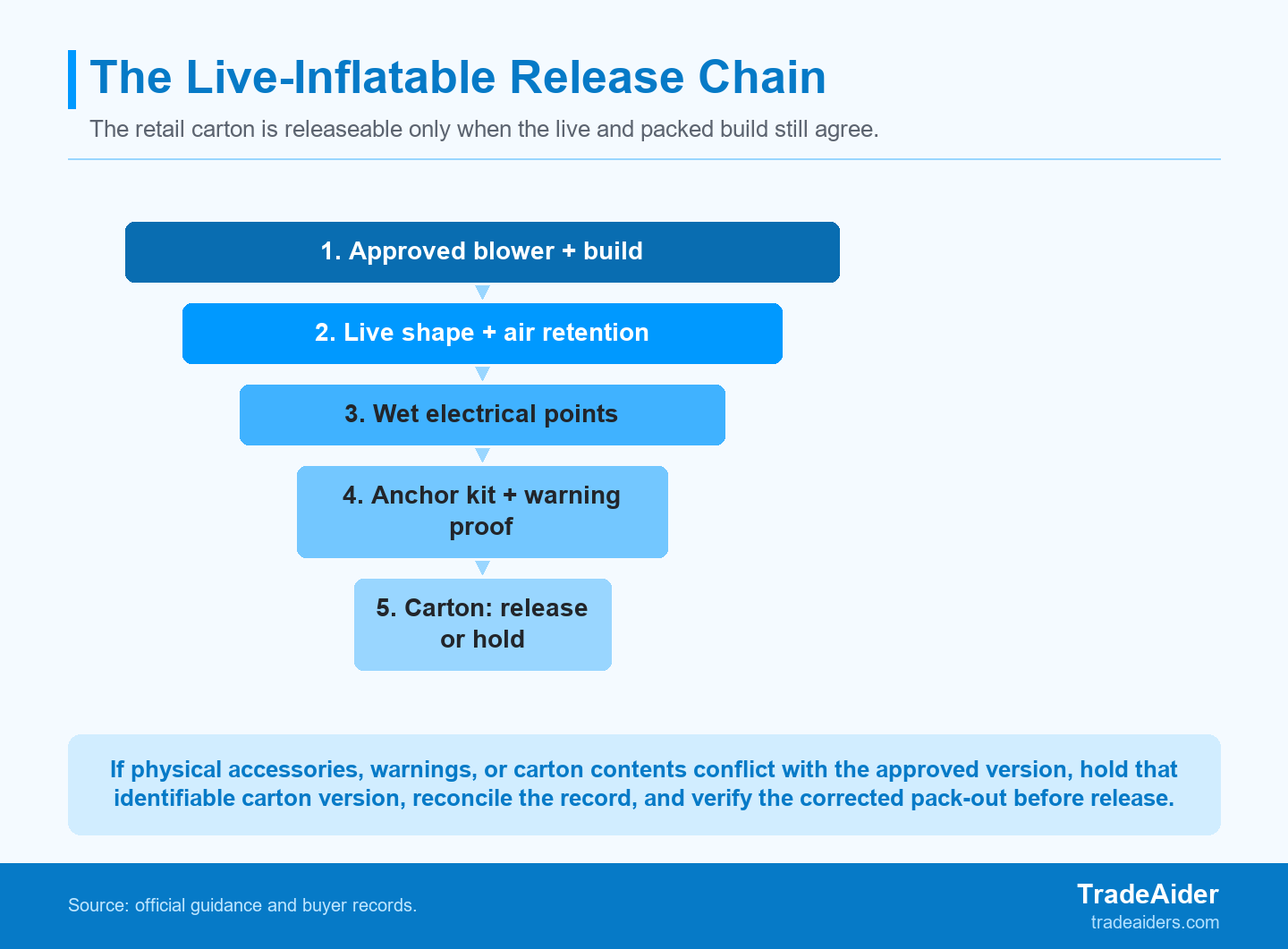
A yard inflatable can be released only when the live product and packed retail configuration agree with the approved build.
This framework avoids two common mistakes. The first is separating the inflatable body from the blower even though the decoration does not function without the installed air source. The second is treating a sealed carton as evidence of completeness even though the stakes, tethers, instructions, warnings, and electrical accessories may be inside it. The Live-Inflatable Release Chain therefore moves from an approved build, through live function and weather-facing components, to the exact carton that a shopper receives.
| Release link | What to compare | Record to retain | Release question |
|---|---|---|---|
| Blower and inflation route | Approved blower, connection, startup, shape, seams, valves | Reference ID, observation conditions, photos or video | Does the specified build inflate and retain its intended form? |
| Rain-facing components | Housing, connector, cord exit, light path, instructions | Component version and route-specific evidence | Is the observed configuration the one documented for the destination? |
| Anchor kit | Stakes, tethers, bag, instructions, warning artwork | Approved BOM and physical count | Does the physical set match the retail promise? |
| Carton version | Retail carton, label, inserts, accessory identity | Carton artwork and packing record | Can this specific packed version be released? |
Based on this comparison, a finding should be written as a break in a specific link, not as a vague statement that the inflatable “failed quality.” That precision lets the buyer decide whether a local correction is enough, whether a carton version needs a hold, or whether a different technical or market evidence route is required.
Prove the Blower Is the Approved Configuration
A buyer-defined startup and inflation-time check is useful only when it is tied to the approved blower, voltage route, inflation route, and sample reference. For a structural analogy, HSE inspection guidance for sealed play inflatables includes checking that the inflation device conforms to the original manufacturer specification. Its formal scope is not domestic yard décor, so it is not a blanket legal requirement for a Christmas decoration; it is a useful reminder to inspect the installed blower against the approved build rather than against appearance alone.
Before bulk packing, lock the blower identifier, rated market route, plug or connector arrangement, air outlet orientation, attachment method, and any integrated light connection. Then agree the observation conditions: starting state, surface, power arrangement, timing method, shape reference, and period for checking retained form. Do not invent one inflation-time limit for every product. A small tabletop character, a tall outdoor arch, and a multi-chamber scene can need different buyer-approved criteria. A during-production inspection is the point to spot a substituted blower, restricted air route, or recurring seam issue before the complete range is committed to retail cartons.
Test the Air Path Before You Judge Appearance
A standing decoration can conceal air loss, so the inspection record should separate operating shape, seams, valves, and designed venting. The air path is the route that carries blower air through the decoration, including the seams, valves, and chambers that shape the product. A useful record identifies the blower outlet, attachment collar, major chambers, intended vents, zipper or valve closures, and the seam locations that support the visual shape. Compare the fully inflated article with the approved reference from more than one view, including the base, stress points, and any area hidden by a scarf, hat, or appliqué.
Record observable function rather than relying on a single verbal conclusion. Note whether the unit starts consistently, whether it reaches the agreed shape, whether a chamber softens during the agreed observation period, whether fabric blocks the air route, and whether the body stands as the intended configuration requires. If a product has multiple chambers or lighted details, identify which chamber or feature is affected. This gives the factory a repair target and prevents a buyer from treating every soft area as the same defect.
Separate Seam Leakage From Normal Venting
A seam-leak finding needs a location, observation time, and repeatable condition; it should not be inferred from a single cosmetic view. First confirm whether the opening is a designed vent, a blower outlet, a closure that the approved design leaves accessible, or an unintended seam or weld gap. Then record the article version, the relevant location, the chamber affected, the observed change in shape, and the condition under which it appeared. A photo of a soft-looking area is useful only when it is connected to that context.
The next decision should follow the mechanism. A pinched internal liner, a twisted intake collar, a skipped seam, a poorly seated zipper, and a fabric obstruction may require different correction and verification. Avoid calling a field observation a pressure test, a durability certification, or a universal performance conclusion. The buyer should define the acceptance condition in the approved build, and the inspection record should show whether the actual unit met that condition under the agreed observation.
Treat Rain Ingress as a Configuration Boundary
Rain-exposure evidence concerns the assembled configuration around the blower housing, connectors, cord exits, and lights, not a generic splash claim. IEC 60529 is the IP Code framework for degrees of protection provided by enclosures. That does not mean a factory spray observation creates an IP classification. It means a buyer should keep the words “ingress,” “enclosure,” and “rating” tied to the actual component evidence and claimed configuration. The check begins by mapping where water could meet the powered system: blower housing, plug or connector, cable entry, cord exit, light-module wire path, and any controller.
HSE's blower-fan safety bulletin describes a mains-powered inflatable-blower design used in wet conditions where water could reach live contacts. Its examples concern particular products and uses, including play or advertising inflatables; they do not classify every seasonal yard decoration. The operational lesson is narrower and useful: inspect the complete powered configuration that will be supplied, and escalate any mismatch between the approved component arrangement, instructions, and the intended outdoor use. If a buyer needs a product-specific technical route, TradeAider's product testing service can help align the agreed evidence with the actual build. It does not replace the buyer's market or compliance decision.
Check Light Modules and Cord Exits as Separate Components
Decorative lighting and a textile shell create different observable failure paths, so each needs its own record against the approved build. CPSC holiday-decoration guidance advises checking lighting for damaged sockets, frayed or bare wires, and loose connections. For a factory inspection, compare the light count, placement, wire routing, connector seating, cord exit protection, switch or controller behavior, and visible damage with the approved configuration.
Keep the shell and the electrical observation separate in the record. A stable-looking snowman may still have a pinched lead at a seam, an exposed connector, a loose lamp module, or a cord exit that differs from the approved sample. Conversely, a fabric crease can be a cosmetic issue without proving an electrical problem. This separation gives the buyer a clearer corrective route and makes it less likely that a visual check is overstated as product certification.
Release the Anchor Kit and Pack-Out as One System
Anchors, ropes, instructions, warning artwork, accessory bag, and carton contents must agree with the approved bill of materials before release. HSE's sealed-play-inflatable guidance checks whether anchors and ropes are present and in good condition, but that guidance is not a direct rule set for a yard decoration. Use it as a structural prompt: a product sold with a specified securing kit should be checked as a set, against its own approved instructions and design. The physical accessory bag is therefore evidence of the retail configuration, not an afterthought once the body has inflated.
At pack-out, verify the number and type of stakes, tether lengths and attachment points where specified, any repair patch or storage bag, instruction sheet, warning language, electrical instructions, and accessory-bag identifier. Compare each item with the approved BOM and the carton artwork. CPSC's holiday guidance also advises fastening outdoor lights securely to a firm support to protect them from wind damage. That consumer-safety advice does not set a universal anchoring design for every inflatable, but it reinforces why the securing instructions and supplied items must not be treated as invisible packaging details.
Make the Carton Prove the Retail Configuration
A carton count alone cannot prove retail readiness; the evidence must connect the physical accessory set and warnings to the correct carton version. Record the exterior artwork or SKU, carton identifier, insert revision, accessory-bag label, physical count, and the reference BOM used at the check. If the product appears in more than one size, voltage route, retailer pack, or destination version, keep the records separate. A correct stake bag in a different carton does not cure a missing stake bag in the carton selected for release.
The same discipline protects dispatch controls. Once the buyer has approved a defined carton version, container loading supervision can preserve marked carton identity into loading. It cannot reconstruct a pack-out record that was never tied to the physical set, so carton proof belongs earlier in the Live-Inflatable Release Chain.
Apply Market Evidence Only to the Electrical Configuration
Electrical-market requirements depend on the product configuration and destination, so a buyer should map the actual powered components before treating one route document as transferable. For Great Britain, the Electrical Equipment (Safety) Regulations guidance states the applicable AC voltage range of 50 to 1,000 volts. The EU Low Voltage Directive likewise describes equipment between 50 and 1 000 V. In Australia, the EESS guidance describes responsible-supplier requirements for in-scope electrical equipment.
These sources are route context, not a one-line clearance for a complete inflatable. Before asking an inspector to verify labels or documents, identify the actual blower, input voltage, plug, detachable or integrated light modules, controller, destination, responsible party, and the claims on the retail pack or instructions. Keep technical files, declarations, registration, marking, and testing questions with the responsible owner and the applicable destination route. A pre-shipment inspection can then confirm whether the physical product and packaging match the approved evidence; it does not replace the legal or technical determination.
Illustrative Scenario: The Carton Record Does Not Match the Anchor Kit
When the approved anchor-kit record conflicts with the physical retail carton, hold the documented carton version until the accessory build and records agree. The following example applies the Live-Inflatable Release Chain to a document-product conflict rather than treating an inflation check as a complete release decision.
Why the Hold Follows the Carton Version
A hold can remain limited when the affected carton version is identifiable, but it cannot be released on a packing statement that the physical set contradicts.
A marketplace quality manager is preparing a Christmas yard-decoration launch for two destination routes. An illustrative shipment contains 1,800 outdoor inflatable decorations packed in 6-piece retail cartons. The factory presents an approved accessory BOM showing eight ground stakes and a tether set for the selected carton version.
The sampled cartons carry the approved carton artwork but contain six stakes and no tether bag. The accessory packing record still lists the eight-stake configuration, while another identifiable carton version carries a separate six-stake record. The physical accessory set and the declared BOM conflict for one identifiable carton version, so a passing blower check cannot prove the retail configuration is complete.
Hold the 360 cartons marked with the eight-stake artwork and continue release review only for carton versions whose physical contents and records agree. Reconcile the carton artwork, accessory BOM, physical bags, and packing records; then identify and correct every affected carton before a focused verification.
Confirm the corrected carton version, physical stake and tether count, warning artwork, accessory-bag identifier, and sealed pack-out against the approved record. This example is illustrative. It does not determine anchoring suitability, weather rating, or market compliance for every product.
This boundary is operational, not a statement that every incomplete accessory set creates the same market outcome. The buyer still decides the product requirements, destination route, and acceptable correction. The inspector's contribution is to make the mismatch visible, identify the affected carton version, and verify the corrected range rather than allowing an unrelated passing sample to stand in for it.
Send an Outdoor-Inflatable PSI Brief Before Peak Dispatch
A usable PSI brief names the approved blower and artwork, the functional observation plan, the accessory BOM, the carton version, and the release boundary. Here, PSI means pre-shipment inspection. It is most useful when the order is finished enough for the check to represent the actual packed release population: a PSI is conducted when 100% of the order quantity is completed and at least 80% is packed for export.
Send the approved sample or build card, blower and electrical-component identification, destination and carton-version list, functional observation conditions, acceptable-defect definitions, accessory BOM, instruction and warning artwork, packing configuration, and dispatch window. Ask for a record that connects observations to the defined version rather than a generic “pass/fail” statement. The objective is a completed-configuration record that the buyer, factory, and inspector can all use without guessing which retail variation it represents.
Who Is TradeAider?
TradeAider provides China-based quality-control support that can translate an outdoor-inflatable build card into a defined inspection scope. Its inspection coverage includes many provinces: Guangdong, Zhejiang, Jiangsu, Shandong, Fujian and other regions, with online real-time monitoring available for buyers who need visibility during the process. TradeAider lists an all-inclusive rate of $199/man-day for Inspection & QA Services. Buyers can review TradeAider's provider context before sharing a build reference.
TradeAider is an Amazon Service Provider Network (SPN) partner. TradeAider reports client outcomes including an 18% reduction in return rates and a 23% improvement in defects caught before shipment; these are client-reported results, not universal outcomes. TradeAider also provides testing services, covering Hardline Products, Softline Products, Electrical & Electronic Products, and Industrial Products, enabling buyers to manage quality control and testing needs within a single service framework.
If the approved build, carton list, and dispatch timing are ready, request an outdoor-inflatable PSI scope.
Frequently Asked Questions
Is a blower startup test enough for an inflatable Christmas decoration?
No—A startup check is only one part of a release decision because the approved air path, shape retention, cord route, accessories, and carton identity still need evidence. Record the installed blower and the agreed conditions, then compare the fully inflated form with the approved reference. If the product inflates but the carton contains the wrong accessory set, the retail configuration is still not proven. Do not use a universal inflation-time number unless the buyer has set it for that exact build.
Can a water spray prove that a yard inflatable is rainproof?
No—A water observation can document a specified condition, but it does not replace route-appropriate design, documentation, or component evidence. Keep the record specific: configuration, exposure condition, component locations, observed result, and the approved reference. Do not call the result an IP rating, certification, or universal weather claim. If the blower housing, connector, cord exit, or light module differs from the approved configuration, treat that mismatch as a separate decision before release.
What should an anchor-kit inspection record include?
Record the approved accessory BOM, physical count, stake or rope type, instructions, warning artwork, accessory-bag identity, carton version, and any missing or mixed contents. Add photographs that show the carton identifier and the unpacked accessories together where practical. The important question is not merely whether some stakes exist in the factory; it is whether the exact retail carton selected for release contains the documented kit and instructions for that version.
Can one electrical document cover the US, UK, EU, Canada, and Australia?
Not automatically—The electrical configuration, voltage range, responsible party, labeling, and destination route determine what evidence is relevant. Map the installed blower, plug, light modules, controller, retail claims, and intended destination before comparing a document to the product. An inspection can confirm whether the physical build and packaging match the evidence the buyer supplied. It should not be presented as the final legal classification, certification decision, or route approval for every market.
Related Articles
Grow your business with TradeAider Service
Click the button below to directly enter the TradeAider Service System. The simple steps from booking and payment to receiving reports are easy to operate.

