
A practical inspection budget is not a fixed percentage of order value; it is a risk-adjusted control budget based on product category, supplier maturity, compliance exposure, defect cost, order size, and shipment timing. For many consumer-goods importers, the useful planning range is often about 0.5% to 3% of order value, but high-risk first orders can justify more and mature repeat orders can justify less.
Importers often ask for a single magic number: how much should QC cost as a percentage of the order? The honest answer is that percentage alone can be misleading. A $500 inspection on a $10,000 order is 5%, while the same inspection on a $100,000 order is 0.5%. The inspection work may be nearly identical even though the percentage changes dramatically.
A better framework starts with exposure. What would happen if the shipment arrived with wrong labels, failed function, unsafe materials, mixed SKUs, weak packaging, missing accessories, or noncompliant documentation? If the correction cost would be large, a higher QC percentage is rational. If the product is mature, low risk, and produced by a proven supplier, the percentage can fall.
- Low-risk repeat order: lean PSI budget may be enough.
- New supplier or new SKU: add audit, PPI, DPI, or tighter PSI scope.
- Compliance-sensitive product: add testing and document review.
- High-value launch: budget for reinspection or loading evidence.
The Direct Answer
Spend enough on QC to protect the failure modes that would hurt more than the inspection budget.
TradeAider fits the budgeting decision by helping importers choose which inspection gates are commercially justified, instead of treating every SKU or supplier the same.
The CBP reasonable care guidance frames importing as an informed-compliance responsibility. For buyers, the practical QC lesson is that prevention evidence is part of running an import process with discipline, not a cosmetic add-on after production is finished.
The CPSC testing and certification page explains that manufacturers and importers must test many consumer products and certify covered products based on passing test results. That means some QC budgets must include testing and certification evidence, not only visual inspection.
The budget should therefore be built in layers: supplier-risk control, production-risk control, finished-goods inspection, compliance testing, and shipment-release evidence. The buyer does not always need every layer. The buyer does need to know which layer protects which risk.
QC Budget Framework By Order Risk
The right QC percentage rises when failure cost, uncertainty, or compliance exposure rises.
| Order Situation | Typical QC Budget Logic | Recommended Control Layer | Why The % Changes |
|---|---|---|---|
| Repeat low-risk SKU | Lean percentage, focused on shipment release | PSI with known checklist | Supplier history lowers uncertainty |
| First order with new factory | Higher percentage accepted as onboarding cost | Factory audit + PSI, possibly DPI | Buyer needs capability and finished-lot evidence |
| Custom product or tight tolerance | Budget for earlier checks | PPI or DPI + PSI | Defects may become expensive after mass production |
| Regulated or claim-heavy SKU | Testing and inspection both required | Testing + PSI + document check | Visual inspection cannot prove compliance |
| Large retail or marketplace launch | Budget for reinspection reserve | PSI + possible reinspection + loading check | Late failure can affect listings, returns, and launch timing |
A percentage target should never force the wrong control decision. If a $20,000 first order needs a factory audit and PSI, the QC percentage may look high. That does not automatically make it wasteful. It may be the cost of learning whether the supplier can produce the order before the buyer scales up.
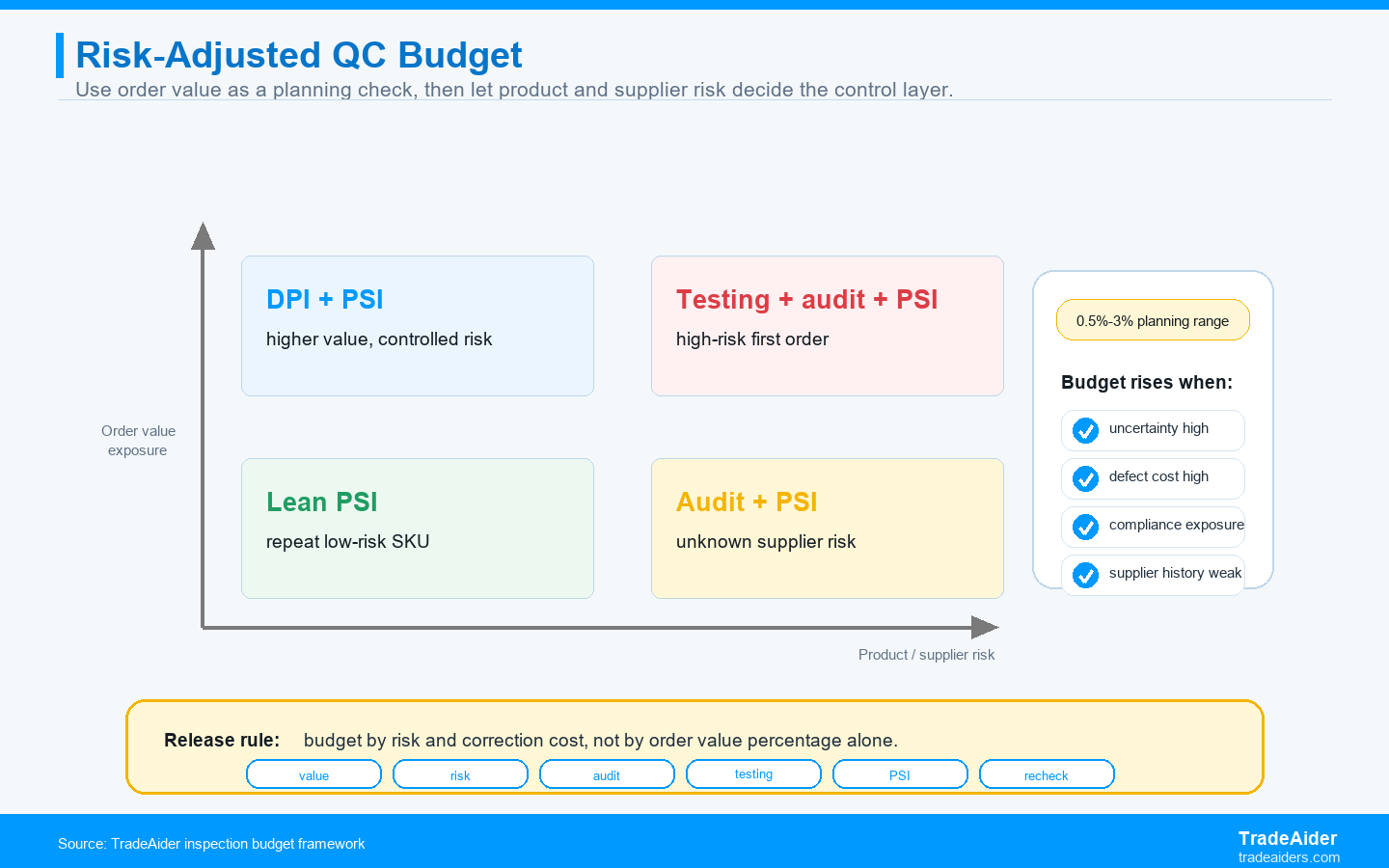
The QC budget should rise when uncertainty, defect cost, or compliance exposure rises.
How To Convert Percentage Into A Budget
Convert the percentage into named control points before negotiating with the supplier.
Start with order value, then list realistic failure costs. Include refund, replacement, warehouse sorting, relabeling, return handling, support tickets, marketplace listing issues, chargebacks, disposal, and lost selling time. If one preventable defect could cost more than the inspection plan, the inspection budget is not the expensive part of the order.
Next, map the order stage. A supplier audit belongs before deposit or before scale-up. PPI belongs before the factory produces too far with wrong materials. DPI belongs when process drift is likely. PSI belongs before final payment and shipment release. Loading supervision belongs after product acceptance when container evidence matters.
Finally, reserve a contingency for failed inspection. Buyers often budget for one inspection but not for rework verification. If a first inspection fails, reinspection may be the most important spend in the whole program because it proves whether the factory corrected the issue before shipment.
A Simple Budget Formula Importers Can Use
A practical QC budget formula combines base inspection cost, risk multipliers, and correction reserve.
Start with a base control plan. For a known supplier and repeat low-risk SKU, that base plan may be PSI before final payment. For a new supplier, the base plan may be audit plus PSI. For a product with compliance exposure, the base plan should include testing or document review. This base plan is the minimum spend required to avoid releasing goods blindly.
Then add risk multipliers. Add budget when the product is new, the supplier is new, the packaging is custom, the product has safety or claim exposure, the order value is large, the destination market is strict, or the shipment date leaves little time for correction. These are not abstract concerns; each one increases the cost of a late failure.
Finally, add a correction reserve. If the buyer has no budget for reinspection, the first failed inspection creates a bad choice: ship with known defects or spend unplanned money under schedule pressure. A planned reserve lets the buyer verify rework calmly. For first orders, this reserve can be more important than shaving a small amount off the first inspection quote.
This formula also helps with supplier negotiation. The buyer can tell the supplier that inspection is not a surprise penalty. It is a release condition built into the order budget. If the supplier wants faster release, the supplier should keep production ready, files current, and defects corrected before the inspector arrives.
Where TradeAider Fits In Inspection Budget Planning
TradeAider fits by turning a percentage budget into a practical inspection scope.
TradeAider's inspection calculator can help buyers estimate inspection service needs, while the service plan should still be based on product risk and shipment timing. The goal is not to spend the most. The goal is to put the right control at the point where it changes the decision.
For new suppliers, factory audit helps decide whether the supplier should receive production money. For active production, During Production Inspection helps identify drift before all goods are packed. For release, Pre-Shipment Inspection checks the finished lot when 100% of order quantity is completed and at least 80% is packed for export.
The business fit is especially strong when the buyer has a budget ceiling but not a control plan. TradeAider can help the buyer prioritize: audit first, DPI first, PSI only, testing support, or loading evidence depending on the risk.
When A Lower QC Budget Is Actually More Expensive
A lower QC budget is risky when it only looks cheaper because the correction cost has not been counted.
A buyer can cut inspection spend in three ways: inspect later, inspect less, or inspect nothing. Each cut saves visible money before shipment. The hidden question is what cost moves downstream. If the defect is cosmetic and easy to sort after arrival, a leaner plan may be reasonable. If the defect affects safety, claims, labeling, marketplace acceptance, or retailer receiving, the saving may simply move cost from prevention to correction.
The most common budget mistake is comparing inspection cost only to supplier price. A better comparison includes the landed value of the shipment, the selling plan, the replacement cost, the customer-support burden, and the impact of lost launch time. A $700 inspection can look large beside a small deposit but small beside a failed launch, delayed retailer delivery, or container of wrong labels.
A low budget is also risky when the buyer has not protected final payment. If the supplier receives the balance before inspection, the buyer may need to fund correction with weak leverage. A slightly higher QC budget before payment can be cheaper than negotiating rework after the supplier has already been paid and the vessel deadline is close.
The buyer should therefore review QC spend after every order. If inspection repeatedly finds nothing meaningful, the scope may be leaner on repeat orders. If inspection repeatedly finds issues that require correction, the budget may need to move earlier into PPI, DPI, testing, or supplier audit. Budget learning is part of supplier development.
A useful management rule is to compare QC spend against prevented decisions, not only against defect counts. If inspection stopped a wrong label, blocked a weak carton, or forced rework before payment, the value may be much larger than the number of sampled defects suggests.
SPAR Scenario: The 1.8% QC Budget That Protected A Launch
The buyer did not choose 1.8% because it sounded tidy; the buyer chose it because the protected failure cost was larger.
Situation: A Shopify brand places a $42,000 first order for bathroom shelves with custom packaging and marketplace barcodes. The supplier is new, and the launch date is tied to paid ads.
Problem: The buyer wants to keep QC below 1% of order value, but the product has finish risk, barcode risk, carton risk, and unknown factory capability. A failed launch could cost more than the inspection plan.
Action: The buyer budgets for a factory audit, PSI, and a reinspection reserve. TradeAider audit checks supplier capability before full commitment. PSI later finds weak carton corner protection and barcode placement errors. The factory corrects and reinspection verifies the fix.
Result: The QC spend is around 1.8% of order value, higher than the buyer's original target. The business result is better because the budget protected the launch from a defect pattern that would have been harder to fix after import.
Action Card: Inspection Budget Framework
Set the QC budget after naming the risk, not before.
- Start with product risk, supplier maturity, order value, and destination-market exposure.
- Use percentage only as a planning check, not as the main decision rule.
- Add testing when compliance, safety, material, or claim evidence is required.
- Reserve budget for reinspection when first-order or high-risk failure is plausible.
- Tie QC spend to payment and shipment release decisions.
If you have an order value but not a QC budget, send TradeAider the SKU, order value, supplier history, product risk, destination market, production stage, and payment terms. The next step is to ask TradeAider to scope a risk-adjusted inspection budget before final payment.
Frequently Asked Questions
What percentage of order value should importers spend on QC?
Many importers plan around 0.5% to 3% of order value, but the right percentage depends on risk. New suppliers, regulated products, and high-value launches can justify more.
Is 1% of order value enough for inspection?
Sometimes. A mature repeat order may need less than 1%, while a first order with testing, audit, and reinspection may need more.
Should testing be included in the QC budget?
Yes, when the product has safety, compliance, material, chemical, electrical, child-use, or claim-related risks. Inspection and testing answer different questions.
Can TradeAider help choose which QC step to buy first?
Yes. TradeAider can help prioritize audit, PPI, DPI, PSI, testing support, reinspection, or loading supervision based on the buyer's risk and timing.
Related Articles
Grow your business with TradeAider Service
Click the button below to directly enter the TradeAider Service System. The simple steps from booking and payment to receiving reports are easy to operate.

