
- 会社概要

- 当社のサービス
- あなたの業界
- リソース
- ニュース&ブログ
AQL (Acceptable Quality Limit) is a statistical method defined in ISO 2859-1 that determines how many units from a production lot to randomly inspect, and the maximum number of defective units allowed before rejecting the entire lot — without checking every item.
Most importers never have to choose between these two methods. The industry default is AQL sampling under ISO 2859-1:2026, the international standard used by quality control firms, retailers, and third-party inspectors worldwide. But "most importers" isn't the same as "all importers." A 100% full inspection is sometimes the right call — and knowing which is which could save you thousands of dollars, or prevent a costly recall.
Key Takeaways
- Definition: AQL sampling inspects a statistically representative subset of your order. 100% inspection checks every unit individually.
- Standard: AQL 2.5 is the industry benchmark for major defects on consumer goods, with critical defects always set at AQL 0.
- Cost comparison: For 2,500 units, AQL sampling takes ~2 days vs. ~26 days for 100% inspection — a cost difference of up to 13×.
- Decision: Use AQL for most consumer goods. Use 100% inspection when goods are high-value, safety-critical, or when a supplier has previously failed inspection.
- How it works: Lots at AQL under ISO 2859-1's OC curve carry approximately 95% probability of acceptance — providing statistically reliable quality decisions without inspecting every unit.
What Is AQL Sampling?
AQL sampling is the global standard for quality control inspections on manufactured goods. Under ISO 2859-1:2026, the standard specifies sampling schemes indexed by acceptance quality limit for lot-by-lot inspection — which means your inspector pulls a statistically determined number of units from the finished batch, checks them against your specifications, and uses the results to accept or reject the entire lot. The "Acceptable Quality Limit" is the worst tolerable average defect rate across multiple production runs from the same supplier.
In practice, most consumer goods use a three-tier AQL structure:
- Critical defects — AQL 0: Safety hazards (exposed wires, choking parts, sharp edges on children's products). Zero tolerance.
- Major defects — AQL 2.5: Affects product function (item doesn't turn on, broken zipper, wrong color). Maximum 2.5% acceptable in sample.
- Minor defects — AQL 4.0: Cosmetic issues that don't affect use (slight thread irregularity, minor scuff). Maximum 4.0% acceptable.
The inspection level determines your sample size. Level II (General Inspection Level II, or GII) is the default for the vast majority of consumer goods inspections. Use TradeAider's AQL calculator to determine your exact sample size before booking.
What Is 100% Full Inspection?
100% inspection — also called full inspection or piece-by-piece inspection — means every single unit in the shipment is physically checked against your specifications. No sampling, no statistical inference: every item either passes or fails individually. The inspector confirms quantity, appearance, functionality, and packaging for each unit before signing off.
The obvious benefit is completeness. The trade-off is cost and time. According to InTouch Quality's analysis, inspecting 2,500 tablet PCs under AQL sampling takes approximately 2 inspector-days (200 units sampled). The same order under 100% inspection would require one inspector working for 26 days — or multiple inspectors working in parallel at proportionally higher cost. At $199–$250/man-day, the difference is stark.
A second consideration: inspector fatigue. QC research consistently shows that even so-called "100% screens" typically detect around 80% of defects in practice — not 100% — because sustained visual inspection becomes less reliable after 5–6 hours. AQL sampling on a smaller, fresh-eyes sample often catches more per unit checked than a fatigued 100% pass.
Introducing the AQL Decision Matrix
The AQL Decision Matrix is a practical framework for choosing between AQL sampling and 100% inspection based on four variables that actually drive the decision. Use it before every inspection booking — not as a rigid rule, but as a structured way to evaluate the trade-offs for your specific order.
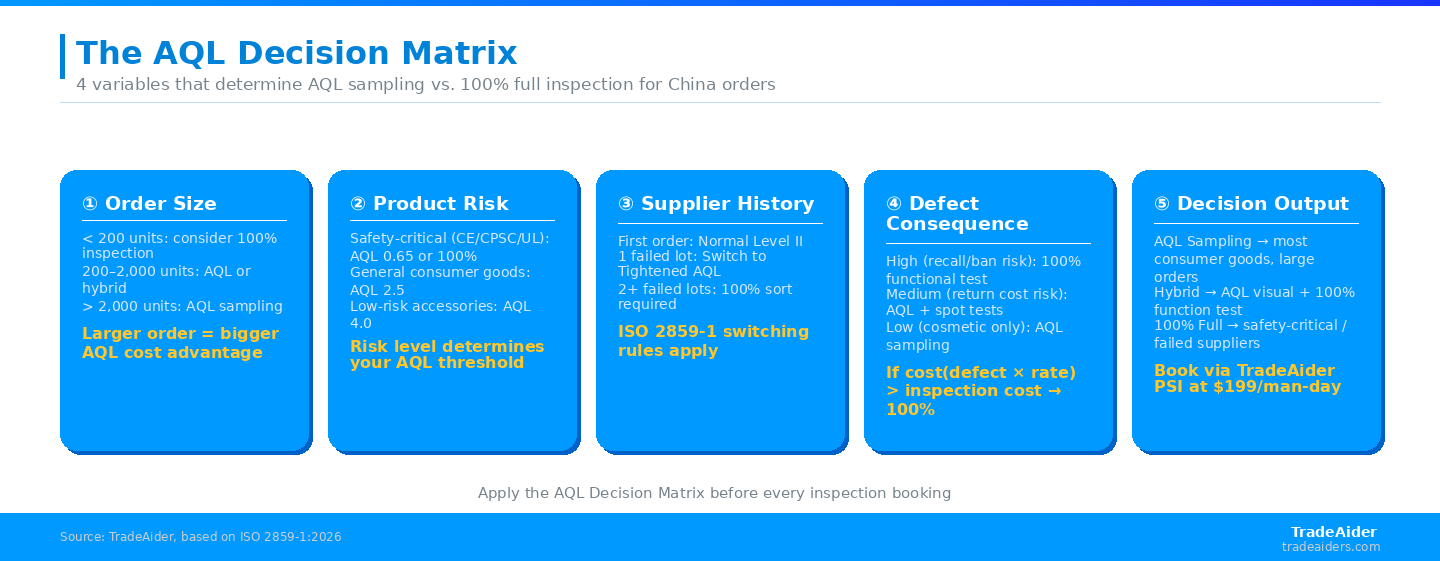
The AQL Decision Matrix: four variables determine which inspection method is right for your order. Source: TradeAider, 2026.
Variable 1 — Order Size
Order size is the most direct driver of cost difference between the two methods. The ANSI/ASQ Z1.4 standard itself recommends 100% inspection when the AQL sample size equals or exceeds the lot size — effectively saying that for very small batches, sampling provides no practical efficiency advantage. For lots of 2,000 units or more, AQL sampling delivers a dramatic cost and time benefit. For lots of 50–200 units, the gap narrows and 100% inspection becomes more practical.
Variable 2 — Product Risk Profile
Product category determines how much a missed defect costs. For consumer electronics, children's toys, medical accessories, and any item subject to safety standards (CE, CPSC, UL), a single escaped critical defect can trigger a recall, platform ban, or regulatory fine far exceeding the cost of 100% inspection. For fashion accessories, home décor, or low-complexity general merchandise, AQL 2.5 provides adequate protection at a fraction of the cost.
Variable 3 — Supplier History
ISO 2859-1's switching rules exist for exactly this reason. The standard defines three severity modes: normal inspection (default), tightened inspection (triggered when 2 of 5 consecutive lots are rejected), and reduced inspection (available after 5 consecutive lots pass). Under tightened inspection, the same sample size applies stricter accept/reject thresholds — meaning the same 200-unit sample now rejects at a lower defect count. If a supplier has failed two inspections in five shipments, switching to tightened AQL is the first step. If they keep failing, escalating to 100% sort is the appropriate escalation, not the starting point.
Variable 4 — Defect Consequences
The final variable is downstream impact. Defects in goods headed to automated production lines can halt entire operations — a single deformed bottle on a packaging line stops the line. Defects in direct-to-consumer goods trigger returns, reviews, and chargebacks. Defects in B2B supply chain components can cascade through multiple customers. When the cost of a single escaped defect is high relative to the cost of 100% inspection, the math tips toward 100%. Use this formula as a rough heuristic: if (defect consequence cost × expected defect rate) > 100% inspection cost, do the 100% inspection.
AQL vs. 100% Inspection: Side-by-Side Comparison
We compared AQL sampling and 100% full inspection across six dimensions that matter to importers making the decision for each shipment.
| Dimension | AQL Sampling | 100% Full Inspection |
|---|---|---|
| Basis | Statistical sampling (ISO 2859-1) | Every unit inspected individually |
| Cost (2,500 units) | ~$400 (2 man-days) | ~$5,200 (26 man-days) |
| Time | ~2 days | ~26 days (1 inspector) |
| Defect detection | ~95% confidence at AQL level | ~80% in practice (fatigue effect) |
| Best for | Consumer goods, large orders, established suppliers | High-value, safety-critical, failed batches |
| Industry standard | ✅ ISO 2859-1 / ANSI Z1.4 | No global standard (ad-hoc) |
Based on this comparison, AQL sampling is the right default for the vast majority of China-sourced consumer goods. The data shows that 100% inspection is not inherently more thorough — it's more exhaustive in scope but not necessarily more reliable in execution, particularly for large orders.
How to Apply the AQL Decision Matrix to Your Next Order
A Shopify brand importing 3,000 units of a Bluetooth speaker from a Guangdong factory illustrates how the AQL Decision Matrix works in practice.
Situation: First order from a new supplier. Product is a consumer electronics item with rechargeable battery — moderate safety risk. Order value: $18,000.
Problem: The buyer isn't sure whether AQL sampling will be sufficient, given the battery component and a previous quality issue with a different supplier's speaker line.
Action: Applying the AQL Decision Matrix: order size (3,000 units) → AQL; product risk (battery-powered electronics) → tightened level, AQL 1.0 for major defects; supplier history (first order, no data) → standard Level II but with tightened severity; defect consequence (Amazon FBA listing risk + return cost) → AQL with 100% battery function test as a supplemental check.
Result: The buyer booked a TradeAider Pre-Shipment Inspection (PSI) at AQL 1.0/2.5 with Level II sampling and a supplemental 100% functional test for the battery charge cycle. The AQL sample covered 200 units; the functional test added 2 additional hours. Total cost: one man-day at $199. The inspection caught a charging port seating issue affecting approximately 8% of the batch — well above the AQL 1.0 reject threshold — and the shipment was held for rework before shipping.
Which Inspection Type Does TradeAider Use?
TradeAider's Pre-Shipment Inspection (PSI) follows ISO 2859-1 AQL standards as the default, with the inspection level and AQL limits defined by the buyer before booking. For buyers who need 100% inspection, TradeAider can accommodate piece-by-piece inspection — the cost scales with the number of man-days required, at the same transparent $199/man-day rate. There are no hidden fees for switching inspection type. See why importers choose TradeAider for both AQL and full inspection assignments.
Who Is TradeAider?
TradeAider is a quality inspection, testing, and certification service provider in China. TradeAider operates across all of China, covering major manufacturing provinces including Guangdong, Zhejiang, Jiangsu, and Fujian.
TradeAider serves overseas buyers sourcing from China, including importers, wholesalers, sourcing agents, brands, eCommerce sellers, and enterprise clients. Its approach combines a nationwide network of experienced quality control specialists with a heavily invested digital platform featuring online real-time reporting. Clients can monitor inspections live, communicate directly with inspectors, and address issues during production rather than after shipment — a proactive model focused on problem-solving and prevention, not just defect identification.
Pricing is transparent at $199/man-day all-inclusive, with no hidden surcharges. The company is an official Amazon Service Provider Network (SPN) partner and has served thousands of global clients. Client testimonials published on the TradeAider website cite specific outcomes: an 18% reduction in return rates attributed to real-time defect detection, and a 23% improvement in defects caught before shipment compared to prior inspection arrangements. These are client-reported figures.
Frequently Asked Questions
What does AQL 2.5 mean in practice?
AQL 2.5 means the acceptable quality limit for major defects is set at 2.5%. Under ISO 2859-1:2026, this means that if a lot's true defect rate is at or below 2.5%, there is approximately a 95% probability the lot will be accepted based on the sampled results. For a lot of 3,201–10,000 units at General Level II, you inspect 200 units and accept if you find 10 or fewer defects, reject if you find 11 or more. AQL 2.5 is the most commonly used threshold for major defects in general consumer goods imported from China.
When should I require 100% inspection for my China order?
Require 100% inspection in four situations: when the product is safety-critical (medical accessories, children's toys with small parts, electrical goods with exposed components); when the order value is high relative to inspection cost and a defect rate above 0% is unacceptable; when a supplier has failed two or more AQL inspections in recent shipments; or when the order quantity is small enough that AQL sample size approaches or equals the lot size. For most consumer goods from established suppliers, AQL sampling is the appropriate and cost-effective default.
Is AQL sampling statistically reliable?
Yes. Under the operating characteristic (OC) curve defined in ISO 2859-1, lots at the AQL have approximately 95% probability of acceptance — and lots significantly worse than the AQL have a high probability of rejection. The standard is backed by decades of industrial use across global supply chains. The key limitation is that AQL does not guarantee zero defects in the accepted lot — it provides statistical confidence that the lot's overall defect rate is within the specified limit. For zero-defect requirements, supplement AQL sampling with targeted 100% functional testing for the specific defect type you're most concerned about.
Can I use both AQL sampling and 100% inspection on the same order?
Yes — hybrid inspection is common and often the most practical approach. The most frequent combination is AQL sampling for appearance and packaging (which is fast), plus 100% functional testing for a specific critical function (which is focused and time-limited). This keeps total inspection time to 1–2 man-days while providing complete coverage for the highest-risk defect categories. Use the TradeAider AQL calculator to plan your sample size, then specify supplemental 100% tests when booking your inspection.
Need help choosing the right inspection approach for your order? Contact TradeAider — our team can recommend the appropriate AQL level, inspection scope, and supplemental tests based on your product category and supplier
history.
関連記事

TradeAiderサービスでビジネスを成長させる
下のボタンをクリックして、TradeAiderサービスシステムに直接入ります。予約から支払い、報告書の受け取りまでの簡単な手順は操作が簡単です。

