
- 会社概要

- 当社のサービス
- あなたの業界
- リソース
- ニュース&ブログ
ASTM, ISO, and EN standards do not compete as interchangeable acronyms; they answer different market, product, and evidence questions. The correct standard starts with destination market and product category, then moves to legal requirement, buyer contract, test method, label evidence, and inspection release check.
For a China-sourced product sold into both the US and EU, one physical SKU can need two evidence files before shipment. Two markets multiplied by three evidence layers creates six places where a buyer can discover the wrong standard too late.
Importers often ask the factory, "Can you meet ASTM, ISO, or EN?" That question is too broad. The useful question is: Which standard supports the market where this product will be sold, the product category being claimed, and the evidence the buyer needs before payment or shipment?
- ASTM: Often used for US-facing product safety or performance standards, especially when a specific ASTM method is required by law, buyer contract, or retailer policy.
- ISO: Often used for international management systems, sampling methods, or product-specific international standards.
- EN: Often used for European standards and harmonised routes under EU product rules.
- Release gate: A PSI is conducted when 100% of the order quantity is completed and at least 80% is packed for export.
The Direct Answer
Use ASTM when the US buyer, regulator, or product category points to an ASTM method; use ISO when the international standard or management system is the evidence route; use EN when the product is entering the EU and a European standard or harmonised route applies.
For TradeAider inspection planning, the standard family matters because the inspection scope has to verify whether the shipment matches the evidence package, not whether ASTM, ISO, or EN sounds more authoritative in a supplier quotation.
The buyer should not treat a factory's existing test report as proof until the report is matched to the destination market, product model, production version, label, and claim. A supplier may have an ISO 9001 certificate and still lack the product test evidence needed for a toy. A supplier may show an ASTM report for one version while the EU order needs EN evidence for another market. The standard name is only useful after the buyer knows what decision the evidence must support.
According to ISO's standards overview, ISO publishes international standards across many fields. According to ISO 9001 quality management guidance, quality management focuses on controlled processes and evidence-based decisions. The so what for importers is that "ISO certified factory" is not the same as "this product has the right test evidence." Factory capability and product compliance are related, but they are not the same proof.
ASTM vs ISO vs EN Standards Reference Table
The reference table should be read from buyer decision to evidence type, not from acronym to paperwork.
| Standard Family | Common Buyer Question | Best Evidence Use | Importer Release Rule |
|---|---|---|---|
| ASTM | Does this product meet a US-recognized product safety or performance method? | Product test report tied to model and claim | Verify report, label, sample, and shipment version match |
| ISO | Does the supplier or method follow an international system or sampling route? | Management system, test method, sampling, or product-specific standard | Do not confuse factory certificate with product compliance evidence |
| EN | Does this product need European standard evidence for EU sale? | European product standard, harmonised standard, or CE-route evidence | Match EU evidence to product, label, declaration, and destination market |
| Buyer contract | Did the buyer or retailer specify a standard beyond law? | Purchase order, spec sheet, inspection checklist | Freeze the standard before mass production starts |
| Factory claim | Is the supplier using the right standard for this SKU? | Report scope, date, model, sample, and issuing body | Reject evidence that belongs to a different model or market |
The comparison reveals that standards should not be selected by name recognition. ASTM, ISO, and EN can all matter, but each one supports a different evidence path. A buyer who asks only for "ISO" may receive a factory certificate that does nothing for product-level compliance. A buyer who asks only for "ASTM" may miss an EU harmonised standard needed for a European launch.
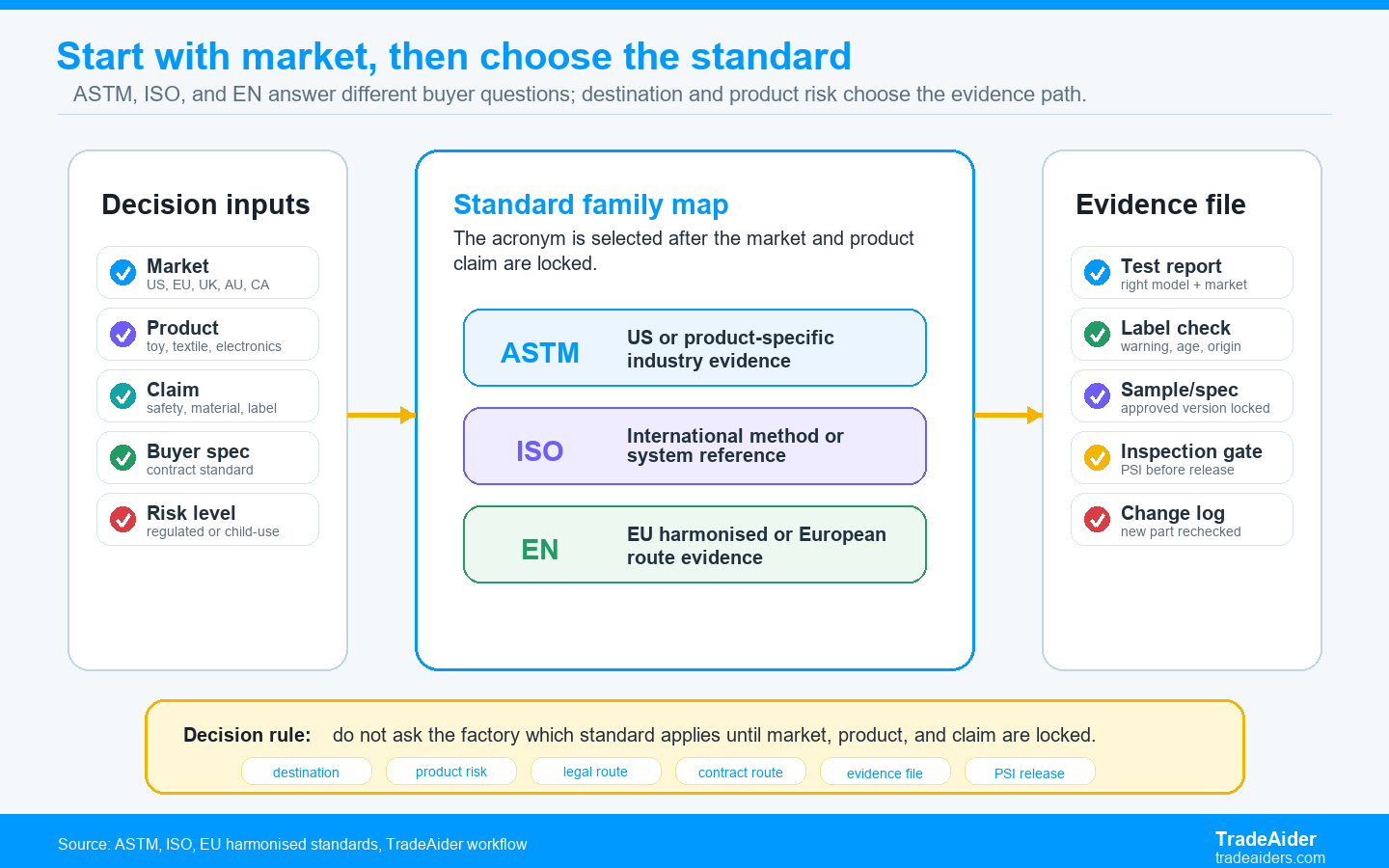
Choose the standard after locking market destination, product category, and evidence use.
How the Three Standard Families Create Different Risks
The risk is not choosing the wrong acronym; the risk is using the wrong evidence to make a shipment decision.
According to ISO 2859-1 sampling procedures, sampling inspection is tied to defined lot and acceptance rules. According to ASQ Z1.4 sampling resources, attribute sampling supports acceptance decisions. These sources explain why product standards and inspection standards must work together: a test report may support compliance evidence, while sampling and inspection support release evidence for the actual lot.
ASTM risk appears when the report does not match the US product claim
ASTM standards often matter when a US buyer, regulator, retailer, or product category references a specific ASTM method. According to ASTM F963 information, ASTM F963 is a consumer safety specification for toys. According to CPSC toy safety business guidance, toy safety compliance is product-specific. The buyer should therefore check report scope, product name, age grade, material, color, model number, production date, and label. A factory report for one toy version does not automatically support a new accessory, new coating, new age grading, or new packaging claim. The risk is highest when the US listing promise changes after testing, because the old report may describe a narrower or safer configuration than the one the buyer now plans to sell.
ISO risk appears when buyers mistake system evidence for product evidence
ISO evidence can be valuable, but it must answer the right question. ISO 9001 can indicate that a factory has a quality management system, yet it does not prove that a particular product meets a safety, chemical, electrical, or labeling requirement. ISO 2859-1 can support sampling inspection logic, yet it does not define whether a toy, electronic device, or textile is legally compliant. The buyer should ask whether the ISO reference is a factory-system credential, a test method, a sampling method, or a product-specific requirement. If the answer is unclear, the evidence is not ready for release.
EN risk appears when EU market evidence is treated as optional
EN standards matter when the product is being sold into the European market and a European standard route applies. According to the European Commission toy safety harmonised standards page, toy safety has harmonised standard references in the EU context. According to the European Commission CE marking page, CE marking is tied to conformity with applicable EU legislation. This means the buyer needs to connect the EN evidence to the EU product claim, declaration route, label, packaging, and technical file. A US-facing report may be useful context, but it is not automatically EU-ready evidence.
How to Choose the Right Standard Before Ordering
Choose the standard after locking the market, product category, claim, and evidence decision.
The buyer should build the standards question in a sequence. First, define destination market. Second, define product category and intended user. Third, list product claims and customer-visible promises. Fourth, identify legal, marketplace, retailer, and buyer-contract requirements. Fifth, request reports and samples that match the actual model. Sixth, add inspection checks that confirm the shipped product matches the evidence file.
Start with destination market before asking the factory
Destination market decides which evidence path matters first. A US order may need ASTM evidence for a toy, FCC evidence for a wireless device, or other US category evidence. An EU order may need EN evidence, CE marking route, RoHS evidence, or other EU documentation. If a buyer asks the factory for "international standards" before naming the market, the factory may send whatever report is easiest to find. The practical rule is to write the destination market and sales channel on the standards request, because the same physical SKU can carry different evidence duties in different markets.
Match evidence to the exact production version
Reports and certificates should be matched to the exact SKU being ordered. The buyer should check model number, material, color, size, age grade, component version, label artwork, packaging, factory name, production date, and report scope. If the factory changes material after testing, the old report may no longer support the new product. If the supplier sends a report for a similar model, the buyer should treat it as a lead, not proof. A standards file protects the shipment only when the file describes what the factory actually packs. In practice, the buyer should reject evidence that cannot be traced back to the approved sample, current production specification, and exact market version on the carton.
Use inspection to confirm the evidence reached the lot
TradeAider's Pre-Shipment Inspection cannot replace testing or legal review, but it can verify that the finished lot matches the evidence package. The inspector can check model number, label, packaging, barcode, warning text, origin mark, manual, accessories, and visible compliance marks against the approved documents. A PSI is conducted when 100% of the order quantity is completed and at least 80% is packed for export, which makes it useful for catching final packaging and version-control errors. The original scenario is simple: 2 markets x 3 evidence layers equals 6 pre-shipment checks. The limitation is that those checks do not decide the law; they confirm whether the physical shipment matches the evidence the buyer intends to rely on. If the lot contains two label versions or two accessory sets, the standards file may be correct for only part of the shipment, so release should wait until the factory sorts by version and quantity.
SPAR Scenario: The Wrong Standard Was Found After Cartons Were Printed
The cheapest time to choose the standard is before labels, cartons, and test samples are locked.
Situation: A US importer orders 4,800 children's storage boxes from a factory in Zhejiang. The first sales plan is for the US, but a distributor later asks for an EU version. The factory says it has "ISO documents" and a prior test report.
Problem: The report belongs to an older product size, the ISO certificate is a factory quality certificate, and the EU packaging needs different standard evidence and label review. The cartons have already been printed for the US launch.
Action: The buyer separates the US and EU evidence files, requests a current product test scope, freezes the label artwork, and uses PSI to check carton version, warning label, barcode, and model number before release.
Result: The shipment loses 7 days and 1,200 cartons are reprinted. The trade-off is still better than mixing US and EU evidence in one shipment. The remaining limitation is that the buyer must now maintain two market-specific evidence files for the same base SKU.
Standard Selection Checklist
The standard file is ready only when market, product, evidence, and shipment version point to the same SKU.
- Write the destination market and sales channel before asking the factory for reports.
- Identify whether the standard is legal, contractual, retailer-driven, or inspection-related.
- Match report scope to model number, material, label, packaging, and production version.
- Use TradeAider product testing support when the evidence file is missing or outdated.
- Use inspection to verify that the packed lot matches the approved standard evidence before shipment.
If your standards decision is still split between ASTM, ISO, and EN evidence, send TradeAider the destination market, PO, approved sample notes, current test reports, and packing status. The next step is to ask TradeAider to map the standard evidence into a shipment-release checklist so the factory knows which labels, warnings, barcodes, manuals, and packed-carton details must be verified before release.
Frequently Asked Questions
Is ASTM the same as ISO?
No. ASTM and ISO are different standard organizations and standards families. The right choice depends on product category, destination market, buyer contract, and evidence need.
Do EN standards apply only in Europe?
EN standards are European standards and are most relevant when the product is being placed on the European market or when a buyer contract specifically requires them.
Can inspection prove ASTM, ISO, or EN compliance?
No. Inspection cannot replace testing, certification, or legal review. It can verify that the product, label, packaging, and shipment version match the evidence file the buyer plans to rely on.
関連記事



TradeAiderサービスでビジネスを成長させる
下のボタンをクリックして、TradeAiderサービスシステムに直接入ります。予約から支払い、報告書の受け取りまでの簡単な手順は操作が簡単です。

