
- 会社概要

- 当社のサービス
- あなたの業界
- リソース
- ニュース&ブログ
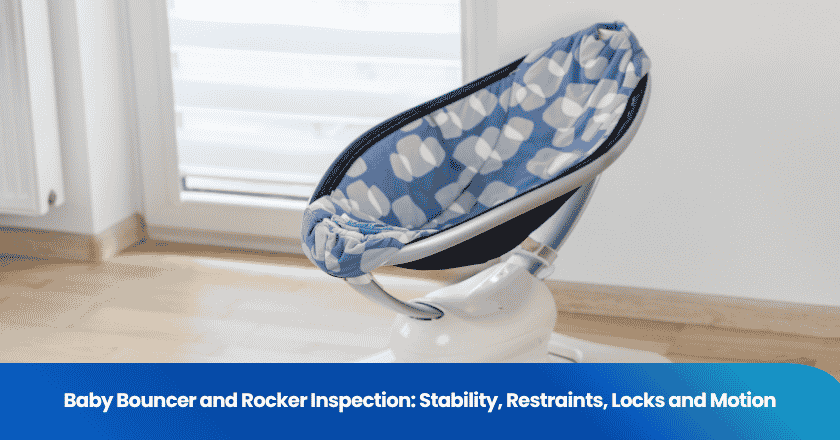
A reclined infant seat can rock smoothly, keep its buckle fastened by hand and click its fold lock shut, and still fail a forward stability load, an anchorage pull or a lock check once a child is sitting in it. A baby bouncer and rocker inspection therefore focuses on four measured records — stability in every direction, restraint anchorage retention, the folding or locking mechanism, and the motion and interference path — alongside the complete applicable compliance file, rather than on how the seat feels during a demonstration.
The first decision is not a check at all. Regulators classify these seats by how the product moves relative to the floor, so the same reclined shell changes rule the moment the base stops moving in its entirety, and the check set, the occupant weight limit and the evidence owner all follow from that classification.
Three Decisions That Set Up the Whole Inspection
- Classify the seat by how the base and the whole product move before booking a single test, because the classification fixes the rule, the weight limit and who has to produce the result.
- Treat a smooth rock, a hand-held buckle and a lock that clicks as screening signals, and record the load, the hold time and the test position for each of the four checks instead.
- Hold the affected group on any stability, anchorage or lock finding, and re-verify the corrected units against the condition the rework was meant to fix.
Start by Classifying the Seat, Not by Its Name
Classification is the step that makes the rest of the plan meaningful. It decides which rule the file has to reference, which occupant weight limit is allowed, whether the result comes from the factory or from a laboratory, and which findings can hold the shipment. Get it wrong and the buyer either tests a rocker against a bouncer's checklist or files a certificate where a load result belongs, because the check set follows from the base.
The destination decides the framework. Where no product-specific rule covers the product, the General Product Safety Regulation (EU) 2023/988 lays down the essential rules for a consumer product placed or made available on the European Union market, and the child care standards currently cited in the Official Journal of the European Union are the reclined cradle standards EN 12790-1:2023 and EN 12790-2:2023, added to Annex I of Implementing Decision (EU) 2019/1698 by Commission Implementing Decision (EU) 2024/2406 of 12 September 2024, and both use the European reclined-cradle product classification; a US bouncer or rocker name does not determine whether a particular model falls within their scope. An EU buyer confirms the classification and the cited standard per destination rather than assuming the US rule travels with the product. Keeping the standard and the method apart is worth doing explicitly: TradeAider's inspection standard guidance follows ISO 2859-1 (ANSI/ASQC Z1.4-2003), sorts defects into the critical, major and minor classes, and puts the buyer's own acceptance criteria inside a published sample plan.
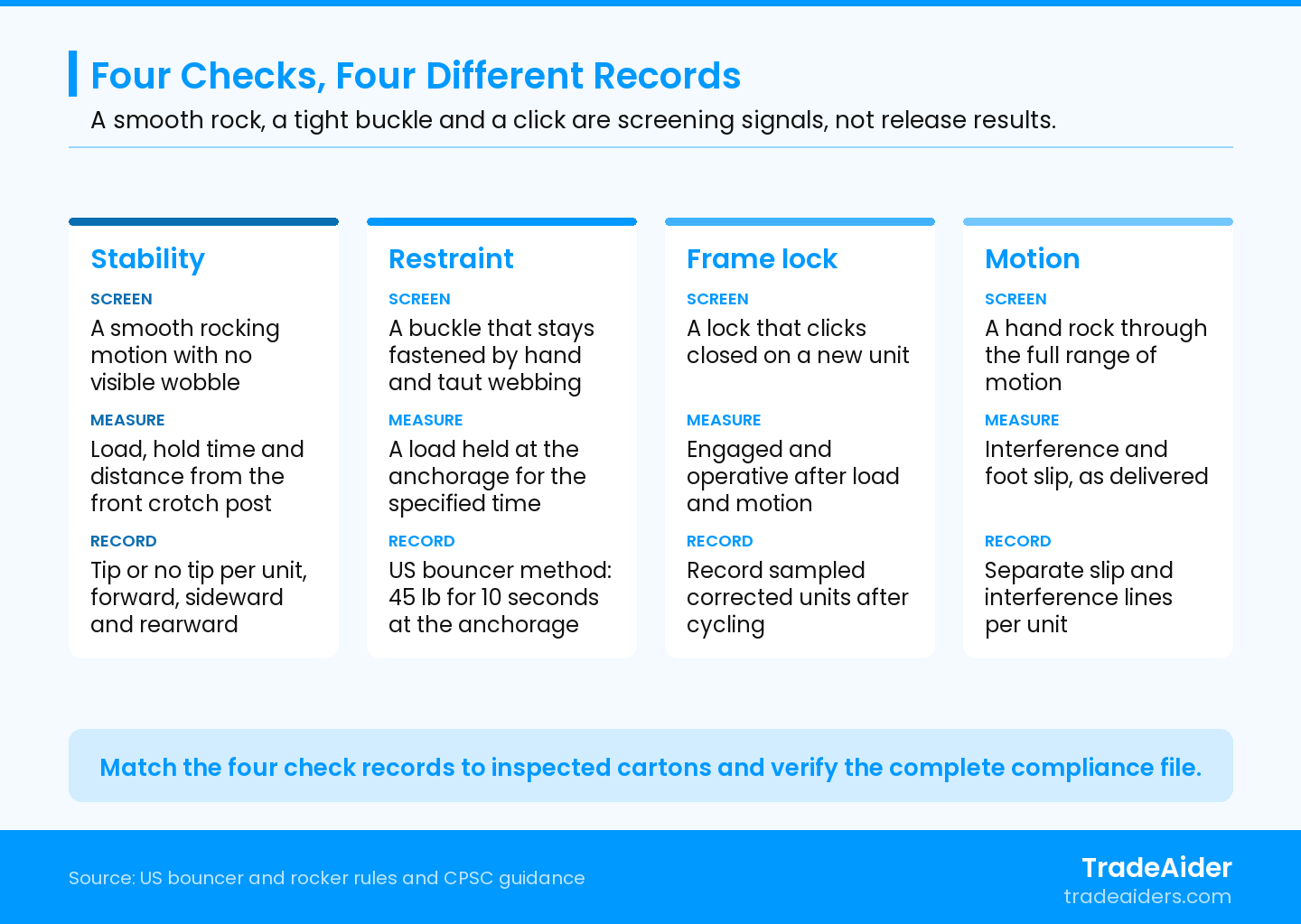
A smooth rock, a tight buckle and a lock that clicks are screening signals; the lot is released on the measured stability, anchorage, lock and motion records tied to the identified cartons.
How the Base Moves Decides the Category
An infant bouncer seat is a freestanding product intended to support an occupant in a reclined position to facilitate bouncing by the occupant, with the aid of a caregiver or by other means. The 2017 final rule initially adopted ASTM F2167-17; for products manufactured after December 19, 2022, the accepted mandatory edition is ASTM F2167-22. That is why a fixed base which moves up and down belongs in this class, and why a bouncer file has a mandatory rule behind it.
Rockers are reclined seated products that move in their entirety, most commonly on curved legs, while swings have a stationary base; CPSC also notes that some bouncer seats are advertised as rockers because they rock up and down, but that those products do not meet the rocker definition if the base is stationary, and that multi-mode items such as rockers which attach to a swing base are subject to both the swing and the rocker standard. No mandatory US standard currently exists for infant rockers, so the rocker file runs on a voluntary ASTM standard while the bouncer file runs on a mandatory rule. The same seat shell, on a different base, moves from one to the other.
Multi-Mode Seats Carry More Than One Rule
A multi-mode frame, meaning one product sold as more than one kind of seat, widens the obligation rather than choosing one side, and it also widens what the paperwork has to name, starting with the occupant weight limit for each mode. The proposed definitions cap an infant rocker at 20 lb and an infant/toddler rocker at 40 lb, and CPSC says it intends to refer to the July 2024 version of the voluntary standard if it proceeds to a final rule. Treat the file as the strictest applicable standard, keep the mode names on the cartons and the manual, and record which edition each mode was tested against, because that reference is still moving.
Restraint Retention Is an Anchorage Result, Not a Buckle Result
Restraint retention is a load path, not a fitting. The buyer needs to know that the load is carried through the restraint anchorages, which are the points where the restraint is fixed to the seat, so the record belongs at the anchorage rather than at the buckle, and a buckle that stays fastened under a firm hand pull, or webbing that looks taut, is a screening signal rather than the measured result in the delivered configuration. That distinction decides who produces the evidence: when assessing the team's role, review TradeAider's company background and confirm whether the anchorage test belongs to the agreed on-site scope or requires laboratory apparatus.
Both a Waist and a Crotch Restraint Must Be Fitted
The required configuration is two restraints, not one. ASTM F3084 is written for infants who cannot yet sit up unassisted and for toddler use to about two and a half years, and both infant rockers and infant/toddler rockers include a restraint system, with the requirement stated as both a waist restraint and a crotch restraint. A seat offered with an optional shoulder harness therefore does not close the requirement, so the inspection confirms on each sampled unit that both restraint types are present, adjustable and actually used, and records the slot and strap positions the caregiver would set.
The Anchorage Load and Hold Time
The published condition on the restraint anchorages is specific, and the same numbers appear on both sides of the classification even though their legal status is not the same. The restraint system anchors shall not separate from the attachment points when subjected to a force of 45 lb that is maintained for 10 seconds, and CPSC records that these requirements are identical to the restraint system test requirements for infant bouncers under 16 CFR part 1229. The bouncer side is mandatory in the United States; the identical rocker condition sits in the voluntary standard CPSC has proposed to adopt. The same numerical anchorage condition does not automatically make one test report applicable to both product types; the laboratory must confirm the tested configuration and scope, but the buyer states which status applies before releasing, and keeps a per-unit record of the load, the hold time, the attachment point and the outcome.
Stability Has to Be Answered in Every Direction
Forward stability asks whether the seat stays put when weight is pushed onto the front of it, closest to where a leaning occupant's mass sits. A stability result is a measured load rather than a general impression, so a seat that resists tipping forward has still not answered the sideward and rearward question, and the record keeps one line per direction, produced in the position the product is most likely to tip in rather than in its centered display position.
Forward Tipping and the Load Position
The test condition is tightening, and the record has to follow it. CPSC staff record that the bouncer forward stability test specifies that the static test load should be the manufacturer's recommended weight if it is greater than the 21 lbf test load, and that the force shall be applied one inch further from the front crotch post, and they recommend that infant rockers adopt the same more stringent test. Three fields belong in the record: the load used, the hold time and the distance from the front crotch post. The hold time is set by the edition in force, so the buyer takes it from the standard rather than from a factory checklist. Use the load and application point prescribed by the applicable standard, including the manufacturer's recommended weight where the method requires it. A buyer may request an additional engineering check, but cannot substitute its own load limit for the compliance method.
Sideward and Rearward Positions Carry Their Own Result
CPSC staff has identified multiple incidents of rockers tipping over with infants seated in the product. That is the reason a sideward or rearward result only means something in the position most likely to tip. The method the buyer writes into the brief is short: load the seat, place it in the product's most unfavorable sideward and rearward positions on the floor it will be used on, and record whether the base lifts for each unit and in which reclined position. A curved-leg rocker and a fixed-base bouncer tip in different conditions, so the same position on both products is not the same test.
Frame Locks and Folding Structure After the Load
A latching or locking device that prevents unintentional folding is one of the general requirements in the US bouncer rule, not a packing detail, and that requirement changes the order of the visit. A lock checked on a new unit before any load says nothing about the delivered product, because the mechanism is required to hold the seat in its use position through the loads the earlier checks apply. The lock therefore has to be re-confirmed as engaged and operative after loading, and again when the motion sequence is done, and the record adds the seat-to-frame hinge and the seat-mounting hardware, since those are the parts that carry the load into the base.
Motion, Interference and Slip Checks
A rocking motion check is one item in a longer chain. The US bouncer performance requirements, updated through the mandatory ASTM F2167-22 edition, run from restraints and stability through slip resistance, structural integrity, dynamic and static load, disassembly or collapse, a drop test, toy bar attachment integrity and battery compartments. A seat that moves well has still not been checked against the rest of the list, and a buyer who only ran the motion check has a demonstration rather than an inspection record.
Two of those items belong to the motion walk-through. Moving members are constructed so that they do not create a scissoring, shearing or pinching hazard when they rotate, slide, pivot or fold relative to one another, so the interference check runs through the delivered range of motion in the reclined positions the product is sold in. The rockers standard ASTM F3084 also excludes positions that recline to ten degrees or less above the horizontal and those intended primarily for sleeping. That is why the sleep wording on the label is not a cosmetic choice, and why the reclined angle a seat is sold in has to match the class the file treats it as. Slip resistance sits in the same list in its own right, so how far the feet move on the test surface belongs on its own line rather than inside the stability result. A base that tips and a base that slides are different findings with different consequences, and a seat checked only in the position it ships in misses the reclined setting a caregiver actually uses.
| Check family | Screening signal | Measured result | Evidence owner |
|---|---|---|---|
| Stability | A smooth rocking motion | Load, hold time and distance from the front crotch post, per direction | Laboratory result; factory record per unit |
| Restraint retention | A buckle that holds by hand | Anchorage load held for the specified time | Laboratory result; factory record per unit |
| Frame lock | A lock that clicks closed | Engagement and function after the load and motion sequence | Factory record per unit |
| Motion | A hand rock through the range | Interference and foot slip in the delivered configuration | Factory record per unit |
Read the table as a division of labor rather than a summary of the section, and treat the split between the first two rows and the last two as a planning convention the buyer confirms with the laboratory rather than as a published allocation. The first two rows are conditions where a measured result and a factory record have to agree; the last two are conditions the visit can produce on its own once the units are stable enough to load. A factory that records only the screening column has produced a demonstration, and the buyer cannot tell which of the four families is still open when the report arrives.
The visit itself has a readiness condition. A pre-shipment inspection is carried out when the order quantity is 100% complete and at least 80% packed for export, and that 80% threshold concerns packing rather than production completion. It matters here because the load and motion sequence needs finished, stable units and enough time to observe them, so an inspection planned before the sequence can run will only produce a partial record that the buyer has to complete later.
Warning, Weight and Tracking Evidence
The label states the conditions under which the previous checks are meant to hold, so it is checked on the unit rather than on the artwork file. Under ASTM F2167-17, warning text tells caregivers to stop using the bouncer when the baby starts trying to sit up or has reached the manufacturer's recommended maximum weight, not to exceed 20 lb, whichever comes first, and the fall hazard warning is placed on the front surface of the seat back so a seated caregiver sees it. A weight printed on the carton and a different weight printed on the product is a finding, not a typo.
The wording also changes with the accepted edition, which is what splits a lot in two. ASTM F2167-22 became the mandatory bouncer standard for products manufactured after December 19, 2022 and states that the product is not safe for sleep or unattended use. Artwork approved under an earlier edition therefore cannot be reused on a later run, and the suffocation warning text is checked against the edition in force for the run. The tracking label and the permanently affixed domestic manufacturer or importer information stay part of the children's product requirements in the United States, which is the record a buyer uses to find the affected lot when a recall is issued. The certificate closes the file differently: because bouncer seats are children's products, a CPSC-accepted third party conformity assessment body tests the samples while the manufacturer or importer issues the Children's Product Certificate, and that certificate states the product meets the applicable rules without carrying a stability, anchorage or lock result for the cartons in front of the inspector.
Which Findings Hold the Shipment
A stability, restraint anchorage or lock finding is a release condition in its own right. A passing workmanship sample does not close it, and a rework is re-verified against the condition it was meant to fix rather than against the observation that prompted it. The practical consequence is that the affected group stays on hold until each affected condition has a fresh result, that an unperformed check is reported as a coverage gap instead of a pass, and that a lot split across two production runs is decided twice rather than once.
The sample plan handles the rest of the lot. An acceptance sampling plan is indexed by an acceptance quality limit (AQL) and fixes the sample size and the accept and reject numbers for classified defects, and an AQL sampling calculator sizes that plan, while the buyer separately identifies safety-critical acceptance rules and laboratory methods. Functional attributes can also be sampled; a workmanship pass cannot override a safety-critical failure or an unperformed compliance test. The two decisions are made separately and reported separately, because a lot that passes the workmanship sample and fails a stability load is a hold, not a pass with a note.
Illustrative Example: One Order, Two Runs, Two Different Files
In an illustrative order of 8,000 reclined infant seats sold with both a bouncer mode and a rocker mode for the US market, built in two runs of 4,000, with a hinge pin change partway through the second run, the approved sample of 50 units from the revised-pin group rocked smoothly, the buckle stayed fastened by hand and the factory demonstration showed the fold lock clicking closed. The buyer had agreed a stability, restraint, lock and motion brief in advance.
On the most upright reclined position, which the bouncer rule covers, 3 of the 50 sampled units from the revised-pin group crept forward when the forward stability load was applied at the specified distance from the front crotch post. After the agreed motion cycling, the fold lock on 2 of those same 50 sampled units no longer stayed engaged and the seat-to-frame hinge showed play. The warning label on the first run's cartons carried the earlier sleep wording, while the second run's cartons carried the revised wording and the manufacturer's maximum recommended weight.
None of the three signals in the first paragraph would have separated the two runs; the measured results did. Because part of the second run used a revised hinge pin and the whole run used a different label, the buyer used verified hinge-pin and packing records to identify 1,200 changed-pin units, 2,800 unchanged-pin units in the second run and 4,000 units in the first run. The 1,200 units stayed on hold pending corrective work and repeat stability and lock checks. The other groups were eligible for separate release only after their own agreed inspection results and compliance records passed; matching label artwork alone did not establish physical conformity. The first run also required the warning correction to be verified on actual units. No defect rate for the 8,000 units was inferred from 50 sampled units.
The factory tightened the front-leg geometry and replaced the hinge pin, then re-ran the affected units through the same motion sequence. Fresh units from the corrected run repeated the forward stability load at the specified distance from the front crotch post and re-checked fold-lock engagement after the motion sequence, and the label correction was verified on actual corrected units against the required artwork and the edition in force for each run's date of manufacture. This is an illustrative example with 50 sampled units: it is not an AQL sample size, not a measured defect rate, and not evidence about the units that were not sampled. The Children's Product Certificate and the third-party laboratory result are separate evidence owners that this scenario does not test.
What to Send to Scope a Bouncer and Rocker Inspection
Send the seat model, base movement, occupant weight limit, restraint and folding positions, destination markets, applicable standard edition, packing status and carton groups. Ask the team to confirm which of the four checks the visit can complete, which need a laboratory, and which report fields will record results, batch scope and excluded checks. contact TradeAider to scope your bouncer and rocker inspection.
Frequently Asked Questions
Are baby bouncers and rockers tested to the same rule?
No. Classify the actual base and motion before selecting the test program. A stationary-base bouncer and a whole-product rocker follow different US routes. Use the currently applicable mandatory bouncer edition and the selected current voluntary rocker edition; a proposed federal rocker rule may change future requirements.
Does a Children's Product Certificate close the bouncer inspection?
No; what makes a certificate useful to a buyer is not the certificate but what arrives with it, so ask the supplier for the CPSC-accepted third party conformity assessment body's report reference, the standard edition it was run against and the sample size behind it. A certificate with no traceable test report cannot be reconciled against a lot, and the certificate itself states only that the product meets the applicable rules.
Can the factory run the stability and anchorage tests?
It can record lot observations, but the formal result comes from testing by a qualified laboratory under the applicable standard, so the factory result is a screening record. Treat the split between laboratory results and factory records as a convention to confirm with the laboratory before the visit rather than as a published allocation, and write the agreement into the report format the buyer requires so the two are never merged.
How many units need the motion and lock checks?
Re-verify the corrected group under an agreed plan naming the method, sample allocation and acceptance rule. A buyer may additionally require a 100% lock-engagement screen where feasible. That screen does not replace the prescribed laboratory test or prove every other safety condition passed.
関連記事


TradeAiderサービスでビジネスを成長させる
下のボタンをクリックして、TradeAiderサービスシステムに直接入ります。予約から支払い、報告書の受け取りまでの簡単な手順は操作が簡単です。

