
- 会社概要

- 当社のサービス
- あなたの業界
- リソース
- ニュース&ブログ

A baby feeding bottle inspection should check the assembled bottle for leaks, measure its graduations, examine closure fit and component security, and verify the retail pack and export carton. Use finished units from the shipment, including different bottle sizes and component batches. The checklist below separates useful on-site checks from tests that need the applicable standard's equipment and conditioning.
Baby Feeding Bottle Inspection Checklist
Before sampling, identify the SKU, size, approved component list, destination market and production batches. Record the bottle body, teat and closure combination actually checked. Agree the method, number of units and acceptance rule for each test rather than treating the workmanship sample size as suitable for every purpose.
| Check | Inspection action | Acceptance basis | Fill in the result |
|---|---|---|---|
| Graduations | Measure the volume at selected marked levels, covering relevant sizes and print or mold versions. | Applicable EN 14350 requirements or specified market/product criteria. | Marked volume: ___; measured volume: ___; deviation: ___ |
| Closure fit | Assemble the teat, ring, cap and disc where supplied; examine thread start, engagement and seating. | Approved design and assembly instructions; specified torque where applicable. | Combination: ___; fit defect: ___ |
| Leakage | Fill and assemble as specified; run the agreed orientation and dwell observation; inspect body and closure. | Agreed fill, temperature, duration and rejection rule. | Fill/time: ___; orientation: ___; leak location: ___ |
| Component retention | Apply the relevant security or mechanical method, with required sample preparation. | Applicable force, direction, conditioning and separation criteria. | Component/method: ___; result: ___ |
| Small parts and disc size | Assess the components covered by the selected standard using the prescribed gauge and method. | Relevant market rule and product scope; sealing disc requirements where supplied. | Component: ___; size/gauge outcome: ___ |
| Retail pack and carton | Count listed components; compare artwork and identifiers; inspect packing and agreed transit-test results. | Approved pack list, artwork, destination requirements and packaging test plan. | Carton: ___; missing/damaged item: ___; discrepancy: ___ |
Assemble the Closure Before Checking for Leaks
Check thread engagement and component seating
Start the locking ring squarely and check that it turns without jumping, cross-threading or stripping. Compare engagement and the assembled position with the approved design. Confirm that the teat and any sealing disc sit correctly, without trapped edges or distortion. Apply a torque requirement only where the specification or applicable method provides one; do not compensate for poor fit by overtightening.
Examine bottle necks, threads and sealing surfaces for damage or molding defects. Also inspect the bottle body for cracks. A leak may come from either the closure or the body, so record the observed location before diagnosing a cause. A retention pull on the teat cannot replace a closure-fit check.
Use an agreed leak observation
Fill and close the bottle according to the agreed procedure, then hold it in the specified orientations for the specified time. An inverted-dwell check exposes some closure pathways to liquid; side positioning may reveal others. Record fill level, liquid temperature where relevant, orientation, dwell time, units tested and the location of any wetness. Include a body-leak observation rather than looking only around the ring.
A failed leak check is handled under the agreed acceptance rule for the affected product group. Do not rank leakage above component detachment or other safety findings without a basis in the risk assessment. The observation establishes leakage under those conditions; it does not establish performance under every pressure, temperature or transport condition.
Measure Graduation Accuracy
A graduation is the mark indicating the bottle's liquid volume. Under the cited EN 14350 requirements, the lowest numbered graduation must not be above 60 ml, and a graduation is required every 30 ml from 60 ml upward. Volumetric accuracy is ±5% at 100 ml and above, and ±5 ml below 100 ml. Confirm the applicable EN 14350 edition and method for the order.
For example, the ±5% band at 150 ml is 142.5–157.5 ml. A reading of 141 ml falls outside it; 143 ml falls inside. Do not apply a flat 5 ml allowance to the 150 ml line. Inspect the clarity and permanence of the marking as well as the delivered volume.
A practical volume-measurement setup
A published bottle-accuracy study filled bottles with deionized water and weighed the contents to 0.1 g at 25°C. The survey covered 91 bottle types across 28 brands purchased in Australia in 2013–2014: 88 hard-sided bottles and three liner systems. Among the 88 hard-sided bottles, 19 had at least one out-of-tolerance marking. Ten of 36 bottles claiming EN 14350 compliance were outside tolerance, and one 50 ml marking held 31.4 ml. This was a historical retail study, not a factory-batch defect rate.
For a gravimetric inspection, tare the empty bottle, place it on a level surface and read the meniscus consistently at the defined mark. Convert water mass to volume using the procedure's temperature and density basis. Keep the balance resolution, water temperature and reading position in the record. Follow the agreed standard method for a formal conformity result; the study's measurement setup is not a substitute for the complete current procedure.
Include relevant bottle sizes and graduation-tool or artwork revisions. The acceptance quality limit (AQL) sampling calculator can document the agreed attribute plan, but volume measurements still need an identified allocation and acceptance rule. A single accurate approved sample cannot show whether a later print or mold version is accurate.
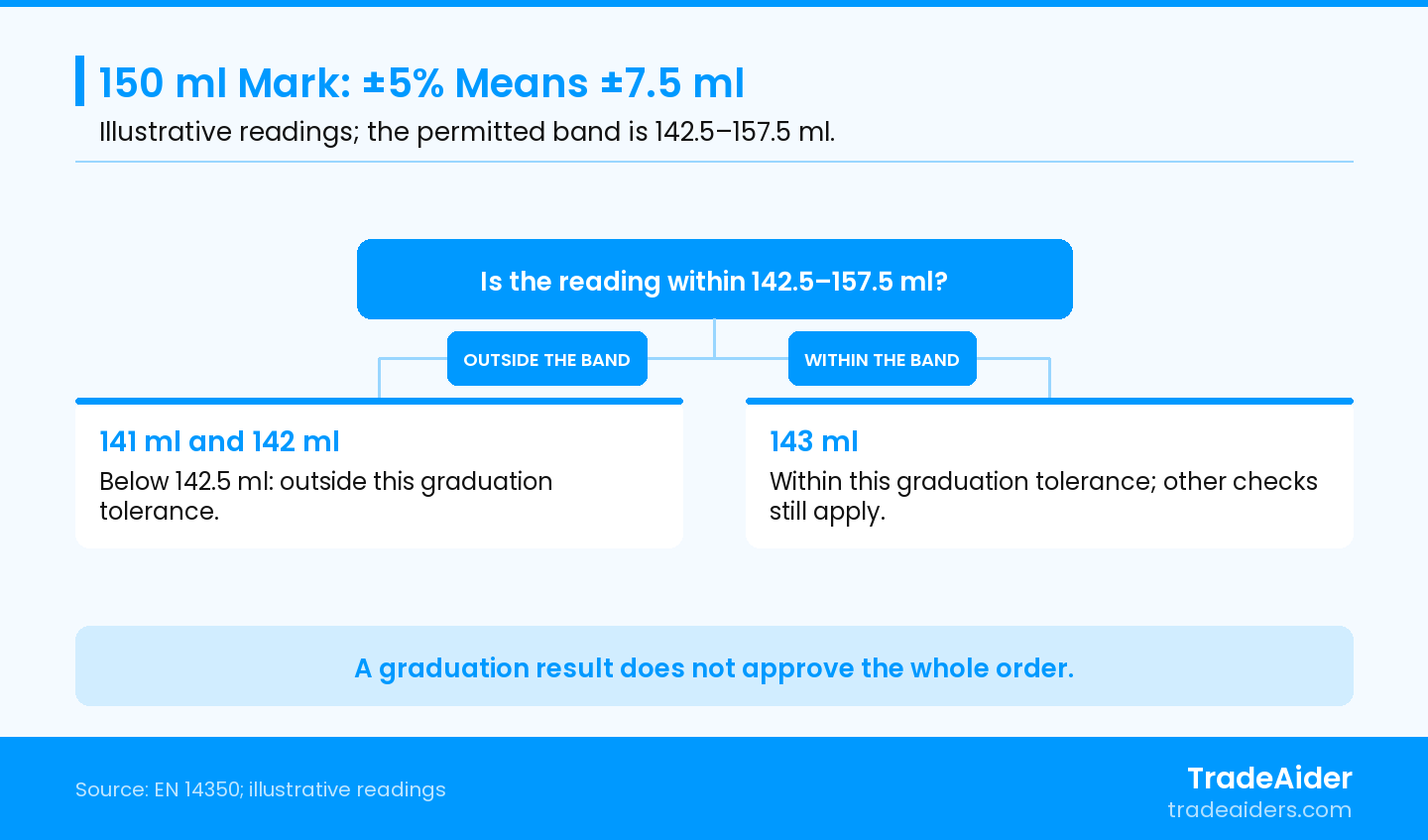
Use the tolerance at the mark being tested. These readings illustrate graduation decisions, not a shipment defect rate.
Check Retention and the Relevant Small-Parts Requirements
Check the teat and other components under the applicable assembled-use mechanical method. Record the component, sample preparation, force, direction and result. A ring or cap intentionally removable for cleaning is not automatically required to remain permanently attached; assess its applicable construction and small-parts requirements instead. Test a sealing disc only when the design includes one.
The cited EN 14350 construction provisions address parts designed to be removed for cleaning or separated after relevant mechanical testing. Covered parts must not fit entirely into the small-parts cylinder in any orientation, without compression; the sealing disc must be at least 35 mm in diameter. That is a diameter requirement, not a disc-thickness limit or proof of a particular leakage cause.
Use the prescribed conditioning and test sequence, including boiling or other preparation where applicable. Reserve the necessary samples and equipment before the visit. A hand pull on an unconditioned teat cannot establish conformity with a conditioned mechanical test.
Do not transfer one market's rule to another
The specified feeding, grooming and hygiene products are exempt from the US small-parts ban in 16 CFR part 1501. That exemption is not general safety clearance for a feeding bottle or detached teat. Assess other applicable requirements and the actual product construction.
The separate warning rule in 16 CFR 1500.19 applies to specified categories, including certain toys and games. A cylinder result alone does not establish a feeding-bottle labeling duty. Likewise, apply EN 14350 through the relevant product scope and agreed test program, alongside EU product-safety duties; do not treat a US exemption as permission to disregard that program.
Open Retail Packs and Inspect the Export Cartons
Count the components in sampled retail packs against the approved list. An assembled test sample may pass while another pack is missing a listed cap, ring or spare teat. Those are different sampled units, so check pack completeness explicitly. Compare the artwork revision, size designation, barcode, cleaning instructions and component description with the contents.
For EU-market orders, General Product Safety Regulation (GPSR) has applied since December 13, 2024. Relevant importer identification includes the name and postal and electronic address on the product or, where that is not possible, on packaging or an accompanying document. Check required destination-language instructions and safety information, noting the regulation's exception for products usable safely without them. Confirm the relevant responsible-operator and traceability requirements.
Check master-carton quantity, marks, dividers, inserts and protection of the bottle and closure. TradeAider schedules pre-shipment inspection when production is 100% complete and at least 80% packed for export; the 80% concerns packing. Select cartons across the identified product groups rather than inspecting only a convenient finished display sample.
Check packaging damage and the contents after a drop evaluation
ASTM D5276 covers free-fall drop testing of loaded containers and evaluation of protection provided by the container and inner packing. Agree conditioning, drop level, sequence and acceptance criteria for the shipment's packaging and route. This is a specified packaging evaluation, not a universal legal requirement or a guarantee against all transit damage.
After the agreed evaluation, inspect the carton, retail packs and contents for cracks, displaced components and other damage specified in the plan. If post-impact sealing matters, perform the corresponding leak observation. A carton-drop pass alone does not prove that a bottle still seals, and checking only whether its cap remains fitted misses other possible damage.
Keep component batches linked to carton identifiers
US law requires distinguishing tracking marks on children's products and their packaging to the extent practicable. The information in 15 U.S.C. 2063(a)(5) enables identification of production location, date and cohort, such as batch or run. Separately, as an inspection practice, maintain a packing crosswalk linking those identifiers and component batches to master-carton numbers. That recommendation does not mean every identifier must legally appear at all three packaging levels.
Example: Changed Threads and Reprinted Volume Marks
Illustrative example: 150 cartons, with a possible 40-carton affected group
In this hypothetical order, 6,000 bottles in two size variants are packed into 150 master cartons. During production, a replacement thread mold is introduced and the 150 ml and 210 ml marks are reprinted. Three sampled bottles at the 150 ml line measure 141 ml, 143 ml and 142 ml. With a 142.5 ml lower limit, the first and third fail; the second passes. Two of twenty bottles also leak at the closure during the agreed ten-minute inverted observation.
The buyer initially holds the potentially affected order because the factory cannot identify which cartons contain the changed components. Production, packing and segregation records subsequently establish that 40 cartons contain the changed version and reliably exclude the earlier 110. Without those records, the concern remains across all 150 cartons. A packing timestamp alone would be insufficient if components from both versions were mixed.
The supplier restores the approved construction and artwork, then repeats the relevant fit, leakage and graduation checks on identified corrected units. The earlier 110 cartons still need satisfactory results under their own inspection plan before any separate shipment decision. These illustrative numbers explain the reasoning, not client data, a universal test allocation or an order-wide defect estimate.
Specify the Plan Before the Inspection Visit
- Inspect the actual bottle, teat and closure combinations, then measure the relevant graduation marks.
- Set leakage and retention methods, sample allocations and acceptance rules before the visit.
- Use reliable component and carton records to identify affected goods after a production change.
TradeAider's inspection-standard guidance describes its default ANSI/ASQ Z1.4 sampling approach and adjustment to stated buyer requirements. Define defect classes, the unit of inspection and acceptance numbers before findings arrive. AQL indexes an attribute plan; it is not a maximum defect percentage permitted in every individual sample.
Send the SKU list, drawings, components, graduation criteria, assembly instructions, destination, test methods and packing schedule when you contact TradeAider to scope a feeding bottle inspection. Ask the team to confirm the on-site methods and any required laboratory work. The resulting report should identify the tested combinations, measured values and affected cartons so a specific defect can be corrected and checked again.
Frequently Asked Questions
Can an inspection replace an EN 14350 laboratory report?
No. Shipment inspection checks sampled finished goods against the agreed specification. An EN 14350 conformity assessment must follow its applicable preparation, conditioning, equipment and test methods. Confirm which methods can be performed during the visit and arrange the remaining laboratory tests. Keep the product construction and sample identification consistent between the two activities.
How many units should the leakage check cover?
Agree the allocation in the functional test plan, including coverage of bottle sizes, closures, teats and relevant production changes. Some checks can share the workmanship sample when the method permits; others need additional or separately conditioned units. State the number, procedure and rejection rule before the visit rather than choosing a convenient count afterward.
Does a leak identify the defective component?
It identifies where liquid was observed under the test conditions, which helps diagnosis but does not prove a root cause. Recheck assembly, thread condition, sealing surfaces and the bottle body. Compare relevant component combinations before changing the design. Keep a teat-retention failure separate from a closure leak so each receives the appropriate correction.
関連記事


TradeAiderサービスでビジネスを成長させる
下のボタンをクリックして、TradeAiderサービスシステムに直接入ります。予約から支払い、報告書の受け取りまでの簡単な手順は操作が簡単です。

