
- 会社概要

- 当社のサービス
- あなたの業界
- リソース
- ニュース&ブログ
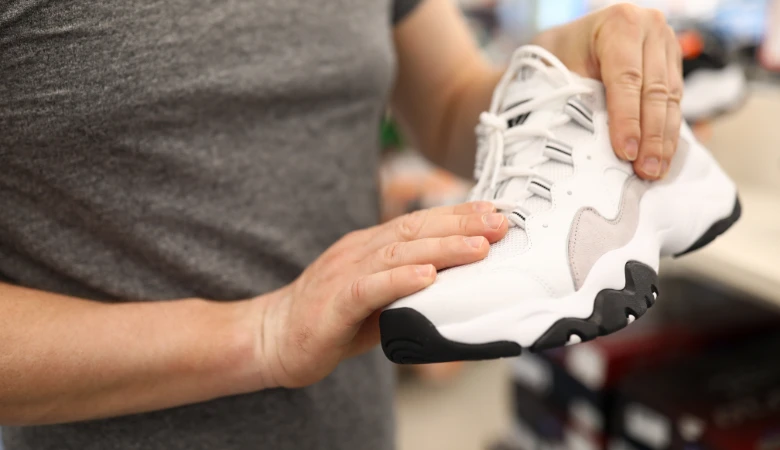
China shoe quality control becomes useful to an importer only when it answers a release question for the current shoes: what can ship, what must be held, and what records still need to be reconciled. A country label, factory certificate, or final appearance check cannot make that decision alone. The buyer needs a current set of product, test, market, and lot checks tied to the shipment.
The Useful Comparison: Evidence Layers, Not Country Labels
A factory location and a generic standard label cannot substitute for current, product-specific release evidence. China may set a relevant local safety baseline, while an importing buyer may also need a specific material record, performance result, market requirement, and lot decision. Treating any one of those as a complete verdict makes it easy for a documentation gap to hide behind a reassuring country or standard reference.
Release readiness requires matching evidence for the approved product, fit-for-use testing, destination-market controls, and the traceable lot. Here, release evidence means the records and checks a buyer uses to approve, hold, or reinspect a specific shipment. This is a practical four-layer rule, not a probability score or legal conclusion: if one layer describes a different shoe, a different market, or a different production population, hold the affected scope until the records align.
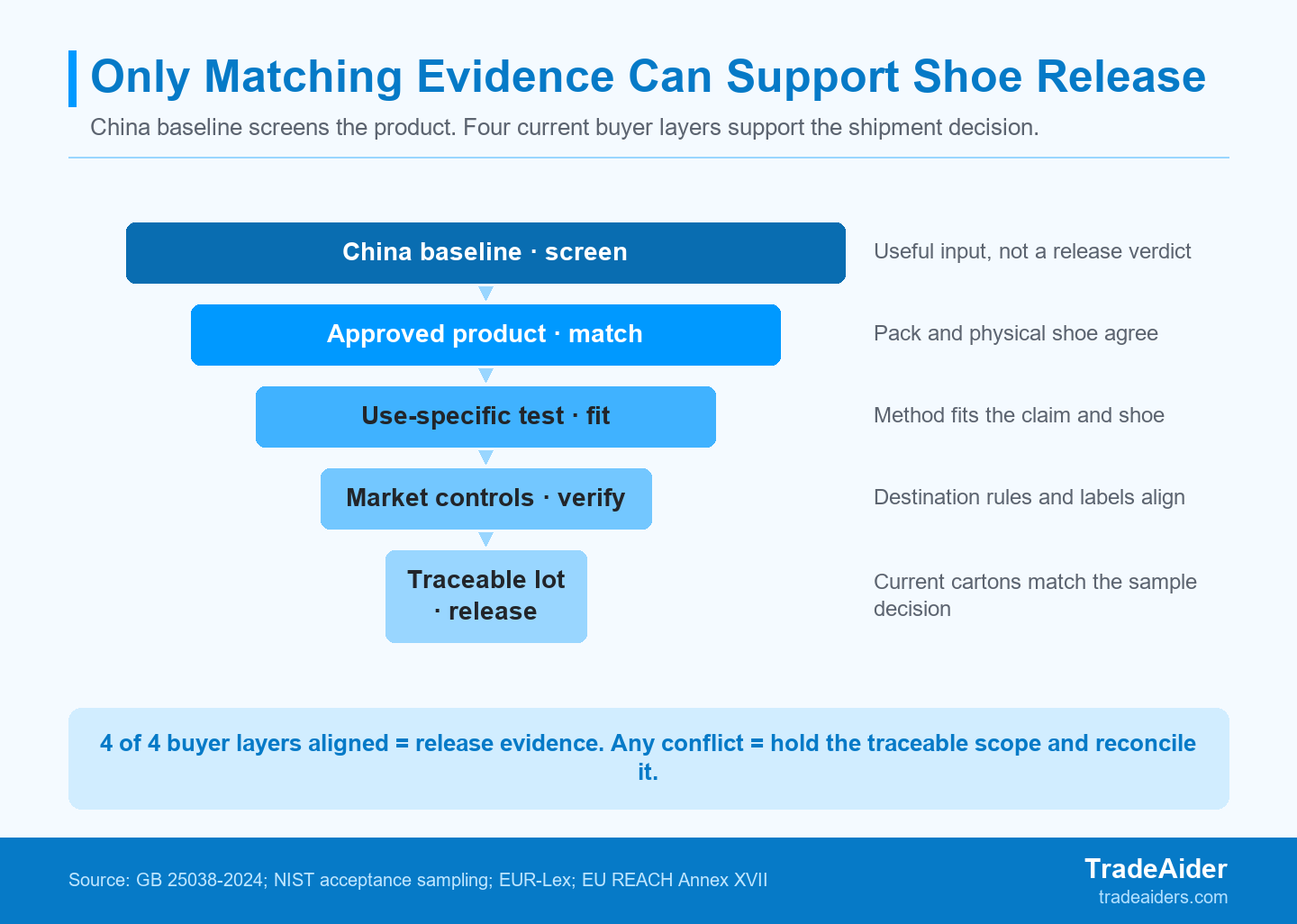
A China-market standard is one screening input. Release evidence is complete only when the product, test, selling-market controls, and traceable lot agree.
- Approved product: the physical shoe matches the current technical pack, approved component list, approved sample, and artwork.
- Fit-for-use test: the test method addresses the shoe's construction, intended use, and any performance claim being made.
- Destination-market controls: safety, material, label, and economic-operator requirements are checked for the selling market, not assumed from the factory location.
- Traceable lot: the inspection result belongs to the defined shoes, colorways, cartons, and production window being released.
That comparison is more useful than asking whether China is “good” or “bad” at shoe quality. It turns an abstract location comparison into a buyer-owned evidence map. A weak test result can be corrected without questioning an accurate material record; a correct material record can still fail if labels or market documentation describe another configuration; and a good sample result cannot safely release shoes outside the sampled lot.
Compare the Same Four Control Layers
China's official record lists GB 25038-2024 as a current mandatory standard for general footwear safety requirements, effective June 1, 2025. That gives a buyer a defined China-market safety input, but it does not by itself establish that a particular export shoe has the right material disclosure, use-specific test evidence, or destination-market documentation.
ISO identifies a process approach as a quality-management principle for managing related activities as a system. For footwear buying, the useful implication is not that a management-system label approves a shipment. It is that design approvals, material changes, test files, inspection findings, and release ownership need to connect instead of being reviewed as isolated documents.
| Control layer | China safety baseline asks | Global buyer expectation asks | Release evidence |
|---|---|---|---|
| Approved product | Does the footwear meet applicable baseline safety requirements? | Does the physical shoe match the approved construction, materials, fit, and artwork? | Approved sample, technical pack, bill of materials, revision control |
| Fit for intended use | Which safety-related properties are relevant to the product? | Does the planned test reflect the use, surface, materials, and claim of this shoe? | Test scope, method, sample identity, and result tied to the configuration |
| Selling-market controls | What is required for the applicable China-market baseline? | What safety, labelling, chemical, and operator duties apply where the shoe is sold? | Market review, label artwork, material support, and accountable party |
| Lot release | Is there a defined basis for evaluating the finished product? | Does the sampled result apply to the exact production and packing population being released? | Lot definition, sample plan, defect rules, packing status, and hold records |
From this comparison, the release decision should not be “China versus global.” It should be “do all four layers describe the same shoes?” Before the footwear brief is approved, review an inspection standard before the footwear brief is approved so the buyer, supplier, and inspector share defect definitions and acceptance criteria.
Start With the Product the Buyer Actually Approved
The technical pack and approved reference create the identity against which later footwear evidence is judged. The pack should identify the shoe construction, measurements, outsole, lining, upper materials, colourway details, label artwork, packaging, and current revision. A bill of materials is simply the approved list of materials and components used to make the shoe; it matters because a result for one lining, outsole compound, or adhesive system may not support another.
Ask the supplier to connect every later record to that identity. A test report should state the material or finished-shoe configuration tested. A factory change request should show which revision changed and which colorways are affected. An inspection sheet should identify the sample source and the defined lot. If those references are missing, a buyer may have several documents that look complete but cannot prove they apply to the same product.
Then Match Tests to the Shoe's Intended Use
SATRA TM92 assesses completed footwear under repeated flexing, with conditions determined by the type of footwear being tested. That makes the method useful when flex durability is a relevant failure mode, but it does not justify adding a flex test to every shoe without first considering construction, materials, use, and the buyer's claim.
ASTM F2913 measures whole-footwear slip performance against test surfaces under reproducible laboratory conditions. If a shoe is sold with a slip-related use claim, the buyer should confirm the relevant surface and performance expectation before selecting the method. A laboratory result is evidence for the tested conditions; it is not a blanket promise about every surface a wearer may encounter.
Build the test plan around the failure that would matter after sale. A casual sneaker may need a different priority than safety footwear, a children's shoe, or a fashion style with a delicate finish. A TradeAider product-testing brief should name the claim or risk, the relevant component or finished shoe, the required method or market rule, the sample identity, and the decision that the result will support. When the test scope is uncertain, use TradeAider's product testing service to plan the evidence before bulk release rather than waiting until packed shoes create a costly choice between delay and unsupported shipment.
Use AQL Sampling for a Lot Decision, Not a Country Score
NIST describes acceptance sampling as a sample-based decision to accept or reject a lot, not as an estimate of every unit's quality. That boundary is essential for an AQL inspection. The result can support an agreed release decision for the defined lot; it cannot prove that every uninspected pair is defect-free or turn a sample result into a national quality ranking.
Set the lot before the visit, not after a defect appears. Record the order number, colorway, size range, production dates, packing status, inspection level, AQL, defect classes, and any special checks. Then confirm that the inspection sample is drawn from the release population rather than from an early production sample or a carton selected for convenience. The more clearly the population is defined, the more precisely the buyer can hold, reinspect, or release a portion of the order.
Acceptance Quality Limit (AQL) is a pre-agreed sampling rule that decides whether a stated shipment meets the buyer's pass limit. It does not replace a specification. A low AQL cannot fix a missing material record, and a good AQL result cannot validate a label that describes the wrong lining. Once the lot, inspection level, and defect rules are agreed, use TradeAider's AQL calculator to check the sample-plan inputs and keep the final result tied to the same population.
Add Destination-Market Controls Before Release
EU GPSR guidance states that covered products on the EU market are subject to its obligations regardless of their place of production. A shoe made in China can therefore need an EU-market review even when the factory has already met an applicable local requirement. For the buyer, the decision point is the destination, product scope, and responsible economic operator—not an assumption that the manufacturing country resolves all market obligations.
EU footwear labelling rules address the upper, lining and sock, and outer sole, with a two-main-material rule when no material reaches 80%. Material disclosure is therefore not just artwork approval. A lining substitution, coating change, or outsole compound change can require the buyer to check whether the product record, label artwork, and supporting material information still match before cartons are closed.
The cited EU REACH Annex XVII restriction text identifies footwear among products within the scope of the listed restriction. This is a footwear-specific example, not a statement that every restriction applies to every shoe. The buyer should identify the relevant substance, article, destination, and threshold before treating a test file or supplier declaration as sufficient evidence.
The control sequence matters. Confirm market requirements while materials and labels can still be changed, then carry those requirements into the inspection brief. A late review may reveal a mismatch after labels are printed or a component is already packed, when the cost of sorting, relabelling, retesting, or holding stock is far higher.
Illustrative Scenario: When the Shoe and Its Records Disagree
A product-to-document conflict should trigger traceable containment and verification, not a superficial final pass. A correct-looking shoe cannot be released responsibly if the approved material record, test evidence, or label artwork identifies a different construction. The right response is to isolate only the demonstrated scope, reconcile the discrepancy, and verify the corrected evidence before the held population joins the release lot. Where the finding is discovered while the run can still be segregated, use During Production Inspection to verify the correction before packing spreads the risk.
Why Traceability Determines Whether a Split Release Is Safe
A narrow hold is defensible only when component, colorway, and packing records prove the affected scope. Consider an illustrative, not client-specific, order for a European private-label buyer: 4,800 casual leather-and-textile sneakers in two colorways from a China factory. Bulk assembly is complete, 80% of the pairs are packed, and export labels have been printed but not applied to every carton. The approved technical pack identifies a leather lining and a specified outsole compound for each colorway.
During a finished-goods check, one colorway is found with a microfiber lining while the approved bill of materials and label artwork still identify leather. Cut-date and colorway records identify the 2,400-pair run, but the available test file is not linked to the substituted lining. The issue is not resolved by an acceptable appearance sample: the physical shoe, material record, label, and test evidence no longer describe the same configuration.
The buyer holds the traceable colorway instead of automatically rejecting all 4,800 pairs. The factory separates the affected cartons, updates the material record, checks whether the label artwork is accurate for the substituted component, and obtains the evidence needed for that configuration before repacking the held scope.
A follow-up review checks the corrected product-to-document match, colorway segregation records, current cartons, and any applicable destination-market evidence before the held scope is released. The operational trade-off is a delay for the identified colorway, not necessarily the full order; that trade-off is defensible only because the records establish the boundary. This illustrative composite scenario does not set a universal material, test, or release rule. Actual requirements depend on the shoe, contract, and selling market.
Prepare a Release Packet Before You Book the Check
An inspection result is useful only when the approved product, test evidence, market requirements, and current lot status are available to interpret it. Send the inspection partner one decision-ready packet rather than a loose collection of product photos and purchase-order details. The packet lets the result answer whether the defined shoes can move, which scope must be held, and what must be corrected before a new release decision.
- The current technical pack, approved sample, bill of materials, measurement points, and revision history.
- Destination-market requirements, label artwork, material declarations, and the specific test evidence that applies to the current configuration.
- The lot definition: colorways, production dates, carton ranges, packing status, sample plan, AQL, and defect classifications.
- Escalation ownership: who can approve a change, who receives a hold notice, and what evidence is required before reinspection or release.
Choose the inspection stage that still gives the buyer room to act. A material or construction concern belongs before it becomes a packed-lot problem. A repeated production finding should be checked while the affected window can be separated. When footwear, labels, and packing records are substantially ready, schedule a pre-shipment inspection once the footwear lot and packing records are ready.
Before the visit, confirm which cartons belong to the release population and which remain outside it. Give the inspector the current packing list, carton marks, assortment ratio, product revision, and the physical location of held stock. State whether an unresolved issue requires a written hold notice, a rework check, a relabelling check, a new test result, or a full reinspection. The buyer should also set a cut-off: changes made after the inspection sample is selected must be declared and assessed before the result is used to release cartons. These details keep an otherwise sound inspection result from being applied to stock that changed after the evidence was collected.
If the evidence packet or inspection scope is unclear, contact TradeAider to confirm the evidence needed for your footwear inspection.
Frequently Asked Questions
Can an AQL inspection prove every pair is defect-free?
Not necessarily. An AQL inspection supports an accept-or-reject decision for the defined lot and agreed defect rules; it cannot establish that every uninspected pair has no defect. The buyer should use the result alongside a clear lot definition, specification, and traceability records. If a repeated issue is found, the next decision is whether the records identify a bounded production window or whether the uncertainty extends further.
Which footwear test should a buyer request first?
Start with the failure mode tied to the shoe's intended use, material construction, buyer claim, and destination-market requirement. A flexing method may matter for a shoe where repeated bending is a concern, while a slip-performance method needs the relevant footwear and surface context. Do not start from a generic test menu. First establish what failure would make the shoe unsuitable, what configuration is being tested, and which decision the result must support.
Can one colorway be held while another ships?
Yes, but only if production, component, and packing records prove that the released colorway is outside the affected scope. The buyer should be able to trace the substitution or defect to specified materials, dates, colorways, work orders, or cartons. Without that proof, a split release may merely move uncertainty from the held shoes into the released shipment. Verify the boundary before allowing cartons from either scope to be mixed.
Which documents should accompany a footwear inspection?
Provide the approved sample, technical pack, approved component list, relevant test evidence, market requirements, defect rules, and current packing status. Also identify the exact lot, colorways, carton ranges, production dates, and the decision-maker for holds or reinspection. These documents give the inspector a usable basis for comparing the physical shoe with the release requirements instead of returning a generic list of visual observations.

関連記事


TradeAiderサービスでビジネスを成長させる
下のボタンをクリックして、TradeAiderサービスシステムに直接入ります。予約から支払い、報告書の受け取りまでの簡単な手順は操作が簡単です。

