
- 会社概要

- 当社のサービス
- あなたの業界
- リソース
- ニュース&ブログ
Inspection methods for quality control in manufacturing work best when each method owns a different stage of risk: incoming inspection protects materials, first-piece and in-process inspection protect process setup and drift, SPC monitors measurable variation, AQL sampling supports lot release, final inspection verifies finished goods, and corrective action prevents repeat defects. A method list is useful only after the buyer knows where the defect can enter the process.
ISO 9001 treats quality as a managed system of requirements, process control, documented information, performance evaluation, and improvement. In manufacturing, that means inspection methods should not be isolated checks; they should sit inside a control path from incoming material to shipment release.
NIST process-control guidance explains that process control techniques compare process behavior against expected performance and make abnormal changes visible. That is the reason in-process inspection and SPC matter before final inspection.
For finished goods, ISO 2859-1:2026 provides AQL-indexed sampling schemes for lot-by-lot attribute inspection. That helps buyers make a release decision, but it does not replace upstream controls when defects can repeat through production.
ISO/IEC 17020:2026 emphasizes competent and consistent inspection bodies. Manufacturing QC depends on that consistency because incoming, in-process, and final inspection results must be comparable enough to guide action.
- Incoming inspection protects inputs: materials, components, documents, and supplier lots should be checked before they enter production.
- In-process inspection protects the process: first-piece approval, line checks, and SPC find drift while correction is still possible.
- Final inspection protects release: AQL sampling, labels, packing, quantity, and defect severity support ship or hold decisions.
- Corrective action closes the loop: inspection methods should feed root cause, rework, reinspection, and next-order controls.
Which Manufacturing Inspection Methods Matter Most?
The most important manufacturing inspection methods are incoming material inspection, first-piece or first-article approval, in-process inspection, statistical process control, visual inspection, dimensional measurement, functional testing, AQL sampling, final random inspection, packaging and label checks, loading supervision, and corrective-action verification.
The best method is not the most advanced one. It is the method that catches the defect at the point where the buyer or factory still has leverage. If the defect is a wrong material, incoming inspection matters. If the defect is machine drift, in-process monitoring matters. If the decision is whether finished goods can ship, final inspection matters.
This stage logic prevents final inspection from carrying every responsibility. A final report can show that a lot failed, but it may be too late to prevent the defect from spreading. Conversely, in-process checks can improve the line, but they cannot prove that the final packed shipment matches the buyer's release file.
The O*NET profile for inspectors, testers, sorters, samplers, and weighers lists tasks such as measuring products, inspecting for specifications, collecting samples, recording test data, and recommending corrective action. Manufacturing QC methods should turn those tasks into a coherent sequence.
Manufacturing QC Inspection Methods by Stage
Each method should answer a stage-specific control question.
| Stage | Best-Fit Methods | What They Prove | If They Fail |
|---|---|---|---|
| Incoming | Material inspection, COA review, dimensional checks | Inputs match PO and specification | Quarantine material or reject supplier lot |
| Setup | First-piece approval, tooling check, sample comparison | Line can produce conforming output | Stop setup and correct before mass run |
| In-process | Line inspection, SPC, defect concentration review | Process remains stable | Adjust process, sort affected output |
| Finished lot | AQL sampling, visual, measurement, function tests | Sampled goods meet release rule | Hold, sort, rework, test, or reinspect |
| Packaging | Label, barcode, carton, count, pallet checks | Shipment identity and protection are correct | Relabel, repack, or hold affected cartons |
| Corrective loop | Root-cause review, reinspection, trend tracking | Fix is verified and repeat risk reduced | Escalate supplier or change control plan |
Manufacturing inspection fails when these stages collapse into one final checklist. A buyer may receive a long final report but still not know whether the defect came from material, setup, process drift, packing, or inspection judgment.
The practical goal is traceability of evidence. Each method should leave enough proof for the next decision, whether that decision is to continue production, isolate a subgroup, release a lot, or change the next order's control plan.
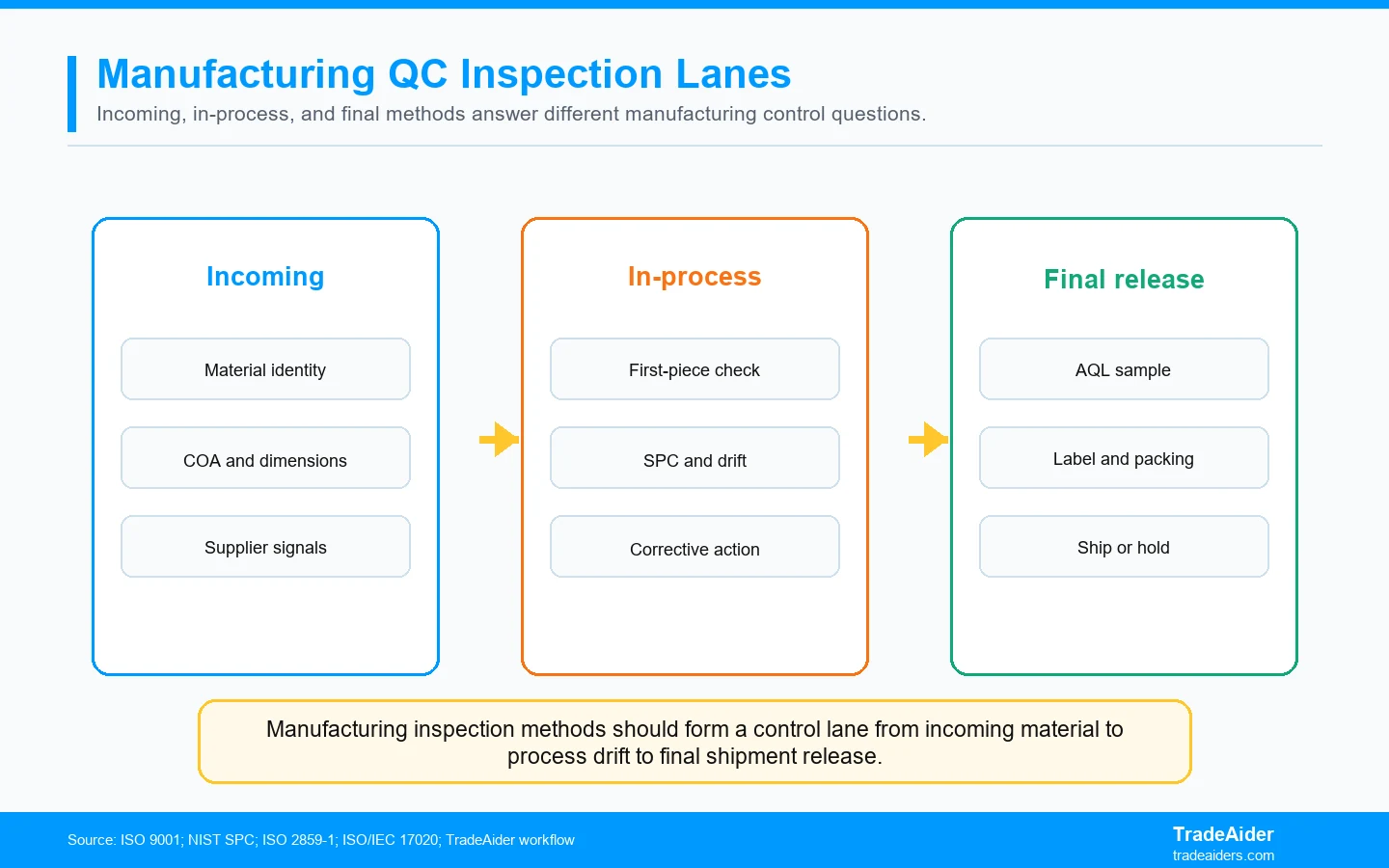
Manufacturing inspection methods should form a control lane from incoming material to process drift to final shipment release.
Manufacturing Inspection Methods Work Best as a Stage System
The method should sit where the defect mechanism enters or where the buyer must make a decision.
Incoming inspection protects the process from bad inputs
Incoming inspection checks materials, components, COAs, supplier lot numbers, packaging, dimensions, surface condition, and document identity before production uses them. It matters most when material variation can create defects that are expensive to trace later.
For example, wrong plating thickness, poor fabric shade, mixed fasteners, incorrect resin, or missing component certificates can all move downstream if incoming checks are weak. Once bad inputs are consumed, final inspection may find symptoms without clean root-cause evidence.
First-piece approval protects setup
First-piece or first-article checks compare the first acceptable output against the approved sample, drawing, tolerance, function, tooling setup, and label or packaging rule. This method is useful because many manufacturing defects begin as setup differences.
The buyer or inspector should record which version was approved, what was measured, who approved it, and what changed afterward. If the line changes material, tool, operator group, mold, fixture, label, or process setting, first-piece logic may need to repeat.
In-Process Methods Catch Drift Before It Becomes a Lot Failure
In-process inspection is valuable because it turns defect discovery into correction while production is still moving.
Line checks should focus on critical-to-quality points
In-process inspection should not randomly repeat every final check. It should focus on the variables that can drift: dimension, torque, fill level, assembly fit, seal quality, color, weight, temperature, pressure, barcode application, or defect count by shift.
The inspector should record time, production date, line, operator group where relevant, machine or fixture, and affected cartons or semi-finished batches. Without that location data, the buyer may know a defect exists but not where to sort.
SPC and control charts show when variation becomes a signal
NIST guidance on control charts explains their role in monitoring quality characteristics over time. For manufacturing buyers, the so-what is that measured drift should trigger action before it becomes finished-goods failure.
Not every product needs a formal control chart from the buyer. But if the supplier claims process stability, the buyer can ask what critical measurements are tracked, what limits apply, and what action is taken when the signal moves outside control.
Final Inspection Methods Protect the Buyer Release Decision
Final inspection checks whether the finished lot, as packed for export, matches the buyer file.
AQL sampling needs lot identity and defect classes
Before final inspection, the buyer should define the lot, carton count, SKU mix, production dates, packing status, sample size, inspection level, and defect severity. AQL sampling is useful only when the sample represents the shipment.
TradeAider buyers can use the AQL calculator for sample planning, then pair it with defect examples that fit the product. A missing safety label, failed function, wrong barcode, and small hidden cosmetic mark should not share the same severity.
Packing and labels are manufacturing quality outputs
Manufacturing QC does not end when the product functions. Carton marks, retail labels, barcode, instruction sheet, warning label, accessory count, pallet protection, moisture protection, and master carton strength affect receiving, sales channels, and customer experience.
A final report should therefore include packaging and label evidence, not only product photos. If a finished product is good but the wrong barcode or warning label is applied, the shipment can still be a commercial or compliance failure.
Corrective Action Turns Inspection Into Quality Control
Inspection methods become quality control only when findings change the process, supplier behavior, or release rule.
Failed methods should produce a specific containment plan
A failed incoming check should quarantine material. A failed first-piece check should stop setup. A failed in-process check should isolate output by time, line, or batch. A failed final inspection should define hold, sort, rework, test, or reinspection.
If every failure ends with the same supplier promise to improve, the methods are not controlling quality. They are only recording defects after the fact.
The next control plan should change
After an inspection failure, the buyer should update defect examples, sample spread, measurement points, label checks, supplier approval questions, or inspection timing. The next purchase order should not start with the same blind spot.
This learning loop is where manufacturing QC becomes stronger than a one-time visit. Every method should either protect the current lot or improve the next control plan.
Scenario Estimate: Final Inspection Alone Can Make Root Cause Expensive
When a defect mechanism starts upstream, final inspection may find the problem after too much output is exposed.
Assume a 24,000-unit molded component order develops a dimensional drift after a fixture wears down. If the drift is found only at final inspection, the buyer may need to sort all finished cartons to isolate 1,200 suspect units.
If in-process checks had measured the critical dimension every two hours, the supplier might have isolated a 300-unit window around the drift. At $0.28 per unit for sorting and handling, the direct sorting exposure changes from about $336 to about $84 before counting delay and reinspection.
This estimate is illustrative. The decision rule is simple: if the defect mechanism can drift during production, use an in-process method before relying on final inspection.
Where TradeAider Fits in Manufacturing Inspection
TradeAider helps importers connect manufacturing inspection methods across setup, process, finished goods, packaging, reporting, and corrective action.
For setup risk, Pre-Production Inspection can verify materials, samples, tooling, labels, packaging, and line readiness before production runs. For process drift, During Production Inspection can inspect early output and supplier correction evidence.
For finished goods, Pre-Shipment Inspection can apply AQL sampling, visual checks, measurements, functional checks, label and packing checks, and release reporting when the order is complete and mostly packed for export.
If the unresolved risk is hidden performance, chemical, material, safety, or durability, TradeAider can coordinate product testing services so the buyer does not overtrust a visual or AQL method.
SPAR Scenario: Manufacturing Methods Isolated the Right Subgroup
The buyer used stage evidence instead of blaming the whole shipment.
Situation: A buyer ordered 18,500 assembled parts from a supplier with a recent fixture change.
Problem: Final inspection found fit defects, but the buyer did not know whether the full order was affected.
Action: TradeAider reviewed production dates, carton range, first-piece notes, and in-process measurements, then reinspected the affected window.
Result: The buyer held 680 suspect units for sorting, released the clean production dates, and required fixture verification before the next run.
Manufacturing Inspection Method Checklist
Use this checklist to build a stage-based manufacturing QC plan.
- Which material, setup, process, finished-goods, or packing risk matters most?
- What evidence should incoming inspection collect before production uses inputs?
- Which first-piece checks must be approved before mass production continues?
- Which CTQ points can drift and need in-process monitoring?
- Does final AQL sampling represent all SKUs, cartons, and production dates?
- What corrective action and reinspection rule applies after each failure?
A manufacturing inspection plan is not stronger because it has more methods. It is stronger when each method owns one stage of risk and hands clear evidence to the next decision.
If you cannot say what action a method triggers, the method needs a clearer release or correction rule.
If your supplier has multiple QC checks but defects still appear late, send TradeAider the product type, PO, approved sample, supplier history, production stage, and known defect mechanism. The next step is to build a stage-based manufacturing inspection plan that separates incoming, in-process, final, and corrective-action evidence.
Frequently Asked Questions
What are manufacturing inspection methods?
They are checks used at different production stages to verify materials, setup, process stability, finished goods, packaging, labels, and corrective action against buyer requirements.
Is final inspection enough for manufacturing QC?
Final inspection is useful for release decisions, but it may be too late when defects start in materials, setup, tooling, or process drift.
When should in-process inspection be used?
Use in-process inspection when defects can spread during production, when a new supplier or process is involved, or when CTQ measurements can drift over time.
How does SPC differ from AQL sampling?
SPC monitors process behavior over time, while AQL sampling supports acceptance or rejection of a defined finished lot.
What should a manufacturing inspection report include?
It should include product identity, sample spread, measurements, defect photos, severity, carton or production location, packaging evidence, and recommended action.
関連記事

TradeAiderサービスでビジネスを成長させる
下のボタンをクリックして、TradeAiderサービスシステムに直接入ります。予約から支払い、報告書の受け取りまでの簡単な手順は操作が簡単です。

