
A mill test certificate, or MTC, records a material’s identity and reported test results against stated requirements. It is also commonly called a material test report, or MTR. To use it for a receiving decision, compare the ordered grade and condition, the certificate’s heat number (which identifies a production melt) and product references, and the marks on the actual goods. Reconcile the dimensions, quantity and any later processing. A plausible certificate supports only the material and scope that can be connected to it; a missing connection needs source records or an appropriate technical decision before use.
What connects the certificate to this metal delivery?
- The ordered material requirements and the actual certificate type.
- The grade, heat/product identity and reported results.
- The physical marks, delivered scope and processing records.
- A documented action and owner for each unresolved connection.
Establish what the mill test certificate is meant to prove
A mill test certificate is useful when its stated material, results and validation meet the requirements for your order. Start with the purchase specification and intended application. Identify the material standard and edition, grade, product form, delivery condition, required tests and document type. A request for “an MTC” leaves important questions unanswered, especially when the customer requires a particular inspection document.
BSI lists BS EN 10204:2004 as current and describes it as a standard for types of inspection documents for metallic products. Use the document type specified for the order alongside the applicable material and delivery requirements. A reference to the document standard does not itself establish the correct grade or prove that these goods match the report.
SSAB’s inspection-document guide describes type 3.1 validation by a manufacturer-authorized inspection representative independent of production. Its type 3.2 description includes both the manufacturer’s representative and a customer-authorized representative or an inspector appointed under official regulations. The reported testing concerns delivered products or inspection batches comprising part of them. Confirm the validation and coverage actually required for the purchase.
Read the validation role carefully. Independence from the production department is different from independence from the manufacturer. A buyer-appointed inspection company is not automatically the issuer of the mill’s document, and an ordinary inspection report does not become a higher document type because it carries another company’s logo. Establish the required parties and responsibilities before treating a document as acceptable.
Ask for the complete, legible document and any referenced continuation pages. Preserve the issuer, certificate identifier, issue date, order reference and revision history where applicable. A screenshot of a result table can omit the material description or validation that gives those results their meaning. Retain the original record when a corrected version arrives, so the recipient can understand what was changed.
Agree the physical observations and acceptance criteria separately from the mill’s reported testing. TradeAider’s inspection reference guide provides a starting point for discussing that inspection scope. It does not replace the material specification or determine which certificate type your customer, application or applicable rules require.
Read the grade, condition and results against the order
The material grade, product specification and delivery condition should agree with the order. A grade is a material designation linked to specified requirements; a delivery condition describes the supplied state, such as an agreed heat-treatment or processing condition. Similar names, a broad alloy family or an informal “equivalent” description do not establish that the complete purchasing requirement is met.
DIN Media identifies EN 10168 as the list and description of information for steel-product inspection documents. A field-description reference helps distinguish the document’s information from the material requirements being assessed. Read the actual headings, units and identifiers; a familiar form layout does not establish that the ordered grade and condition were supplied.
Use the following field review alongside the actual required document. These are common review categories, not a claim that every material certificate has the same layout or every listed test is required. Record the exact references and identify omissions that affect the intended use.
| Field group | Read from the actual document | Compare with the order |
|---|---|---|
| Issuer and document | Mill, certificate ID, date, validation and revisions | Required document type and responsible parties |
| Material designation | Product standard/version, grade and delivery condition | Exact specified designation and any approved substitution |
| Product and scope | Form, dimensions, quantity and represented test unit | Ordered and delivered forms, sizes and coverage |
| Traceability | Heat, product, coil, plate or other defined references | Actual marks and the controlled stock/delivery map |
| Chemical results | Elements, values, units and analysis reference | Required composition criteria and relevant analysis basis |
| Mechanical or other results | Named property, method, result and test conditions | Applicable limits, specimen basis and required extra tests |
Read chemical composition and mechanical results as different evidence. Tensile strength concerns resistance under tension; yield strength concerns the onset of specified permanent deformation; elongation describes extension under the stated test conditions. Check units and the applicable specimen and product basis. A satisfactory chemistry result does not supply an absent mechanical result, and an unrequested impact or hardness field should not be invented to make the table look complete.
Keep the mill’s document issuer separate from the party recording observations of the goods. Link each observation to the certificate, heat number and delivery item it concerns.
Match the heat and product identity to the physical goods
A heat number differs from a material grade. Material from different heats can share a grade designation. Product, coil, plate, bundle and distributor stock references may identify other parts of the supply chain. Establish which identifier is which before comparing the physical marking with the certificate.
SSAB’s marking guide explains that its production systems use different product identity codes, with examples combining heat, serial, plate, slab, coil or bundle references. Ask the issuer to explain the actual marking system. A stock number or a substring that resembles a heat number is not an established certificate link without that explanation and supporting records.
Photograph the complete mark and enough surrounding material or packaging to show where it was found. Record the stock location, product form, dimensions and associated tag. Transcribe the identifier carefully, preserving letters, leading zeros and separators. If a character is unclear, keep the photograph and ask for clarification rather than silently changing it to the certificate’s nearest-looking value.
Use the marking route accepted for the actual product and order. A plate stamp, a painted reference and a bundle tag may provide different evidence in different supply arrangements. Do not impose a universal stamping method, or assume an unmarked cut piece can be assigned to a heat by appearance. Obtain the applicable marking instructions and the records connecting that piece to the identified parent material.
For cut or repacked material, follow the documented transfer from the original plate or coil to the supplied pieces. The record should identify the parent stock, cutting or allocation reference, resulting goods and retained identification. A new warehouse label is useful only if its connection to the original material is supported. Check that the handling process preserved that connection when bundles were opened or mixed.
Agree the extent of identity checks separately from workmanship sampling. The AQL sampling calculator can help discuss an acceptance quality limit, or AQL, plan for agreed attribute checks. It does not decide the traceability level or convert a few matching marks into proof that an unexamined mixed stock belongs to the same heat.
Reconcile the certificate with the actual delivery
Reconcile the delivery by the traceability level and material requirements agreed for the order. Retain the connection between certificate, product identity, dimensions, quantity, processing records and the goods presented. A shared heat reference alone does not show that every size, delivery condition or processed item is covered by the same result.
Follow the connection in both directions: from the certificate to the stock or processing record and delivered items, and from an item’s mark back to its supporting certificate. Record the required level of correspondence. Depending on the actual requirements, the controlling reference may concern a defined lot, product identity or individual piece. Set that requirement explicitly rather than assuming every purchase needs the same system.
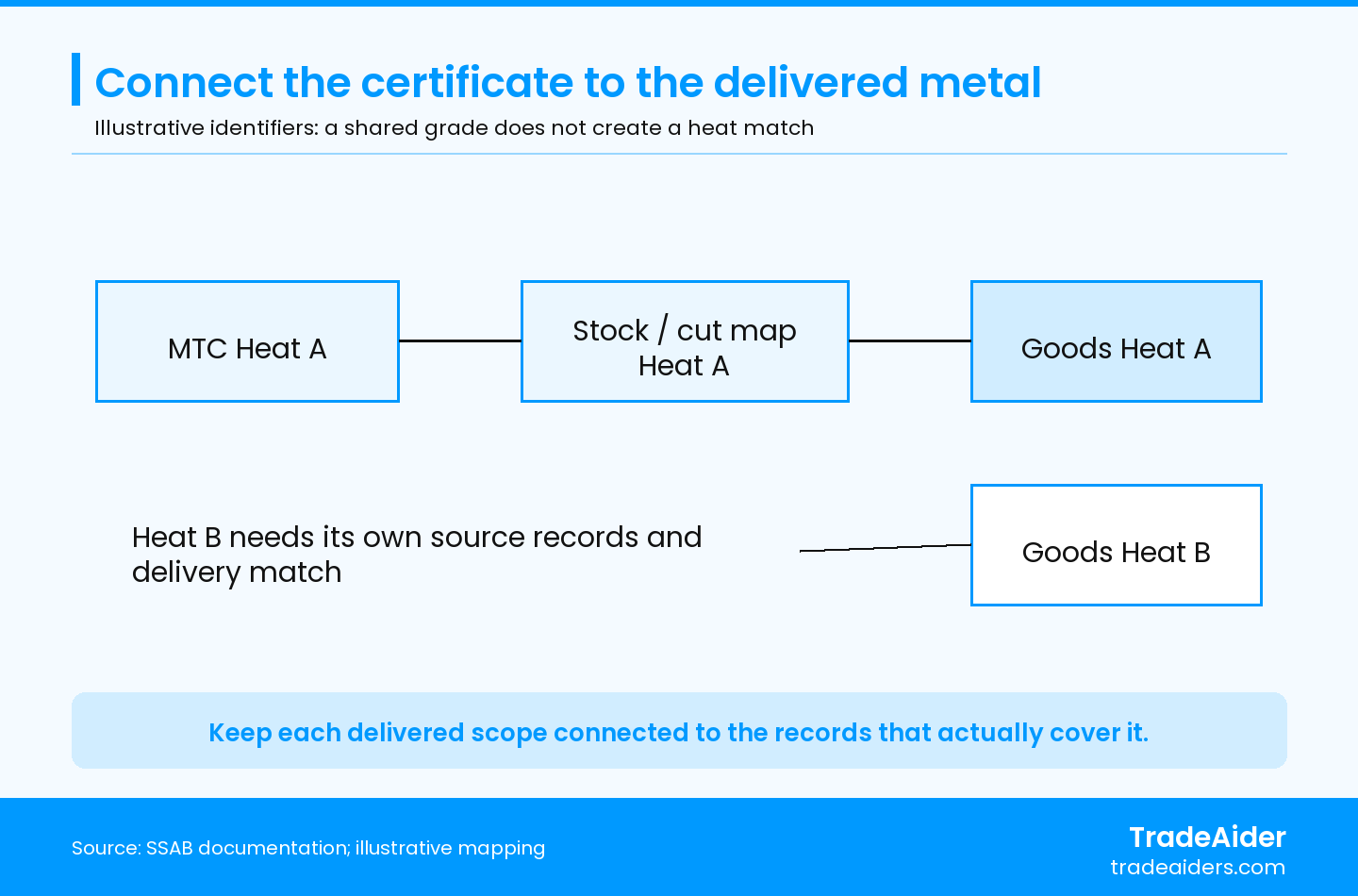
Illustrative record relationship. The Heat A chain covers only the goods actually mapped to it. Heat B needs its own supporting records and delivery match; a shared material grade cannot supply the missing connection. Letters are hypothetical identifiers.
Complete a separate entry for each distinguishable material scope. Where several heats, sizes or conditions appear, add entries instead of combining them under a convenient order heading. Preserve unknown values as unresolved, not as assumed matches.
| Connection to record | Enter for the presented goods | Evidence or open action |
|---|---|---|
| Order requirement | Order line, material standard, grade and condition | Approved specification and document type |
| Source document | Issuer, certificate/revision and represented test unit | Complete source record and validation status |
| Physical identity | Full heat/product mark and stock location | Clear photos and issuer’s marking explanation |
| Delivery scope | Form, dimensions, quantity and delivery reference | Which goods are covered or remain unmatched? |
| Later processing | Cutting, allocation, heat-treatment or other relevant records | Connection to parent stock and final condition |
| Decision and owner | Open item, affected scope, responsible person and recipient | Required document, test or physical recheck |
Reconcile how much material was received and how much is supported by each document and stock allocation. An upstream certificate may describe more material than the current delivery; that is a reason to check the allocation record, not automatic proof of an invalid document. Likewise, a certificate cannot be assumed to cover extra delivered material just because the grade matches.
Before material is consumed, discuss the available records, stock access and feasible comparisons through TradeAider’s Pre-Production Inspection services. Pre-Production Inspection, or PPI, can be scoped around raw materials and readiness before production. Confirm the actual visit timing and checks. A physical inspection assignment does not authorize the provider to validate a mill certificate or certify the material’s full performance.
Separate issuer confirmation from additional material testing
Certificate authenticity and material conformity are separate questions. First establish the issuing organization and use its verified contact details or official document route. Preserve the complete file and the response. A clearer scan or a matching logo is not sufficient confirmation, while an unusual layout is a reason to investigate rather than proof of forgery.
As an issuer-specific example, SSAB tells Hardox buyers to find the unique sign or wear-plate certificate identity and contact SSAB for confirmation. Use a verified issuer contact or its official validation route where available. Confirmation of a document or product identity still needs to be connected to the actual delivered goods.
Make a confirmation request precise: identify the certificate, revision, product reference and the particular discrepancy. Check that the reply addresses those records, rather than merely confirming that the manufacturer exists. If the issuer cannot confirm the record or the document remains incomplete, keep that limitation in the evidence package. The supplier’s commercial assurance should not be recorded as an independent issuer response.
Additional material testing needs an agreed question, sample identity, suitable method and acceptance criteria. Positive material identification, or PMI, uses analytical techniques to investigate the material’s composition. Handheld X-ray fluorescence, or XRF, is one such technique; it is not a complete assessment of all material properties.
Thermo Fisher explains that handheld XRF cannot measure carbon needed to distinguish carbon-dependent stainless grades. PMI should use a method capable of answering the actual composition question. A composition reading does not by itself recover a lost heat-number history or establish mechanical properties and delivery condition.
If further testing is needed, have the responsible technical reviewer define the property to assess, represented scope and required competence. Identify the sampled material, sampling location and transfer to the laboratory or test operator. Keep the resulting report tied to those specimens. Do not add a new heat marking solely because a sample’s composition resembles an available certificate, or treat a limited chemical result as evidence of every required mechanical characteristic.
Resolve a certificate-to-goods mismatch before use
When the certificate and physical references do not connect, preserve the actual marks and isolate the affected scope under the buyer’s material-control procedure. Obtain the correct source records or an authorized technical disposition. Relabeling the goods to match the available certificate does not supply the missing evidence.
Start by distinguishing a missing document from an observed material difference. The right certificate may be absent, a stock record may be incomplete, or the supplied material may actually differ from the order. Record what was seen and which link is missing. If the affected goods cannot be separated reliably, keep the wider uncertain scope visible until the material-control owner resolves it.
Illustrative scenario: Cut plates arrive in separate identified groups. The order specifies the same grade and delivery condition for both. The supplied certificate and cutting map support Heat A, but the other group is marked Heat B. These letters are hypothetical identifiers. The buyer photographs both groups, records their quantities and locations, and isolates Heat B under the receiving procedure. A matching grade description does not put Heat B into the Heat A certificate’s scope.
The distributor then supplies a source certificate and cutting record for Heat B. The reviewer checks the actual grade, condition, required results, validation and delivery allocation. The receiving team rechecks the physical marks against those records before the designated buyer decides on use. If the source records do not resolve the connection, the technical owner determines whether an authorized assessment, replacement or rejection is appropriate. Testing, where permitted, answers its agreed question; it does not rewrite the original production history.
Keep the initial discrepancy and the documents that closed it. Record the final affected scope, decision, decision maker and any restrictions on use. Corrected paperwork alone does not close a physical marking discrepancy, and a corrected label alone does not establish the authenticity of the supporting certificate. This scenario illustrates a control decision; it is not a measured TradeAider client case, a confirmed material failure or a universal legal release procedure.
Give the inspector and recipient a usable evidence brief
An inspection report should identify the goods presented, the records compared, the marks and measurements observed, and the unresolved questions. Keep document authenticity, material-property evidence and physical delivery correspondence distinct. Record the responsible owner and recipient decision before treating an open material question as closed.
Send the available purchase order and material specification, full certificate set, product/heat mark photographs, packing or delivery list, stock map and relevant cutting or processing records. Identify the goods and locations to be presented. State the agreed observations, dimensions, methods, acceptance criteria and any destructive examination or sampling authorization. Assign specialist questions to the technical owner instead of expecting the inspector to resolve them from appearance.
Confirm who will receive and accept the report, including the overseas buyer when a purchasing agent arranges the visit. Agree the language, format, document references and any institution-specific requirements. The report should state unavailable goods, inaccessible marks, missing source records and unperformed checks. The recipient can then see the actual findings and decide what additional evidence remains necessary.
If the assignment later concerns finished goods, distinguish it from material receipt. Pre-Shipment Inspection, or PSI, applies when the order quantity is 100% complete and at least 80% packed for export. The packing threshold does not mean production may be only 80% complete. Neither stage replaces the actual required mill documentation or specialist tests.
An initial inquiry can begin with the available product, order, location, destination and timing. Identify missing technical records during scope discussions, then agree the controlling requirements and feasible checks before execution. To discuss a physical material-inspection assignment and the required report, contact the TradeAider team.
Frequently asked questions
Does a mill test certificate expire after a fixed number of months?
Do not apply a universal expiry period; check the order, application and material-condition requirements. The certificate’s issue date, the material’s production date and its later storage or processing history answer different questions. A recent certificate can still refer to different goods. An older source record does not, by age alone, settle whether the material remains suitable for its intended use.
Can a distributor supply the mill certificate for cut material?
Yes, where the required source records and cutting or stock map retain the accepted connection to the supplied goods. The seller and certificate issuer can be different organizations. Check the original material reference, the distributor’s allocation and the identifiers on the actual cut pieces. A different customer name or a smaller delivered quantity is a reason to examine that chain, not automatic evidence of fraud.
Is a missing wet stamp enough to reject a digital certificate?
No; check the agreed document type and accepted electronic validation. SSAB’s inspection-document guide explicitly describes electronic production and PDF delivery. Retain the original file and use the issuer’s appropriate verification route if there is a concern. A paper printout or visible stamp alone cannot establish authenticity, and the absence of a wet stamp alone should not override the actual accepted validation requirements.
関連記事

TradeAiderサービスでビジネスを成長させる
下のボタンをクリックして、TradeAiderサービスシステムに直接入ります。予約から支払い、報告書の受け取りまでの簡単な手順は操作が簡単です。

