
- 会社概要

- 当社のサービス
- あなたの業界
- リソース
- ニュース&ブログ
A first FBA shipment is not just inventory with a label. It is the first physical version of the promise made in a new listing, and it has no return history or repeat-order pattern to expose mistakes gradually. Before the lot leaves the supplier, the buyer needs evidence that the finished product matches the intended build, the shipment can be received as planned, and any applicable market requirements have an owner.
A practical new product launch inspection checklist therefore does more than list defects. It connects an approved baseline to a finished-lot check, then connects that result to the units and cartons that will enter the FBA workflow. The inspection brief belongs before the final inbound handoff, while the factory can still correct a mismatch.
Build a Proof Chain Before You Release the First Lot
For a first launch, the useful release question is whether four separate records support the promise you are about to make with inventory. The records are the approved baseline, the finished-lot result, the FBA-readiness check, and the applicable compliance evidence. A gap in one record should remain visible instead of being hidden inside a broad statement that the order passed.
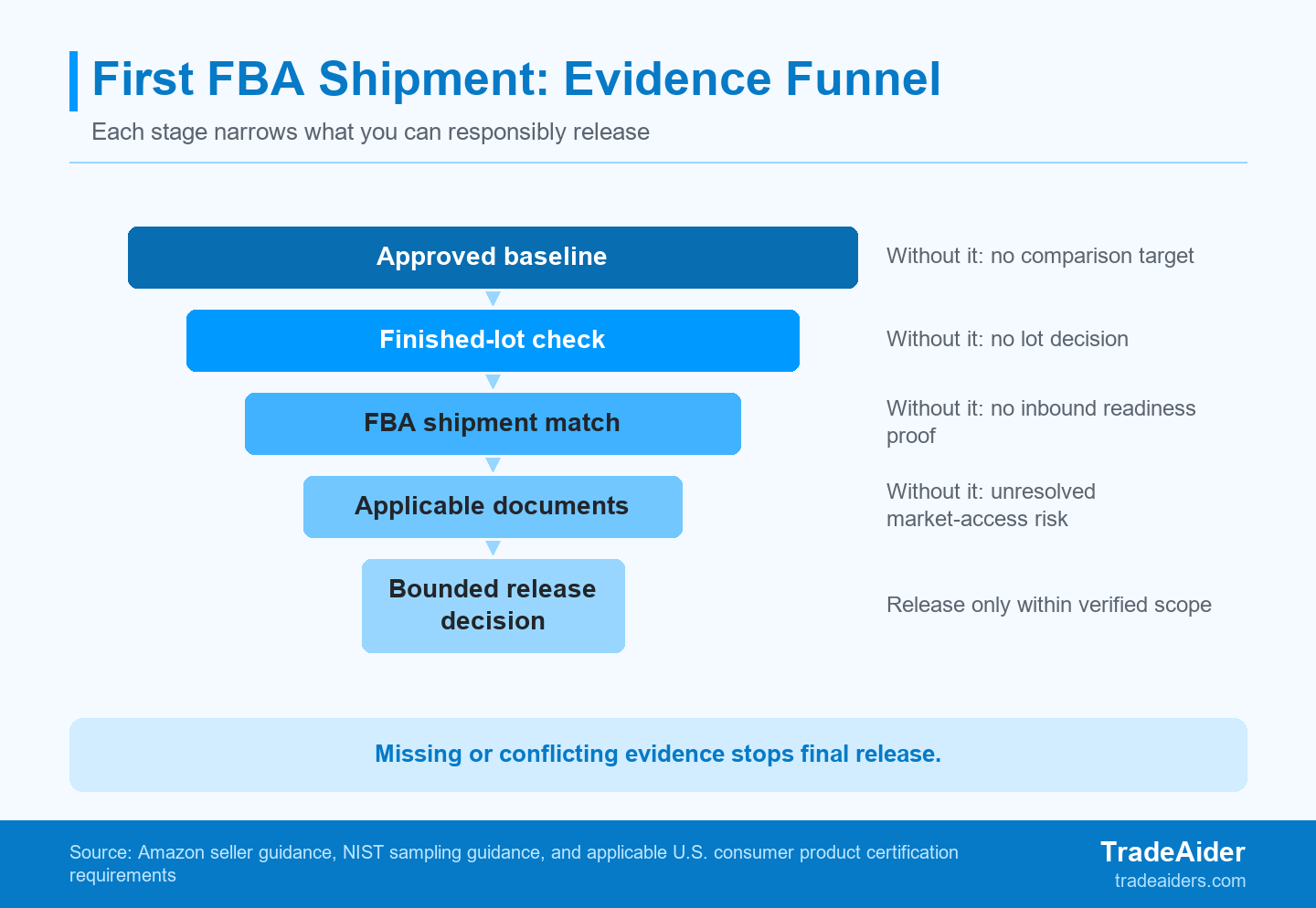
A first-launch release is only as strong as the weakest evidence record in the chain.
A clean label scan does not prove that the finished product matches the approved sample, and a product sample pass does not prove that every carton is ready for Amazon receiving. Keeping the records separate is not extra administration. It prevents a supplier photo, a barcode scan, or a single report from being asked to answer a question it was never designed to answer.
Amazon directs sellers to use the Send to Amazon workflow to prepare, pack, and label inventory before it enters the fulfillment network. Use that handoff as the point by which the four records must agree, even though the exact workflow can vary by product, marketplace, and account state.
- Baseline: define the sellable product, pack, artwork, and defect rules before the visit.
- Lot decision: inspect the completed population against that baseline and record the response to findings.
- Inbound match: verify the unit, carton, and working FBA shipment information together.
- Compliance record: identify the documents, marks, or test evidence that apply to this product and market.
Start With a Controlled Specification Pack
The first record is a controlled specification pack: the approved sample or reference images, the product and packaging requirements, the label instructions, and the defect rules that matter to the launch. It should state which file version is controlling, who approved it, and which measurements, functions, or visible details determine acceptability. A usable inspection standard turns a product promise into a checkable brief instead of leaving the inspector to infer what the buyer meant.
Treat the approved sample as the comparison baseline, not as evidence that the production lot has already earned release. The buyer should attach sample photos from the relevant angles, a bill of materials or component description where it affects function, final packaging artwork, instruction files, and any approved tolerance. For a desk accessory, that may include dimensions, finish, load-bearing parts, included hardware, retail-box protection, and the exact configuration shown in the listing. The important point is not to create a long document. It is to remove ambiguity before someone samples the finished goods.
Keep the pack operational. Mark critical items that require a hold, distinguish major issues from acceptable cosmetic variation, and name the evidence expected after rework. If the supplier proposes a substitution, an updated file and explicit approval should be added before it becomes the new comparison point. Otherwise, the inspection may produce detailed observations without a defensible answer to the release question.
Use Sampling to Decide About This Lot
NIST describes acceptance sampling as a way to decide whether a lot is likely acceptable, not a way to estimate the lot's overall quality level. In plain terms, acceptance sampling is a planned sample check used to make a decision about a defined lot. It is useful when a buyer needs a reasoned release, rework, sort, or hold decision without claiming that every unit has been examined.
A first launch deserves a deliberate plan because there is no established production history to lean on. Identify the lot being submitted, the units or cartons available for selection, the product features to test, the defect classifications, and the response if a finding appears. Set the rule before the visit rather than negotiating it after the inspector has found a problem. A finished-lot pre-shipment inspection service can then work from the same baseline the seller will use to decide whether the order moves.
NIST says a sampling plan should identify what to measure, how and when samples are taken, the sample size, data storage formats, and responsibilities. Add one more commercial field: the permitted response. For example, a critical functional mismatch may trigger a hold, while a correctable packaging issue may trigger documented rework and a focused recheck. If you need help recording a planned acceptance rule before the visit, use an AQL calculator as a setup aid, then make sure the exact product criteria still appear in the inspection brief.
Verify FBA Readiness Against the Shipment You Will Create
Amazon's FBA prep guidance covers barcodes, labels, packaging, and product-specific preparation before inventory is sent to a fulfillment center. FBA prep means the work that makes the inventory ready for Amazon's inbound handling requirements. It is a separate check from whether the product itself matches the approved sample.
At unit level, confirm the sellable configuration, label placement, scan result, packaging closure, warning or bundle instruction where applicable, and the protection needed for the product's handling risk. An FNSKU is Amazon's seller-specific inventory barcode identifier. The check is not simply whether a label exists; it is whether the correct identifier is legible, accessible after any required packaging, and tied to the sellable unit that the shipment record describes.
Then compare the physical preparation against the current shipment setup, not a screenshot from a previous order. For a new product, Amazon requirements and seller choices may affect whether units are packed individually or as cases, which identifiers are used, and what carton details must be supplied. When the product check and the FBA preparation check need to be coordinated in one launch brief, Amazon FBA inspection support can help define the scope before the factory visit.
| Record | What to Verify | Evidence to Keep | If It Fails |
|---|---|---|---|
| Baseline | Product and pack match approved requirements | Approved files and reference images | Clarify or correct before judging the lot |
| Finished lot | Sampled product, function, set contents, and workmanship | Finding log, photos, measurements, and recheck record | Release, rework, sort, or hold |
| FBA readiness | Unit label, packaging, carton configuration, and shipment fields | Scans, carton photos, and packing record | Relabel or reconcile before handoff |
| Compliance | Applicable certificate, test, mark, manual, or warning evidence | Current supporting documents and owner | Hold for product-specific review |
Reconcile the Unit, Carton, and Shipment Records
Amazon's Send to Amazon workflow uses selected inventory, packing details, shipping confirmation, and box labels as part of shipment creation. Those fields should be treated as a reconciliation target during the launch check, not as a substitute for the product inspection result.
Compare the same SKU, sellable-unit count, barcode, carton count, carton dimensions, and carton mark across the physical goods and the working shipment record. Verify a small but representative set of cartons from different areas of the completed lot. A mismatch may be mundane, such as a revised case quantity that never reached the shipping file, but it can still cause a receiving problem or make a later investigation harder to scope. Record the carton identifiers used for the check so the result can be traced back to the shipment.
Treat Compliance Evidence as a Separate Release Record
The eCFR certificate rules require a finished-product certificate to identify the product and the applicable rules, and they address testing-location information where that information is required. That does not mean every product needs the same certificate. It means the launch brief should identify the exact product, destination, and requirement before anyone calls the documentation complete.
Federal law requires a certificate for products subject to consumer product safety rules and adds third-party testing and certification rules for children's products subject to a children's product safety rule. This is a useful reminder that product category changes the evidence question. A visual inspection can confirm what is in front of the inspector, but it cannot by itself determine every applicable test, certificate, warning, or market-access obligation.
For the destination and product you are entering, identify the applicable certificate, testing, marking, manual, warning, or claim-evidence requirement before you treat the compliance record as complete. Assign an owner for each item and record the version or date being reviewed. When the product needs evidence beyond the factory check, include product testing planning in the launch schedule instead of trying to solve the question after inventory has entered FBA.
Illustrative Scenario: The Sample Passed, but Run B Did Not
This illustrative case shows why correct FBA labels cannot settle a mismatch between an approved sample and a production run. It is a fictional first-launch order, not a reported client case or a general defect rate. The point is to show how a buyer can use a traceable production boundary instead of choosing between an unsupported blanket release and an unsupported conclusion about every carton.
The case uses a two-run order so that the release question stays specific: what does the evidence support for run A, and what does it support for run B?
Why Conditional Release Needs a Named Boundary
A US Amazon seller is launching a two-piece under-desk cable tray set from a new Zhejiang supplier.
The first order contains 3,600 sets across two production runs: 1,400 sets in run A and 2,200 sets in run B.
The listing, FNSKU, retail carton art, and working Send to Amazon shipment details are ready for a finished-lot review.
The approved sample uses a rigid steel mounting bracket with pre-drilled holes.
Twelve of twenty sampled units from run B use a thinner bracket that flexes during the agreed installation check. Run A and run B have different production records and carton marks, while label scans and carton counts are otherwise correct.
The barcode and carton evidence supports inbound preparation, but it does not resolve the production-build mismatch. The separate run records create a possible product-family boundary.
The seller holds run B for correction and verification and considers run A separately only after its samples match the approved baseline and its carton records remain traceable.
The supplier must replace the nonconforming brackets in run B, segregate corrected cartons, and provide a run-level packing record.
A focused sample from corrected run B is then compared with the bracket requirement, installation result, carton mark, and set count in the release brief.
Conditional release means moving only the named production run whose baseline comparison, carton records, and verification result are all documented. This illustrative example does not certify future production or prove that the held run now meets the same criteria. That named boundary is what keeps a limited decision honest.
Assemble the Release Packet Before Final Shipment Confirmation
Before final shipment confirmation, assemble one release packet that names the baseline, lot result, FBA readiness record, applicable compliance evidence, decision owner, and open exceptions. Keep it simple enough for the seller, supplier, inspector, and prep team to use: one current specification pack, one result record, one carton and shipment reconciliation, and a short note stating release, conditional release, rework, or hold.
For a first launch, add the inspection date, the submitted quantity, the production-run or carton boundary, the required correction evidence, and the person authorized to change the shipment status. TradeAider can review a completed brief as part of an inspection scope, but the buyer should still make the commercial release decision. When your files are ready, Schedule a pre-shipment review before the final shipment details are confirmed.
Frequently Asked Questions
Use the checklist to organize a first-launch decision, then verify the current Amazon and category-specific requirements that apply to your own shipment.
When should inspection happen for a first FBA shipment?
Schedule the finished-lot inspection only when the units, retail packaging, and shipment information are stable enough to test against the release brief. In practical terms, the product should be completed, the relevant packaging should be available, and the working FBA instructions should be current. Inspecting earlier can be useful for production control, but it cannot replace the final comparison of the sellable units and cartons that will actually move to Amazon.
Can supplier photos replace an independent first-launch inspection?
Supplier photos can support a review, but they do not by themselves create a sampled lot decision or verify the selected units against the agreed release criteria. Photos may show that a carton was labeled or that a product was assembled, yet they usually cannot establish the distribution of defects, functional consistency, or the scope of a production-run mismatch. Use them as supporting evidence, not as the only basis for releasing a new lot.
Should the FBA shipment plan be created before inspection?
Create the working shipment information early enough to check units and cartons, then confirm final details only after the finished goods and carton records match the release brief. The working plan gives the inspector a target for labels, SKU configuration, and carton fields. Waiting until after freight pickup removes the chance to reconcile a mismatch. Treat final confirmation as the end of the evidence chain, not the moment when the evidence is first assembled.
What should trigger a hold on a first FBA shipment?
Hold the shipment when a critical requirement cannot be verified, a material product mismatch is found, or the affected scope cannot be bounded well enough to make a defensible release decision. A hold can be narrow when records clearly identify the affected run or cartons. It should be broader when traceability is missing. The point is not to punish a supplier; it is to keep an unverified risk from becoming the first customer experience for a new listing.

関連記事

TradeAiderサービスでビジネスを成長させる
下のボタンをクリックして、TradeAiderサービスシステムに直接入ります。予約から支払い、報告書の受け取りまでの簡単な手順は操作が簡単です。

