
- 会社概要

- 当社のサービス
- あなたの業界
- リソース
- ニュース&ブログ
A generic pass report cannot tell an importer whether the current goods, pack, records, and release population fit the destination they are about to serve. The practical answer is to start with the market and product category, then make the physical inspection and document review describe the same finished shipment.
A Market Scope Is an Evidence Plan, Not a Generic AQL List
A pre-shipment inspection (PSI) is a finished-goods check before shipment, normally scheduled when the order is 100% complete and at least 80% packed for export. Its market-specific scope should begin with the destination, not with a recycled list of cosmetic defects. A finished lot is the identifiable completed units or cartons covered by one release decision; if the inspection, package photos, and records do not point to that same lot, the report cannot support a confident shipment decision.
A market-specific pre-shipment inspection scope should connect the destination, product category, current retail pack, evidence file, and identifiable finished lot before sampling begins.
An inspection report is more useful when its observations can be traced to the same product and carton population that the importer intends to release.
- Keep one baseline for quantity, workmanship, packing, and product identity.
- Add a destination layer for the relevant category, labels, documents, and route.
- Use carton ranges or lot codes to contain a mismatch instead of guessing at whole-order impact.
- Escalate an unresolved evidence question before the goods are loaded, not after arrival.
Set the Destination and Product Boundary Before Sampling
The destination and product category should be set before a PSI checklist is drafted because market rules and evidence routes are not interchangeable across regions.
Pre-shipment inspection can verify physical goods, packaging, quantity, workmanship, and provided records, but it does not by itself grant legal market approval.
That distinction prevents two costly errors. The first is asking an inspector to certify a regulatory outcome that depends on a category-specific assessment route. The second is allowing a document review to replace a check of the current physical goods. The importer owns the market route and evidence decision; the inspection brief tells the factory and inspector exactly which observable facts and supplied files must be compared.
| Scope layer | What the PSI team can verify | What the importer must reconcile |
|---|---|---|
| Common finished-goods layer | Model, color, count, workmanship, function checks, pack condition, carton marks | Purchase specification and approved sample or production reference |
| Destination layer | Current label, warnings, instructions, plug or accessory presentation, required product identifiers | Applicable market, product category, and category-specific route |
| Evidence layer | Whether supplied files name the same product and pack shown on site | Test scope, declarations, technical file, and any approval or registration pathway |
| Release layer | Carton range, lot code, seal or packing record, and unresolved findings | Which population may move, which population remains on hold, and why |
Use the market name as a routing field, not a decoration on the report cover. “EU,” “UK,” “ASEAN,” “South Africa,” and “Gulf” each prompt different questions. In regional groupings, the country and product category must be named before a useful document request can be made.
EU: Connect the Current Product to Its Safety File and Market Operator
Before placing products on the EU market, manufacturers must conduct an internal risk analysis and draw up technical documentation that includes a general description and safety-relevant characteristics. The EU General Product Safety Regulation sets that baseline.
A technical documentation file is the product file that explains relevant safety characteristics, assessment evidence, and the current configuration. A PSI does not recreate that file. It should test whether the goods, consumer pack, and traceability details visible at the factory are plausibly the same configuration described by it.
For an EU-bound PSI, compare the product and retail package with the current technical file, test scope, traceability details, and any applicable sector pathway rather than treating a visible mark as sufficient proof.
Build the EU addendum around a short evidence match: exact model or SKU, product photos, retail-pack artwork version, manufacturer and economic-operator details where applicable, warnings and instructions, and the report or declaration reference that the buyer expects to rely on. If a product group is subject to specific Union legislation, the route may be more detailed than general product-safety rules. The inspection brief should name that question rather than assume one product mark settles every requirement.
When the open question is whether a product configuration has the right test evidence, a factory visual check is only one part of the release picture. A separate product testing support for market evidence path can help the buyer distinguish an on-site observation from a test or conformity-assessment question.
UK: Split Great Britain From Northern Ireland Before Checking Marks
Great Britain guidance directs businesses to identify the correct market and relevant sector rules before using the applicable conformity assessment, documentation, and marking route. GOV.UK presents market identification as the first step.
For a UK-bound release, the inspection team should verify the destination territory, the current marking and documentation route, legible product information, and the product-to-package match.
“UK” is too broad for a finished-lot instruction. The brief should state whether the shipment is for Great Britain or Northern Ireland, identify the product sector, and list the evidence references supplied by the importer. The factory check can then confirm the practical items: the correct model, placement and legibility of the intended marking where relevant, the current instruction or warning pack, and whether cartons mix versions meant for different destinations.
Keep the result phrased as a comparison, not a declaration. A useful finding is “packaging version B was observed on cartons 41–80 and matched the buyer-provided artwork reference.” A weak finding is “UK compliant,” because the inspector cannot infer unlisted legal conditions from a visual check.
ASEAN: Treat the Region as a Routing Question, Not One Clearance File
ASEAN's published principles identify harmonised regulatory regimes for particular product sectors rather than a single general product-clearance system for all goods. ASEAN's published harmonisation principles describe that sector-based approach.
For inspection planning, convert an ASEAN destination into a named country and product-category route before the PSI scope is approved. That gives the factory a concrete language, label, and evidence question rather than an empty regional label.
Start the brief with the importing country, the commercial product description, model family, intended consumer or industrial use, and the current label language. Then ask what must be shown on the final goods and which document owner can answer the remaining route question. This is more precise than asking a factory to “check ASEAN compliance,” which gives neither the inspector nor the importer a testable standard. If artwork, components, or instructions are still changing, during-production inspection planning can surface the mismatch before final packing.
Start With the Product Sector Covered by Regional Arrangements
ASEAN describes market-integration instruments that include mutual recognition arrangements and harmonised regulatory regimes in named sectors, including electrical equipment, cosmetics, pharmaceutical products, automotive products, construction materials, and prepared food products. The ACCSQ sectoral plan identifies those named areas.
For the PSI scope, record the product family before discussing any regional arrangement. An electrical appliance, a cosmetic product, and a construction material create different evidence questions. The physical check can still be practical: model designation, ingredient or component presentation where relevant, packaging state, instructions, and the document reference supplied for that specific product family.
Then Build a Country-Specific Release File
An ASEAN shipping destination should be converted into a named country and product-category route before the PSI scope is approved, because regional arrangements do not create one generic release file for every good.
Use a five-field country card in the factory brief: destination country, product category, language or label question, evidence-owner contact, and carton range. Add the document version or artwork revision that the inspector will compare, and name who can resolve an inconsistency before the inspection date. This makes a later final inspection more useful because the inspector receives a defined comparison rather than a broad regional instruction.
South Africa: Check Whether a Compulsory Specification Creates an LOA Path
The South African NRCS Act defines a Letter of Authority certificate issued to a manufacturer or importer and defines market-surveillance inspection as checking whether compulsory-specification requirements are met. The NRCS Act provides those definitions.
A Letter of Authority is an NRCS approval document issued to a manufacturer or importer for an applicable compulsory-specification route. Its relevance is product-specific. A PSI brief should therefore ask first whether the product falls within an applicable compulsory specification, then request the buyer's current reference and the exact physical identifiers that need to match it.
For South Africa, use the product category to decide whether a compulsory-specification or LOA question belongs in the PSI brief, then verify the current product and label against that route.
For a covered route, list the manufacturer or importer identity, model or product code, label location, applicable document reference, and any lot or date code the buyer needs preserved. Do not turn the presence of an LOA number into a generic pass criterion for products outside that route. The point is to make the inspector's comparison observable and the importer's evidence review specific.
Gulf Markets: Map the Country, Regulation, and Shipment Route Together
For electrical equipment covered by the Gulf low-voltage regulation, the manufacturer and importer declarations address demonstrated safety and EMC requirements, and the equipment must bear the applicable Gulf conformity marking. The GSO technical regulation describes that covered electrical-equipment route.
This is a useful example of why “Gulf” cannot be the whole scope. Start with the importing country and the applicable product regulation. For a relevant electrical product, the PSI brief can ask the inspector to confirm the model, plug and rating presentation, current product and package identifiers, legibility of supplied artwork, and the carton population attached to the buyer's evidence references. It should not instruct the inspector to issue a conformity decision.
Use a common physical inspection baseline, then add the destination-specific evidence questions separately. That arrangement keeps defect sampling useful without hiding a missing label, declaration, or shipment-route decision behind a single AQL outcome.
Release Only When Goods, Pack, and Evidence Name the Same Version
A release decision should be based on the intersection of product identity, package version, destination route, evidence scope, and an identifiable lot or carton boundary.
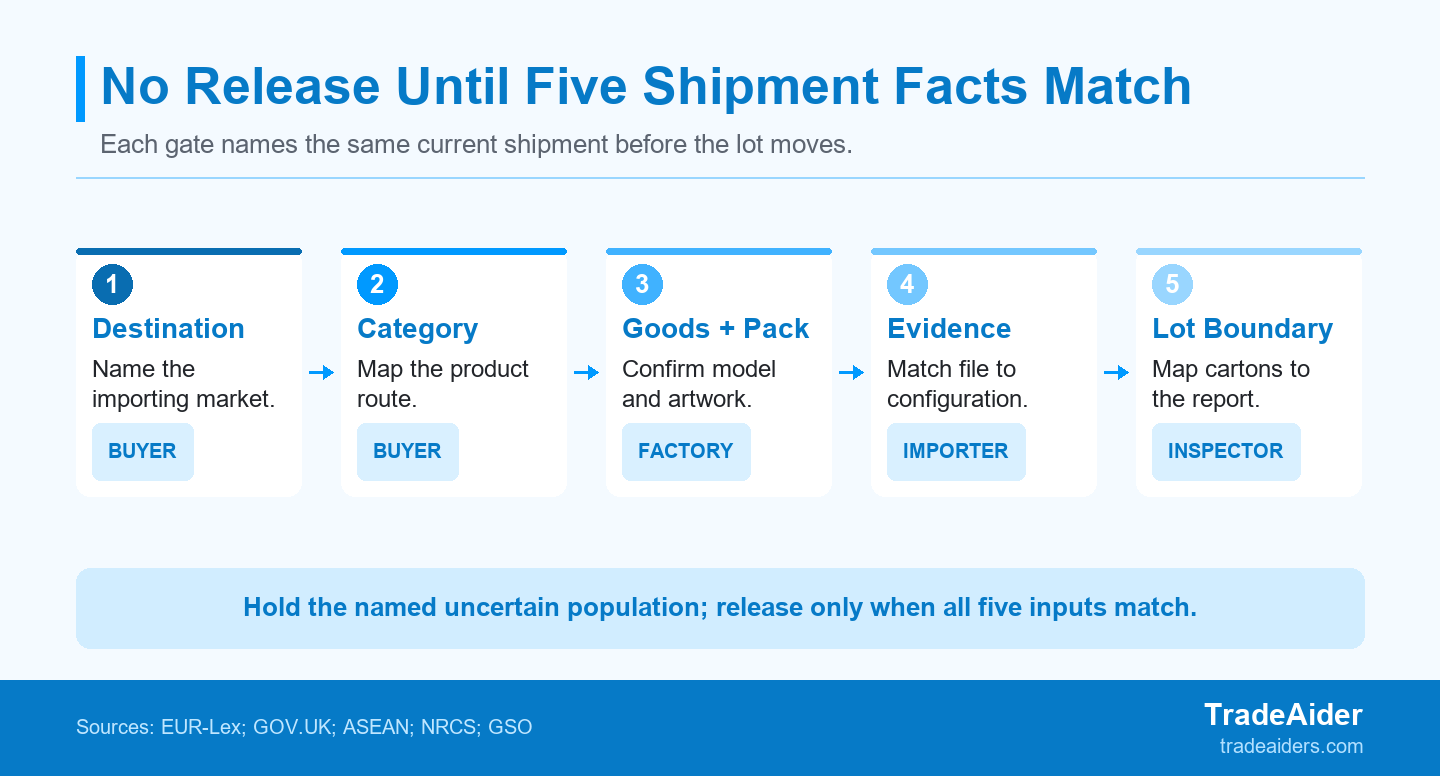
Release only the lot whose destination route, current goods and package, evidence file, and carton boundary all match.
When any one link in the chain is unclear, hold the affected population while the importer restores a verifiable connection rather than using a generic pass result as a substitute.
Think of the release file as five matching names, not five separate attachments. The purchase specification names the model. The final pack names the current consumer-facing version. The evidence file names the configuration it supports. The inspection report names the sampled goods. The carton map names the population being released. A mismatch in any one of those fields is a decision signal, not merely an administrative nuisance.
TradeAider can use a destination-specific brief to focus a pre-shipment inspection service on the finished goods, package version, and reportable evidence checks that the buyer has identified. The buyer should still retain ownership of the applicable regulatory route and any category-specific approval decision.
Illustrative Scenario: Reworked Saudi Labels Need a Separate Release Gate
In the illustrative scenario, cartons with reworked Saudi labels remain on hold until the current label, model identity, evidence file, and carton range are confirmed together.
Illustrative example, not a TradeAider client case or a regulator conclusion. An importer has 6000 small appliances packed in 300 cartons for a Saudi route. After final packing, the factory reworks Arabic warning labels on 90 cartons. The other 210 cartons retain the earlier approved packaging state. The model is visible on the goods, and the carton map identifies the reworked range.
Hold the Reworked Subset, Then Recheck the Exact Cartons
The importer rechecks the reworked cartons against the approved label proof and named evidence file before releasing that subset.
An importer coordinates a Saudi shipment with a factory, inspection team, and compliance adviser. A 6000-unit small-appliance order is packed in 300 cartons, and a distinct carton range received reworked Arabic labels after a packaging correction. The issue is not whether the factory says a correction was made. The rework log does not connect the 90 cartons to the current label proof and model-specific evidence file. Because the subset is identifiable, the importer can hold the 90 cartons without asserting that the other 210 cartons are automatically cleared by a different record.
The release question is narrow: can the current label, the model identity, the relevant evidence reference, and the carton map be read as one configuration? If not, the reworked subset stays on hold. This avoids both extremes—shipping a known information gap and treating an observable subset issue as an unsupported conclusion about the full order.
The corrective package is simple: approved reprint proof, product and carton photos, the carton-range map, and a written scope comparison for the current model and pack. Release the 90 cartons only after sampled cartons match that package. This example shows evidence control, not a determination of legal compliance for any product category.
Send a Factory Brief That Makes the Inspector's Scope Testable
A factory brief is testable when it names the destination, product category, package version, document list, inspection sample, and release boundary.
For each shipment, hand over one concise brief before the inspection date:
- State the importing country and the intended product category.
- Name the exact model, retail-pack artwork, and carton or lot range.
- List the physical checks: quantity, workmanship, function, packaging, labels, and identifiers.
- List the document references the inspector must compare, without asking for legal certification.
- Define the release rule and the escalation owner for a mismatch.
That structure gives the factory a clear preparation list and gives the buyer a report that can be reconciled with the intended destination. When the product, destination, and evidence questions are known, Contact TradeAider about a market-specific inspection brief.
Frequently Asked Questions
Can one PSI checklist cover every destination?
No, one physical-check baseline can be reused, but the destination, product category, current package, and documentary route must be checked separately before release. Reuse the sections for quantity, workmanship, function, packing, and product identity. Then add only the market questions that apply to the named product and country. A checklist becomes risky when it uses a regional label without identifying the actual import route.
Does a passed inspection prove market compliance?
No, a passed inspection documents observations on the sampled finished goods and supplied records, while legal conformity depends on the applicable product and market requirements. The report can show whether the current product and pack matched the brief. It cannot replace a required conformity assessment, declaration, registration, or legal review. Keep those responsibilities visible in the release decision.
How should ASEAN be named on a factory brief?
Name the importing ASEAN country and product category first, then record any relevant sector arrangement and local label or document questions. Add the exact model, retail-pack version, evidence owner, and carton range. This prevents an inspector from receiving an untestable instruction such as “ASEAN standard” and gives the importer a concrete record to update if the destination changes.
When should a reworked label trigger a hold?
A reworked label should trigger a hold when the current artwork, product identity, evidence file, and affected carton range cannot yet be matched as one configuration. The hold can be limited to the traceable reworked subset. Once the buyer has the approved proof, photos, correct evidence reference, and a carton map, a focused recheck can support a documented release decision.
関連記事
TradeAiderサービスでビジネスを成長させる
下のボタンをクリックして、TradeAiderサービスシステムに直接入ります。予約から支払い、報告書の受け取りまでの簡単な手順は操作が簡単です。

