
- 会社概要

- 当社のサービス
- あなたの業界
- リソース
- ニュース&ブログ
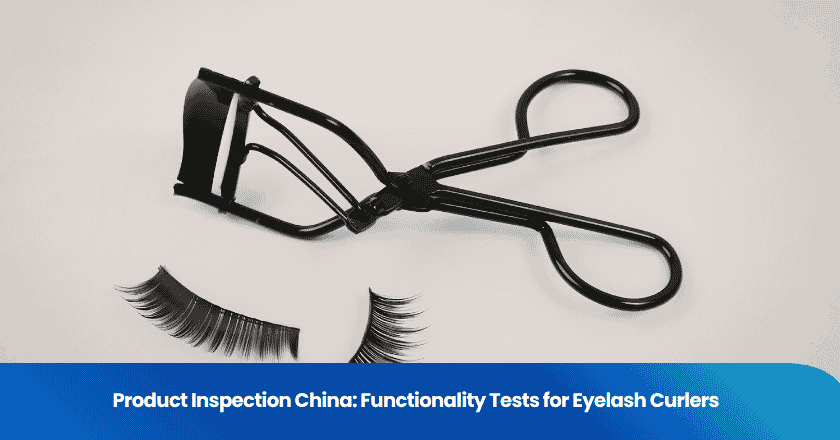
Eyelash curlers may be small, simple-looking tools — but their proximity to the eye area makes functionality failures genuinely dangerous. A spring that breaks mid-use, a silicone pad that slips during application, or a heated model with inconsistent temperature control can cause lash damage, lid burns, or worse. For importers sourcing eyelash curlers from China, a product inspection that focuses specifically on mechanical and functional performance is non-negotiable — and the checklist needs to go considerably deeper than a visual pass/fail.
This guide explains the functionality tests that should appear on every eyelash curler inspection checklist, how they're conducted on-site in China, and what compliance certifications matter for the US, EU, UK, and Australian markets.
Key Takeaways
- Spring mechanism integrity is the highest-priority safety check — a broken spring during use is the most common cause of eyelash curler-related injury reports.
- Silicone pad quality directly affects both safety and consumer experience — correct hardness (durometer), secure fit, and surface uniformity are all inspectable criteria.
- Heated models require additional testing — temperature accuracy, auto-shutoff function, and CE/RoHS compliance are essential checks for electric curlers.
Why Eyelash Curler Safety Deserves Dedicated Inspection Attention
The U.S. Consumer Product Safety Commission has on record a product recall involving eyelash curlers that broke during use — a recall triggered by 24 reported incidents including 13 injuries, three of which required medical attention. The failure mode was a spring mechanism that broke unexpectedly. This kind of structural failure is entirely preventable when spring integrity testing is part of the inspection protocol.
The eyelash curler market is also growing quickly, with the global market projected by analysts to exceed $1.2 billion USD by 2030. As volume grows, so does the number of manufacturers entering the China supply base — including factories with less experience in precision metal and silicone assembly. This makes independent quality inspection more, not less, important as importers scale their beauty tool sourcing.
Core Functionality Tests for Standard (Non-Heated) Eyelash Curlers
1. Spring Mechanism Integrity and Tension Test
The spring is the single most safety-critical component of a standard eyelash curler. Inspectors assess both the current state of the spring (no cracks, corrosion, or visible metal fatigue) and its functional performance under repeated use cycles. A durability benchmark of at least 5,000 open-close cycles without structural failure or performance degradation is a reasonable minimum specification for a market-grade curler. As industry safety requirements for eyelash curlers outline, durability testing should confirm no structural failure across this cycle count. Inspectors should document the spring's behavior across a defined number of cycles and flag any signs of weakening tension, binding, or deformation.
As lash care safety experts note, cracked or warped frames create safety hazards that can pinch or damage delicate eyelash follicles — and dirty, deteriorated pads increase infection risk significantly. Frame integrity is checked visually and by applying lateral pressure to test for rigidity versus brittleness.
2. Silicone Pad Assessment
The silicone pad is the direct contact surface between the tool and the lash. Its quality determines whether the curler creates a smooth, even curl without pulling, pinching, or damaging individual lashes. During inspection, pads are assessed across four dimensions: surface uniformity (no bubbles, tears, or uneven thickness), secure fit in the pad slot (shouldn't shift under normal use), hardness (durometer) compared to the approved spec or golden sample, and surface cleanliness. Pads that are too hard will crimp lashes rather than curl them; pads that are too soft won't maintain consistent pressure and will produce uneven results.
The pad fit is a particularly important check — a pad that can shift or slip during use exposes the metal frame edge to the lashes, which is both damaging and a potential cause of lash pull-out. This is a mechanical check, not a visual one: the inspector should attempt to displace the pad manually to confirm it's properly secured.
3. Jaw Alignment and Closure Gap Check
When the curler is closed, the upper and lower jaw frames should meet uniformly along their full length, with the silicone pad compressed evenly. Misaligned jaws create uneven pressure distribution — resulting in a partial curl or a pinching point at the edge of the jaw where lash damage is most likely. Inspectors check jaw alignment both visually and by pressing the closed curler against a flat surface and observing whether light is visible through any point of the jaw gap.
4. Hinge and Handle Ergonomics
The hinge connects the two jaw arms and must allow smooth, controlled opening and closing without binding or wobbling. Loose hinges create an unpredictable grip response; overly stiff hinges require excessive finger pressure that reduces application control. Handle grip surface — whether rubberized, matte-coated, or bare metal — should match the approved sample and be evaluated for non-slip performance. An ergonomic, secure grip is correctly considered a safety feature, not just a comfort preference: it ensures the user maintains full control of the tool near the eye area.
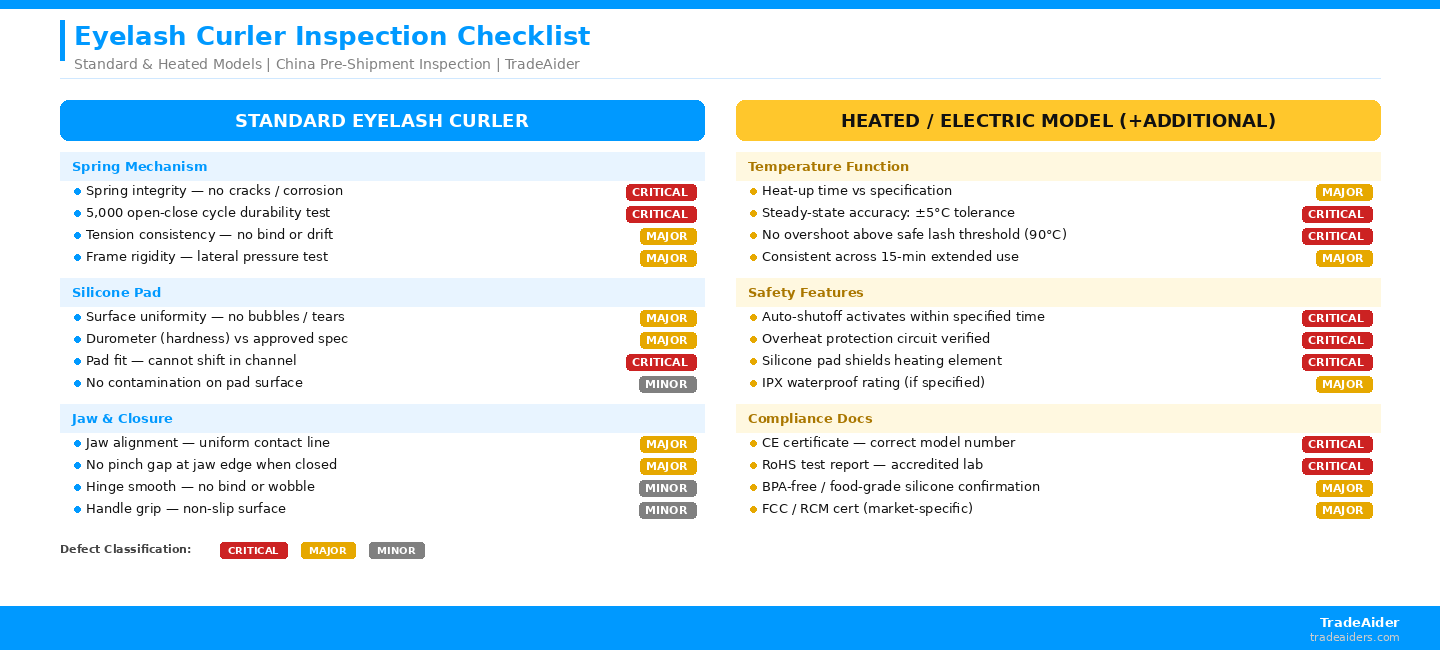 The complete eyelash curler inspection framework — standard models on the left, heated/electric models on the right.
Additional Tests for Heated and Electric Eyelash Curlers
Heated eyelash curlers introduce a completely separate category of inspection requirements. Beyond the mechanical checks above, electric models require verification of temperature accuracy, safety feature functionality, and regulatory compliance documentation.
Temperature Accuracy and Stability
The heating element must reach its rated temperature and maintain it within a tight tolerance window during operation. According to industry standards for heated beauty tools, temperature control accuracy must be maintained within ±5°C during use. Devices that overshoot their rated temperature risk lash damage and potential burns; devices that underperform won't produce the intended curl. Inspectors verify temperature performance using a calibrated contact thermometer, testing both cold-start heat-up time and steady-state stability at the rated setting.
As safety-focused beauty tool manufacturers note, lash hair is made of keratin, a protein that weakens with excessive heat (above 90°C). Consumer heated curlers should operate well below this threshold — typically in the 60–80°C range — and a good inspection confirms not just that the device reaches the stated temperature, but that it doesn't exceed it under sustained use.
Auto-Shutoff Function Test
Auto-shutoff is a critical safety feature on any heated beauty tool. The device should power down automatically after a defined period of inactivity. Inspectors verify this by allowing the device to heat to operating temperature and then timing the shutoff cycle. Failure to shut off is classified as a major defect that should trigger rejection of the batch pending investigation.
Overheat Protection Verification
Beyond auto-shutoff, premium electric curlers include overheat protection circuitry that prevents the device from exceeding safe temperature limits even if operated continuously. Inspectors test this by monitoring device temperature during extended operation beyond the normal use cycle and confirming that the protection circuit activates before the device reaches unsafe temperature levels.
Compliance Certification Requirements by Market
| Market | Required Certifications (Heated Models) | Key Standards |
|---|---|---|
| US | FCC (for wireless), CPSC compliance | No sharp edges; electrical safety; CPSC reporting |
| EU / UK | CE marking, RoHS compliance | Electrical safety directive; restricted substances |
| Australia | RCM (Regulatory Compliance Mark) | AS/NZS electrical safety standards |
| All markets | BPA-free plastics, food-grade silicone pads | Material safety for eye-area contact |
Compliance documentation — CE certificates, RoHS test reports — should be verified during the inspection process, not assumed. Inspectors should confirm that test reports were issued by an accredited laboratory and that the certification covers the specific model being shipped, not a similar model from the same supplier. The FDA's guidance on eye cosmetic safety also provides relevant context on the safety requirements for tools used near the eye area.
A Real-World Scenario: What Happens When Inspection Is Skipped
An Amazon seller sourcing heated eyelash curlers from a new Shenzhen factory skipped the pre-shipment inspection to save on lead time. The first batch of 2,000 units arrived with two problems: a subset of units where the auto-shutoff wasn't functioning (discovered when customers reported devices staying on overnight), and a silicone pad durometer that was too soft, causing inconsistent curl results. The result was a wave of negative reviews, a batch recall from Amazon, and a rework cost that was approximately 12x the cost of a pre-shipment inspection that could have caught both issues on the factory floor.
This scenario is common enough that it has a predictable prevention: a one man-day pre-shipment inspection at $199 that includes both mechanical function tests and a heated model compliance check. All the tests described in this article are covered in TradeAider's standard inspection approach, with real-time photo reporting and a same-day written report. For more on what a PSI covers, see the inspection standards guide. To understand what sets TradeAider's approach apart from conventional QC companies, visit the why TradeAider page.
Packaging and AQL Sampling for Eyelash Curlers
Beyond the product-level tests, packaging checks are an important component of any eyelash curler inspection. The product must be secured within the inner packaging in a way that prevents the jaws from opening and potentially damaging the pad or contents during transit. For blister card packaging, blister seal integrity and card print quality should be verified. For boxed presentations, the box closure, insert fit, and window clarity (for display packaging) are all inspectable criteria.
AQL sampling for eyelash curlers should follow ANSI/ASQ Z1.4. For most shipment sizes, General Inspection Level II at AQL 2.5 for major defects (spring failure, pad displacement, heated model safety function failure) and AQL 4.0 for minor defects (cosmetic finish, packaging minor) is appropriate. Use TradeAider's AQL calculator to determine the correct sample size for your order quantity before confirming your inspection scope.
Frequently Asked Questions
How do I know if my eyelash curler supplier's CE certificate is genuine?
A genuine CE certificate for a heated eyelash curler should reference the specific product model, the issuing notified body (for products under the Low Voltage Directive, a notified body is required), and the test standards covered. Ask your supplier for the original certificate and the associated test report. You can verify notified body numbers through the EU's official NANDO database. Inspection companies can also request documentation review as part of a factory audit — TradeAider's factory audit service includes document verification alongside on-site capability assessment.
Should I inspect both standard and heated versions separately?
Yes — they are effectively different product categories from an inspection standpoint. A standard curler inspection focuses on mechanical performance and material safety. A heated curler inspection adds the electrical testing protocol, compliance documentation review, and temperature function verification. If you're sourcing both types from the same factory, they should be inspected against separate checklists even if the inspection is conducted on the same man-day.
What's the most common defect found in eyelash curler inspections?
For standard curlers, the most frequently found issues are silicone pad fit (pads that shift or don't seat securely in the channel) and jaw alignment (uneven closure that creates a pinching point). For heated models, temperature consistency is the most common issue — devices that heat to spec on the first cycle but show drift or inconsistency after 10–15 minutes of operation. Both categories of defect are reliably detectable with a structured inspection protocol but will go completely undetected by visual-only QC.
Sourcing eyelash curlers — standard or heated — and want to make sure the batch is right before it ships? Get a free quote from TradeAider and have an inspector on-site within 48 hours.
関連記事

TradeAiderサービスでビジネスを成長させる
下のボタンをクリックして、TradeAiderサービスシステムに直接入ります。予約から支払い、報告書の受け取りまでの簡単な手順は操作が簡単です。

