
Pre-Shipment Inspection (PSI) is a quality control check performed by an independent third party at the factory after at least 80% of production is complete and goods are packed, verifying that product quality, labeling, packaging, and quantities match buyer specifications before goods are shipped to Amazon's fulfillment centers.
The most consequential decision in your PSI process is not which provider to use — it's whether to run AQL statistical sampling or a 100% full inspection of every unit. Amazon requires sellers to maintain an Order Defect Rate below 1%, and the inspection method you choose determines how reliably you catch defects before they reach customers. Get this decision wrong on a high-risk product category and you may spend your entire inspection budget — only to discover after the fact that your sampling plan missed a systematic defect affecting 15% of the order. U.S. retail returns cost $890 billion in 2024, and quality-driven returns are among the most damaging to Amazon seller accounts because they generate both negative reviews and increased ODR simultaneously. This guide provides the framework to make the right call for every SKU you source.
Key Takeaways
- Definition: AQL sampling inspects a statistically calculated subset of your order; 100% full inspection checks every unit. Neither method eliminates all defects, but they manage risk very differently.
- Framework: The FBA SKU Risk Matrix evaluates four factors — product category, supplier history, order economics, and account health status — to determine the right inspection approach.
- Default recommendation: AQL 2.5 for major defects under ISO 2859-1 General Level II is the appropriate starting point for most Amazon FBA consumer goods.
- When to escalate: New suppliers, high-value orders, safety-relevant categories, or a previous PSI failure are the four conditions that most reliably justify escalating to full inspection or tightened AQL levels.
- Pricing reality: A 100% full inspection of a 2,000-unit order typically requires 2–3 man-days versus 0.5–1 man-day for AQL sampling. At $199/man-day, that cost difference should be weighed against the risk of the defects you might miss.
What Is Pre-Shipment Inspection (PSI)?
Pre-Shipment Inspection is the most widely used quality control step for Amazon FBA sellers. The inspection is conducted when production is 100% complete and at least 80% of the goods are packed in export cartons — a timing designed to ensure the inspector sees finished products in shipping condition, not pre-production samples or unboxed items. Within PSI, the inspector applies either an AQL sampling plan or a 100% full check to evaluate product quality, FBA labeling compliance (FNSKU barcodes, suffocation warnings, poly-bagging), packaging integrity, carton markings, and quantities against the purchase order.
Pre-Shipment Inspection is also commonly referred to as Final Random Inspection (FRI) when it uses AQL random sampling, or simply "full inspection" when every unit is checked. The distinction matters because it determines not only inspection cost and duration, but also what you actually learn about your order's quality. ISO 2859-1:2026 — the international standard governing AQL sampling plans — defines Acceptable Quality Limit as the maximum percentage of defective items considered acceptable as a process average. It is the worst tolerable quality level, not a quality target. Understanding this distinction is essential for setting up your inspection correctly.
Introducing the FBA SKU Risk Matrix
The FBA SKU Risk Matrix is a four-factor decision framework that systematically determines whether AQL sampling or 100% full inspection is appropriate for a given order. Applying the FBA SKU Risk Matrix before booking your inspection eliminates guesswork and ensures your quality investment is proportional to the actual risk profile of each shipment. Each factor is scored independently; the combination of scores drives the final recommendation.
Factor 1 — Product Category and Defect Risk
Product category is the most reliable predictor of whether AQL sampling is sufficient. Low-risk categories — basic household goods, non-electrical accessories, simple hardline products — have defect modes that are visually detectable and rarely safety-critical. AQL 2.5 under General Level II is appropriate. Medium-risk categories — consumer electronics, powered tools, items with mechanical moving parts — have defect modes that can be functional (not visible) and may trigger Amazon safety complaints. AQL 1.5 or tightened inspection is appropriate. High-risk categories — children's products, items with electrical components, food-contact goods, and any category under CPSC, CE, or other mandatory certification — carry liability implications where a missed defect can trigger product recalls, listing suspension, or legal exposure. AQL 1.0 or 100% functional testing is appropriate for these categories.
Factor 2 — Supplier History and Trust Level
Supplier history is the second axis of the FBA SKU Risk Matrix. For a supplier you have worked with for five or more consecutive shipments without a PSI failure, reduced inspection (switching to AQL from tightened) is defensible per ISO 2859-1's switching rules. For a first-time supplier, this matrix recommends tightened inspection or full inspection for the first order regardless of category — the absence of a defect track record means you are accepting unknown risk. For a supplier who has previously failed a PSI or delivered quality complaints that drove Amazon returns, the recommendation escalates immediately to full inspection with a documented corrective action request before the next production run.
Factor 3 — Order Size and Cost Economics
Cost economics are the practical constraint on full inspection. For orders under 500 units, 100% inspection adds minimal time relative to AQL sampling — the cost difference may be less than one man-day — and the extra confidence is often worth the marginal spend. For orders of 500–3,000 units, AQL sampling under General Level II provides a statistically valid sample (80–125 units for most lot sizes in this range) at a fraction of full inspection time. For orders above 5,000 units, full inspection becomes cost-prohibitive for most sellers unless the product category demands it. The break-even analysis between inspection cost and defect risk is a calculation every FBA seller should run: one Amazon removal order, return processing fee, or account performance warning typically costs more than an additional man-day of inspection.
Factor 4 — Amazon Account Health Status
Amazon account health status is the highest-urgency factor in the FBA SKU Risk Matrix. If your account has received recent product quality complaints, negative feedback related to product condition, or an ODR warning, escalating to full inspection for your next shipment is the appropriate response — not because it guarantees zero defects, but because a documented full inspection report with photos provides evidence of due diligence if Amazon requests a plan of action. Amazon's 2025 data shows that fewer than 0.1% of its 2+ billion annual orders result in A-to-Z guarantee claims, but for sellers already approaching the ODR threshold, even a small additional quality issue can cross the suspension line. A full inspection report is your best evidence that you took reasonable steps to prevent the problem.
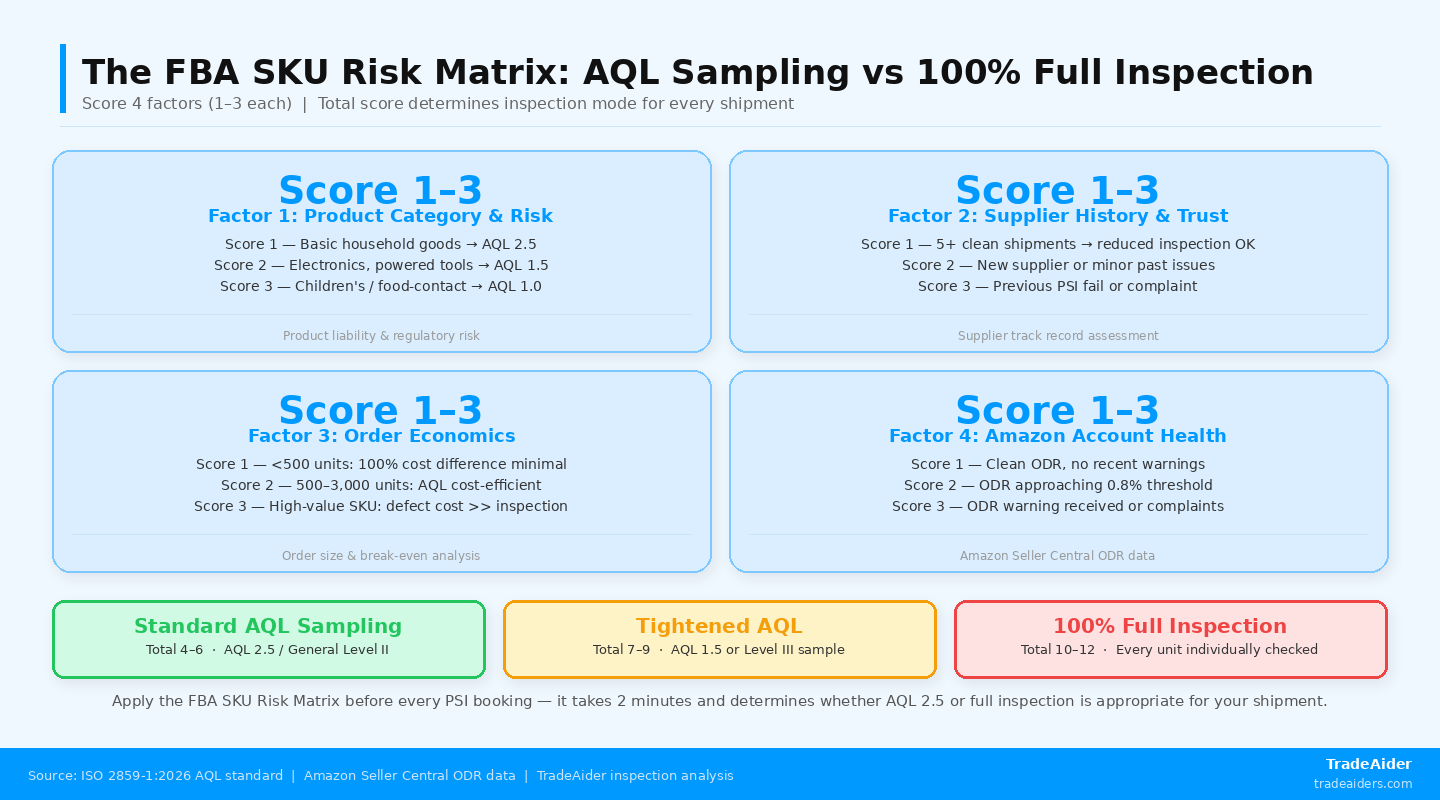 The FBA SKU Risk Matrix: score 4 factors (1–3 each) — Total 4–6 = AQL Sampling, 7–9 = Tightened AQL, 10–12 = 100% Full Inspection. Source: TradeAider 2026.
How to Apply the FBA SKU Risk Matrix to Your Next Order
Score each factor on a 3-point scale: 1 = low risk, 2 = medium risk, 3 = high risk. Add the four scores. A total of 4–6 points recommends standard AQL 2.5 under General Level II. A total of 7–9 points recommends tightened AQL (AQL 1.5 or AQL 1.0) or AQL 2.5 with a higher inspection level (General Level III for a larger sample). A total of 10–12 points recommends 100% full inspection. Review your AQL sampling requirements before finalizing your inspection brief, and communicate your defect classification criteria clearly to your inspection provider before they visit the factory.
AQL Sampling vs 100% Full Inspection: Side-by-Side Comparison
The comparison below covers the eight dimensions FBA sellers most commonly use to evaluate inspection approaches. Neither method is universally superior — the right choice is determined by the FBA SKU Risk Matrix score for each shipment.
| Dimension | AQL Sampling (ISO 2859-1) | 100% Full Inspection |
|---|---|---|
| Units inspected | Sample size (e.g., 80 units from 1,000) | Every unit in the order |
| Cost (man-days) | 0.5–1 man-day (typical 1,000-unit order) | 2–4 man-days (same order) |
| Time required | Half-day to 1 full day | 1–3 days (order size dependent) |
| Defect detection reliability | Statistical (95% confidence at AQL threshold) | Comprehensive, but subject to inspector fatigue |
| Best for categories | General consumer goods, stable suppliers | High-risk, first orders, high-value, safety items |
| Pass/fail basis | Lot accepted/rejected based on sample results | Individual units sorted; defect count exact |
| Amazon account benefit | Standard due-diligence documentation | Strongest evidence in account health appeals |
| Switching rules available | Yes — normal / tightened / reduced per ISO 2859-1 | No switching required; applies to all units |
Based on this comparison, the central insight is this: AQL sampling is the right default for most FBA orders because its statistical confidence is well-calibrated to detect systematic quality problems at defensible cost. Escalating to 100% full inspection delivers its greatest value in three specific situations — first orders, high-risk categories, and account health recovery scenarios — where the cost of a missed defect exceeds the cost of the additional inspection time. Use the TradeAider PSI service page to review exactly what both AQL and full inspection cover at $199/man-day.
AQL Levels for Amazon FBA: Which to Use for Your Products
AQL 2.5 for major defects and AQL 4.0 for minor defects under General Inspection Level II is the industry standard starting point for consumer goods sold on Amazon. Critical defects — safety hazards, functional failures that render the product unusable, mislabeled products — are always set at zero tolerance regardless of category. The table below maps product risk tier to recommended AQL levels.
| Product Risk Tier | Examples | Critical AQL | Major AQL | Minor AQL |
|---|---|---|---|---|
| Low Risk | Household accessories, basic hardline goods | 0% | 2.5% | 4.0% |
| Medium Risk | Electronics, powered tools, apparel | 0% | 1.5% | 2.5% |
| High Risk | Children's products, food-contact items, safety equipment | 0% | 1.0% | 1.5–2.5% |
When AQL Passes But You Still Have a Quality Problem
AQL sampling has a known limitation: it is designed to detect systematic quality problems at statistically defined confidence levels, not to guarantee zero defective units in a shipment. If your AQL inspection passes under 2.5 major — meaning the sample showed fewer defectives than the acceptance number — but you still receive quality complaints on Amazon, the most common explanations are: (1) the defect rate was near the AQL threshold but fell within the acceptance band by chance; (2) the defect is a late-production issue that appeared after the inspected sample was pulled; or (3) the defect is category-specific and the checklist did not include the specific test that would have caught it. Real-time monitoring during inspection significantly reduces the third risk — when you can observe the inspector working live, you can request additional test steps for specific concerns in real time. Reducing Amazon returns requires addressing root causes in the supply chain, not just adjusting return handling workflows after the fact.
Who Is TradeAider?
TradeAider is a quality inspection, testing, and certification service provider in China. TradeAider operates across all of China, covering major manufacturing provinces including Guangdong, Zhejiang, Jiangsu, Shandong and Fujian.
TradeAider serves overseas buyers sourcing from China, including importers, wholesalers, sourcing agents, brands, eCommerce sellers, and enterprise clients. Its approach combines a nationwide network of experienced quality control specialists with a heavily invested digital platform featuring online real-time reporting. Clients can monitor inspections live, communicate directly with inspectors, and address issues during production rather than after shipment — a proactive model focused on problem-solving and prevention, not just defect identification.
Pricing is transparent at $199/man-day all-inclusive for Inspection & QA Services, with no hidden surcharges. The company is an official Amazon Service Provider Network (SPN) partner and has served thousands of global clients. Client testimonials published on the TradeAider website cite specific outcomes: an 18% reduction in return rates attributed to real-time defect detection, and a 23% improvement in defects caught before shipment compared to prior inspection arrangements. These are client-reported figures.
Frequently Asked Questions
What is AQL 2.5 in the context of Amazon FBA pre-shipment inspection?
AQL 2.5 means the inspection will accept a shipment if the defect rate in the sampled units does not exceed 2.5% for major defects. Under ISO 2859-1:2026 General Level II, a 1,000-unit order would require sampling approximately 80 units; acceptance requires finding no more than 5 major defective units in that sample. It is the most commonly used AQL level for consumer goods sold on Amazon and provides a statistically sound basis for lot acceptance without requiring inspection of every unit. Critical defects are always set to zero tolerance — AQL 2.5 applies only to major and minor defect classes.
How many units are inspected in an AQL Level II inspection for 1,000 units?
For a 1,000-unit order under ISO 2859-1 General Inspection Level II, the standard sample size is 80 units. This is determined by the lot size code letter (J for lot sizes 501–1,200), which maps to a sample size of 80 in the AQL master table. At AQL 2.5 for major defects, the inspector accepts the lot if 5 or fewer major defectives are found and rejects if 6 or more are found. Use the TradeAider AQL calculator to look up sample sizes and acceptance numbers for your specific order quantity.
When should an Amazon FBA seller choose 100% full inspection over AQL sampling?
100% full inspection is appropriate when any of the following apply: it is your first order from a new supplier; the product is in a safety-sensitive category (children's products, electronics with electrical components, food-contact goods); a previous AQL inspection on the same SKU or from the same supplier resulted in a fail or near-fail; or your Amazon account has received recent quality-related performance warnings. For repeat orders from proven suppliers with a clean inspection track record in stable, low-risk categories, AQL sampling under General Level II delivers adequate quality assurance at significantly lower cost.
Can I switch from AQL sampling to full inspection mid-cycle?
Yes. ISO 2859-1:2026 includes switching rules that allow buyers to move between normal, tightened, and reduced inspection based on accumulated lot history — but you are never locked into an inspection mode. If your last AQL inspection returned results near the rejection boundary, requesting tightened inspection (which uses a larger sample at the same AQL threshold) or escalating to full inspection on the next order is always an option. The right time to make that decision is before booking the inspection — not after a failed result has already created urgency. Contact TradeAider to discuss the appropriate inspection plan for your order history and product risk profile.
関連記事
TradeAiderサービスでビジネスを成長させる
下のボタンをクリックして、TradeAiderサービスシステムに直接入ります。予約から支払い、報告書の受け取りまでの簡単な手順は操作が簡単です。

