
- 会社概要

- 当社のサービス
- あなたの業界
- リソース
- ニュース&ブログ

A quality-control glossary helps importers turn vague supplier conversations into clear inspection instructions. Terms such as AQL, lot size, sample size, critical defect, major defect, minor defect, reinspection, CAPA, carton drop, barcode check, and release decision should be understood before the QC company arrives at the factory.
Most quality disputes begin with ordinary words used in different ways. The buyer says acceptable, the supplier says minor, the inspector says major, and the customer says defective. Without shared vocabulary, every inspection report becomes a negotiation. A glossary does not solve every problem, but it makes the conversation more precise.
Pre-shipment inspection terms are especially important because PSI often happens near the end of the production timeline. The goods may be packed, the supplier may be asking for final payment, the vessel date may be close, and the buyer may not have time to debate basic definitions. The stronger move is to define key terms before production and attach them to the purchase order or inspection booking.
- Sampling terms: lot size, sample size, inspection level, AQL, accept number, and reject number.
- Defect terms: critical, major, minor, nonconforming unit, workmanship, and appearance.
- Timing terms: PPI, DPI, PSI, reinspection, and loading supervision.
- Evidence terms: approved sample, specification, photo record, carton marks, and release decision.
The Direct Answer
Importers should learn the inspection terms that affect sampling, defect classification, timing, evidence, and shipment release before they book a PSI.
ISO 9000:2015 is the ISO quality-management standard for fundamentals and vocabulary, which is why consistent terminology matters in quality systems. Source: ISO 9000:2015.
ISO 2859-1:2026 defines the current ISO system for AQL-indexed sampling procedures for inspection by attributes. Source: ISO 2859-1:2026.
The importer does not need to become a statistician or auditor to use these terms well. The goal is practical: write better inspection instructions, read reports faster, challenge unclear findings, and make supplier negotiations less emotional.
Sampling Terms
Sampling terms decide how many units are checked and how the lot is judged.
| Term | Plain-English Meaning | Why It Matters | Buyer Tip |
|---|---|---|---|
| Lot size | The number of units submitted for one inspection decision | Drives sample size | Define SKU and batch clearly |
| Sample size | The number of units inspected | Controls evidence volume | Do not choose it randomly |
| Inspection level | The sampling intensity used to find sample size | Changes the number inspected | Use higher intensity for higher risk |
| AQL | The acceptance quality limit used to set pass/fail thresholds | Connects defect count to release decision | Set by defect class |
| Accept number | Maximum defects allowed for a sample result to pass | Defines pass boundary | State before inspection |
| Reject number | Defect count that fails the lot | Defines fail boundary | Connect to rework or reinspection |
These terms are often misunderstood because buyers focus only on the AQL number. AQL does not work alone. It needs lot size, inspection level, sample size, and defect classes. If any of those inputs are missing, the inspection result becomes harder to defend.
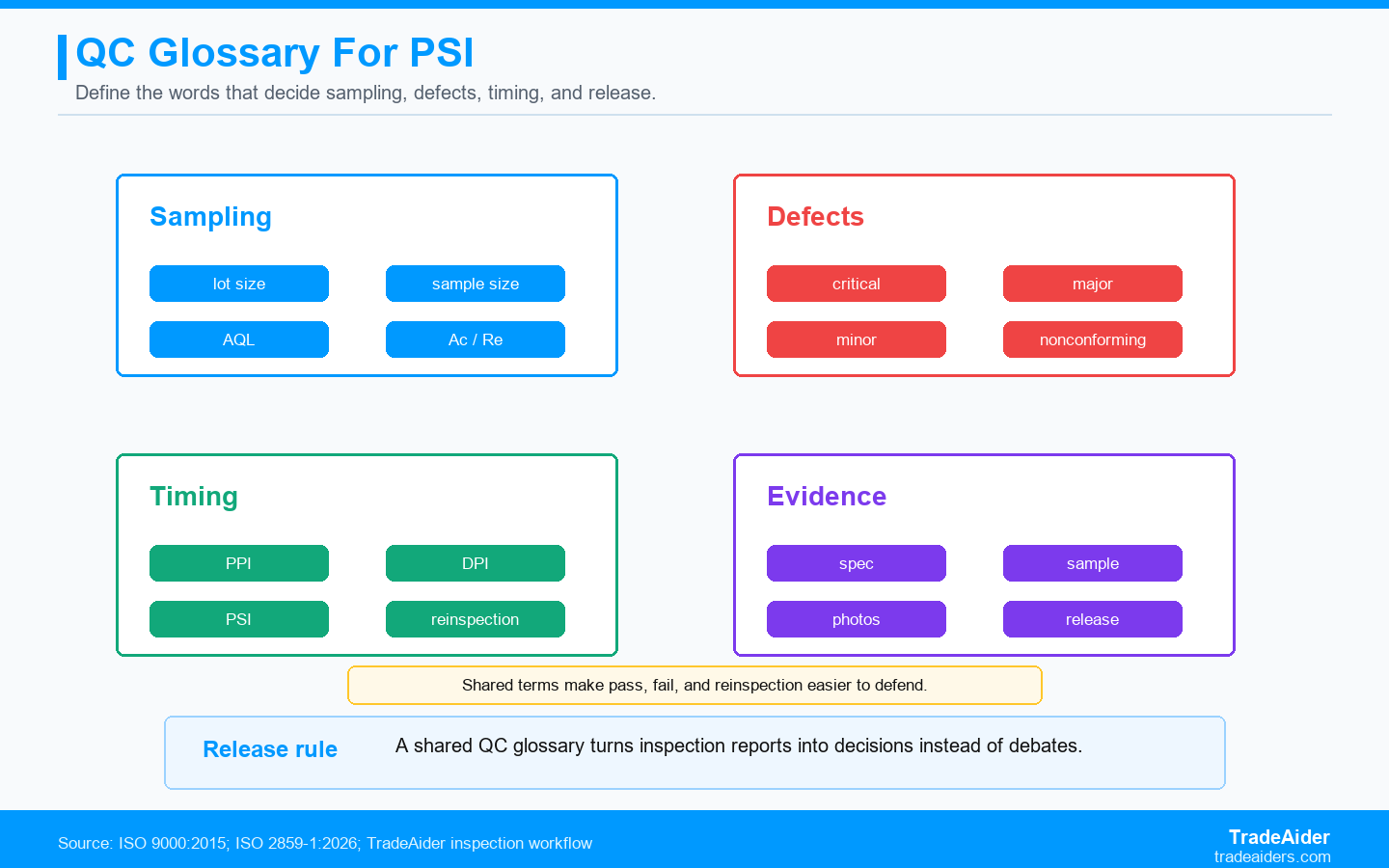
A shared QC glossary turns inspection reports into decisions instead of debates.
Defect Terms
Defect terms decide how serious each finding is.
A critical defect is a defect that can create safety, legal, complete function, or severe customer risk. Buyers often set zero tolerance for critical defects. Examples may include sharp edges on a child product, exposed wiring, missing safety warning, severe contamination, wrong regulated label, or a condition that makes the product unsafe or unusable.
A major defect is a defect that can affect saleability, normal use, customer acceptance, or product function. Examples may include missing accessories, wrong color, failed function, visible damage, severe packaging error, wrong barcode, wrong model, or poor assembly. Major defects are often the most important commercial category in consumer-goods PSI.
A minor defect is a less serious defect that does not usually prevent sale or use but still affects appearance or perceived quality. Examples can include small hidden marks, slight packaging scuffs, small loose threads, or minor cosmetic inconsistency. Minor defects matter when they become frequent because they show process drift.
| Defect Class | Typical Impact | Example | Buyer Control |
|---|---|---|---|
| Critical | Safety, legality, complete failure | Sharp edge, missing warning, exposed wire | Usually zero tolerance |
| Major | Saleability or normal use | Wrong color, missing part, failed function | Strict AQL and supplier correction |
| Minor | Cosmetic or low-impact issue | Small hidden mark or slight scuff | Track frequency and trend |
| Nonconforming unit | One unit with one or more defects | A sampled item with defects | Count consistently in the report |
Timing Terms
Inspection timing decides when problems can still be corrected.
PPI means pre-production inspection. It checks materials, components, setup, samples, and readiness before mass production. It is useful when the buyer worries about wrong materials, poor setup, or supplier misunderstanding before the order starts.
DPI means during production inspection. It checks goods while production is underway. It is useful when the buyer wants to catch process drift before the whole lot is finished. DPI can reduce late surprises because the factory can still correct problems before all units are packed.
PSI means pre-shipment inspection. It checks finished goods before shipment release. It is the most common final gate for quantity, workmanship, packaging, labels, accessories, function, carton marks, and AQL sampling. PSI is valuable, but it is late in the timeline, so serious failures can create delay.
Reinspection happens after failed inspection, sorting, rework, or replacement. It should not simply repeat the same vague visit. A reinspection should focus on failed findings, corrected units, remaining risk, and whether the supplier's correction evidence is reliable.
Evidence Terms
Evidence terms decide whether the report can support payment, shipment, or dispute decisions.
An approved sample is the physical or documented reference that defines expected product appearance, construction, color, material, function, and packaging. Without an approved sample, the inspector may have to judge against unclear expectations.
A specification is the written product standard. It can include dimensions, materials, tolerances, function, packaging, labels, barcode, accessories, warning text, carton marks, and defect rules. A strong specification makes inspection less subjective.
A release decision is the buyer's instruction after reading the report. The decision may be ship, hold, rework, sort, reinspect, discount, reject, or escalate. The buyer should define release rules before final payment so the supplier knows what will happen if the lot fails.
Where TradeAider Fits In QC Terminology
TradeAider fits by translating importer vocabulary into inspectable report fields.
TradeAider's inspection and QA services can apply buyer instructions to sampling, AQL, defect classification, packaging checks, label checks, photo evidence, and release reporting.
For finished goods, Pre-Shipment Inspection can turn the glossary into a report: lot size, sample size, defect class, photos, measurements, packaging, carton marks, barcode, and release findings.
The business fit is clarity. TradeAider helps importers move from unclear supplier language to a shared inspection vocabulary that can be used in purchase orders, reports, and corrective-action discussions.
SPAR Scenario: One Word Changed The Inspection Result
The buyer and supplier both said acceptable, but they meant different things.
Situation: A buyer orders 5,000 premium gift boxes and tells the supplier that small surface marks are acceptable.
Problem: The supplier interprets visible front-panel scratches as minor. The buyer considers them major because the product is giftable and customer-facing.
Action: TradeAider helps the buyer classify defects before PSI: front-panel scratch is major, hidden bottom scuff is minor, broken corner is major, wrong barcode is major, and missing label is critical if it affects market release.
Result: The report becomes actionable because the inspector can classify findings consistently. The supplier sorts the front-panel scratches instead of arguing about the word acceptable.
Action Card: Add These Terms To Your Inspection Brief
A short glossary can prevent a long dispute.
- Define lot size, sample size, inspection level, and AQL values.
- Write critical, major, and minor defect examples for your exact product.
- State which files control the inspection: PO, specification, approved sample, packaging, labels, and carton marks.
- Define release decisions for pass, fail, rework, sorting, reinspection, and shipment hold.
- Ask the QC company to show these terms clearly in the report.
The glossary should be short enough for suppliers to use but specific enough for inspectors to apply. A ten-page manual that no one reads is less useful than a clear two-page inspection brief with examples and photos.
The buyer should revise the glossary after real defects appear. If customer returns show a new issue, add that issue to the defect list. If suppliers repeatedly misunderstand a term, rewrite it in more concrete language. Quality vocabulary should improve with every order.
Good terminology also helps internal teams. Sourcing, product development, logistics, customer service, and finance can read the same report and understand what pass, fail, major, minor, reinspection, and release mean. This makes payment decisions faster and less political.
Common Terms Importers Misuse
Some words sound familiar but create risk when they are used casually.
Acceptable is one of the most dangerous words in quality control because it sounds objective but usually hides a missing standard. Acceptable to whom: the factory, the buyer, the retailer, the marketplace, or the end customer? A better instruction says what defect is allowed, where it may appear, how large it may be, how many units may show it, and whether it changes the release decision.
Random sample is another term that deserves care. A sample should be selected from the inspection lot in a way that represents the shipment, not handed to the inspector by the supplier from a convenient stack. If goods are stored across pallets, cartons, colors, or production dates, the sampling method should avoid letting one easy subgroup stand in for the whole lot.
Commercially acceptable is useful only when the buyer defines the commercial context. A small cosmetic mark may be acceptable for a low-cost industrial component but unacceptable for a premium retail gift set. The same physical defect can change class when customer expectation, price point, brand promise, or product use changes.
Pass is also often misunderstood. A passed inspection does not mean the product has no defects. It means the sampled result met the agreed release rule. The buyer should still review the report, photos, measurements, and defect notes before approving shipment, especially for first orders or complaint-sensitive products.
How To Keep The Glossary Alive
A glossary should improve with every shipment, not sit frozen in an old template.
After each inspection, the buyer should update the glossary with new defect examples. If the report found unclear issues, add photos and classification notes. If the supplier challenged a term, rewrite it. If customers returned goods for a problem that was not on the inspection checklist, add that term before the next order.
The glossary can also support supplier training. Send the supplier the same terminology used by the QC company. Ask the factory to pre-check against critical and major defects before the inspector arrives. This does not replace independent inspection, but it helps the factory understand what the buyer will not accept.
If your team needs a cleaner PSI vocabulary, send TradeAider your product files, previous reports, defect photos, and supplier history. The next step is to ask TradeAider to turn your QC terms into an inspection-ready brief.
Frequently Asked Questions
What is the most important QC term for importers?
AQL is important, but defect classification is just as important. The buyer must define what counts as critical, major, and minor for the product.
Is PSI the same as final inspection?
In many sourcing workflows, PSI is the final inspection before shipment release, but the exact scope should be defined in the inspection brief.
What is CAPA?
CAPA means corrective and preventive action. It describes how the supplier fixes the current issue and prevents recurrence.
Should suppliers receive the glossary?
Yes. Suppliers should receive the defect rules and release terms before production so they know how the shipment will be judged.
関連記事


TradeAiderサービスでビジネスを成長させる
下のボタンをクリックして、TradeAiderサービスシステムに直接入ります。予約から支払い、報告書の受け取りまでの簡単な手順は操作が簡単です。

