
- 会社概要

- 当社のサービス
- あなたの業界
- リソース
- ニュース&ブログ
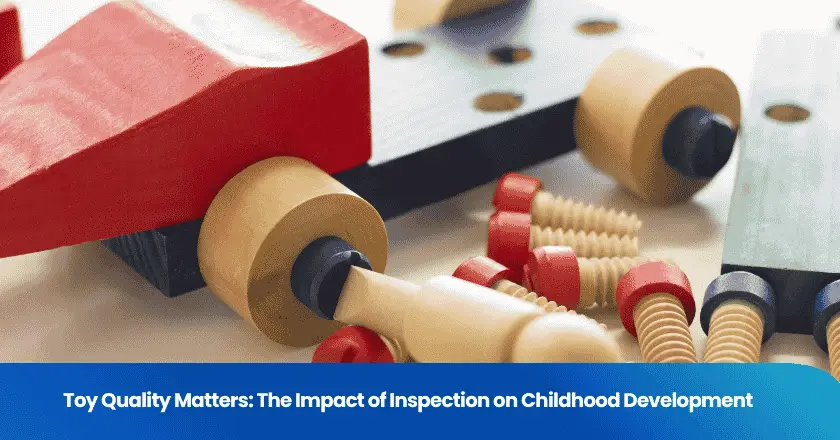
Toys are far more than entertainment for children — they are the primary tools through which young minds explore the world, build skills and shape developmental foundations. From first grasping blocks to imaginative pretend play, every play interaction contributes to cognitive, physical, emotional and social growth. For brands, importers and retailers sourcing toys from China, this means product quality is not only a compliance obligation but a direct factor in supporting healthy childhood development.
Professional third-party toy inspection ensures that products deliver on their developmental promise while eliminating preventable safety risks. By verifying workmanship, age appropriateness, structural integrity and regulatory compliance at the factory, inspection turns toys from potential hazards into reliable, supportive tools for growth.
How Quality Toys Support Multi-Dimensional Childhood Development
High-quality toys do not merely occupy children's time — they create structured opportunities for growth across every developmental domain.
Cognitive and Problem-Solving Growth
Well-constructed, age-appropriate toys stimulate cognitive development by encouraging observation, experimentation and logical thinking. Puzzles, building sets and cause-and-effect toys help children practice pattern recognition, spatial reasoning and trial-and-error problem solving. For these benefits to be fully realized, toys must function as designed: pieces must fit consistently, mechanisms must operate reliably, and components must hold up to repeated use. Poorly made toys with loose parts, jamming mechanisms or inconsistent sizing break the learning loop, leading to frustration rather than skill building.
Fine Motor and Physical Development
Manipulating toys is how children build fine motor skills, hand-eye coordination and gross motor control. From stacking rings and shape sorters for toddlers to craft kits and construction toys for older children, quality construction ensures children can grasp, turn, assemble and maneuver parts safely and comfortably. Sturdy, ergonomically designed toys support repeated practice without injury or unnecessary effort, helping children build dexterity and physical confidence at their own pace.
Emotional and Social Skill Building
Play is also a primary space for emotional and social development. Role-play toys, board games and collaborative playsets help children practice sharing, turn-taking, empathy and emotional expression. Durable, well-made toys hold up through group play and repeated use, providing a stable foundation for social interaction. Toys that break easily or fail unexpectedly can trigger conflict, disappointment and emotional distress, undermining the social and emotional learning value of play.
Creativity and Imaginative Play
Open-ended toys — from building bricks and art supplies to pretend play sets — nurture creativity and divergent thinking. For imaginative play to flourish, toys need to be safe, adaptable and durable enough to support varied, unscripted use. When materials are non-toxic, parts are secure and construction holds up to creative rearrangement, children can focus on invention and storytelling rather than worrying about breakage or safety risks.
The Hidden Developmental Risks of Low-Quality Toys
Low-quality toys do not just deliver a poor user experience — they can actively interfere with healthy development, in both immediate and long-term ways.
Physical Safety Hazards That Disrupt Development
Substandard toys often carry physical risks such as loose small parts, sharp edges, unstable structures and easily breakable components. Beyond the direct risk of injury, these hazards limit how children can play. Parents must restrict independent exploration, supervise constantly or remove toys entirely, depriving children of the self-directed play that drives developmental growth. For infants and toddlers in critical developmental windows, even temporary play restrictions can reduce opportunities for skill building.
Chemical Exposure Risks to Long-Term Health
Toys made with non-compliant materials may contain excessive heavy metals, phthalates, banned dyes or other harmful substances. Chronic low-level exposure to these chemicals has been linked to developmental delays, cognitive impairment and behavioral issues in children by global public health bodies. These risks are invisible to the naked eye and can only be reliably identified through targeted compliance verification and testing.
Poor Durability and Frustration Disengagement
Toys that break after minimal use teach children that objects are unreliable and play leads to disappointment. Repeated experiences of broken toys can reduce a child’s willingness to explore, experiment and persist through challenges — attitudes that carry over into learning and problem solving later in life. Well-made toys that last through repeated play, by contrast, build persistence and a sense of mastery.
Misleading Age Grading That Mismatches Developmental Stages
Toys labeled with incorrect age ratings either present unnecessary safety risks for younger children or fail to provide adequate stimulation for older children. A toy intended for a 6-year-old marketed to a 3-year-old may present choking hazards; a toy designed for toddlers offered to school-age children offers no developmental challenge and little lasting play value.
How Third-Party Toy Inspection Protects Developmental Value
Toy inspection does not directly evaluate educational merit, but it systematically addresses the quality and safety barriers that prevent toys from delivering their full developmental benefit.
Proactive Hazard Elimination for Unrestricted Play
Inspectors conduct thorough checks for physical hazards including small part detachment, sharp edges, structural breakage and strangulation risks, aligned with international safety standards. By catching these issues at the factory before products reach the market, inspection ensures children can engage in independent, self-directed play without unnecessary safety restrictions, supporting natural developmental exploration.
Age Grading and Design Compliance Verification
Professional inspection verifies that toy design, components and warning labels match the advertised age grading. This includes validating that toys for children under 3 contain no detachable small parts, that activity levels match motor skill expectations for the target age group, and that warning labels are clear and accurate. Proper age alignment ensures toys are appropriately challenging — not so easy as to be boring, not so advanced as to cause frustration.
Workmanship and Durability Verification for Sustained Play Value
Inspectors assess construction quality, material strength, assembly security and finish consistency to verify that toys will hold up to normal and reasonably foreseeable use. More durable toys deliver longer developmental value: they support repeated practice, extended imaginative play and hand-me-down use, maximizing the learning return on every play session.
Chemical Compliance Verification for Long-Term Developmental Safety
Inspection includes review of material safety documentation and compliance records for restricted substances such as heavy metals, phthalates and banned chemicals. When paired with accredited laboratory testing, this verification reduces the risk of chronic chemical exposure that can impair cognitive and behavioral development over time.
Global Safety Standards Built on Developmental Science
Major toy safety standards are not arbitrary rules — they are grounded in decades of child development research and injury prevention data. Aligning inspection with these standards ensures toys meet evidence-based benchmarks for safety and developmental appropriateness.
The EU Toy Safety Directive (2009/48/EC) and corresponding EN 71 standard series set age-based safety requirements, small part thresholds and chemical limits informed by child developmental stages.
In the US, ASTM F963 Consumer Safety Specification for Toy Safety incorporates child development research into its age grading guidelines, mechanical safety requirements and labeling rules, enforced by the U.S. Consumer Product Safety Commission.
For toys manufactured and sold in China, the mandatory GB 6675 national standard similarly applies developmental science to safety requirements, age grading and testing protocols.
TradeAider Toy Inspection Services Across China
TradeAider provides professional third-party toy inspection services covering all major toy manufacturing regions in China, including Guangdong, Zhejiang, Jiangsu and Shandong provinces. We serve toy brands, e-commerce sellers and global importers committed to delivering safe, high-quality products that support healthy child development.
Our local inspectors follow standardized protocols aligned with EU EN 71, US ASTM F963 and China GB 6675 standards, with customizable checklists tailored to product category, target age group and destination market requirements. We cover the full inspection lifecycle: pre-production material verification, during-production process audits, pre-shipment inspection and container loading supervision.
Clients receive official photo-documented inspection reports within 24 hours of on-site completion. Through our online service system, buyers can also monitor inspection progress and view real-time findings, enabling timely decisions on batch acceptance, on-site rework or shipment hold.
Frequently Asked Questions
Can toy inspection measure the educational value of a product?
On-site inspection focuses on safety, workmanship, durability, design compliance and labeling accuracy, rather than directly assessing educational or developmental merit. However, by verifying that a toy matches its advertised age grading, functions reliably and is free of safety hazards, inspection ensures the product can deliver its intended developmental benefits as designed.
Why is age grading such an important part of toy safety?
Age grading is based on child development research, including motor skill levels, oral exploration behavior and cognitive ability at different ages. A toy appropriate for an older child may present serious choking or injury risks for a younger child. Inspection verifies that age labeling is accurate and that warning statements are clearly visible to help caregivers make informed choices.
How does toy durability relate to childhood development?
Durable toys support repeated, extended play, which is how children build mastery, persistence and skill over time. Toys that break easily cause frustration, discourage independent exploration and reduce total play time. By verifying construction quality and material strength, inspection helps ensure toys can withstand the repeated use that drives developmental growth.
Is chemical safety really relevant to cognitive development?
Yes. Multiple global public health bodies have documented that chronic exposure to certain restricted chemicals found in low-quality toys — such as lead, certain phthalates and heavy metals — can negatively impact cognitive development, attention and behavior in children. Verification of chemical compliance is therefore a critical component of supporting healthy long-term development.
Conclusion
Play is the work of childhood, and toys are the tools of that work. When toys are well made, age appropriate and free of hazards, they become powerful catalysts for cognitive growth, physical skill building, emotional development and creative thinking. When they are poorly made, unsafe or non-compliant, they not only put children at physical risk but also undermine the developmental value of play.
Third-party toy inspection is the practical bridge between developmental science and the global toy supply chain. It translates evidence-based safety standards into on-the-ground factory verification, ensuring that every toy that reaches a child’s hands is built to support, not hinder, healthy growth. For brands and retailers committed to children’s well-being, investing in professional inspection is an investment in the developmental potential of every child who plays with their products.
関連記事


TradeAiderサービスでビジネスを成長させる
下のボタンをクリックして、TradeAiderサービスシステムに直接入ります。予約から支払い、報告書の受け取りまでの簡単な手順は操作が簡単です。

