
- 会社概要

- 当社のサービス
- あなたの業界
- リソース
- ニュース&ブログ
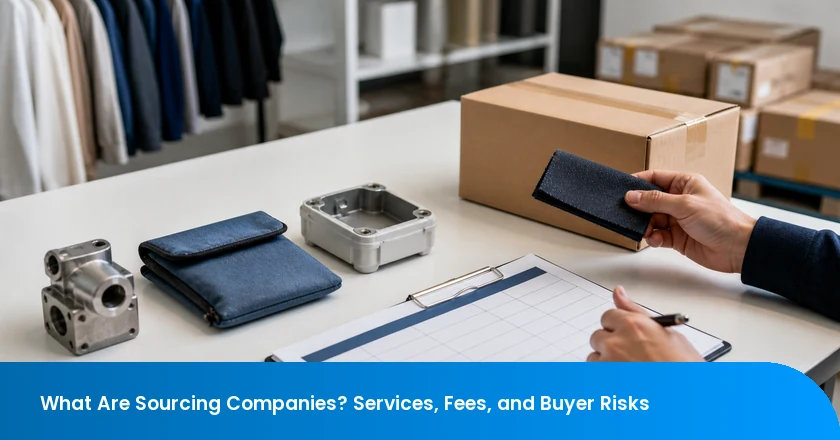
The costly sourcing mistake is rarely the fee by itself. It is awarding an order while the commercial role remains a black box: the buyer cannot identify the factory, the party selling the goods, who pays the intermediary, or who can say the order is ready to move. A sourcing company can be useful for supplier search and coordination, but it cannot turn an unknown supplier path into a controlled buying decision. Before a buyer compares quotes, those four answers need to be recorded in writing.
The Decision Rule: Make the Sourcing Company Disclose Four Things
A sourcing-company proposal is decision-ready only when the supplier, contracting party, fee source, and release authority are documented. Call this a disclosure gate: a short, buyer-owned set of answers required before awarding production. It is not a legal test and it does not guarantee a provider's performance. It does make an otherwise vague proposal comparable to the alternatives.
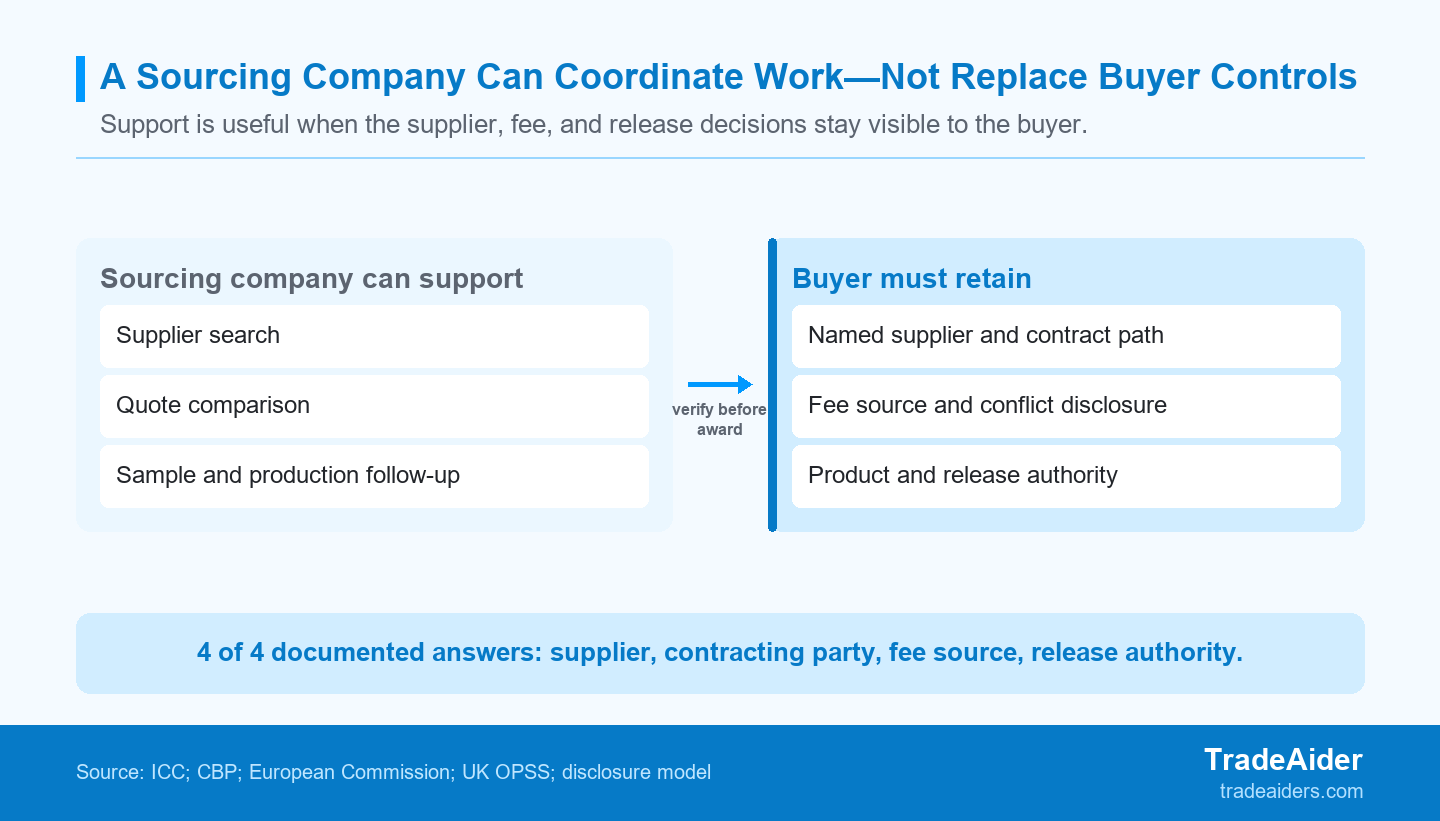
A sourcing company may coordinate the work, but the buyer should retain the commercial and release decisions that make a supplier award defensible.
- Supplier: the factory's legal name, address, and the product it is expected to make.
- Contracting party: the entity that will sell the goods and receive the purchase order or payment.
- Funding disclosure: whether the buyer, supplier, or resale margin pays the provider, and what work that payment covers.
- Release authority: who may recommend, approve, hold, or release the order when quality, documentation, or timing changes.
A provider that cannot answer one of these questions may still have access to useful suppliers. The appropriate response is to pause the award, not to assume that a low quote fills the missing record. Keeping the four answers together also separates commercial selection from product verification: one decision chooses the relationship; the other decides whether the actual goods meet the buyer's requirements.
What a Sourcing Company Can Do—and What It Cannot Take Over
A sourcing company can coordinate supplier search, quotation comparison, samples, and production communication under an agreed scope. In plain terms, it is a provider that helps a buyer find, compare, and coordinate overseas suppliers. That role can reduce search and communication work, but it does not automatically make the provider the manufacturer, the seller, the importer, or the party with final product-release authority.
CBP informed-compliance material describes reasonable care as an explicit importer responsibility. This is a narrow United States customs example, not a universal rule for every commercial arrangement. Its practical lesson is still useful: a buyer should identify the responsibility it retains instead of assuming that an intermediary's involvement transfers it away.
CBP states that a customs broker can act for an importer, while the importer remains ultimately responsible for meeting applicable federal requirements. A sourcing company is not necessarily a customs broker, so do not stretch that guidance into a description of every sourcing service. Use it as a reminder to write the actual scope: who checks documents, who communicates with the factory, who identifies a problem, and who makes the final decision when evidence is incomplete.
Supplier search should therefore end with evidence, not merely an introduction. TradeAider's Factory Audit service gives buyers a way to use a factory audit to review the supplier before bulk commitments. An audit can inform a supplier decision; it does not replace the buyer's commercial decision about contract terms, price, destination-market requirements, or release authority.
Compare the Commercial Model Before You Compare the Quote
The useful distinction among agent, trader, and coordination models is the disclosed contract and economic role, not the marketing title. A company calling itself a sourcing partner may be paid directly by the buyer, may resell goods in its own name, or may coordinate a project while another party contracts with the factory. None of these arrangements is automatically wrong. They create different records the buyer needs to inspect.
| Commercial role | What the buyer should see | Decision risk if unclear |
|---|---|---|
| Buyer-side agent | Factory identity, written buyer-paid or disclosed commission scope, and named deliverables. | The buyer assumes an agent is neutral without knowing who funds the recommendation. |
| Trader or reseller | Seller's legal identity, pricing basis, factory disclosure level, and contractual product obligations. | A factory price is compared with a resale price as if their responsibilities were identical. |
| Project coordinator | Task list, escalation path, fee trigger, and the buyer's retained approval points. | Coordination updates are mistaken for supplier verification or shipment approval. |
Before the scope is signed, buyers should also set an inspection standard before the scope is signed. A provider's promise to “manage quality” has little operational meaning unless the buyer has defined the product, defects, sampling logic, report format, and decision that the check is meant to inform.
First, Establish Who Sells the Goods and Names the Factory
ICC describes Incoterms 2020 as trade terms that allocate specified costs, risks, and obligations between buyers and sellers. Incoterms do not define every sourcing-provider relationship and cannot replace a purchase contract. They do underline why the buyer must first know who the seller is: delivery language, invoices, product obligations, and responsibility for the factory relationship cannot be interpreted in a vacuum.
Ask for the legal entity on the quotation, the entity that will sign or accept the purchase order, and the manufacturer's legal name and address. If a trader will sell the goods while a factory remains undisclosed, record that fact and decide whether the model gives the buyer enough access to specifications, inspections, corrective actions, and product records. A clean answer is more valuable than a label such as “direct factory price.”
Then, Test Whether the Fee Structure Changes the Recommendation
A fee model can be compared only when the buyer knows who pays it, what work it covers, and whether it changes when order value changes. A fixed coordination fee, a buyer-paid commission, a supplier-paid commission, and a reseller margin may each be workable arrangements. The problem begins when the fee source or trigger is absent from the conversation while the provider also recommends the supplier.
Request a one-page commercial disclosure beside the quote. It should state the payer, calculation basis, timing, included tasks, exclusions, refund or change conditions, and whether the amount changes with order value, supplier choice, or reorder volume. This does not accuse a provider of a conflict; it gives the buyer enough information to decide whether the recommendation and the price can be evaluated on the same page.
Keep Supplier, Product, and Release Evidence Independent
EU guidance says importers must verify that imported products conform to EU law before placing them on the market. That is an EU-market example, and the exact requirements vary by product and destination. It shows why supplier coordination is not enough evidence for a product, its labels, its documentation, or the lot the buyer intends to release.
Independent audit, inspection, and testing can give the buyer evidence at different order stages, but each scope must match the product, market, and order status. A factory audit asks whether a proposed supplier can support the intended work. A pre-production check asks whether approved samples, materials, and requirements are in place before bulk work. A production or pre-shipment check asks a different question about the current goods and the specific decision still available to the buyer.
Where the decision turns on material safety, performance, or a product-specific requirement, buyers may also use TradeAider's product testing service to obtain evidence for the applicable product question. A test result is useful only when its method, sample, product version, and market relevance are clear; it cannot validate a supplier's commercial role or approve a different production lot.
If the buyer has selected a supplier but bulk work has not started, use a Pre-Production Inspection to confirm the approved requirements before bulk work. Give the inspection provider the approved sample, specification, artwork, material list, special checks, and the decision owner. The result should identify what was reviewed and what remains outside scope; otherwise a positive update may be mistaken for approval of requirements that were never checked.
Keep the release decision with the party that owns the commercial risk. The sourcing provider may communicate with the factory and explain a correction. An independent provider may report observations against the buyer's agreed criteria. Neither role should silently convert an observation into permission to ship when the buyer has not established the acceptance criteria, the affected quantity, and the authority to release or hold the order.
Once the buyer has defined the shipment and pass criteria, check the sample-plan inputs with TradeAider's AQL calculator. Sampling is useful only when the lot, inspection level, defect classifications, and accept/reject rule are established before the visit. It helps make a defined lot decision; it does not prove that every unit is defect-free or erase a missing supplier or contract record.
Run Due Diligence Before You Share the Purchase Order
The EU General Product Safety Regulation requires a responsible economic operator in the EU for products within its scope. This is a product-safety example for covered EU products, not a universal rule for every sourcing arrangement. It is a useful prompt to identify the people and entities that must hold records, make decisions, and answer for the product in the market where it will be sold.
UK guidance identifies demonstrating compliance and maintaining a product or batch reference as practical evidence and traceability expectations. A buyer can apply the same record discipline without pretending that one jurisdiction's guidance governs every order: keep the proposal, supplier identity, scope, specifications, sample approvals, changes, inspection reports, and final decision together.
Start with records that resolve the greatest uncertainty. Verify the factory's legal identity and address; compare the factory named on the quote with the entity in the contract; obtain the fee disclosure; and define the escalation path if the product, schedule, or documents change. Then test whether the provider's claimed services are supported by a scope with observable deliverables rather than vague verbs such as “ensure” or “manage.” A gap in a low-risk administrative task may be tolerable. A gap in supplier identity, product compliance, or release authority is a reason to hold the award until the record is complete.
Illustrative Scenario: A Low Quote With an Unclear Commercial Path
In the illustrative scenario, a $100,000 order with an undisclosed 5% supplier-paid commission creates a $5,000 commercial question that must be disclosed before the supplier award. The arithmetic is simple: $100,000 × 5% = $5,000. It is not a market benchmark, proof of an improper payment, or a reason to reject a supplier-paid arrangement. It shows why even a small percentage cannot be evaluated without a named factory, a stated scope, and a clear explanation of who benefits when the order is awarded. Where an agreed correction needs verification while production is still open, use During Production Inspection to verify a correction before packing spreads the risk.
The Hold Ends Only When the Evidence Explains the Quote
A private-label importer is comparing three sourcing-company proposals for custom travel organizers from China. The illustrative order is 12,000 units with a planned award value of $100,000. One provider submits the lowest quote, but its paperwork lists a trading name instead of the factory and says that the supplier will handle the provider's fee. Sample requirements are agreed, yet no bulk purchase order has been issued, so the buyer can still choose a supplier and commercial model.
The provider cannot name the manufacturing legal entity, show the proposed contract party, or state whether its fee changes when the order value changes. The buyer can calculate that a 5% supplier-paid commission equals $5,000 on this order, but cannot tell what work the payment covers or how it affects the recommendation. The lower quote therefore does not prove a lower total cost or a better supplier; supplier identity, commercial route, fee source, and release authority are distinct decisions.
The buyer holds the full 12,000-unit award and asks for the factory's legal identity and address, the proposed contracting party, written fee disclosure, and a scope that says who may recommend, inspect, and release the order. The provider returns a named factory, a separate fixed coordination fee, a written task scope, and permission for a buyer-selected independent check before bulk production.
The buyer should restart the comparison only when the supplier identity, contracting party, fee source, and release authority are all evidenced. This is an illustrative composite scenario, not a TradeAider client case. The $100,000 order and 5% commission are assumptions used to explain the decision, not market benchmarks or an accusation; documented answers improve a comparison, but they do not guarantee supplier performance.
Prepare a Buyer-Controlled Handoff Before Production or Shipment
A buyer-controlled handoff package should include the PO, product specification, supplier identity, fee disclosure, current production status, and the decision the independent check must inform. This package makes the service request decision-ready: it tells the reviewer which goods to examine, which requirements apply, what has changed, and whether the buyer needs an award decision, a correction check, or a shipment-release decision.
- Attach the commercial map: quote, contracting party, named factory, and provider fee disclosure should travel with the request.
- Attach the product baseline: approved sample, specification, artwork, materials, labels, and destination-market requirements should state what the goods must match.
- Name the current stage: record whether the order is before bulk production, in process, complete, packed, or awaiting shipment.
- State the decision: identify who receives the report, what can be held, and what evidence is needed to reopen a paused decision.
When the order is substantially complete and packing records are available, schedule a Pre-Shipment Inspection when the order and packing records are ready. The purpose is not to outsource ownership of the release decision; it is to obtain evidence against the buyer's stated requirements while action is still possible.
If the supplier, product scope, and production stage are clear but the right independent check is not, bring the handoff package and contact TradeAider to confirm the independent checks your order needs.
Frequently Asked Questions
Is a sourcing company the same as a trading company?
No; a sourcing company may act as a buyer-side service provider, while a trading company may sell goods in its own name, but the contract and disclosure determine the actual role. A trading company can be a valid seller, and a sourcing provider can offer useful coordination. The buyer should ask who sells the goods, whether the factory is disclosed, how the intermediary is paid, and which party owns product obligations before treating two quotes as comparable. The commercial role is established by records and commitments, not by the label printed on a website or quotation.
How do sourcing companies usually charge buyers?
Sourcing companies may use a fixed project fee, a retainer, a percentage of order value, a supplier-paid commission, or a margin inside a resale price. None is automatically a warning sign. The buyer needs the payer, calculation method, trigger, included work, and change conditions in writing. That record shows whether the fee can change with the supplier recommendation or order value and lets the buyer compare the total commercial path rather than a headline price. Ask for the disclosure before choosing between quotes, not after the award has made the commercial route difficult to change.
Can a sourcing company guarantee product compliance?
No; a sourcing company can coordinate documents, samples, and testing, but the responsible buyer or importer must still verify the requirements that apply to the actual product and market. Compliance depends on product scope, destination, documentation, labeling, testing where applicable, and traceable goods. Use the sourcing scope to assign tasks, then retain a buyer-owned decision point for the evidence that must support placing or releasing the product. A service update is useful only if it identifies the product, evidence reviewed, remaining limits, and the person who decides what happens next.
When should I use independent inspection instead?
Use an independent inspection when the order needs an objective check against a buyer-owned specification, especially before bulk production, after a correction, or before shipment release. The appropriate timing depends on the question still open: approved inputs before bulk work, a correction while the run can still be separated, or completed goods before a release decision. Supply the provider with the product baseline, current status, and the exact decision the report needs to inform. If the buyer cannot say what could be held or released after the report, the scope should be clarified before the visit is booked.
関連記事

TradeAiderサービスでビジネスを成長させる
下のボタンをクリックして、TradeAiderサービスシステムに直接入ります。予約から支払い、報告書の受け取りまでの簡単な手順は操作が簡単です。

